Showing posts with label Château Pichon-Lalande. Show all posts

Saturday, January 25, 2014

More Thoughts on Quality.

First class seats on an airplane are better than the seats in coach. There is no question that this is true. They are more comfortable to sit in, they offer more space, they come with better food and drink, and also with the privilege of getting on and off of the plane before everyone else. They are the best seat on an airplane. They also cost a lot more than any other seat. Whether or not they are worth the expense is a decision that is our own, made according to our own individual calculus. That we have this decision and can opt not to buy first class seats does not imply, though, that there is some question about whether first class are best.

Wine is like this too - some are better than others. But it's much more complicated of a thing to appreciate this in wine and I think that there are three major reasons for this:

1) It's easy to for anyone, even a person who has never been on an airplane before, to understand why first class seats are better. Appreciating why one wine is better than another wine is not as straightforward.

2) We develop personal preferences, we find styles of wine that we like, prefer one kind of wine over another. It is easy and self-serving, even, especially as we gather more wine drinking experience, to assume that our personal preferences are in line with an objective truth about quality.

3) We get confused by price. We buy coach seats when we fly because, well, who can afford to fly first class? And no one wants to waste their lives wishing for what they cannot have. The $12 bottle of Château Peybonhomme les Tours Blaye Côtes de Bordeaux is delicious, terroir expressive, and entirely worthy of our attention. It might be among the best red wines at $12 in NYC today. But it is not better than first class, no matter how many bottles I can buy for the same price. It's more fun (or less unsettling, anyway) to think that we've struck gold in the high quality $12 bottle than it is to think about how much better Léoville-las-Cases is.
-----
If it sounds like I'm saying this from somewhere on high, I don't mean it that way at all. It's the opposite, actually. I've been trying to learn as much as I can about wine (while also enjoying drinking it) for the past ten years, and the point is, I'm still scratching the surface when it comes to any real knowledge of what is great wine and what is not. I simply am not exposed to enough wine, I cannot build the necessary context. I have come far enough, though, to know how much there is that I don't know.

Occasionally I do get to have an experience where I learn something real about quality. Here are two such recent experiences.

Right before Thanksgiving a friend and I drank the 2004 Éric Texier Côtes du Rhône-Brézème Domaine de Pergault. I bought three bottles on release in 2007 and this was my last bottle. Three years ago I drank a bottle and was not thrilled, but SF Joe, a guy who knows the wines pretty well suggested in the comments that I should give it a bit more time, perhaps three years more, in the cellar. He was absolutely right.

The wine was so much better three years later. Here is my note on drinking this wine in late November:
Just lovely, glad I waited for this. I caught the previous bottle too soon, as someone else suggested. Now this is mellow and alluring, with a rusty hue to the color, peppery, bloody, and floral aromas that are soft and gentle. Balanced and lovely on the palate too. The wine shows its class, but it also shows the limitations of the terroir - this is gorgeous wine, but it doesn't achieve the complexity or grandeur of great Syrah from a more illustrious site.
You can probably see where I'm going with this. Although the wine showed better three years later, and although it was delicious and I loved drinking it, it was not great wine. I was reminded of this the other night when I had dinner with a few friends that I haven't seen in a while and we drank a great Syrah by the culty Rhône producer Noël Verset. It was a wine made in what I understand is the worst modern vintage for northern Rhöne wines - 2002. It was lighter and perhaps even more rustic than Verset wines are in more typical vintages. But it was undeniably great wine. Two months later it became clear to me, this idea that Verset Cornas is better than Texier Côtes du Rhône. Really, is that such big news? No. I wonder though, what it means, to know this. If I were a rich person, would I buy and drink only Verset Cornas and the few other Syrahs of similar quality? If money were no object, would I make room for Texier Côtes du Rhône also, even if I could afford first class any time I wanted it? 

Recently a very generous friend opened a few mature first and second growth Bordeaux wines for a group of friends at dinner. He decanted them and we actually drank them without knowing which was which. We all thought that the same two wines were the best of the group, and that one of the two was better than the other. They turned out to be 1979 Latour and 1979 Pichon-Lalande, and the Latour was the better of the two. It's "supposed" to be better - it's a first growth wine and Pichon-Lalande is a second growth. But these wine classifications are not always accurate. In this case, if these wines are representative, the classification is spot on. Both wines were wonderfully aromatic and complex, and both were delicious and classic in their Bordeaux character, even if they came from an off vintage. But the Latour just was a more complete wine on the palate, it maintained a better presence through the midpalate and showed more complexity and depth on the finish. 

I read in Alexis Lichine's Guide to the Wines and Vineyards of France that Latour's vineyards literally abut those of Pichon-Lalande in Pauillac, and that Pichon-Lalande's vines spill over into St. Julien. The map in the book makes it look as though Latour's vines are closer to the river. As in many other places in France, and throughout the wine world, the distance of a stone's throw separates vineyards that are truly different in their potential. It's one thing to "know" this because others tell me so, or because the producers are classified as one thing or another. But to drink these wines side by side, with friends and over dinner - differences in quality become immutable, even to a relatively untrained eye like my own.

Monday, February 04, 2013

Drinking Four Wines by Château Pichon-Lalande

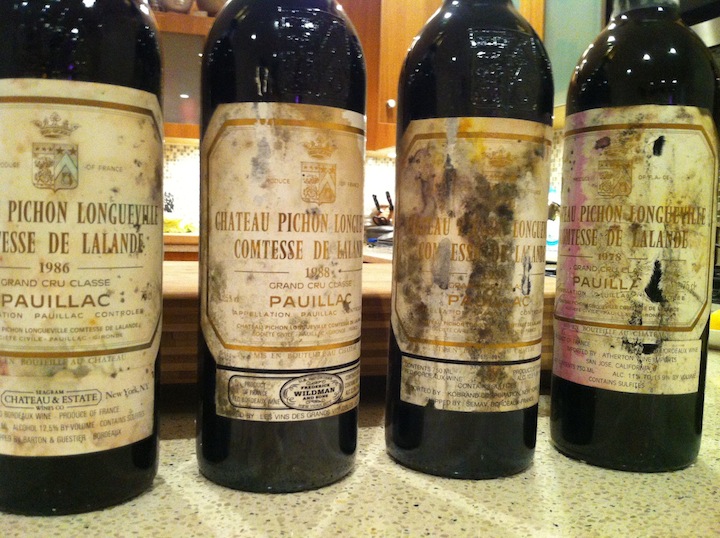
Not long ago I had the opportunity to drink four bottles of very fine Bordeaux, wines by Château Pichon-Lalande. A good friend was in NYC for the weekend and he brought these from his cellar - lucky me! I've had mature Bordeaux before but one bottle at a time, and quite infrequently. This may not surprise you, but I don't have any old Bordeaux in my cellar. Here's another thing that might surprise you - I truly wish that I did.

There are few wines that could be considered less hip and cutting edge than Bordeaux right now. And rightfully so, in a way. The modern wines tend to be over extracted fruit bombs with little to offer in the way of terroir articulation, never mind detail or elegance. They are big, artificially made wines, in most cases. And they are hugely successful, making tons of money for everyone involved.

But like most things that are classic, old Bordeaux is classic for a good reason. They are made from noble grapes and come from interesting terroir, and when well made they combine brawn with detail, complexity, and grace. Many wine lovers of my generation and younger may not have had a great old Bordeaux - it's not something that gets much attention anymore. I think that those of us who haven't had a great old Bordeaux are missing out, not only on beautiful experience, but also on a vital piece of wine appreciation and history. How can we even approach having an understanding of why wine is great without knowing what a grand old claret tastes like?

Pichon-Lalande is one of the top second growths, and comes from Pauillac, a terroir that apparently gives some of the brawnier wines of the region. You can almost see this in the color - look at that inky purple!

My friend generously brought wines from 1978, 1985, 1988, and 1989. Although the youngest was 23 years old, none can really be considered old by Bordeaux standards. My pal Peter says that you shouldn't bother opening good Bordeaux before it hits 20 years old, and that's probably just the beginning of its maturity.

I roasted a leg of lamb over potatoes, and we went to town. The wines were amazing, all four of them. They continued to evolve over many hours, and were delicious and deeply satisfying throughout. In general, I appreciated the raw power of the wines, and this was easy to do because they also showed such detail and complexity. There was power, but that was only part of the package. There was also balance - these were wines that showed lovely and refreshing acidity, and great complexity of aroma and flavor. Inspiring, really. Not in the way that I felt like going out and buying the current vintage, because as I understand it, the new wines will not become like these wines, even with 25 years in the cellar. They are made differently now. But inspiring nonetheless. If you have any old Bordeaux and you want some one to appreciate it with, I will make dinner.

The 1989 was a wonderful wine, Peter said that it was the grandest wine of the four, and that it had years, maybe decades of life in it. It was the most complete wine on the table, but I found it hard to compare the wine from 1989 to the wine from 1978 - I just don't know enough to be able to understand where the 1989 is in the context of the evolution of Bordeaux. Will it shed some weight and feel like the 1978 in 10 years? Will it always feel this full bodied, but become more gentle and mellow, and offer even more complexity with further maturity? I would guess, yes.

I found the 1978 to be the most rewarding on this evening, with its mellow and gentle nose of tobacco and leather, its complex and long cedary finish. It felt like being inside a log cabin in the woods. Still plenty of energy, an elegant structure, very long and plain and simple - absolutely delicious.

The 1985 was the most approachable right after we opened and decanted the bottles, and was perhaps the most fruit forward of the wines. I enjoyed it tremendously, but in the end we found the other vintages to be more compelling. The 1988 felt more mature than I might have expected, but in a good way, and showed ripe fruit that was thoroughly infused with earth. I loved this one in particular with the lamb, and it seemed to have a lot to offer even as we finished it. This one might, sneakily, be a wonderful wine.

There are plenty of reasons to ignore modern Bordeaux, I get it. The wines can be bombastic and overbearing, and the story of the Bordeaux region seems to be one of opulence and privilege, there is no struggle, no individuality. People in meticulously hip Brooklyn restaurants want to drink wines made without sulfur by scruffy guys or gals living in ramshackle trailers on lonely hillsides. Those wines have their place, I guess. But that's not Bordeaux.

But there is something to this, to old Bordeaux wine. Don't believe me? Get your hands on an old bottle by a good producer - you and three of your friends can do this and spend less than $50 per person. And really, this is history, and it's worth knowing for yourself.

Would you ignore The Police because Sting was kind of lame later in his career? Would you dismiss Woody Allen because Scoop kind of sucked? Are you not going to drink the one bottle of 1976 Lynch-Bages that Chambers Street is selling for $115 because 2010 Lynch-Bages costs $150 and will never be as good? Seriously, what kind of person are you, anyway?