Hung up on Classification, Champagne Style
I think that the lines that distinguish grower Champagne from big house Champagne are too rigidly drawn. If a producer farms their own grapes and makes wine from those grapes, we say that they are making grower Champagne. If a producer like Francis Boulard, for example, buys just over 5% of the grapes he uses to make his wines, do we still say that he makes grower Champagne? Most of us would say yes, and that's probably because his practices in the vineyard and in the cellar reflect the values that are encapsulated within the grower Champagne ethos. We're willing to give a little, in other words, when categorizing producers and their wines.
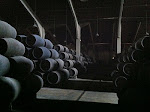
 Entry hall at Champagne Louis Roederer.
 Unless those producers are operating on a large scale. Consider Louis Roederer, for example. Roederer is a huge estate that owns vineyards all over Champagne, over 200 hectares in total. Roederer's range includes a non-vintage Brut, three vintage wines including a Blanc de Blancs, a blended Brut, and a rosé, and then Cristal and Cristal Rosé. All of these wines are made exclusively from Roederer's own grapes, except for the non-vintage Brut. That's right - Cristal is a grower Champagne. And if you're ready to dispute this, thinking that the farming is Monsanto-style industrial, think again. Listen to what Peter Liem has to say in his overview of the house on ChampagneGuide.net:
...Roederer has completely stopped using systemic herbicides and is increasingly investigating more environmentally-friendly methods of viticulture, even attempting trials at biodynamics beginning in 2007 (following a seven-year period of “cleaning” the relevant parcels), which has since been expanded to five hectares in all. Another 25 hectares are planted with cover crops, tilled and worked organically, and the house is seeking to gradually expand these practices in the future.The grapes are estate grown, viticulture and cellar work is conscientious and modern, and yet I do not think that anyone who pays attention to these things would classify Cristal, or any of Roederer's wines as grower Champagnes. Unless I am misunderstanding the definition of grower Champagne, Roederer's wines are grower wines, except for the NV Brut.
The point of this, actually, is not to convince you that Roederer makes grower Champagne. The point is that our thinking about grower Champagne might be a bit too rigid, having been shaped by marketing forces that although more romantic and not as well funded, are still marketing forces, in the end.
 Jean-Baptiste Lecaillon pouring 2002 Cristal.
 What would you rather drink - Cédric Bouchard's Roses de Jeanne or Roederer's Cristal? Until recently I would have immediately chosen Bouchard's wine, and although I'm not sure right now which I consider to be the finer wine, in the past I would have always chosen Bouchard based on my ideas about the stylistic differences between the two houses. But you know what - Bouchard sells a wine that he didn't farm or make, wine that was made by an old friend of the family, a wine called Inflorescence La Parcelle. If you bought that wine before the 2007 vintage, you are buying wine that Cédric Bouchard selected, not farmed or made.
And there's nothing wrong with that! I love Inflorescence, and the fact that Cédric Bouchard didn't farm the grapes or make the wine himself doesn't make it a lesser wine. The fact that Roederer is huge and a luxury brand doesn't make Cristal a lesser wine. Rappers and bling aside, Cristal is among the greatest wines of Champagne, and if you reject it based on dogma about grower versus big house Champagne, you are shooting yourself in the foot.
 2002 and 2004 Cristal, and pretty tasty too.
 And here's another thing - I don't see how any Champagne can be considered to be "natural wine." Almost without exception, commercial yeasts are added to the bottle in order to initiate secondary fermentation, and that goes against the "natural wine" formula. So Bouchard, Selosse, Lassaigne, and all of the rest of them, everyone is equal when it comes to not conforming to "natural wine" standards.
Ever find yourself not buying Pierre Peters Champagne because it is too popular, a Terry Theise big house within the world of grower Champagne? Ever find yourself turning up your nose at a glass of Roederer NV Brut in favor of another, perhaps lesser wine because Roederer is a big house? Every find yourself secretly thinking that some or other grower Champagne really doesn't taste so great, or secretly enjoying a glass of big house wine? I have, and it's all pretty silly. Pierre Peters makes utterly fantastic Champagne, truly fine wines, and so does Roederer. The Roederer NV Brut will surprise you if you drink it with an open mind. Actually, I have no idea what you'll think of it. But neither do you, unless you get rid of the presumptions that we both have about big houses and grower wines. These presumptions grew out of noble ideas, but we might not need them anymore, as we become more sophisticated drinkers who can think for ourselves.