Sunday, January 31, 2010

Conversation with Becky Wasserman - Part 3

This wraps up my recreation of our conversation, and I hope it's been half as interesting and edifying to read as it was to actually sit and talk with Becky and Peter.

BG: What is the biggest change in Burgundy from 30 years ago until now?

BW: It's a generational change. The kids went to viticulture school and their equipment and wine making is super clean. Clean is an inexact word, because when you walk into the cellars they're still covered in the beautiful furry mold, but everything is clean. And they're interning with wineries all around the world. They taste at each others places now - Roumier, Grivot, and others, they go to each others' places for lunch and to taste. That wasn't common in the old days. Another issue is land pricing. Real estate price is now more important than the revenue you can earn from the wine on it. Land is so expensive in Burgundy now that its out of the hands of Burgundians, and that was never the case. You have to have financial backers if you're buying decent land in Burgundy.

PW: There has been change in the wine making too. There were pioneers - Lafon, Roumier, Arlot, Dujac - their first focus was on achieving a base level of cleanliness (Becky again doesn't exactly agree with the word 'clean'), but then they realized that you don't make a wine in the winery, you make better wine with a better vineyard and a better plant.

BG: Where do you stand on organics and biodynamics?

BW: We check the biodynamic calendar before opening a fine wine.

PW: (Chuckles) Yeah, but we have no dogma on this. You don't have to be biodynamic for us to work with you or to make great wine, there are no technical requirements. We never say to wine makers that they should do this or do that with their wines. The biggest intervention we ever have is to introduce a young wine maker to another wine maker whose wines we like, and hope that they hit it off.

BG: What in your view is the biggest threat to Burgundy as we know it?

BW: My 4:00 AM fear is that genetically modified yeasts will take over.

BG: You mean the yeasts that you can buy in bags at wine making stores?

BW: No, not just the industrial ones, genetically modified yeasts. Yeasts are invasive and they have a lot to do with the taste of wine. Each vineyard can have its own yeasts, and that's a lot of the taste of the wine from that place. I'm afraid of the market pressures that result when people say 'We don't want to wait 10 years to drink this wine, we want to drink it quickly,' for example. Yeasts used for things like this can take over the taste of wine.

BG: You've done 30 years in this business. What are your goals for the future?

BW: (Without hesitation) To spend more time in the vineyards. To stand there, to absorb, to look around, to touch, to feel.

BG: You want to work the vineyards? What would you do there?

BW: (Looks at Peter and speaking French, asks him how to say a word that sounds like 'Resourcée')

PW: You want to be a resource for them.

BW: Yes. I want to be in the vineyards more.

PW: I want to find a way to communicate more effectively, to create educational opportunities. I've been working with people on a project in New Orleans, the Independent Champagne & Sparkling Wine Invitational, and I'm really excited about it. I want to create more opportunities like this to showcase the kind of wines we believe in and to help educate people.

BG: How do you feel about blogs and other new media in the realm of wine writing?

PW: Blogs need to be more accountable. The blogosphere is helping to perpetuate the fallacy that flaws can be terroir. I've had wines that are flawed - plain and simple, but I'm seeing a small niche in the blogosphere that is confusing these flaws with terroir. Many bloggers just don't have enough classic tasting knowledge to be able to understand the difference between funky wines that show terroir and flawed wine. On the other hand, it's much harder to get things into Wine Spectator than it is to get things into blogs.

BW: I like the blogs. There are some you want to read because their voice appeals to you, others don't. I'm glad that there's a lot of wine talk out there.

BG: What do you find yourselves drinking these days when you're drinking wine?

PW
: We get equally excited drinking Passetoutgrains as we do drinking Clos de Chênes. It depends on the food we're eating. If we're having a simple Sunday roast chicken lunch, we drink Passetoutgrains or Bourgogne and we love it - those are great wines. For me it's about context and about the wine being ready to drink.

BW: Yes, that's very important. Drinking Grand Cru or 1er Cru wines when they're young is a shame. Young wines are like young people - they haven't found their personalities yet.

BW and PW: (Plaintively) Can we go now?

BG: Yes, and thank you for talking with me

Saturday, January 30, 2010

Conversation with Becky Wasserman - Part 2

More conversation with Becky and Peter Wasserman:

BG: By the way, thanks for spending so much time talking with me.

BW: It's my pleasure. All of this is pre-obituary and it's good for me to do.

BG: (Nervous laughter, followed by throat clearing and vigorous subject-changing) So, I'd like to learn about pricing in Burgundy. How do you decide the prices for each bottle?

PW: We don't, we're sent a price list each year and that's basically it. If we feel that we want to change the prices some, we can work with the producers on that. We might feel like we want to come down on the villages pricing, and to compensate we'll go up on the 1er Crus, for example.

BG: Are you selecting the barrels that you want and the wines that you want?

PW: No, we're given an allocation and that's what we take.

BG: Why would you want to adjust the pricing - why down on the villages, for example?

BW: You have to understand something - it is always easy to sell the top wines. The Grand crus and the top 1er Crus sell out very quickly, there's never a problem. Even in off vintages, even in a recession, these wines sell. Restaurants buy them, good retailers buy them, there's just never a problem. It's the everyday wines, the Villages wines, the Bourgognes, that are hard to sell. It takes 3 visits a year from me and eight months on the road for Peter to find the right home for those wines every year.

BG: Wow, I'm surprised to hear that. I guess I understand that Lafarge's Clos de Chênes should always be a pretty easy sell, but you're saying that his villages Volnay, and his Bourgogne are tough?

PW: Always. People buy based on the lofty reputation of the wines and not on what's good to drink in the near term, what's appropriate for current drinking.

BG: Can you give me an example of how this works with one of your producers?

PW: Take Freddy Mugnier. I can sell Musigny and Amoureuses no problem. Marechale, which I think is one of the best Nuits st. Georges 1er Crus out there, that wine is very hard to sell. His Villages Chambolle, which is a blend of young vines from great vineyards (he said which ones but I didn't note them), always a hard sell. And this is great wine - I 'm always super excited to drink Freddy Mugnier's Villages wine. But to sell it, I have to tell people "You want Amoureuses, no problem. But you're going to have to step up to the plate on Marechale."

BG: Wow - that's the same kind of bundling that's in the news now with the cable television industry. You can't buy only the channels you want, you have to buy a huge package that includes hundreds of channels you don't want in order to get the ones you do want. And people think that if the channels were available individually, the prices would come down. But I'm not so sure...

PW: If I let anyone who wanted it buy Amoureuses and only Amoureuses, the price would absolutely skyrocket.

BG: Yeah, I guess you'd lose a lot of Villages sales, and also there would be much greater demand for Amoureuses if it wasn't bundled as part of a much larger purchase.

BW: Exactly.

BG: You mentioned the economy before and that it doesn't impact sales on the top wines. I feel like it impacts the market for those wines somehow, though. I'm seeing top wines I don't usually see on shelves. I've seen 2007 Mugnier Musigny on two retail shelves in NYC recently, and I haven't seen that in a long time.

PW: Which stores?

BG: Chambers Street and Uva, in Brooklyn (and since this conversation I saw it online at another NYC area store called Grapes the Wine Company).

PW: I think Chambers' is gray market, but that's great.

BG: Yeah, but here's another issue with pricing. I'm not questioning the greatness of that wine and others like it. But I think it's sad that people who come to wine now, like myself, unless we are very rich, will never taste a Mugnier Musigny. The '07 vintage is something like $450 a bottle. And it's sad because people who love art can go see it at a museum for a reasonable price. People who love opera can pay various prices to hear it live. But Musigny - an incredibly tiny portion of the wine loving population will experience it, and it's sad.

BW: (A frown darkens her expression for a moment) Yes, it is. But you need to know that people like Freddy Mugnier and Christophe Roumier are horrified at the prices charged for their Musigny. Some of this is the awful dollar. It's hovering at about 1.5 to the Euro now, and that makes it very hard. But there are ways to drink these wines. I remember teaming up with seven or eight people and going in together on a great bottle so that we could all taste it (but good luck reconvening those 8 people after the 15 years it takes to properly age that wine - ed.).

PW: Do you realize that these people make maybe 3% profit? Mugnier cannot afford to drink his own Musigny.

BG: That is absurd. So are there still undiscovered producers in Burgundy?

BW: Of course there are! Kids come home and their parents used to sell to the négoce, but they want to make wine under their own label. Brothers and sisters inherit vines and begin to produce wine, things like that.

PW: Do you know how we select who we're going to represent? We eat lunch every day with our staff and we drink wine. If we're moved by the wine then we go to meet the people to see if we want to work with them. Our business is very personal and we have to want to work with the people we represent. We literally do not sell what we do not drink ourselves - the lowest wines too, from Bourgognes to0, We happily drink everything that we sell.


Stay tuned for the final installment of a conversation with Becky and Peter Wasserman...

Thursday, January 28, 2010

A Conversation with Becky Wasserman - Part 1

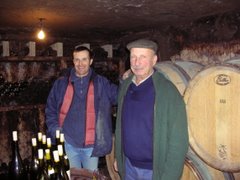
The American wine icon Becky Wasserman is in New York City to celebrate the 30th anniversary of Le Serbet, her wine exporting company. Becky got started when very few people here in the United States knew anything about wine from Burgundy, and when very little was available in retail shops. She is considered to be one of the architects of the Burgundy wine market and she is respected and admired by everyone I know. Becky works in Beaune and lives with her husband Russell in a village called Bouilland, in "the back coast" behind Savigny-lès-Beaune.

I was lucky enough to spend a few hours the other day with Becky and her son Peter. It was my first time meeting her and it was a wonderful opportunity to hear the story of how she created her business, to hear about her and Peter's experiences as Burgundy wine merchants. I found them both to be absolutely lovely people, easy going and down-to-earth. They are wine rock-stars, but they are the gentle folk who you want as your neighbors (although I don't know how loud she likes her music), your co-workers, or your lunch companions.

I did my best taking notes, but my transcription of our conversation is mostly paraphrased. Also, both Becky and Peter were answering my questions and our discussion was lively - I am not always sure whether it was Becky or Peter who said certain things, and you'll just have to forgive me for that. They share about 50% of their DNA, so who said what isn't so big of a deal, is it?

BG: How did you get started in the wine business?

BW: (Lots of awkward laughing with Peter immediately ensues) I was an artist's wife. We moved from Philadelphia to Burgundy in 1968 for my husband's art. As a girl in Manhattan, anything French made me shiver, so this was a dream for me. I had two young sons. My husband was a wine connoisseur - there weren't many wine collectors back then. He was, however, a collector of mistresses, and so our marriage was ending. I knew that I needed financial independence so I wouldn't have to rely on my husband after we parted ways. I was thinking about work as a bilingual receptionist at one of the Beaune hotels, but I knew a cooper in Saint Romain who asked a favor of me. He was owed a debt and he asked if I would go to California to get the money from this wine maker.

BG: Was this a pulp-fiction underworld kind of assignment for you - did you carry a pistol?

BW: (Smiles generously) No.

BG: (Shifts uncomfortably in chair) Okay, go on. Sorry.

BW: I developed a small business brokering sales between this cooper and California wine makers. I would take the California wine makers to taste at the famous domaines, I would translate for them, and translate their negotiations buying barrels. I can't remember who it was, but I think it was Diamond Wine Merchants in California, he asked me for a list of producers to import, and that was the first list I did.

BG: Which producers were on the list?

BW: Pousse d'Or, when Gerard Potel was making the wines, Aubert de Villaines wines from Bouzeron, Burguet, Bachelet, Roty, although that didn't last long, some producers from the Mâconnais and something from Corbières. This was pioneer work - they bought a few cases and tried to place them. Then a second importer asked for a list, and then a third took my selections. I was Kermit Lynch's agent in Beaune from 1977 - 1981 also.

BG: Were you working on your own business at the same time?

BW: No, he liked to keep things exclusive.

BG: How long did it take to make your's a workable and successful business?

BW: (laughing) 20 years.

BG: Honestly?

BW: Yes, it's hard to earn money when you only work with quality.

BG: What was the biggest challenge you faced in business?

BW: In any business, the lovely parts are lovely, and people always think that my business is all lovely. But that's this much of it (holds up two fingers pinched together), and then there is a lot of work that's just business. Getting people to pay their bills was difficult at first. The French union rules weren't easy to navigate - we had truckers who would arrive at a domaine, but wouldn't load wine onto the trucks. Or they wouldn't unload it. There could be an old lady and her grandchild and no one else there, but the driver would not lift those cases.

BG: Wait a minute - how could people just not pay their bills? Wouldn't that mean no one would work with them?

PW: It happens all the time. People pay according to a schedule, not upon delivery. And if they didn't pay, it could take years to sort out a resolution. Nowadays our importers are fantastic about this - they all pay on time. If one runs into trouble and cannot pay, we work something out together. but in the beginning, this was a real problem.

BG: You mentioned that the lovely parts are lovely. What are those parts?

BW: There are moments of unimaginable and gorgeous pleasure. Standing in the vineyards, realizing that the interaction between soil and vine has been going on for hundreds of years in this spot, feeling like I'm part of the cycle.

PW: And knowing that we contribute to the family lives of our 96 producers - they send their kids to school, they live their lives, and we have something to do with that.

BW: And knowing that we're fighting against the death of individuality. Despite the rise of artisinal cheese and things like that, there is a lot of pressure against individuality, and we're fighting that in what we do.


To be continued...

Tuesday, January 26, 2010

Wine and Cheese - Hudson Red with Chidaine Montlouis

There are some great cheeses produced in New York and Vermont. Local cheeses have achieved, in my opinion, higher quality within the cheese world than local wines have within the wine world. One of my new favorites is a raw milk washed rind cheese called Hudson Red, made by Twin Maple Farms Creamery and distributed by the ersatz coop Pampered Cow Cheese.

Hudson Red is not the stinkiest of washed rind cheeses, but it's not tame. Fresh and grassy with a creamy texture, and a pungent finish, this cheese had character. And it's completely delicious.

I like highly aromatic wines with washed rind cheeses - Gewurz or Muscat perhaps, but Hudson Red is on the mellow side of the washed rind spectrum. We've had this cheese several times now and I have yet to find "the right wine." No calamities, but nothing inspiring either. When I thought about eating it this time, I imagined it pairing well with a demi-sec Chenin Blanc, and so we went with one of François Chidaine's wines.

2005 François Chidaine Montlouis sur Loire Les Tuffeaux, $23, Louis/Dressner Selections. In a great place right now, this seems to have shed most of its sweet and tender baby fat. Still decidedly an off-dry wine, but the residual sugar is less prominent than it was a few years ago. The wine has achieved a better balance now, and some how seems fresher than it did a while back. Numbers say the wine is still young, but the intensely woolly notes suggest something a bit more mature to me (wool in background of photo represents woolly tones - ed.) I think this wine has his a comfortable stride - it's drinking beautifully right now. I have only one bottle left, and I might try to hold it for a while, but if I had several of these I wouldn't hesitate to open one soon.

That said, the pairing with Hudson Red was merely good, not great. The woolly, green tea, roast nuts of the wine played alongside, not with the cheese. This wine might have done better with a young chalky goat cheese from the Loire Valley. And I'm still unsure of the perfect wine for the lovely Hudson Red.

Monday, January 25, 2010

Drinking Didier Dagueneau's Wines for the First Time

Thanks to the generosity of a friend, I had the opportunity recently to drink two incredible wines made by the late Didier Dagueneau. I had never had a Dagueneau wine, and after just these two bottles, I understand what it is I missed.

You probably know that Didier Dagueneau died in September of 2008 when the plane he was piloting crashed. Although his children have taken over the estate, it is fair to say that unless I find and purchase back vintages, I have missed Didier Dagueneau's wines. By the way, one could say that in drinking the 2007's, I didn't really drink his wines. He made the wines, but he wasn't there for elevage and bottling..

I was pretty much blown away by the two wines I drank - I've never had finer Sauvignon Blanc from anywhere. And it's silly to say it that way because these wines, and from what I've read, Dagueneau's wines in general, are not about Sauvignon, but more about the specific plots where they are grown.

I have little context to offer you here. I cannot compare these to other vintages of Dagueneau, and I've had only a few Pouilly-Fumé wines, so this isn't about why these wines are so much better than the others. If you're interested in a bit of context, here is a decent place to start.

I want to share what it was to drink these two bottles because of their astonishing radiance and beauty. I was surprised at how great these were because of all of the hype surrounding this producer. Think of seeing the Mona Lisa in person - you know how beautiful it's supposed to be, but you've never seen it and it becomes more of an icon than a reality. And then you see it, and it surprises you with the power of its actual beauty. So I hear - I've never seen the Mona Lisa.

And by the way, I had no agenda whatsoever. I wasn't hoping to like Dagueneau's wines because the man is a deceased icon. In fact, it took me the course of an evening with them to understand how incredible they were, to the extent that one can understand a wine after drinking two bottles.


2007 Didier Dagueneau Pouilly Fumé Pur Sang, $90, Louis/Dressner Selections. the thing that killed me about this wine was how perfectly and completely clear it was. Unadorned, spare, elegant, graceful, this wine simply rests on the tongue and in the nostrils. It is an intense and weightless ray of stony citrus fruit with a quiet buzz of energy that lingers past the finish. A lovely wine on the surface, but this is one of those wines that rewards every iota of concentration that you give. It was growing still as I finished it.

2007 Didier Dagueneau Pouilly-Fumé Silex, $100, Louis/Dressner Selections. Clearly the same author, but a different kind of storytelling. This wine, for me, was defined by its unmistakable flintiness, that slightly smoky stony...flinty sense on the nose. Bigger in body than the Pur Sang, and whereas the Pur Sang was about its seamless balance, this wine showed off its complex and intense flavors of flint-infused ripe fruit and mineral water, but still delivered in a package that is all silky refinement, all class.

I loved both wines - they were beautiful in a way that makes you rethink what you know about Sauvignon Blanc from the Loire. And I cannot say that I preferred one over the other because they are so different. I might prefer Pur Sang as an apertif, and I might prefer Silex with seafood. I might prefer Pur Sang with fresh goat cheese and Silex with harder aged goat cheese. And this is '07 I'm talking about. I only wish I could have tasted these wines in the past. Those old bottles are, sadly, out of my price range now.

Friday, January 22, 2010

Deep Thoughts on Deliciousness

The other day I was reading an excellent article in the current issue of The World of Fine Wine, an article that makes the case for Beaujolais as a "fine wine," the same way we think about Burgundy or Barolo, for example. I cannot link directly to the article, as The World of Fine Wine doesn't publish content online, but you should subscribe anyway. Like The Art of Eating, this is a must-have. Some of the very finest wine thinkers write for WOFW - this Beaujolais piece, for example, is by Peter Liem.

It is a well considered and thoughtful article. Instead of merely talking about how great Beaujolais is, it establishes a simple framework for thinking about "fine wine," and then looks at whether or not Beaujolais meets some or all of the criteria. There are many interesting ideas in the article, but one in particular stuck with me, and for me it's less about Beaujolais than about evaluating wine in general. Here is the quote:

The expression of terroir demonstrates the intellectual side of cru Beaujolais, but another element that is often ignored, particularly in an environment driven by professional blind tastings and numeric scoring, is sheer drinkability: the capacity of a wine to compel us to keep returning to it over and over again. Somewhere along the line, the notion of deliciousness seems to have become, if not pejorative, then at least frivolous—as though we should feel guilty for delighting in a wine’s visceral pleasures.
Interesting, right?

There are many directions one could go with this idea. It makes me think of how I tend to undervalue wines if they are inexpensive, even if like Muscadet for example, I love the wines. Or the amazing and substantial $16 bottle of Ott Gruner Veltliner I recently had - why didn't I load up on that wine? I ran out and bought some $40 Hirsch Riesling after tasting those wines, why not the cheaper wine that offered little other than deliciousness? It makes me think about how complexity implies quality, and although I enjoy complexity, why does the degree of complexity correlate with the way we experience quality? It makes me think about a lot of things.

Care to share your thoughts?

Wednesday, January 20, 2010

Blaufränkisch: Some Post-Tasting Thoughts

I was lucky enough to be invited to the recent Blaufränkisch tasting and luncheon at Gramercy Tavern, organized by David Schildnecht. First of all, let me tell you that there are a great many worse ways to spend the lunch hours between 12-2 pm than by sitting in a private room at Gramercy with a gaggle of smart wine writers and friendly Austrian wine makers, eating what had to be 7 courses and drinking good wine.

This was a challenging tasting for me. Firstly, I had almost no previous experience drinking Blaufränkisch. Secondly, no information was provided about the producers or the wines - no fact sheets, no bios, nothing. It was a choice between attempting to write the names of Austrian producers and wines that I was entirely unfamiliar with, or to simply drink the wines and consider them in what was for me essentially a blind format. But this worked out well for me - I had no preconceived notions, no biases. I was a clean slate. And everyone else had some familiarity with the producers and wines - I was the lone idiot, so this is not a knock on the organizers.

As an example, I did not know during the tasting that Roland Velich of Moric is a superstar that Peter Liem compared to the wine maker at DRC in his ability to coax greatness out of his terroir and his grape. And this certainly shows that I am not a distinguished taster of Blaufränkisch, but I was not moved by his wines.

In general, I liked the wines and I am quite curious to drink Blaufränkisch again, preferably at home with dinner (when asked, the producers suggested that one of the best pairings for Blaufränkisch is simply prepared beef). But as Eric Asimov noted in his post, I thought that some of the wines were made in a style that didn't seem to compliment the raw material.

We began with four white wines, and I was very impressed with two of them. The 2007 Prieler Pinot Blanc Seeberg was just delicious. Lean, focused, and completely dry, this wine was full of orchard fruit pits and peels. It was fresh, and eminently drinkable, and should cost about $25. The 2008 Umathum Traminer was a tasty and interesting wine. A blend of red and yellow Traminer from 45 year old wines on slate soils, this wine was vivid and expressive, and also completely dry. It should cost about $30. With these two wines, there was nothing that got in the way of the fruit and soil. Not so for the other two. The 2007 Moric Gruner Veltliner had a beautiful chalky and grassy nose and the broad and airy character of a wine that is fermented in oak. It didn't handle its alcohol very well, however, and the palate was not as harmonious as the nose. I found this wine to be intellectually interesting, but I'm not sure whether or not I'd want to drink it with my dinner. The other white was a Pannobile Chardonnay that I thought was completely overwhelmed by vanilla oaky aromas.

That kind of sums it up for me - the raw material seems to be of very high quality, the producers care about their impact on the environment and many are using biodynamic, organic, or sustainable techniques, most are fermenting with natural yeasts, and everyone's heart is in the right place. But some are subjecting their wines to an oak regimen that, to my taste, doesn't promote the best in the wines.

Of the reds, there were two producers whose wines really stood out for me. I very much enjoyed the wines of Uwe Schiefer. Schiefer is a veteran of the young Burgenland Blaufränkisch scene. His 2007 Blaufränkisch Reihberg, from vines between 45 and 80 years old on the Eisenberg hill (Eisenberg is considered to be the finest Burgenland Blaufränkisch terroir) was energetic and showed great purity. It is a balanced and expressive wine that showed something of the spicy, savory, fleshy characteristics that I now understand are typical of Blaufränkisch. It was very well balanced and I imagine that it would cellar very well. Schiefer also poured his 1999 Blaufränkisch Reihberg and I loved it. The nose was vividly floral, and the palate showed a lovely grassy, peppery undertone, but very mellow. The finish was long and left a pleasant menthol fragrance. I was surprised to hear that this wine saw 100% new oak. So it's not as simple as whether or not they use lots of oak - clearly there are other factors at play.

I also loved the reds by Murh-Van der Niepoort, although these wines were an anomaly in this group, as they are from Carnuntum, a region to the north of Burgenland. The producer said that she is most interested in freshness, and this is apparent when drinking her wines. I liked the weird savory roasted vegetable flavors of her 2006 Carnuntum Spitzerberg, but the 2007 was as good as any wine on the table, with beautiful floral aromatics and an ethereal texture that allowed the layers of fruit, soil, and flower to unfold gracefully.

I don't know the prices of the red wines I just recommended, but I bet that they are not cheap. I'm guessing a minimum of $50, perhaps more. If I'm right, these are not easy wines to experiment with, to just buy a bottle to see whether or not you like it.

Blaufränkisch is one of the parents of Zweigelt, a more commonly grown red wine grape in Austria. I am currently in possession of several liters of absolutely delicious and I would say terroir-expressive Zweigelt wine. I paid under $11 for each of those liters. I might feel differently one day, and there are people who are far more erudite than I who can argue differently, but right now I'll take my chances with Zweigelt for $11.