Peter Liem is an expert on Champagne and Sherry, and probably several other wine regions too, although he would never say that himself. In fact, perhaps the thing that he is worst at in the world is self-promotion. One of the results of his humble quiet attitude about his expertise is the fact that many of us wine lovers don't realize that he is behind many of the interesting ideas and trends in wine appreciation, and even now in the crafting of wine. This last assertion will become quite clear in the coming years, as the changes in Sherry wine making and importing take full effect in this country - Peter's thoughts on the wines are carefully listened to in the Sherry Triangle.
Peter is writing a book on Sherry with Jesus Barquin of Equipo Navazos, and there is no question in my mind that this will be one of the most enjoyable and important wine books in recent history. He just knows that much, and his sensibilities are that nuanced. The book will be out in the spring, and remember over the next few months, as you read and hear more about Sherry, that Peter is as much as anyone or anything, the genesis of the Sherry resurgence in NYC and the US.
The following is Peter's text and photos about a set of wines that we tasted in Jerez last week. I think it's fitting that his writing appears before I (bumblingly) attempt to write anything further about the trip. So without further ado...
The Palmas of González Byass
In the modern day, fino sherry is typically thought of as a light, pale wine, one that is best drunk when it is relatively young. This, of course, ignores the fact that fino is by definition an aged wine, being anywhere from three to ten years old when it is bottled.
As with other fine wines, fino develops more complexity and depth as it ages, acquiring flavors and aromas that cannot be derived in any other way. Unlike other wines, however, fino doesn't necessarily have clearly defined beginnings and endings to its élevage. When a red wine is put into barrel, for example, there is a point at which it finishes that phase of its aging: it no longer benefits from being in barrel (and indeed, may decline if left there), and so the winemaker bottles it. In the case of fino, which is aged in a solera, it essentially lives a perpetual existence — guided by a skilled capataz, or cellarmaster, through its various criaderas, it continues to gain in complexity and character as it progresses down a path that ultimately leads to amontillado. Thus, a bottling taken from a solera represents a sort of photograph of a particular moment in time, capturing the character of the wine in that instant. In bottle, we see a fino as the capataz, the photographer, chooses to present it to us, yet just as the subject of a photograph continues to live and grow and evolve after the picture is taken, so does a fino.
In October, González Byass released a collection of wines that offers a fascinating, behind-the-scenes glimpse of the way that fino evolves in barrel. The house's fino, Tio Pepe, is the best-selling sherry in the world, and its soleras are enormous, encompassing over 22,000 barrels. Last year, the firm released a small quantity of Tio Pepe En Rama, a special selection of barrels that were bottled with a minimum amount of filtration. This was supposed to be a one-off release, in celebration of the house's 175th anniversary, yet it was received with so much enthusiasm in the marketplace that González Byass opted to do a second version earlier this year. Encouraged by the success of that project, the house decided to push the concept a little further, and the result is the new collection of Palmas: four rare and scrupulously selected wines that brilliantly illustrate the aging curve of fino. Unfortunately for most of the world's wine-drinking population, the Palmas are being released exclusively in the UK and Spain, but hopefully González Byass will elect to continue bottling these wines and make them available elsewhere in the future.
 The term palma is used by cellarmasters in their classification of the various casks in the cellar. In his book Sherry, The Noble Wine, Manuel González Gordon writes: "Palmas (one, two, three or four) refer to certain Fino Sherries notable for the cleanness and delicacy of their aroma; the number of Palmas denotes their age." Julian Jeffs, in his book Sherry, reminds us that this is an internal classification rather than an official one: "The term palma is reserved for fino of the highest quality, with a particularly clean and delicate aroma. As the wine ages it may become dos palmas, tres palmas or cuatro palmas, but this classification is purely arbitrary; a shipper may put the dividing line where he likes, so that one shipper's palma could be similar to another's tres palmas." Barrels designated as palmas are marked by a diagonal line with one to four branches, as seen in the above photo of a barrel of cuatro palmas.
On a visit to González Byass last week, Brooklynguy and I met with master blender Antonio Flores to talk about the new Palmas and to taste the wines. We began, logically, with a tasting of Tio Pepe from barrel, as it's necessarily the starting point of any discussion of the Palmas. When Tio Pepe is bottled, the wine averages about four and a half years of age, and the idea of the Palmas is that they depict stages of fino beyond that. "Las Palmas are the evolution of Tio Pepe," says Flores. "They portray life after Tio Pepe."
A fino that ages oxidatively after losing its flor becomes an amontillado. You can make an amontillado, generally speaking, in one of two ways: either you fortify an existing fino to 17 percent of alcohol to kill the flor, or you allow the flor to die off naturally, losing its stability over a period of many years as it's slowly starved of nutrients. González Byass is an advocate of the latter method, which is both more time-consuming and more labor-intensive, as it requires the maintenance of more intermediate soleras. The firm makes two amontillados: Viña AB, which averages about nine years of age, and Del Duque, a VORS averaging 30 years of age. The soleras of Tio Pepe feed the criaderas of Viña AB, and Viña AB, in turn, eventually feeds Del Duque.
Prior to turning into amontillado, however, a selected portion of the house's top finos are used to refresh an extraordinary collection of 600 barrels of what is essentially fino-amontillado, tucked away in a corner of the firm's imposing, three-story Gran Bodega. These barrels, arranged into several criaderas, demonstrate how blurred the lines between all these categories really are. At what point does fino stop and amontillado begin? When does an aged fino become a fino-amontillado? Regardless of how you choose to categorize them, these wines represent something special, and it is from these barrels that the Palmas were selected.
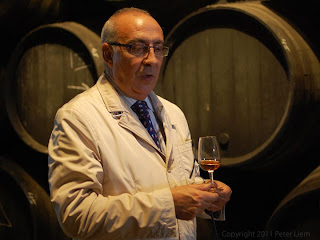 The first, Una Palma, is a wine of about six years of age, and is still very much a fino, even if its savory, burnished flavors are moving towards another stage of maturity. "We're still looking for flor character here," says Flores (pictured above). To make this, Flores and his team began with 150 barrels that showed the character that they were looking for; from these, they narrowed the selection to 20, then to ten, finally ending up with just five of the finest barrels, from which they produced 2,400 500-milliliter bottles. The wine is noticeably deeper and richer than even the En Rama version of Tio Pepe, showing its greater age in its nutty, umami-driven aromas and buttery texture. It's extremely salty and minerally in its undertones, finishing with an almondy bitterness and long, fragrant length.
This umami savoriness becomes even more pronounced in the Dos Palmas, which comes from an even smaller selection of wines that average about eight years of age. Here the flor is growing thinner in the barrel, and the wine is beginning to offer hints of what lies beyond the world of biological aging, showing brief glimpses of marzipan and toffee. It's still strongly marked by flor, with aromas of roasted almonds, iodine and brown butter, and while it retains a saline backbone of minerality on the finish, it's fuller and more expansive than the Una Palma, developing more body and weight.
As this continues into the next criadera, its average age increases to ten years, and here the flor is so old and feeble that it no longer forms a coherent layer, instead being broken up into patches that lie on top of the wine. The color of this wine, the Tres Palmas, is a little deeper and more amber than that of the previous two, and its nose is moving slowly into the realm of oxidative aging, with aromas of caramel and dried apples alongside old flor notes of almond butter and vegemite. It explodes in fragrance on the palate, feeling heady in richness yet seamlessly harmonious and elegantly refined, and its finish is marked by an intense concentration of aroma and long, saline length. "In the old days, at the end of the 19th century or the beginning of the 20th, people would say that this was just an old fino," says Flores. "For me, it's definitely a fino-amontillado now. But it's a very personal decision, and it depends upon the nose of the individual taster."
Like Tio Pepe En Rama, these were bottled with a minimal amount of filtration, using a relatively porous filter simply to remove any flies or large pieces of sediment. In bottle, there are still some particles of flor, and because of this, Flores says that these wines should be drunk sooner rather than later. "The Una Palma, Dos Palmas and Tres Palmas should be drunk within six months," he says, "when they are the same as they are in barrel. After that, they will change in character. Also, the yeasts may cause the wine to be a little unstable over time."
 The final wine in the collection is no longer a fino, but it clearly demonstrates that it originated as one, many years ago. "We wanted to show the other end of the spectrum," says Flores. The Cuatro Palmas, pictured above, comes from a solera of just six barrels, called the Solera Museo, which contains the house's oldest "drinkable" amontillados, according to Flores: "Forty to fifty years is the limit of drinkability," he says. "We have older wines, but they're so concentrated and woody that they are no longer drinkable." These barrels, in fact, represent the continuation of the fino and amontillado spectrum even beyond Del Duque — when Del Duque is bottled it averages 30 years of age, but the Cuatro Palmas averages 45 years, meaning that even though Del Duque is already a VORS, it effectively acts as a criadera for the Solera Museo.
The Cuatro Palmas is not a blend of the six barrels, but rather a selection of a single barrel in the solera, yielding a mere 150 bottles of wine. "All six barrels are magnificent," says Flores, "but we chose the barrel with the most finesse, to remind you that it was once a fino." The wine smells amazing, its exotic aromas of dried fruit, brown spices, nuts and fresh caramel seamlessly wound into a pungently fragrant whole. Even with its powerful concentration on the palate, it still thrives on its impeccable elegance and harmony, persisting with lacy, filigreed detail and seemingly unending length. In this regard, it's easy to relate it back to its beginnings as a fino, despite its great age: while the influence of flor is now a memory rather than an overt presence, it forms the foundation of the wine's character, giving it a racy, elongated shape and an inimitably silky texture. As we spent time tasting the Cuatro Palmas, Antonio Flores kept referring to it as a fino rather than as an amontillado, and that in itself reveals a lot about the way that he views this extraordinary wine.
 This entryway was tiled.
 This one also was tiled.
 This one too.
 This one is not unusual, in that it was tiled.
  At this point, you cannot be surprised about the tiles in this entryway.
  What, you thought there'd be no tiles?
 Tiled fireplace of old? A baker sells bread through that window.
 Here, a tiled entryway.
 Tiled entryway with rug.
 The designer here chose tiles for the entryway.
 This concludes this series. Notice that all of the entryways are tiled.