Showing posts with label Guest posts. Show all posts

Tuesday, November 01, 2011

The Palmas of González Byass - A Guest Post by Peter Liem

Peter Liem is an expert on Champagne and Sherry, and probably several other wine regions too, although he would never say that himself. In fact, perhaps the thing that he is worst at in the world is self-promotion. One of the results of his humble quiet attitude about his expertise is the fact that many of us wine lovers don't realize that he is behind many of the interesting ideas and trends in wine appreciation, and even now in the crafting of wine. This last assertion will become quite clear in the coming years, as the changes in Sherry wine making and importing take full effect in this country - Peter's thoughts on the wines are carefully listened to in the Sherry Triangle.

Peter is writing a book on Sherry with Jesus Barquin of Equipo Navazos, and there is no question in my mind that this will be one of the most enjoyable and important wine books in recent history. He just knows that much, and his sensibilities are that nuanced. The book will be out in the spring, and remember over the next few months, as you read and hear more about Sherry, that Peter is as much as anyone or anything, the genesis of the Sherry resurgence in NYC and the US.

The following is Peter's text and photos about a set of wines that we tasted in Jerez last week. I think it's fitting that his writing appears before I (bumblingly) attempt to write anything further about the trip. So without further ado...

The Palmas of González Byass

In the modern day, fino sherry is typically thought of as a light, pale wine, one that is best drunk when it is relatively young. This, of course, ignores the fact that fino is by definition an aged wine, being anywhere from three to ten years old when it is bottled.

As with other fine wines, fino develops more complexity and depth as it ages, acquiring flavors and aromas that cannot be derived in any other way. Unlike other wines, however, fino doesn't necessarily have clearly defined beginnings and endings to its élevage. When a red wine is put into barrel, for example, there is a point at which it finishes that phase of its aging: it no longer benefits from being in barrel (and indeed, may decline if left there), and so the winemaker bottles it. In the case of fino, which is aged in a solera, it essentially lives a perpetual existence — guided by a skilled capataz, or cellarmaster, through its various criaderas, it continues to gain in complexity and character as it progresses down a path that ultimately leads to amontillado. Thus, a bottling taken from a solera represents a sort of photograph of a particular moment in time, capturing the character of the wine in that instant. In bottle, we see a fino as the capataz, the photographer, chooses to present it to us, yet just as the subject of a photograph continues to live and grow and evolve after the picture is taken, so does a fino.

In October, González Byass released a collection of wines that offers a fascinating, behind-the-scenes glimpse of the way that fino evolves in barrel. The house's fino, Tio Pepe, is the best-selling sherry in the world, and its soleras are enormous, encompassing over 22,000 barrels. Last year, the firm released a small quantity of Tio Pepe En Rama, a special selection of barrels that were bottled with a minimum amount of filtration. This was supposed to be a one-off release, in celebration of the house's 175th anniversary, yet it was received with so much enthusiasm in the marketplace that González Byass opted to do a second version earlier this year. Encouraged by the success of that project, the house decided to push the concept a little further, and the result is the new collection of Palmas: four rare and scrupulously selected wines that brilliantly illustrate the aging curve of fino. Unfortunately for most of the world's wine-drinking population, the Palmas are being released exclusively in the UK and Spain, but hopefully González Byass will elect to continue bottling these wines and make them available elsewhere in the future.

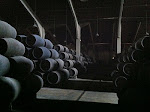
The term palma is used by cellarmasters in their classification of the various casks in the cellar. In his book Sherry, The Noble Wine, Manuel González Gordon writes: "Palmas (one, two, three or four) refer to certain Fino Sherries notable for the cleanness and delicacy of their aroma; the number of Palmas denotes their age." Julian Jeffs, in his book Sherry, reminds us that this is an internal classification rather than an official one: "The term palma is reserved for fino of the highest quality, with a particularly clean and delicate aroma. As the wine ages it may become dos palmas, tres palmas or cuatro palmas, but this classification is purely arbitrary; a shipper may put the dividing line where he likes, so that one shipper's palma could be similar to another's tres palmas." Barrels designated as palmas are marked by a diagonal line with one to four branches, as seen in the above photo of a barrel of cuatro palmas.

On a visit to González Byass last week, Brooklynguy and I met with master blender Antonio Flores to talk about the new Palmas and to taste the wines. We began, logically, with a tasting of Tio Pepe from barrel, as it's necessarily the starting point of any discussion of the Palmas. When Tio Pepe is bottled, the wine averages about four and a half years of age, and the idea of the Palmas is that they depict stages of fino beyond that. "Las Palmas are the evolution of Tio Pepe," says Flores. "They portray life after Tio Pepe."

A fino that ages oxidatively after losing its flor becomes an amontillado. You can make an amontillado, generally speaking, in one of two ways: either you fortify an existing fino to 17 percent of alcohol to kill the flor, or you allow the flor to die off naturally, losing its stability over a period of many years as it's slowly starved of nutrients. González Byass is an advocate of the latter method, which is both more time-consuming and more labor-intensive, as it requires the maintenance of more intermediate soleras. The firm makes two amontillados: Viña AB, which averages about nine years of age, and Del Duque, a VORS averaging 30 years of age. The soleras of Tio Pepe feed the criaderas of Viña AB, and Viña AB, in turn, eventually feeds Del Duque.

Prior to turning into amontillado, however, a selected portion of the house's top finos are used to refresh an extraordinary collection of 600 barrels of what is essentially fino-amontillado, tucked away in a corner of the firm's imposing, three-story Gran Bodega. These barrels, arranged into several criaderas, demonstrate how blurred the lines between all these categories really are. At what point does fino stop and amontillado begin? When does an aged fino become a fino-amontillado? Regardless of how you choose to categorize them, these wines represent something special, and it is from these barrels that the Palmas were selected.

The first, Una Palma, is a wine of about six years of age, and is still very much a fino, even if its savory, burnished flavors are moving towards another stage of maturity. "We're still looking for flor character here," says Flores (pictured above). To make this, Flores and his team began with 150 barrels that showed the character that they were looking for; from these, they narrowed the selection to 20, then to ten, finally ending up with just five of the finest barrels, from which they produced 2,400 500-milliliter bottles. The wine is noticeably deeper and richer than even the En Rama version of Tio Pepe, showing its greater age in its nutty, umami-driven aromas and buttery texture. It's extremely salty and minerally in its undertones, finishing with an almondy bitterness and long, fragrant length.

This umami savoriness becomes even more pronounced in the Dos Palmas, which comes from an even smaller selection of wines that average about eight years of age. Here the flor is growing thinner in the barrel, and the wine is beginning to offer hints of what lies beyond the world of biological aging, showing brief glimpses of marzipan and toffee. It's still strongly marked by flor, with aromas of roasted almonds, iodine and brown butter, and while it retains a saline backbone of minerality on the finish, it's fuller and more expansive than the Una Palma, developing more body and weight.

As this continues into the next criadera, its average age increases to ten years, and here the flor is so old and feeble that it no longer forms a coherent layer, instead being broken up into patches that lie on top of the wine. The color of this wine, the Tres Palmas, is a little deeper and more amber than that of the previous two, and its nose is moving slowly into the realm of oxidative aging, with aromas of caramel and dried apples alongside old flor notes of almond butter and vegemite. It explodes in fragrance on the palate, feeling heady in richness yet seamlessly harmonious and elegantly refined, and its finish is marked by an intense concentration of aroma and long, saline length. "In the old days, at the end of the 19th century or the beginning of the 20th, people would say that this was just an old fino," says Flores. "For me, it's definitely a fino-amontillado now. But it's a very personal decision, and it depends upon the nose of the individual taster."

Like Tio Pepe En Rama, these were bottled with a minimal amount of filtration, using a relatively porous filter simply to remove any flies or large pieces of sediment. In bottle, there are still some particles of flor, and because of this, Flores says that these wines should be drunk sooner rather than later. "The Una Palma, Dos Palmas and Tres Palmas should be drunk within six months," he says, "when they are the same as they are in barrel. After that, they will change in character. Also, the yeasts may cause the wine to be a little unstable over time."

The final wine in the collection is no longer a fino, but it clearly demonstrates that it originated as one, many years ago. "We wanted to show the other end of the spectrum," says Flores. The Cuatro Palmas, pictured above, comes from a solera of just six barrels, called the Solera Museo, which contains the house's oldest "drinkable" amontillados, according to Flores: "Forty to fifty years is the limit of drinkability," he says. "We have older wines, but they're so concentrated and woody that they are no longer drinkable." These barrels, in fact, represent the continuation of the fino and amontillado spectrum even beyond Del Duque — when Del Duque is bottled it averages 30 years of age, but the Cuatro Palmas averages 45 years, meaning that even though Del Duque is already a VORS, it effectively acts as a criadera for the Solera Museo.

The Cuatro Palmas is not a blend of the six barrels, but rather a selection of a single barrel in the solera, yielding a mere 150 bottles of wine. "All six barrels are magnificent," says Flores, "but we chose the barrel with the most finesse, to remind you that it was once a fino." The wine smells amazing, its exotic aromas of dried fruit, brown spices, nuts and fresh caramel seamlessly wound into a pungently fragrant whole. Even with its powerful concentration on the palate, it still thrives on its impeccable elegance and harmony, persisting with lacy, filigreed detail and seemingly unending length. In this regard, it's easy to relate it back to its beginnings as a fino, despite its great age: while the influence of flor is now a memory rather than an overt presence, it forms the foundation of the wine's character, giving it a racy, elongated shape and an inimitably silky texture. As we spent time tasting the Cuatro Palmas, Antonio Flores kept referring to it as a fino rather than as an amontillado, and that in itself reveals a lot about the way that he views this extraordinary wine.

Friday, December 19, 2008

Friday Night Bubbles

I have a special treat for us all to share this week. Peter Liem, the finest Champagne blogger there is (and his other writing isn't bad either), has most graciously written today's Friday Night Bubbles installment. The good news is, you'll learn far more about wine by reading Peter's post than you do when you read typical Friday Night Bubbles posts. The bad news is, I have not yet been able to convince Peter that he should simply assume command of the ship over here on Fridays. He makes it sound as though he has better things to do. Anyway, check this out: Peter Liem doing Friday Night Bubbles.

NV Larmandier-Bernier Terre de Vertus Blanc de Blancs, $55, Louis/Dressner Selections. Non-dosé champagne is highly fashionable in the Champagne region right now, but few people really do it right. The problem is that in order to make good non-dosé champagne, you have to work exceptionally well in the vineyards, to achieve fruit that is ripe enough and complete enough in feel to stand on its own. You can't just take your regular brut NV and decide that you won't add any sugar to it. One producer who knows how to consistently get it right is Pierre Larmandier of Larmandier-Bernier, with his Terre de Vertus blanc de blancs.

This wine is a monocru champagne, coming entirely from the village of Vertus, but even beyond this, it's all grown in a very specific area in Vertus: the chalky heart of the gentle, east-facing slope on the northern side of the village, in the direction of Le Mesnil-sur-Oger. This area makes the most overtly minerally wines of the village, wines that can echo those of Mesnil in their racy, focused structures but that carry less overt weight, making them feel even more linear and energetic, with an intensely pronounced chalkiness. Comparing the wines of Vertus to his wines from Cramant, farther north, Pierre Larmandier says, "It's the same minerality, but Cramant has more power and more body. In Vertus the minerality is a little more naked."

The Terre de Vertus is not technically a single-vineyard wine, as it comes from three adjacent parcels: Les Barillées, Les Faucherets and La Vieille Voie. However, the terroir remains fairly homogenous over Larmandier's 2.5 hectares in these three plots, so for all intensive purposes this functions identically to single-vineyard champagne, expressing the particular characteristics of a highly specific site. As with all of Larmandier's wines, this is grown biodynamically, picked at an elevated degree of ripeness and fermented with indigenous yeasts. A portion of it is fermented in barrique, another portion in large oak foudre and another in stainless steel tank—Larmandier likes the respiration that wood provides, but doesn't want the wine to be influenced by the flavor of oak, so he adds some tank-fermented wine into the blend. He's been very pleased with his foudres so far in the way that they allow the wine to breathe without imparting too much of a flavor imprint, so if he can solve the problem of physical space (those suckers are big), look for Larmandier's champagnes to involve more wine vinified in foudre in the future.

Although the Terre de Vertus has always come entirely from a single year (the first was 1995), it cannot be vintage-dated as it's released too early to qualify for a vintage champagne. The bottle that Brooklynguy and I drank together this week was from 2004, disgorged in April of 2007, meaning that it spent about two years on the lees. I always think that Larmandier's wines need a lot of post-disgorgement aging to show their best, and even tasting this one, 20 months after disgorgement, I felt that it could still use a little more time to put itself together. It started off very compressed and austere, taking about half an hour for the nose to unwind and reveal its fruit, although the palate was more generous, with aromas of sweet apple and citrus peel, infused by fragrant chalkiness and finishing with light notes of clear honey. Silky in texture and tone, it felt driven by the taut, lively character of the terroir, and while it demonstrated a good deal of depth and concentration on the mid-palate, the overall impression was one of raciness and energy. We didn't decant it, but I don't see why it wouldn't have benefited from decanting—after drinking about two-thirds of the bottle, I told Brooklynguy to put it in the fridge and save it for the next day, when it would likely be showing even better (and he confirmed later that this was indeed the case). While it's not a wine to age for a tremendously long time, I would be interested in seeing how it develops over the next three to five years, at least. Back in February of 2007, I wrote in my notebook that the 2004 "will vie with the 2002 as the greatest Terre de Vertus that Larmandier has made so far." I see no reason to amend this statement, and I suspect that there is even more complexity and character contained within this wine, waiting to emerge.

Friday, July 11, 2008

Friday Night Bubbles

Hey Friends - This week you're in for a special Friday Night Bubbles treat. First of all, the wine is amazing, and although this vintage is gone, you should be able to find the current release, the 1998. But more importantly, fellow blogger and wine lover David McDuff is the guest-author, and as you'll see, he brings all of his astute charms for this post.

Would you like to write a guest post for Friday Night Bubbles? I'd love it if you would, whether or not you have a blog. If so, contact me using the info in my profile and we'll set it up. Why should I have to buy all of the Champagne? Without further ado, take it away McDuff...


In an ideal world, there’d be another case of the wine I’m about to write about sleeping in my cellar. In the real world, I can’t think of a more appropriate occasion on which to have pulled the cork from my last bottle.

1996 José Michel Spécial Club Brut Champagne. $42 on release. 12% alcohol. Cork. Importer: Wine Traditions, Falls Church, VA. When I headed up for an impromptu trip to New York last week, I threw a few goodies in my wine tote in hopes of sharing them with friends. There was a bottle of something interesting and slightly spirituous (Vieux Pineau des Charentes) for my Scotch loving friend with whom I was staying, an oldish bottle of Mittelrhein Riesling, just in case I ran into Mr. Rockss and Fruit (which I didn’t), and a bottle of grower Champagne, in hopes of a meet-up with Mr. and Mrs. Brooklynguy. That last meeting not only came together but came off like a charm, thanks to an extremely generous invitation to dinner from my host, a guy who happens to be your host every time (almost, that is) you visit this blog. Happily, the wine I’d carted along was showing just as generously.

José Michel, whose estate is located in the hamlet of Moussy, just southwest of Epernay, has had his hands in the vigneron business at his family property since 1955. A longtime member of the Club Trésors de Champagne, his vintage “Spécial Club” bottling is essentially, as it should be per the Club’s standards, his top wine, his tête de cuvée.

I could go into much more detail about the history of the Club Trésors but you’d be much better off just reading Peter Liem’s excellent post from earlier this year. Zooming into the photo, the embossed detail on the neck of the Spécial Club bottle will reveal that Michel's 1996 comes from a time when the group was still known as the Club de Viticulteurs Champenois. That very bottle, de rigeur for Spécial Club cuvées, would be the only downside to having that ideal case in the cellar. Handsome, yes, but its squat, wide bottomed shape makes for rather awkward storage. Then again, I have thought about expanding my cellar…. But I digress.

Though he produces lovely Blanc de Blancs, José (pronounced Zho-say) is best known as one of the true – and few – champions of Pinot Meunier. His current Spécial Club release, 1998, is a 50/50 blend of Meunier and Chardonnay from vines of up to 70 years in age. I seem to remember a similar blend for the ’96, perhaps with a slightly higher proportion of Meunier. It’s also an assemblage of wines vinified in both steel and oak.

In any event, Michel’s Champagne has benefited wonderfully from its several years of bottle age, showing a rich yet pale golden color and a nose full of autolytic character. Its aromas were richly infused with toasted brioche, hazelnuts, marzipan and buttered croissants. Generous, sweet and totally focused fruit kicked in on the palate, lush up front but with great acid providing muscle on the mineral-laced finish. Did I detect a little red-fruited spiciness? At this moment in time, there’s a great interplay between the onset of tertiary development and the retention of youthful vibrancy and freshness.

Two or three hours after opening, the wine, along with its stream of impossibly tiny bubbles, was still going strong. Its mouthfeel and aromas had become darker and rounder, almost figgy, with an abundance of fruit oils and an unmistakable lacing of beeswax. Beautiful stuff, shared on a beautiful evening in Brooklyn.

Wednesday, May 21, 2008

Deetrane Invades Long Island's North Fork

My good friends Deetrane and his wife P-trane just celebrated their 5th wedding anniversary with a weekend in the North Fork of Long Island. Dee and P were happily surprised at how much they liked the wines. Deetrane still says to me each time I see him now "Do you realize that this is our own BACKYARD?!?" I'm pretty sure that he wants to go back. I know that he came home with at least two cases of wine. Anyway, the following is a bit about the weekend from Deetrane himself. He's a vastly entertaining fellow - don't hesitate to check out his older guest posts.

It's been a while since my last post, and the Brooklynguy has been hounding me to pound one out, so here I am. No, I'm sorry, I don't have any tales to tell about Russian wine-gangsters or the Schlitz-shchlurping NYPD vice squad. Rather, I have a lovely story to tell about an eye-opening visit to… The North Fork of Long Island.

For our 5th anniversary weekend, P-trane and I arrived by car from NYC and following Lenn's suggestion, checked into the Harvest Inn B&B in Peconic. It's a sprawling, 5 year-old replica of a big old farmhouse with wide plank pine floors, super high ceilings and lots of fireplaces. The owners, Darolyn and Chris, welcomed us with gusto and a chilled bottle of chardonnay.

Overall, I was astounded at the consistency and quality of the wines we tasted, which were those of The Lenz, Paumanok, Pellegrini, Peconic Bay and Borghese. These wines have a determinedly old-world feel, in which fruit plays heavily but not excessively, alcohol levels are on the low side (12-13%), and words like integration, balance and harmony come to mind. Given my partiality for Northern Italian, Spanish and Burgundy wines, I felt like I was being reunited with a long-lost relative. There was a certain familiarity combined with fascination of the new.

The high point of the weekend was a vigorous personal tour of the vineyards and winery at Peconic Bay by wine maker Greg Gove. Never has anyone – except maybe Maria de López de Heredia – been so generous and enthusiastic about delving so deeply into their craft with a complete stranger. The low point, such as it was, was probably the wine tasting on Saturday evening at the Harvest Inn. Owner and chef Chris, who just that morning had been a total teddy bear serving his delicious apple-cinnamon pancakes, became an utter tyrant while pouring a fabulous 2002 Peconic Bay Cabernet Sauvignon and an equally impressive 2005 Reisling. Imagine you are back in 4th grade gym class, and the teacher is warning you that you will be ejected from the class if you dribble that basketball before he is done lecturing on the physics of a jump shot. And you're thinking, "geez, I just wanna play ball." We were instructed not only when to drink, but how to swirl, how to hold the class, and what to think about while swallowing. Notwithstanding, the wine was superb and made us that much more excited for our private tour the following day.

We made culinary stops at The North Fork Table and Inn, and Jedediah Hawkins' Inn , which seem to occupy the top two restaurant slots by reputation. Both were memorable for their fresh, local ingredients, but despite raves from the press, locals, and our fellow guests at the inn, the only truly distinctive aspect of meals at those places was the honey-tasting we had for dessert at Jed's, consisting of four markedly different local honeys.

In fact, the best meal I had was at The Vine, a wine bar in Greenport run by investment banker turned sommelier Joe Watson. Either he was a really terrible banker or a really great one, both of which could explain his apparent retirement at the age of 32. I suspect it was the latter. The first thing I saw on the ample wines-by-the-glass list was a 1988 López de Heredia Vina Tondonia, which I instantly ordered for $20 because of the nostalgic pull from my honeymoon trip, previously described here in my last guest post. Imagine my shock and embarrassment when Joe revealed that he, too, had also gotten the tapas treatment by Maria when he was in Rioja! At least Joe didn't get to raid the library with the gnarly moldy vine-rope.

Thursday, November 29, 2007

Deetrane Deep Down in the Cellars of López de Heredia

When my pal Deetrane read the post from the other day about tasting the 1976 Lopez de Heredia Bosconia, he was flooded with good memories. Deetrane and his wife P-trane went to Spain for their honeymoon and visited several wineries. He says that the single best experience they had was their unplanned visit to López de Heredia. So sit back and enjoy as guest-poster Deetrane takes us on a trip down the twisted pathways of his memory lane:

P-trane and I are on the first winery tours of our honeymoon, after several days and nights wending our way from bistro to parador to cava bar across Catalonia and Aragon, before settling into a lovely old convent-cum-hotel in the medieval center of Haro, Rioja’s wine capital.

First up – Bodegas Muga, of course – the only Rioja wine we knew by name up to that point, and one of the largest “premium” Rioja exporters. A quality winery by any standard, and a very detailed, interesting, competent, FREE English-language tour (an intensive primer, in fact, in all things Rioja). But despite it being our first winery visit, we still sensed we were at the Rioja equivalent of the Epcot Center. Authentic no doubt, yet just a little too polished, and few dozen too many Euro-coaches in the parking lot.

Great prices in the shop though. €2.50 for Crianza, €5.50 for Reserva, €8.50 for Prada Eneo (Gran Reserva), €12.00 for Torre Muga! We bought three bottles.

Right next door, the venerable La Rioja Alta. Three Euro-coaches in the parking lot, versus Muga’s fifty. A very good sign. No English signage, much less an English-language tour. An even better sign. As the Spanish-speaking tour guide describes the traditional steps such as fining with egg-whites, we nod sagely (if uncomprehendingly) having just seen all the same stuff at Muga five minutes earlier. But a real, working cooperage, as opposed to Muga’s costumed-mannequin diorama (think Museum of Natural History, or better yet, that crazy robotic contraption in the basement of the Mormon Tabernacle). Even better prices in the shop, with wines from across the parent company’s brands.

A year or so later we opened the 1994 La Rioja Alta Rioja Gran Reserva 890 we purchased there for under €10.00. A revelation – the first time I had tasted a perfectly integrated, balanced, aged red wine of any kind. It was the most memorable, sumptuous and absorbing wine I had tasted in my life, notwithstanding what came next.

Three tour buses were still too many for what P-trane and I were I the mood for. We started to stroll through the streets of the old, mostly low-slung, very urban warehouse style winery district of Haro. We became fascinated by the numerous small patches of old, gnarly Tempranillo vines, planted right between the endless brick, stucco and concrete winery buildings.

We’d gone not more than 20 yards from La Rioja Alta when we heard loud banging shop noises coming from behind set of huge oak doors across the street. We ambled towards the noise into a courtyard, saw that the doors were ajar, and walked in on two coopers in overalls. They were busily banging wrought iron rings, American and French oak planks into barrels and toasting them over open flames that were shooting up from perfectly round, manhole-like openings in the floor. The coopers were friendly, and waved us closer.

Within minutes, a door opened and a short, very mod, thirty-something woman with chic rectangular glasses and a spiky short haircut came in with two fair-skinned, forty-something men (there she is in the picture, courtesy of Alice Feiring). Without prompting, she flashed us a sympathetic glance and said, in perfect English, “I’m Maria de López de Heredia. These guys are economists from the University of Barcelona – friends of my father’s. Let me just ask them if they mind you coming with us.”

We held our breath. No, they wouldn’t mind, came back the answer!

Oh boy!

The next minute we were descending through a metal casement door heading directly underneath the sprawling winery complex, down down down over tiny uneven steps, lower and lower in the bowels of López de Heredia. The walls literally turned black and fuzzy with penicillin mold. Maria gesticulated and pointed and jabbered in Spanish, pausing to translate what seemed like every 14th word.

Who needed translation?

It was…. Insane. With no natural light, a faint bulb here and there was all there was to illuminate row upon row of barrels, a seemingly boundless catacomb of vaulted corridors. On the floor were smooth metal rails, just slightly protruding above slippery cobblestones. After a while we could see faint sparkling lights in the distance. We came upon several cellar workers who were bottling a 1995 Gran Reserva. It was now May of 2003, mind you. This wine was being bottled after some two years in large wooden casks and another five years in barrel. The workers wore hardhats with sputtering sodium lamps, like spelunkers, and thick, black rubber gloves and aprons and reminded me of the Mario Brothers and undertakers at the same time.

One of them was arranging empty green bottles on a small wheeled metal tray sitting on the rails built into the floor. The other was filling the bottles one at time with a little swiveling spigot. As each tray of 12 bottles filled up, they would roll it a few feet to the third guy, who would pick the bottle up and position it in a corking device and pull down on a lever. Each time, he would be liberally squirted with wine – hence the heavy rubber gear. Each guy had a glass of wine standing around the work area, the flicker of the headlamps just enough to see that the Gran Reserva was a crystal clear ruby color. It was 10:15 a.m.

A few minutes latter, we saw bright movie-set lighting further down one of the corridors, this one racked with endless rows of bottled wine. A photo shoot was in progress, and the crew was standing amidst hundreds of bottles on the floor in between the racks, like giants in a sea of penguins.

“Oh, that’s So-and-So,” Maria casually tossed out, “He’s, like, the most famous television director in Spain, but we’re old friends so he’s doing my new brochure pictures today.”

We come to a gigantic, rolling oak door, at least 12 feet high. After several tense (for us) minutes futzing with keys and jostling the padlock, Maria hauls aside this hulking door an we are met with an amazing site. In the center of what can only be described as a dungeon room is a massive round table made from the lid of a giant oak fermenting tank. Standing upright in the middle of that, sort of as a centerpiece, is an old, dried out vine trunk. About six feet above that, a dangling brass chandelier. Over decades, a thick, black rope of pure penicillin mold has climbed down from the ceiling, wrapped itself around the chandelier, and continued on its way to envelope the centerpiece. (Photos courtesy of Crush). All around us are huge concrete bins, with the remaining stocks of winery owned vintages, going all the way back to the beginning (1877). The oldest vintages are mostly piles of mold, dust, broken glass and empty bottles, but Maria assures us there’s still probably some good stuff in there – but no one has the guts to go in and find out!

López de Heredia makes wines from several vineyards, although their most heralded wines come from two vineyards - Tondonia and Bosconia. Bosconia makes only red Rioja, and is pure Tempranillo. The Burgundy-shaped bottle hints at the style of the wine. Tondonia makes white and red, and is a blended wine. The Bordeaux-shaped bottle hints at the style.

Maria turns on the lights and we see platters of Serrano ham, and fresh bread, and… wine glasses! Woo hoo! We tasted flight after flight, starting with some very old Tondonia’s This is WHITE wine, mind you. The oldest we tasted may have been a 1955, followed by a 1961, a 1968, and a 1970. Then we tasted a bunch of old Bosconia, the oldest being a 1954 or so. P-trane and I had never tasted wine this mature or this traditionally made. I can’t really describe it, but needless to say it was around this time that I started drinking a lot more wine, generally!

The economists turn to leave, and Maria tells us to stay put while she escorts them out. P and I are now ALONE in the López de Heredia library. Do I go in search of an intact bottle of 1895 gran reserva? Hmmm, the 1914 stack is looking like a better bet. She’s back, with the television director and his crew in tow. Partay! After doing both white and red flights a second time, with the film director and co., Maria announces that its time to head into town for Tapas. “Do you want to come?” Do we want to come? DO WE WANT TO COME???!???!!!??

We leave our car in the Muga parking lot and hop into Maria’s beat up rat-trap Volkswagen and head to one of her regular bistro’s in the center of Haro near the Plaza Mayor.

Maria orders basically the entire menu over the next three hours, as well as three or four bottles of López de Heredia from the surprisingly ample list at this very casual joint. At this point, bottles of 1988 and 1991 are comparatively blasé.

By about three o’clock, everyone is pissed drunk, Maria has now been translating, drinking and gesticulating for five hours, and it is time to, gulp, drive back to the winery and get our car. We all kissed on both cheeks and said our goodbyes, thanking Maria and television director and the Good Lord for this incredible day. Every year, when we get our Christmas card from Maria, we think about the next time we’ll taste a 1955 Vina Bosconia.

I encourage everyone to visit them. When we were there, there was no organized visiting or tasting at the winery. Maria, who is apparently now the CEO (she had been the head of Marketing) commissioned an ultra-modern tasting building by architect Zaha Hadid, described on Wikipedia as a “notable Iraqi-British
deconstructivist architect.” Yowza.

Sunday, March 25, 2007

Adventures in Wine Buying...The Final Chapter

And we return to Deetrane's dark tale of intrigue, wading through the swamp of the secondary market. Prepare yourself, dear reader, for this..the final chapter (cue: scary music, rain thrashing down outside your window, lightning, etc.).

At the end of the last installment Deetrane, instead of getting to work on time, was sitting in a police lockup wondering if Konstantin would learn of his complicity in the sting, but far more concerned about the fate of several of his cheaply (and illegally) obtained Barbaresco.

Will Deetrane get to keep the wine? Will Konstantin disembowel Deetrane, and feast upon his wine-ravaged liver? Read on, friend, as Deetrane, guest poster and pal extraordinare concludes this grisly tale of Adventures in Wine Buying.

So now that the guts of the story have been told, I can be a bit more introspective and get some things off of my chest. First of all, have this nagging guilt for turning Konstantin in. I know what he did was wrong, but I was profiting from it, too. The restaurant’s take was that if I hadn’t happened to pop in, the theft could have continued indefinitely. So they were grateful. But that thing he said to me in the car, with such a look of complete despair, ruin even, still sort of haunts me. So I don’t want anyone to think I am gloating. This story is really kind of sad.

Anyway, on to the conclusion. Apparently they made Konstantin stew inside an interrogation room for hours. He was sending text messages to Simon at Esca – desperate, pathetic messages, like “I’m so sorry. Please help me. I have no one.”

Meanwhile, the seven bottles I purchased for $150 in the sting were not enough to warrant grand larceny charges, unless they tied in testimony from me about the other 30+ bottles I had already purchased. But with all of the other criminal activity that takes place in the city, I guess the cops just didn’t have enough to book him then and there. So after a good couple days in the lockup, they gave him what is known as a “desk appearance ticket”, or a DAT. This means that they let you go, without arresting you, and tell you that you’ll need to come back later to be formally arrested. Meanwhile, the 1996 Roagna Barbaresco Paje did in fact simmer in the non-air conditioned 10th precinct until it was probably added to someone’s labor day sangria.

Konstantin was never heard from again. The scuttlebutt was that he jumped the first Aeroflot flight back to Russia. I, however, collected the following bottles, most of which I have not yet touched, and for which I am supplying whatever tasting notes I can find, if any (e.g. Wine Spadvocator).

Tenuta Rocca Barolo 2000 x 3

WS: Silky and tight wine with pretty fresh rose and strawberry aromas and flavors. Medium- to full-bodied, with fine tannins and a refreshing, citric aftertaste. Clean and fresh style. Best after 2006. 300 cases made. –JS Score: 90, July 04 - Release Price: $50

Luigi Pira Barolo Marenca 2001 x 3

WS: Intense aromas of blackberries, lightly toasted oak and plums. Very intense. Full-bodied, with big velvety tannins and a long, caressing finish. Serious wine. Best after 2008. 1,000 cases made. –JS Score: 92, Oct 05

Varaldo Barbaresco Sori Loreto 1999 x 3

Paolo Conerno Barolo Ginestra 1999 x 3

Marziano & Enrico Abbona Barolo Pressenda 2000 x6

WS: Fantastic aromas of crushed flowers, licorice, raspberries and strawberries. Full-bodied, with a solid core of ripe fruit and supersilky tannins. Long. Fantastic for this producer. Best I have ever had from here. Best after 2009. 1,220 cases made. –JS Score: 94, July, 2004 – Release Price: $52

Paitin Barbaresco Sorì Paitin Vecchie Vigne 2001 x 3

WS: Rich and decadent, with mushroom, berry and cherry aromas and flavors. Full-bodied, with chewy tannins and a long, ripe fruit aftertaste. Big wine. This is always impressive. Much better than the 2000. Best after 2008. 400 cases made. –JS Score: 93, Dec 2004 – Release Price: $75

Azelia Barolo Bricco Fiasco 2001 x 3

WS: A soft and ripe red with plum and berry character and just a hint of meat. Full-bodied, with velvety tannins and a long finish. Best after 2008. 1,020 cases made. –JS Score: 93, Oct 2005, Release Price: $78

Piero Busso Barbaresco Borgese 1999 x 3

WS: Refined red. Aromas of berries and fresh herbs follow through to a medium-bodied palate, with refined tannins and a pretty, fruity finish. Best after 2006. 500 cases made. –JS, Score: 90, Nov 2002, Release Price: $52

Guido Porro Barolo Vigna S. Caterina 2001 x 3

WS: Extremely attractive aromas of roses, spices and light wood follow through to a medium-to-full body, with fine tannins and a pretty finish. Balanced and refined. Best after 2007. 280 cases made. –JS, Score: 90, Release Price $40

Tua Rita Toscana Giusto di Notri 2002 x 2

WS: This shows beautiful vanilla, violet and berry character on the nose. Medium- to full-bodied, with well-integrated tannins and a subtly complex finish. Fine wine. Very well done for the vintage. More balanced and refined than the 2001. Cabernet Sauvignon Merlot and Cabernet Franc. Best after 2005. 2,450 cases made. –JS, Score: 90, Oct 2004, Release Price: $85

Cascina Ebreo Segreto 1999 x

WS: A traditionally-made (no filtration, wines aged at least two years in oak and another in bottle before release) blend of Barbera (85-90%) and Nebbiolo, made by two Swiss winemakers who bought the derelict estate in 1991. Apparently a well-kept Piedmontese secret.

Braida Barbera D’Asti Ai Suma 2001 x 3

Jammy, new world-style wine – tasted to me like an Amarone. Not quite to my style

Braida Barbera D’Asti Bricco del Uccellone 2001 x 3

Big, leathery, huge monster wine. More to my palate, but could definitely mellow for a few more years.

So we are not quite yet at the end of the saga. I still ahve to drink all of the stuff. And I still wonder if I will find an angry Konstantin lurking one day outside my house. Thanks for reading, you all, but I have to go now, because there's a guy from Craig's List waiting outside with a few cases of Riedel glasses in his trunk...

Tuesday, March 06, 2007

Adventures in Wine Buying...Continued

And now we return to our story, featuring Deetrane, guest-poster and pal extraordinaire:

At the end of the first installment I had just told the Esca staff that I had been buying their wine – stolen from their cellar. Now Pasternak, Frank, Simon and a couple other staff could be seen conferring in the courtyard, making frantic calls on cell phones and traipsing back and forth to the kitchen, with Pasternak eying me and Kevin suspiciously each time. All the while, Frank kept the wine flowing while extraordinary morsels kept appearing from the kitchen. When I asked Frank what was going on, all he could say was that Pasternak was “f*&%ing on the warpath”. I could only apologize meekly, but I was assured that it wasn’t my fault and that I should just enjoy my meal.

When the time came to leave, we were told that the check had been taken care of! I offered to help if I could, and Simon and I exchanged numbers. Two days later, on Wednesday afternoon, I spoke to Simon. Simon explained that on Tuesday he responded to one of Konstantin’s Craigslist posts, masquerading as an interested buyer. They set up a meeting for the next day, with NYPD in tow, but Konstantin stood them up. It soon became clear why.

Also on Tuesday, Esca began their first ever physical wine inventory, counting every bottle in the house. If you’ve been to Esca, you know that this is no small feat – the entire restaurant is packed to the rafters with row after row of wine bottles, in every nook and cranny. Apparently, they had never done a physical count before, so this must have tipped Konstantin off. Simon read me a terse text message he had received that morning from Konstantin:

“’My mother is sick. I’m moving back to Moscow. Thanks for everything. Sorry for the short notice.’ So, Dan,” Simon added, “if he tries to contact you, please let me know.”

I was absentmindedly checking my e-mail just as Simon was saying this. Lo and behold, there was a brand new message from Konstantin!!! I opened it and read it to Simon:

“I am moving to California. I have last 7 btl mix Barolo + Brunello . Buy them from me $150. No more wines after this (:”

What complete idiot! He needed ONE more bite at the apple, huh?

“Tell him you’ll take them all!” Simon responded. “Get a time and a location. Dave Pasternak knows the chief inspector of the NYPD. I’m going to contact him now.”

Wow. So now I was going to be the bait in a sting operation? Who would have thought that a little cheap Barolo and an innocent dinner invitation would have led to this? Of all the restaurants in New York, I had to visit the exact one whose stolen wine I was buying!

I firmed things up with Konstantin – we would meet at 9:00 a.m. on the Upper East Side. I received instructions to be at the 10th Precinct in Chelsea at 8:00 a.m. to get geared up for the buy-and-bust. The next morning Simon met me at the precinct where we were briefed by one of the detectives, who explained that I would accompany him and three other detectives in two cars. I would approach the “perp” while they blended into the crowd, and I would make the buy. They would then surround us and cuff both of us (“We don’t want him to think that you had anything to do with him getting’ busted.”) Immediately afterwards we would be put in separate cars, where he would be driven to his destiny, and I would be on my way. I was assured, numerous times, not to worry, that “nobody’s gonna get hurt.”

After the detectives conducted a collection around the station house to cobble together $150 in sting-money (the sting-money drawer only had $25 left) and photocopied the bills, we set out for the upper east side. While we were driving one of them asked me “What is so special about this wine, anyway?”I will admit that I didn’t know how to answer that question, at 8 in the morning, in the back of a squad car, a couple of gum shoes in the front. So I started to say "Well in Piedmont, they use a grape called Nebbiolo to make their finest wines..." and I rambled on in that vein for about 10 minutes, delivering a mini-lecture on Italian wine. It seemed like they weren't all that interested. Then, and this really happened, they engaged in a heated debate about the merits of Budweiser versus Miller High Life. I found myself, eyes glazed over, staring out the window at traffic. How the tides can reverse themselves so quickly!

Arriving on the scene, both cop cars parked smack in the middle of a bus stop (aiy yai yai, cops!), and the four detectives quickly became all business.

“Aight, kid” – kid? I’m 36. “Go. We’ll see you on the other side.”

I walked down Lexington to the appointed corner, hoping that the sweat forming in various spots wouldn’t give me away. I could see Konstantin on the far corner as I waited for the light to change, crowds of rush hour pedestrians swarming around me. I felt a twinge of guilt at the wrath of justice that I was about to bring down on his bald head.

I walked up to Konstantin and my 8th grade acting lessons kicked in. We shook hands, exchanged a few pleasantries, and I handed him the wad of sting money. As I transferred the bottles to my briefcase, including the lovely 1996 Roagna Barbaresco Paje, I mourned their fiery deaths in the bowels of a sweltering evidence room.

So, that was it –the buy, completed. But where was the NYPD? What about the bust? It felt like an eternity. Konstantin asked where I was headed, if I was going downtown. Wanting to avoid seeming awkward, I turned with him towards the subway entrance we were standing next to and BADA BING, there they were, all four of them, badges blazing!

“Turn around please, hands against the wall, you’re under arrest.” Very calm, like they were ordering hot dogs.

The rest was a blur. Cold metal on wrists. A look of pure confusion on Konstantin’s face. Pathetic feigned outrage on my part. Bug-eyed pedestrians staring at us like we had horns sticking out of our foreheads. And then, suddenly, I’m sitting in the back of the car, and Konstantin is RIGHT NEXT TO ME!!! What happened to two separate cars? Not two seconds had passed before Konstantin says to me, under his breath,

“I sure hope you’re not working with them, because boy am I screwed.”

Um, yeah, you are, I thought, but I figured it was best not to answer, and thankfully the cop in the front seat put the kibosh on any more talk by turning around and telling us in no uncertain terms to shut the f*$% up! And after 45 more minutes of oozing traffic, with nothing to think about except how I was going to be disemboweled by the Russian Mafia, I was relieved to have my cuffs removed when Konstantin disappeared into an interrogation room.

Coming up: The final installment, including what happened to Konstantin, and what happened to all the WINE!!!

Wednesday, February 21, 2007

Adventures in Wine Buying

This is the first guestpost by the honorable Deetrane, wine lover and pal extraordinaire:

I am honored to be a guest blogger here on the Brooklynguy blog. I will do my best to be a worthy Ed McMahon to Neil’s Johnny Carson.

Today I’m going to talk about how I buy wine. In my view, the less you pay for the wine, the better it tastes! Especially if it’s really high-end stuff. So what I try to do, ideally, is this:


- Buy pretty much only at auction (e.g. winecommune.com)

- Spend no more than $25 a bottle

- Stick to the better vintages

- Stick to regions and varietals that I know I like, even if I don’t know the producer


When buying at auction, the key is not to get into a bidding war. There will always be another lot, so put in your maximum bid, and then go do something else. I also go after stuff that others seem to be avoiding, and I will sometimes buy in bulk.

There is certainly a down side to this strategy (like when you find out you just bought a case of wine that really sucks). But if you have decent knowledge of the better vintages in different regions, and you do a little research (I depend a lot on CellarTracker and WineZap), you can avoid winding up with a case of really terrible wine.

This obsession with finding steals (no pun intended – read on) can lead to some very interesting experiences, including brushes with criminals and law enforcement. Like last summer, when it occurred to me to look for wine on Craig’s List. Sure enough, a simple search for a few common appellations turned up the following post:

!!!2000-2001 Brunello, Barolo, Super Tuscan - $20-$20!!!

Hmmm. Whoever posted that had me right in their crosshairs. Right regions, right price, and two of the best recent vintages. I inquired, and a guy named Konstantin sent back a laundry list of ultra exclusive top Italian bottlings, such as 2001 Argiolas Turriga Isola Dei Nuraghi, 2001 Braida Barbera D’ asti 2001 Ai Suma, 2001 Colpetrone Montefalco Sagrantino, and countless Barolo’s, Barbaresco’s and Brunellos. I’d never tasted any of these wines, but some quick research on WineZap showed the average retail price for any of these bottles was about $60. I told him I’d take 3 bottles of the 2000 Marziano Abbona Barolo Pressenda, for $65.

The next day I met a tall, charming Russian guy named Konstantin on a street corner. The wine was in impeccable condition, still cool from being in a cellar. So the day after that, I called him up and bought all his Barbera’s! A few days later, Konstantin e-mailed to tell me about the other insane deals he could offer. Over the next 4 weeks, I continued to receive one or two e-mails a week from this guy, and met him 3 or 4 more times, each time purchasing 3-5 bottles for $20-$30 each. These meetings were very jovial, and we would chat amicably as he removed the wine bottles from his duffel bag. At one point he told me that he worked as a “wine rep”.

About five weeks after my first rendezvous with Konstantin, my buddy Kevin invited me to a restaurant called Esca in Manhattan, where he knew the sommelier. Esca is one of the exalted NYC restaurants co-owned by Mario Batali and Joe Bastianich, which include Babbo, Lupa, del Posto and the best (albeit way to $$$ for me) Italian wine store on the planet, Italian Wine Merchants. I’d been to Babbo once, and let’s just say that I spent the next six months obsessing over the Babbo cookbook and re-creating his melt-in-your mouth tripe alla parmigiana (until I noticed I was the only one eating it). I had also recently read the New Yorker’s in-depth profile of Dave Pasternak, Esca’s Bay Ridge-born chef and co-owner with Batali and Bastianich.

The second I entered the restaurant I was drawn to the ginormous wall of Italian wine along the back wall. I started taking stock of all of the wines Esca had that I myself had recently purchased for a song, courtesy of Konstantin and Craig’s List. I congratulated myself on my impeccable good taste!

Kevin’s friend the sommelier, who we’ll call “Frank” to protect the innocent, seated us, set down the wine list, and poured us a stunning glass of Soave (which until then had always associated with the supermarket jug variety). I disappeared into the wine list. I quickly noticed that not one or two, but ALL of the wines I had either purchased from Konstantin or been offered by him were right there on Esca’s list! They also happened to be the most expensive ones. Even I knew this couldn’t be a coincidence. I asked Frank if he purchased all of Esca’s wine from one wine rep.

“No way,” he replied. “I source it all myself. I don’t get more than one or two wines from the same importer. It’s taken me three years to develop this list.”

I suspected as much. This wine list is a form of Esca’s DNA. Try finding any another one like it anywhere. I felt a bead of sweat forming on my forehead.

“Kevin,” I whispered. “I’ve been buying Italian wine from a guy on Craig’s list.”

“So?”

“Every single bottle is on this wine list!”

“So what?”

“Frank just said that he put this list together from scratch, and gets it from all over the place. Plus, I’ve been making the wine buys on a corner one block away from here! Something is definitely wrong. The wine has to be coming from this restaurant!”

“Should we tell Frank?” Kevin asked.

We really should, I thought. Although he was leaving the restaurant in a week, it was the right thing to do. He’s the wine buyer, and at the very least he’d be curious. When Frank returned to the table with a quartino of Friuli (another revelation), I started to explain that I had purchased many of the same wines on his list at very low prices directly from a wine rep whom I’d met on Craig’s List. When I told Frank how much I was paying, he was dismissive.

“Those bottles are hot, they’re stolen. My cost is at least double that.”

Aw, crap. At that moment I realized that my good fortune was about to end. It was over.

The wines had to be coming from Esca, and we had to tell Frank. The wines were simply too unique and diverse – there was no way that Esca’s wine list could have all of the same wines on them, not to mention that they were all among the most expensive. I couldn’t NOT say something. Frank was Kevin’s friend, and he would be the one to get in trouble. Plus, the spectre of Mario Batali loomed large – he was my hero!

Kevin called Frank back over and I pointed out each wine that I had bought, and for how much. Frank asked me to describe the person I was buying from. I described him as a tall Russian with a shaved head. Howard’s eyes narrowed and he looked straight at me. Speaking in an eerie staccato, as if he knew what was coming, he asked in a rising voice,

“What. Was. His. NAME?”

When I said “Konstantin”, Frank’s face went white with shock and I thought he was going to explode.

“HOLY @*&%! He’s the other manager here!”

Frank did an awkward, spasmodic little wiggle as he digested this information, then quickly regained his poise. It just so turned out that this was Konstantin’s night off. Can you imagine if it had been any other night? What are the odds?!!! Frank then called one of Esca’s co-owners, Simon Dean, back to the restaurant. Simon and I went to a computer in the cramped office downstairs, where I was easily able to call up Konstantin’s numerous advertisements on Craig’s List.

Soon, the place was abuzz. Pasternak quickly surmised something was up and kept coming out of the kitchen, looking askance at me in my cargo shorts, and at Kevin, who really wasn’t dressed much better. Frank kept the quartini coming and told me not to worry. Simon patted me on the back and said how much he appreciated what I did and that they never would have known had I not come in. I offered to give them the wine back (what was I thinking?!!!). Simon politely demurred. Phew.


TO BE CONTINUED…featuring the NYPD, a sting operation, and the answer to the most important question: did Deetrane get to walk away with his hot wine???