Showing posts with label Winery Visits. Show all posts

Wednesday, May 01, 2013

Stony Hill - A Visit to the Iconic Napa Valley Winery

It was a glorious Saturday, sunny and warm but not too hot, clear blue skies, and I was with people I work with, people who have over the years become good friends. I had never before been to the Napa Valley, or to any California wine region. We drove north from San Francisco and at times it was startling in how lovely it was. As we approached Napa we hit traffic, the first sign of the popularity of this place as a tourist destination. I saw a sign for Domaine Carneros and then another for Beaulieu Vineyards. We saw large flat vineyards with rows of skinny vines supported by posts and wires, all draped with thin hoses for irrigation purposes - it gets very hot in the Napa Valley and months can go by in the summer without rain.

We, however, were going to visit Stony Hill, the iconic Chardonnay producer, physically located in the tourist carnival that is the modern Napa Valley, but philosophically located somewhere else entirely. Sarah McCrea, the granddaughter of the founders of Stony Hill Winery, and its current Sales and Marketing Director, told us to drive through St. Helena 3 miles past the Chevron station and onto Bale Grist Mill road to find Stony Hill. We literally inched through traffic, finally reaching the town of St. Helena. It took us almost an hour on a Saturday early afternoon to drive perhaps 10 miles, allowing us plenty of time to look at the various shops of St Helena. I saw that I could buy some very cool and fancy outfits for my dog, if I wanted. I'd have to get a dog first, I suppose. I saw a restaurant that looked like what a Hollywood producer's stylized image of a rural California lunch counter should have looked like circa 1972. It looked good.

And then, finally, Bale Grist Mill Road. We began to climb and immediately we left the tourist world behind for this one lane country road.

Luckily one of us saw the sign for Stony Hill.

We drove by a vineyard whose vines were thick and gnarly, old-looking, without irrigation hoses - just vines.

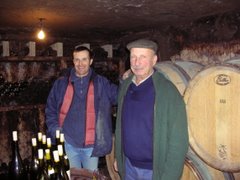
We arrived and were greeted by the very friendly and genuine Sarah McCrea, and her mother Willinda, who said hello and went back to work in the office.

Stony Hill Winery was created when Fred and Eleanor McCrea bought this land in 1943. They planted Chardonnay grapes in 1947 and offered their first wines to friends in 1952. The vines are a lot older now, younger McCreas run the place, there is some new equipment and the barrels turn over, but not a whole lot else has changed. Obviously this in itself says nothing about the quality of Stony Hill wine, but it happens that Fred and Eleanor got it right in the first place. The vineyard plots are mostly exposed to the east, and are on hills with natural springs running underneath - this is how they avoid having to irrigate in the intense heat and dry Napa summers. They ferment and age their Chardonnay in old neutral wood, preferring to highlight the natural aromas and flavors of their grapes, and they avoid malolactic fermentation, preserving the intensity of the acidity in their grapes. People who know about Stony Hill have for decades prized their Chardonnay for its purity and grace, its unadorned intensity and complexity, and have appreciated its ability to improve with time in the cellar.

Sarah took us to see the vineyards and the barrel room, and Milo the Stony Hill springer spaniel accompanied us on our walk.

As we walked from the offices, it was immediate and apparent how far away I felt from the tourist road, how bucolic the scene was.

We walked past a plot of Chardonnay vines and saw beyond that another plot of old Riesling vines.

I looked back at the offices and tasting room and thought, "I could live here."

The old vines were vaguely anthropomorphic in appearance.

They seemed so sturdy and weathered, such beasts compared to the delicate grapes they would give forth, to my untrained but highly opinionated eye.

I looked closely at a Riesling vine and saw that budding had actually begun - early this year, Sarah said.

We reached the barrel room and press. Stony Hill is famous for Chardonnay and produces about 3,000 cases in a typical vintage. There is also a Riesling, a Gewurztraminer, a Semillon sweet wine, and now a Cabernet Sauvignon - first commercial vintage is 2009. There's not a lot of wine, and unbelievably to me, Sarah says they still sell the majority via their mailing list. I guess that makes sense, actually. Why give money to a middleman if people are willing to buy direct?
  

Inside the barrel room we sampled the new Chardonnay vintage, the 2012. Sarah said it was a great year for Stony Hill, as opposed to 2011, which was very hard for everyone in the Napa Valley. 2012 produced balanced wines that show the typical Stony Hill intensity and purity, she said. If the barrel sample I tasted is representative, I wholeheartedly agree. The wine was fragrant and intense with fruit and rock and left a lingering spicy and almost grassy taste after swallowing.

I have been drinking Stony Hill wines, when I can find them, for a few years now. I love the Chardonnay because it is delicious and unadorned and it seems to me that it expresses the greatest aspects of Napa Valley terroir. It is rich and intense - this is a hot place. But it is also acidic and finessed - Stony Hill vineyards are 600 feet above the valley floor. I asked Sarah why her family chose to plant Chardonnay instead of Cabernet, the more popular grape.

"At the time we first planted Stony Hill, no one had really given much thought to where certain grapes should be planted," Sarah's father wrote in an email. "My father just planted what he liked, which was Chardonnay, and three other varieties that U.C. Davis suggested - Pinot Blanc, White Riesling (then known as Johannesburg Riesling), and Gewurztraminer. It turned out that because of the eastern exposure the property was ideally suited for growing white grapes. By the time we needed to replant the vineyard, we had already become quite famous for our white wines, so changing to reds didn't make much sense. It is worth noting that our new Cabernet comes from a relatively new vineyard that has a western exposure that is more suitable for growing red grapes."

We walked a different path back to the tasting room and again I marveled at the scenery - we were way up in the hills here. Does wine made here, in this style, resemble the more industrial wines made on the valley floor?

If you visit Stony Hill you will not taste old vintages, it's not that kind of place. You will taste whatever is current, whatever they still have in stock. And as fun as it is to taste the wines, the viscerally moving aspect of the visit is walking the vineyards with Sarah, Milo, and whoever you came with, experiencing this place high in the hills.

But taste you will, and we did this in a lovely outdoor garden in back of the office area. A happy little pig watched over us from the side of the office.

We tasted 2010 Chardonnay (utterly delicious - the best of the recent Stony Hill vintages I've tasted), 2011 White Riesling, 2009 Cabernet Sauvignon (restrained and expressive, very impressive!), and the 2010 Semillon sweet wine.

As we sipped and talked, we looked out onto a plot of Syrah, relatively young, planted in 1998. This is sold only to wine club members, along with another rarity - a rosé of Cabernet Sauvignon. I've often thought that Syrah and other Rhône grapes should do very well in the intense heat of the Napa Valley - I bet that Stony Hill's Syrah is excellent and I hope to taste it one day.

Tasting these wines I could feel how different they are from the typical Napa wine. These are made to showcase the juice from the grapes grown on their hillside vines, and the soils they come from. Nothing more, nothing less. Now that I've seen the gorgeous setting where these wines are grown and made, I feel like I have a richer understanding of why these wines smell and taste the way they do.  And the prices are quite reasonable - current release Chardonnay shouldn't cost more than $45. I think of Stony Hill Chardonnay as the best wine, dollar for dollar, that's made in the US, but take that with a grain of salt, as I have less experience with California wine than some who are better qualified to make such a statement.

If you haven't tasted a Stony Hill wine, you should. It may change your mind about what the Napa Valley is capable of.

Wednesday, May 21, 2008

Deetrane Invades Long Island's North Fork

My good friends Deetrane and his wife P-trane just celebrated their 5th wedding anniversary with a weekend in the North Fork of Long Island. Dee and P were happily surprised at how much they liked the wines. Deetrane still says to me each time I see him now "Do you realize that this is our own BACKYARD?!?" I'm pretty sure that he wants to go back. I know that he came home with at least two cases of wine. Anyway, the following is a bit about the weekend from Deetrane himself. He's a vastly entertaining fellow - don't hesitate to check out his older guest posts.

It's been a while since my last post, and the Brooklynguy has been hounding me to pound one out, so here I am. No, I'm sorry, I don't have any tales to tell about Russian wine-gangsters or the Schlitz-shchlurping NYPD vice squad. Rather, I have a lovely story to tell about an eye-opening visit to… The North Fork of Long Island.

For our 5th anniversary weekend, P-trane and I arrived by car from NYC and following Lenn's suggestion, checked into the Harvest Inn B&B in Peconic. It's a sprawling, 5 year-old replica of a big old farmhouse with wide plank pine floors, super high ceilings and lots of fireplaces. The owners, Darolyn and Chris, welcomed us with gusto and a chilled bottle of chardonnay.

Overall, I was astounded at the consistency and quality of the wines we tasted, which were those of The Lenz, Paumanok, Pellegrini, Peconic Bay and Borghese. These wines have a determinedly old-world feel, in which fruit plays heavily but not excessively, alcohol levels are on the low side (12-13%), and words like integration, balance and harmony come to mind. Given my partiality for Northern Italian, Spanish and Burgundy wines, I felt like I was being reunited with a long-lost relative. There was a certain familiarity combined with fascination of the new.

The high point of the weekend was a vigorous personal tour of the vineyards and winery at Peconic Bay by wine maker Greg Gove. Never has anyone – except maybe Maria de López de Heredia – been so generous and enthusiastic about delving so deeply into their craft with a complete stranger. The low point, such as it was, was probably the wine tasting on Saturday evening at the Harvest Inn. Owner and chef Chris, who just that morning had been a total teddy bear serving his delicious apple-cinnamon pancakes, became an utter tyrant while pouring a fabulous 2002 Peconic Bay Cabernet Sauvignon and an equally impressive 2005 Reisling. Imagine you are back in 4th grade gym class, and the teacher is warning you that you will be ejected from the class if you dribble that basketball before he is done lecturing on the physics of a jump shot. And you're thinking, "geez, I just wanna play ball." We were instructed not only when to drink, but how to swirl, how to hold the class, and what to think about while swallowing. Notwithstanding, the wine was superb and made us that much more excited for our private tour the following day.

We made culinary stops at The North Fork Table and Inn, and Jedediah Hawkins' Inn , which seem to occupy the top two restaurant slots by reputation. Both were memorable for their fresh, local ingredients, but despite raves from the press, locals, and our fellow guests at the inn, the only truly distinctive aspect of meals at those places was the honey-tasting we had for dessert at Jed's, consisting of four markedly different local honeys.

In fact, the best meal I had was at The Vine, a wine bar in Greenport run by investment banker turned sommelier Joe Watson. Either he was a really terrible banker or a really great one, both of which could explain his apparent retirement at the age of 32. I suspect it was the latter. The first thing I saw on the ample wines-by-the-glass list was a 1988 López de Heredia Vina Tondonia, which I instantly ordered for $20 because of the nostalgic pull from my honeymoon trip, previously described here in my last guest post. Imagine my shock and embarrassment when Joe revealed that he, too, had also gotten the tapas treatment by Maria when he was in Rioja! At least Joe didn't get to raid the library with the gnarly moldy vine-rope.

Sunday, March 23, 2008

Bridge Urban Winery & Tasting Room

There is a winery located in Brooklyn. No kidding, there really is. They don't grow the grapes here, which I have to think is a good thing. They don't actually make the wine here either - they do that at a contract wine making facility in Mattituck, Long Island. But Bridge Urban Winery does have barrels and a steel tank and plans to make small lots of wine at their Brooklyn facility beginning in 2008.

Right now Bridge Winery is more of a wine bar, and it's a very good one. Owners Greg Sandor and Paul Wegimont have been in the Long Island wine world for some time now, and they've selected their favorites from the various New York wine regions to feature at the bar. In fact, it's only New York wine at this place. And since they're licensed as a winery, they can both serve wine and sell it retail. So you can pick up a bottle to bring home if you like what you taste.

Is it a stretch to serve only New York State wines at a wine bar? Definitely not. No one would say that these wines are all better than their counterparts from other places in the world. But they are interesting and well selected wines, and they're local. And a few of them are excellent by any standard. The wine geek will enjoy a visit to Bridge, and so will a couple on a date, or a group of friends out for the evening, whether or not they are wine people. It's just a nice place - plain and simple. I would happily take the BrooklynLady there on a date.

You can choose from at least 15 wines by the glass, and the most expensive will run you about $6. That's right - $6 gets you a glass of sparkling wine by The Lenz or Wolffer or Wiemer, amongst the finest examples of New York sparkling wine. Or a glass of 2001 Old Vines Cabernet or Merlot, also by The Lenz. And those are the most expensive glasses. More fun, I think, is to get a flight of wines, three tastes for about $12. Not tiny little tastes either, but generous pours (4 oz, I think). There are many things to order if you feel like grazing while drinking your wine, from cheese plates (local) to charcuterie (imported from Italy) to panini.

I stopped by early on a Thursday afternoon and Greg and Paul were almost done tasting a lineup of Peconic Bay wines with wine maker Greg Gove. I horned in on that action, and I have to tell you - the 2001 Merlot (a blend really, including 25% Cabernet Sauvignon) was just delicious and interesting and completely graceful. Not sure which wines Greg and Paul eventually decided were right for Bridge's tasting room, but I hope that's one of them.

After that I was treated to a tasting of Bridge Vineyards wines. My favorite was the 2002 Cabernet Sauvignon, $19, with a great nose of slightly pruney cassis and loads of bright red currents. And since we're talking about Long Island, not California - this is 13% alcohol.

I really like this place - it's modern and it's got a great vibe, in a completely romantic setting a block away from the river in the shadows of the Williamsburg Bridge. And I like the owners Greg and Paul. They are passionate about local wine and food, but they're not dogmatic or preachy. They want you to enjoy yourself, and if you're interested, to learn something. If you live in NYC or if you're visiting and you're into wine, go hang out at Bridge for an evening - it's a sure thing, people.

Bridge Urban Winery & Tasting Room
20 Broadway
Williamsburg, Brooklyn
718-384-2800

Thursday, November 29, 2007

Deetrane Deep Down in the Cellars of López de Heredia

When my pal Deetrane read the post from the other day about tasting the 1976 Lopez de Heredia Bosconia, he was flooded with good memories. Deetrane and his wife P-trane went to Spain for their honeymoon and visited several wineries. He says that the single best experience they had was their unplanned visit to López de Heredia. So sit back and enjoy as guest-poster Deetrane takes us on a trip down the twisted pathways of his memory lane:

P-trane and I are on the first winery tours of our honeymoon, after several days and nights wending our way from bistro to parador to cava bar across Catalonia and Aragon, before settling into a lovely old convent-cum-hotel in the medieval center of Haro, Rioja’s wine capital.

First up – Bodegas Muga, of course – the only Rioja wine we knew by name up to that point, and one of the largest “premium” Rioja exporters. A quality winery by any standard, and a very detailed, interesting, competent, FREE English-language tour (an intensive primer, in fact, in all things Rioja). But despite it being our first winery visit, we still sensed we were at the Rioja equivalent of the Epcot Center. Authentic no doubt, yet just a little too polished, and few dozen too many Euro-coaches in the parking lot.

Great prices in the shop though. €2.50 for Crianza, €5.50 for Reserva, €8.50 for Prada Eneo (Gran Reserva), €12.00 for Torre Muga! We bought three bottles.

Right next door, the venerable La Rioja Alta. Three Euro-coaches in the parking lot, versus Muga’s fifty. A very good sign. No English signage, much less an English-language tour. An even better sign. As the Spanish-speaking tour guide describes the traditional steps such as fining with egg-whites, we nod sagely (if uncomprehendingly) having just seen all the same stuff at Muga five minutes earlier. But a real, working cooperage, as opposed to Muga’s costumed-mannequin diorama (think Museum of Natural History, or better yet, that crazy robotic contraption in the basement of the Mormon Tabernacle). Even better prices in the shop, with wines from across the parent company’s brands.

A year or so later we opened the 1994 La Rioja Alta Rioja Gran Reserva 890 we purchased there for under €10.00. A revelation – the first time I had tasted a perfectly integrated, balanced, aged red wine of any kind. It was the most memorable, sumptuous and absorbing wine I had tasted in my life, notwithstanding what came next.

Three tour buses were still too many for what P-trane and I were I the mood for. We started to stroll through the streets of the old, mostly low-slung, very urban warehouse style winery district of Haro. We became fascinated by the numerous small patches of old, gnarly Tempranillo vines, planted right between the endless brick, stucco and concrete winery buildings.

We’d gone not more than 20 yards from La Rioja Alta when we heard loud banging shop noises coming from behind set of huge oak doors across the street. We ambled towards the noise into a courtyard, saw that the doors were ajar, and walked in on two coopers in overalls. They were busily banging wrought iron rings, American and French oak planks into barrels and toasting them over open flames that were shooting up from perfectly round, manhole-like openings in the floor. The coopers were friendly, and waved us closer.

Within minutes, a door opened and a short, very mod, thirty-something woman with chic rectangular glasses and a spiky short haircut came in with two fair-skinned, forty-something men (there she is in the picture, courtesy of Alice Feiring). Without prompting, she flashed us a sympathetic glance and said, in perfect English, “I’m Maria de López de Heredia. These guys are economists from the University of Barcelona – friends of my father’s. Let me just ask them if they mind you coming with us.”

We held our breath. No, they wouldn’t mind, came back the answer!

Oh boy!

The next minute we were descending through a metal casement door heading directly underneath the sprawling winery complex, down down down over tiny uneven steps, lower and lower in the bowels of López de Heredia. The walls literally turned black and fuzzy with penicillin mold. Maria gesticulated and pointed and jabbered in Spanish, pausing to translate what seemed like every 14th word.

Who needed translation?

It was…. Insane. With no natural light, a faint bulb here and there was all there was to illuminate row upon row of barrels, a seemingly boundless catacomb of vaulted corridors. On the floor were smooth metal rails, just slightly protruding above slippery cobblestones. After a while we could see faint sparkling lights in the distance. We came upon several cellar workers who were bottling a 1995 Gran Reserva. It was now May of 2003, mind you. This wine was being bottled after some two years in large wooden casks and another five years in barrel. The workers wore hardhats with sputtering sodium lamps, like spelunkers, and thick, black rubber gloves and aprons and reminded me of the Mario Brothers and undertakers at the same time.

One of them was arranging empty green bottles on a small wheeled metal tray sitting on the rails built into the floor. The other was filling the bottles one at time with a little swiveling spigot. As each tray of 12 bottles filled up, they would roll it a few feet to the third guy, who would pick the bottle up and position it in a corking device and pull down on a lever. Each time, he would be liberally squirted with wine – hence the heavy rubber gear. Each guy had a glass of wine standing around the work area, the flicker of the headlamps just enough to see that the Gran Reserva was a crystal clear ruby color. It was 10:15 a.m.

A few minutes latter, we saw bright movie-set lighting further down one of the corridors, this one racked with endless rows of bottled wine. A photo shoot was in progress, and the crew was standing amidst hundreds of bottles on the floor in between the racks, like giants in a sea of penguins.

“Oh, that’s So-and-So,” Maria casually tossed out, “He’s, like, the most famous television director in Spain, but we’re old friends so he’s doing my new brochure pictures today.”

We come to a gigantic, rolling oak door, at least 12 feet high. After several tense (for us) minutes futzing with keys and jostling the padlock, Maria hauls aside this hulking door an we are met with an amazing site. In the center of what can only be described as a dungeon room is a massive round table made from the lid of a giant oak fermenting tank. Standing upright in the middle of that, sort of as a centerpiece, is an old, dried out vine trunk. About six feet above that, a dangling brass chandelier. Over decades, a thick, black rope of pure penicillin mold has climbed down from the ceiling, wrapped itself around the chandelier, and continued on its way to envelope the centerpiece. (Photos courtesy of Crush). All around us are huge concrete bins, with the remaining stocks of winery owned vintages, going all the way back to the beginning (1877). The oldest vintages are mostly piles of mold, dust, broken glass and empty bottles, but Maria assures us there’s still probably some good stuff in there – but no one has the guts to go in and find out!

López de Heredia makes wines from several vineyards, although their most heralded wines come from two vineyards - Tondonia and Bosconia. Bosconia makes only red Rioja, and is pure Tempranillo. The Burgundy-shaped bottle hints at the style of the wine. Tondonia makes white and red, and is a blended wine. The Bordeaux-shaped bottle hints at the style.

Maria turns on the lights and we see platters of Serrano ham, and fresh bread, and… wine glasses! Woo hoo! We tasted flight after flight, starting with some very old Tondonia’s This is WHITE wine, mind you. The oldest we tasted may have been a 1955, followed by a 1961, a 1968, and a 1970. Then we tasted a bunch of old Bosconia, the oldest being a 1954 or so. P-trane and I had never tasted wine this mature or this traditionally made. I can’t really describe it, but needless to say it was around this time that I started drinking a lot more wine, generally!

The economists turn to leave, and Maria tells us to stay put while she escorts them out. P and I are now ALONE in the López de Heredia library. Do I go in search of an intact bottle of 1895 gran reserva? Hmmm, the 1914 stack is looking like a better bet. She’s back, with the television director and his crew in tow. Partay! After doing both white and red flights a second time, with the film director and co., Maria announces that its time to head into town for Tapas. “Do you want to come?” Do we want to come? DO WE WANT TO COME???!???!!!??

We leave our car in the Muga parking lot and hop into Maria’s beat up rat-trap Volkswagen and head to one of her regular bistro’s in the center of Haro near the Plaza Mayor.

Maria orders basically the entire menu over the next three hours, as well as three or four bottles of López de Heredia from the surprisingly ample list at this very casual joint. At this point, bottles of 1988 and 1991 are comparatively blasé.

By about three o’clock, everyone is pissed drunk, Maria has now been translating, drinking and gesticulating for five hours, and it is time to, gulp, drive back to the winery and get our car. We all kissed on both cheeks and said our goodbyes, thanking Maria and television director and the Good Lord for this incredible day. Every year, when we get our Christmas card from Maria, we think about the next time we’ll taste a 1955 Vina Bosconia.

I encourage everyone to visit them. When we were there, there was no organized visiting or tasting at the winery. Maria, who is apparently now the CEO (she had been the head of Marketing) commissioned an ultra-modern tasting building by architect Zaha Hadid, described on Wikipedia as a “notable Iraqi-British
deconstructivist architect.” Yowza.

Sunday, December 10, 2006

Tasting at Domaine Paul Pernot

The Domaine Paul Pernot was the largest producer we visited, although Pernot is middle sized by Burgundy standards. I have been looking through pages of search results and I cannot find anything informative about this producer to share with you, so I will do the best I can on my own.

I first tasted a Pernot wine a little over a year ago and it was a 2003 Bourgogne red wine. I was not terribly impressed and I didn't seek more of the wines. Who knows...maybe I just needed more experience with Burgundy, or maybe 2003 Bourgogne is just not going to be that impressive in general. But I have a true appreciation for Pernot wines now.

First of all, the wines show real balance and purity. They are not blockbusters (I cannot talk about the two Grand Crus as I have never tasted them), but are somewhat austere and subtle. I found that the aromas in the young wines were quite reserved, but that might be because there is not as much new oak used in most cuvees as other producers use. The aromas of the grape take a little whie to reveal themselves. Secondly, this is a producer whose 1er Cru wines will not destroy your wallet. The 2005 Puligny-Montrachet1er Cru les Folatieres retails for about $40, and its really good!

It was raining quite hard when we arrived in the beautiful village of Puligny-Montrachet. We ran up to the cellar door and knocked, holding our coats over our heads. After a few moments the door opened and a small gray haired man welcomed us inside. Paul Pernot is a caricature of a winemaker. Small but quite stout, completely gray and into his 70s, he wore a pageboy cap, a rumpled apron over his canvas workpants and shirt, and an old blue cardigan sweater to protect against the cellar's chill. BrooklynLady is convinced that the Institute des Vignerons in Beaune issues this outfit to all winemakers when giving out licenses.

We went to a corner of the cellar used for tasting, a dimly lit area with a barrel for a table, several glasses and unlabeled wine bottles waiting to be opened. There were a few notable empty bottles on a shelf above the door: a 1945 Cos D'Estournel among them. As he began to uncork bottles, I noticed that his hands were huge and scratched up - he looked as if he had just finished throttling a horse.

He began a somewhat combative conversation with Jeanne Marie, asking her if she was discounting his wine, and she was promising that it was not her. Pernot sells wine to a few exporters, including Dressner and Jeanne Marie de Champs, and he was upset because he heard that someone was selling them too cheaply. This conversation persisted for the duration of our tasting so BrooklynLady and I contented ourselves with tasting on our own. Here are a few notes:

Whites:

2005 Bourgogne. Straightforward and pleasing, some citrus smells. Nice medium bodied texture, hints of vanilla and stone fruits. More elegant than the other 2005 Bourgogne whites that I tasted.

2005 Puligny-Montrachet. Citrus and flowers on the nose, pretty tight in the mouth, but with some swishing about there are clean citrus and white fruit flavors, and a definite mineral sense too, like wet stones.

2005 Puligny-Montrachet 1er Cru les Folatieres. Smells were hard to make out, although the nose was very pretty. Just a bit jumbled. Some lemon balm, a touch of honey? Tightly coiled and pure flavors of cirtus and white flowers, a little toastiness to it, and a piercing finish, as if the flavors were ready to uncoil after spitting the wine (yes, we learned to spit in Burgundy). I think this wine is a great value, and if I can find it in NYC I will buy a few bottles for cellaring.

Reds:

2005 Beaune Clos de dessus les Marconnets. Austere smells of raspberries and stems, still quite tannic, in the mouth too. Too early to tell what's going on with this wine, although it was light on its feet and pwerful too - seems to have potential.

2001 Beaune Clos de dessus les Marconnets. WOW! We both loved this wine. Drinking perfectly right now, lovely perfume of dark flowers, red fruits, and earth. Silky texture, all velvet in the mouth. Light feeling, but pure and piercing flavors of red and black cherries with a perfumey and earthy backbone. Just lovely - I would pour this for any Burgundy lover. And if I can find it I will grab a few bottles for drinking over the next few months.

Thursday, December 07, 2006

Burgundy Trip Continued: Domaine Jean-Philippe Fichet

David Lillie at Chamber Street Wines put us in touch with Jeanne Marie de Champs, an exporter who represents about 60 Burgundian grape growers. She got us tickets to the Hospices de Beaune auction, and she made appointments for us to visit a few of her growers, and we didn't discuss our tastes before she made the appointments.

You know how when a friend is at your house and they pick out music from your CD book, they tend to pick something that you don't listen to very often, and it is usually a pleasant surprise? For some reason, it didn't occur to me that our appointments might be with producers who focus on making white wine - BrooklynLady and I are Pinot lovers, and are basically ignorant about Burgundy whites. When we learned that we would be visiting Domaines famous for white wine, we were excited. We would probably have focused entirely on Pinot Noir if left to our own devices.

We drove with Jeanne Marie to Meursault on a Tuesday morning to visit Domaine Fichet. I forgot to bring the camera, which explains why I cannot post photos of the lovely buildings in the village. Jean-Philippe Fichet's house was quite large, and the winery even more so. We walked into an absolutely spotless room that receives the picked grapes, with a circular drain in the middle of the floor. The 2006 grapes were apparently pressed there only weeks ago, but you could never tell - it was clean like a hospital room. We walked through a cellar where the 2006 wines were adjusting to new life in barrels, and into a larger cellar with both barrels and big red steel tanks.

We tasted 9 wines and I just couldn't keep tasting notes if I was going to fully enjoy the experience. I will instead share some of what I learned from this tasting. Here are the wines, tasted in this order:

2005 Aligote
2005 Bourgogne
2005 Bourgogne Vieille Vignes
2005 Haut Cotes de Beaune
2005 Auxey Duresses
2005 Meursault
2005 Meursault Les Meix
2005 Meursault Les Chevalieres
2005 Meursault Les Tessons

The Aligote was, as Jeanne Marie only half jokingly said "to get your mouth rid of coffee or whatever you had before you taste the wine." I'm not so sure that the winemaker appreciated that comment. The most obvious thing I learned in this tasting was the way that the wines increased in complexity, and what complexity actually means, to my thinking.

Some of the characteristics of Chardonnay from Burgundy; freshness and vibrancy of fruit, specific fruit flavors, the nature of the acids (structurally, and in flavor - lemony, apple peel), vanilla and other oaky flavors, minerality, texture...all of these characteristics were present to some degree in each wine. And I believe that I could have opened any one of the wines on its own and enjoyed it, smelling and tasting some of those characteristics. But tasting them in succession allowed me to understand what I think is meant by "complexity," the way that the characteristics harmonize with each other yet are still individually identifiable in a complex wine. Wines that are not as complex featured instead one or two of the characteristics prominently, and the others were not accessible.

The Meursault wines were much more focused in their flavors. The Auxey Duresses, for example, was very tasty, but in a flabby way. Compared to the Meursault Les Chevalieres, it was fat sweet fruit all over the place. The Chevalieres had clear lines of lemony acidity, a clear backbone of minerality, and young and tightly wound but delicious fruit with a nutty character.

The Meursault wines were lighter than the others in texture and color, but they packed much more power. And within the Meursaults, Les Chevalieres and Les Tessons had more grip and potential energy than the Village Meursault. They clearly had a lot of developing to do, while the Mersault was more approachable now, its flowers, lemons, nuts, and stones already on display.

This was for both of us the most profound tasting experience with white Burgundy and Chardonnay in general up until this point. We followed this with visits to Domaine Paul Pernot and Maison Olivier Leflaive, and I will describe those soon.

Monday, December 04, 2006

A Great Tasting at Moillard Grivot

After a morning enjoying excellent wine in upstart Pernand Vergelesses, we decided that it was time for the classics, something monumental, something from Cotes de Nuits. As we had no appointment (foolish, I know, but we had appointments at several Domaines over the next few days), we decided to visit Moillard Grivot. I am not usually drawn to large negociant houses, but I read through Nikolai Vogel & Kilian Fitzpatrick's lovingly written descriptions of their Burgundy tasting trips. They recommend Moillard Grivot as a great place to taste wines from various villages and to compare, to learn something about the terroir. And you don't need an appointment.

The Moillard Grivot house in Nuits St Georges was right on the main road with easy parking. The house was literally the tip of the iceberg. When you walk in you can go downstairs to a monumental cellar and walk through aisles upon aisles of barrels and bottles. Like an airplane hangar - HUGE. And a sign said that only 10% of their wine is cellared in that facility.

After our cellar tour we entered the well-lit tasting room, decorated with maps, racks of wine bottles, and what looked like water fountains at the dentist's office, but were in fact modern spittoons. The guy behind the counter gave us rather large glasses (nice - a lot of our tasting was done with too-small glasses) and left us alone with 5 open bottles. We poured, swirled, sniffed, and tasted as we pleased. We probably could have had lunch delivered to enjoy with the wine and they might not have minded.

The Thomas family owns Moillard Grivot now and some wines are bottled under that label. I am reporting prices in Euro because the dollar's value is changing lately. I have no idea for how long these bottles were opened, by the way. Our tasting notes:

2005 Moillard Grivot Meursault 1er Cru Charmes, E29. Great nose of lemons and honey. More reserved in the mouth, with some banana and citrus, some minerality. Well balanced, young. I really liked this wine.

2002 Domaine Charles Thomas Nuits St Georges, (price info lost). Pretty nose of flowers and earth - including a smell that I don't know how to name, but that I have experienced only with better reds from Burgundy. Bright red fruit, but young and tannic, a bit thin in texture. I wonder if the palate will flesh out with age...

1999 Moillard Grivot Nuits St Georges, E24. An earthier, almost musty smell. Not revealing much fruit in the nose. Sappy sweet cooked red fruits in the mouth balanced by a pleasant bitterness at the finish. I did not like this wine upon first tasting it, but the more I smelled it and after a few more sips, the more drinkable and balanced, delicious in fact, I found it to be. BrooklynLady simply disagreed with me - she did not like this wine, found it to be past its prime and cooked.

2002 Moillard Grivot Moray St Denis 1er Cru Les Monts Luisants, E19. Fresh flowers and perfume, with cherries and earth on the nose. Tastes of sweet red fruit, with good balance of cranberry like acidity. Earthy undertones, this wine is complex and beautiful. And for E19/$25?!? I have to get some of this home somehow. Its drinking so well now, seems so well balanced that I wonder if it will improve with age...

2004 Domaine Charles Thomas Bonnes Mares, E67. Darker than the others with completely different aromatics, featuring cinnamon and some wet cement, with dark black cherries. Flavors are sweet and spicy with red and black fruits present, and earthy pine sap. Lots of tight tannins remind you how young the wine is, how much the flavors and aromas will develop over time. Okay, so I get it now. There is something to this Grand Cru business. Tasted alongside the more mature wines of lesser designation, this wine was an absolute powerhouse.

When we were done tasting we were surprised to learn that there was no charge - the tasting was free. I recommend stopping at Moillard Grivot to anyone who will be in Burgundy for more than a day or two. Such a pleasant environment, and such a great way to learn about wines of the Cotes de Nuits, tasting them at your leisure, side by side.

Friday, December 01, 2006

Pernand Vergelesses and Domaine Pierre Maray et Fils

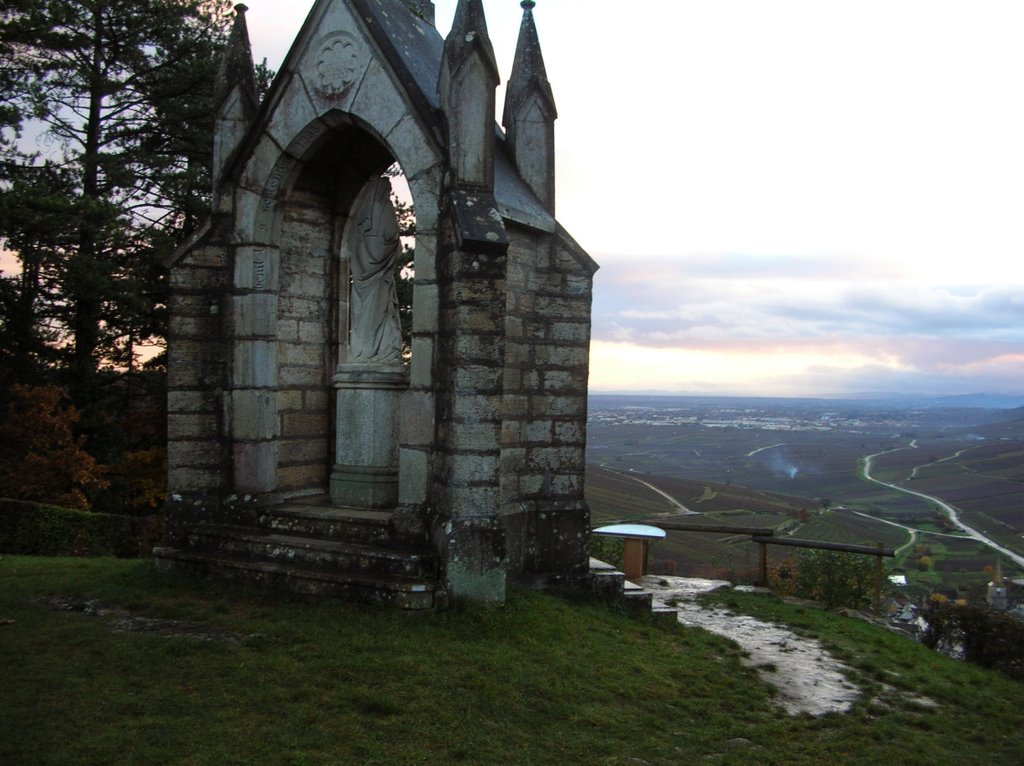
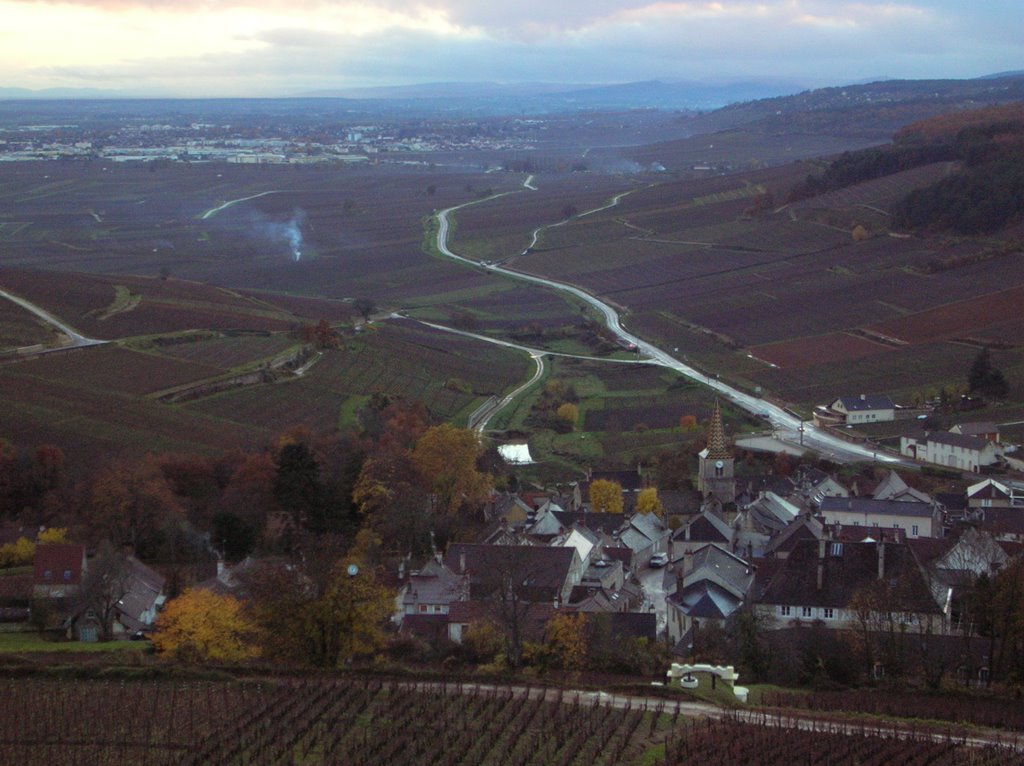
The next morning we drove back to the village, even more lovely in the daylight, and up the hill through the narrow streets past picturesque houses and several Domaines and tasting rooms. Before doing any tasting we drove past town, even further up the hill, and to a point advertised as "Panorama," a site at the very top of the hill overlooking the whole valley. Still morning, this was shrouded in fog, and it was far too scary to even get out of the car. We returned in the evening though, and on the left you can see the view (with monument).

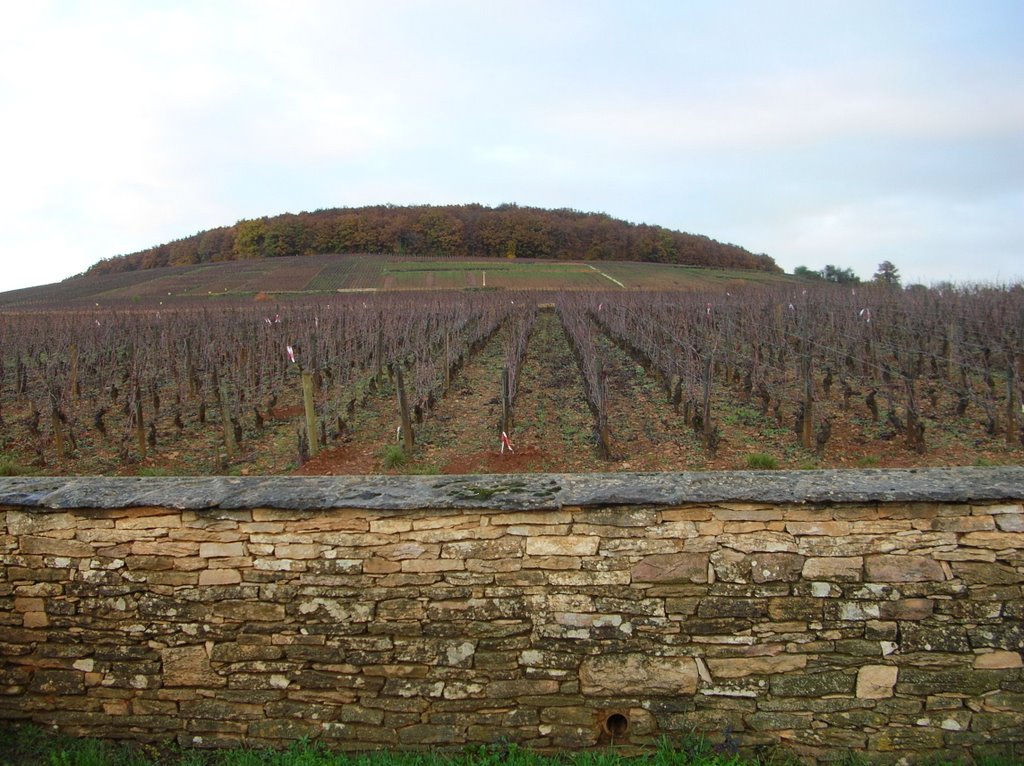
Neither of us knew much about the producers or the wines of Pernand Vergelesses (view of part of the Grand Cru Corton Charlemagne vineyard on the left), so we decided to go to the Domaine Pierre Maray et Fils - why not right? Last night's wine sure was good. Let's see what else they have to offer. They do not have a website and the wines are not available in the US, but here are (another one from the Panorama on the right) some tasting notes, and Pierre's son (Eric, if I remember correctly) believes in tasting red wines first -he says that the whites are easier to taste so they should come last. At least that's what I think he said, but he spoke no English and my French is dodgy at best:

Reds

2004 Pernand Vergelesses, $11. Straight forward smells of red fruit, simple and enjoyable wine. A bit tannic - might be better chilled.

2003 Pernand Vergelesses Les Belles Filles, $13. Surprisingly dark in color, with fresh smells of violets and earth. Sweet and sappy dark fruit, but with a light feeling and a pretty floral finish. A great value at this price and drinking well right now, this is one of 3 bottles that I brought home from France.

2005 Pernand Vergelesses 1er Cru Les Fichots, $20. Lighter in color, with reserved red fruit smells and flavors. Way too young to really tell what's going on here, but the wine seems well balanced in that I can make out some fruit, some acidity, and some earthiness amid the green tannins.

2005 Corton Grand Cru, $40. Darker again, with rich musky smells. Some blackfruit on the palate, but too tightly coiled to tell what's going on. Seems promising based on the interesting animal smells.

Whites

2005 Pernand Vergelesses, $14. Some citrus on the nose, and some wood. Nice flavors of stone fruits and citrus and a rich texture without being heavy. (View of part of Corton Charlemagne Grand Cru vineyards below)

2005 Pernand Vergelesses 1er Cru Sous Fretille, $20. Stronger smells, citrus and some fruit. Good acidity and young ripe fruit, some fat on the sides of the tongue. Richer in texture, this seems like it will become an excellent wine.

2004 Pernand Vergelesses 1er Cru Sous Fretille, $20. Interesting to compare to the 05. A more expressive nose with some flowers and some fruit. Lighter mouthfeel with young but vibrant stone fruit flavors and clean acidity. Very impressive. A more delicate profile than the 05, but it had an extra year of development.
2005 Corton Charlemagne Grand Cru, $48. Very reserved nose, more stones than anything else. Some hints of bright fruit but very young and tight flavors. At this point I am probably too inexperienced with white Burgundy wines to have picked out the flavors of the young Corton Charlemagne. I improved over the next several days though.
If you are interested in trying to find wines from Pernand Vergelesses, any shop that carries a good Burgundy selection should have something. Problem is, it might be Grand Cru Corton Charlemagne, or something like that, and quite pricey. Village level wine from Pernand Vergelesses represents great value. Your best bet might be to look for the wines of Domaine Rapet Pere et Fils- reasonably priced and available.

Tuesday, November 28, 2006

Louise Perrin in Aloxe-Corton

We arrived in France at Charles de Gaulle airport on a red eye flight early on a Saturday morning and immediately headed for the Gare de Lyon to take the high speed train, called the TGV, to Dijon. This was almost two hours of half-asleep-trying-to-look-out-the-window-at-the-passing-countryside-but-too-tired-to-keep-your-eyes-open. After arriving in Dijon we walked a few blocks to Hertz, somewhat comically pronounced "airltz" in French. In that dazed state I drove my 6 and a half months pregnant wife and myself out of town towards Aloxe-Corton.

I felt as if I were dreaming as we passed through the towns of Moray St Denis, Gevrey Chembertin, Chambolle Musigny, Vosne Romanee, and Nuits St Georges...sometimes driving alongside famous vinyards like Clos Vougeot and Clos Marechale. I was a kid in a candy store.

BrooklynLady is great at researching hotels and restaurants, picking the best places for us to go and the yummiest places to eat. She selected the Hotel Villa-Louise for our stay in Burgundy, and it was perfect, really. I unconditionally and without hesitation recommend this hotel to anyone visiting Burgundy. The rooms were spotlessly clean, the beds comfortable, the rooms spacious, bright, and quiet, the surroundings lovely, and the staff friendly and helpful.

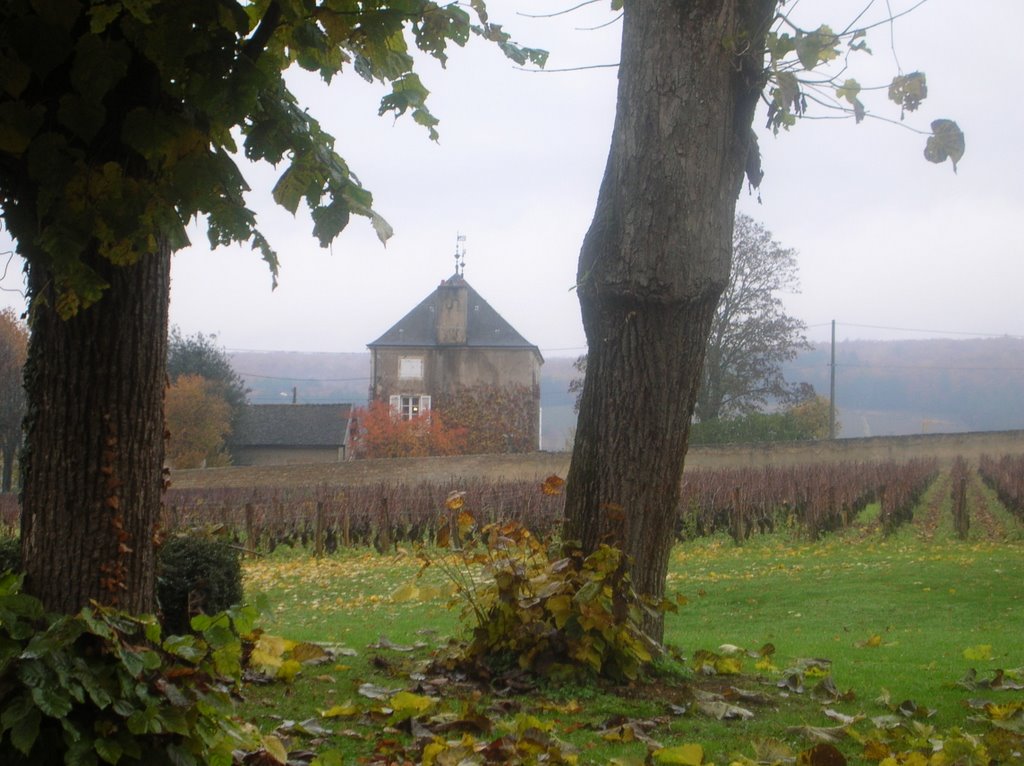
To my taste, the location is perfect also. Just a 10 minute drive from Beaune, the "largest" city in the immediate area, you can easily access restaurants and wineries in the Cotes de Beaune and the Cotes de Nuits. But staying at Villa Louise, you are in a tiny town with 2 quiet little streets, several shockingly lovely houses, vineyards everywhere, and the smell of wood buring in fireplaces wafting all around. Below: view of the Villa Louise garden and Corton vineyards from the backdoor of our room

BrooklynLady didn't even open her bags - the moment we we in our room she hit the bed to relax a bit. I was chomping at the bit though, and would have tasted through a vertical of Prestone antifreeze if that were all that was available. I made a beeline for the cave and tasted the wines. Veronique Perrin runs the Hotel Villa-Louise and she is the winemaker for the Louise Perrin portfolio. She is quite charming and clearly loves her work - she describes the wines with feeling. Her first year making the wines was 1986.
Aloxe-Corton is famous for the whie Grand Cru wines of Corton Charlemagne and the red Grand Crus of Corton. Parker says that Aloxe-Corton Premier Cru and Village wines usually offer good values because they are overlooked by consumers who clamor for the Grand Crus. The village sits in the hills just west off Route 74, the main road to use when driving around Burgundy. Pernand Vergelesses, Corey-Les-Beaunes, and Ladoix are right nearby, and many vignerons who make Aloxe-Corton wines also make wines from the nearby villages. Right: the narrow road leading through the houses of Aloxe-Corton.

I experienced the reds of Aloxe-Corton to be very powerful and structured wines, masculine in character, very tannic with lots of dark fruit. I read that with age, the better wines become silky and seductive. I tasted one 1991 Corton Grand Cru and it was all tobacco, still tannic, no finesse. Just not my style maybe.

Tasting notes follow (but are more brief than normal because I tasted through many wines somewhat quickly). Prices are conversions to dollars, but are clearly lower than if the wines were purchased outside of France.

Whites:

2004 Bourgogne, $9. Bright and pleasant flavors, well balanced. Good value.
2004 Pernand Vergelesses, $17. Richer, with a thicker mouthfeel. Smells of vanilla and maybe some banana.

Reds:
2005 Aloxe-Corton, $25. Green. Young and primary, but with nice smells of cherries. Palate isn't revealing much yet.
2004 Aloxe-Corton 1er Cru Les Vercots, $27. More complex and drinkable, but still reserved. Some earth on the palate.
2004 Corton Grand Cru Les Bressandes, $40. Opened for my tasting, and way too young to drink. Deep ruby colored, tightly wound smells and flavors, dark fruits, spicey and tannic. Some minerals on the finish. I couldn't really tell what was going on with this wine - too soon. Seems promising though.
1986 Cote de Beaune Village, $28. This wine was sitting on the counter already open, but I had to ask for a taste - I guess they figure people are not interested in wines of this "lower class," made from grapes from all over the place. Yet this wine was EXCELLENT. Rusty colored with smells of cooked fruit. Flavors of stewed cherries and caramel, with a light but mouth-filling texture. Veronique said this wine should not be held any longer, "it is your holiday wine," she said. She recommended pairing with strong cheeses.

This exerience hammered home the idea that wine can be beautiful if it is well made and aged properly, regardless of its classification. Sure, maybe that Grand Cru Les Bressandes, it aged properly for 20 years, would eclipse the 1986 cotes de Beaune Village, but for me the point was simply that for immediate drinking, the "lowest level" wine was by far the best. Right: view of Villa Louise and Chateau de Corton-Andre from the vineyards.

More to come...

Friday, October 06, 2006

Domaine du Closel Savennieres

Savennieres is one of the great Loire Valley appellations, producing amazing white wines made from the chenin blanc grape. The wines are usually dry with pronounced minerality, and when well made, offer beautiful stone fruit and honey flavors. Many wines made in Savennieres can improve for decades with cellaring. These are impressive and serious wines, and represent an amazing value when considered with wines of equal quality from Burgundy, for example.

There are several top notch producers of Savennieres, including Domaine du Baumard, Chateau d'Epire, and Nicolas Joly, proprietor of Clos de la Coulee de Serrant, one of only 3 vineyards in France to have status as its own appellation. My personal favorite Savennieres producer is Domaine du Closel. Their website explains their history, describes their vineyards and various cuvees, so I will not go into that here. I will instead describe my visit to the Domaine a year ago.

BrooklynLady and I were well into our Loire Valley trip at this point, and she was nearing the end of her well documented patience for wine traveling and tasting. We got in our tiny little rental Renault and drove from our guest house in Chinon (view out front door on the left), looking for the small village of Savonnieres. Did you notice that? I spelled it differently...because its a different village! After arriving in that village, which looked very industrial, and not at all like a place where grapes are lovingly grown and transformed into world class wine, I asked the friendly people at a car repair shop on the side of the road. They adopted the project of locating the wineries as if it was a quest to find their lost children, immediately broke out the laptop and we were off to the internet!

When we determined that BrooklynLady and I were looking, in fact, for another village entirely, much laughter ensued. Off on our way, with the wife's patience eroded to near danger levels. This all changed when we found Savennieres. A beautiful and quaint village with 2 streets and a little tabac (newstand, but usually offering coffee and even some booze to go along with your smoking and visiting and gossiping and newspapers). In the tabac I asked the guy behind the counter in my halting French if he knew Domaine du Closel.

He smiled and said "yes, I know her. She eez right 'ere, mah friend," and pointed to an older lady perusing the newpapers in the back of the store. He was pointing at Michele de Jessey, introduced to me as Madame de Jessey, the General Manager of the Domaine. She was absolutely charming, and asked if we could give her 15 minutes before visiting her so she could prepare to receive us properly. She suggested that we tour the little 18th century church in the center of town.

When we arrived at the Domaine, Madame de Jessey greeted us at the gate, and October being harvest time, a long low truck overflowing with green grapes passed us as the gate opened. "Would you lke to tour the vineyards before you taste the wines" she asked. Mais bien sur! "Our dog will guide you, just follow him to the vineyards." And yes, we walked behind what clearly is the most intelligent labrador retriever in the world down a little path, through a gate, up a hill, and into the Clos du Papillon (BrooklynLady with smart Lab in Clos du Papillon). There the dog waited for us, and then wehn we turned to leave he scampered out in front again and led us back to the path, but then around the Domaine, through the vegetable garden, and back to the tasting room near the front gate. I expected him to shake my hand and wish me "bon chance" before taking his leave.

We tasted several vintages of Les Caillardieres and of the the Clos du Papillon, the top cuvees of the Domaine. We also tasted the sweet wines that they make in hotter vintages, such as 2003. Everything was truly wonderful, and we were so charmed by our experience that we remain top fans of the Closel wines, keeping several bottles in the cellar as well as a few for current drinking.
The 2002s are just amazing, winning the NY Times Savennieres tasting a while back. These are beautiful wines, but sadly are mostly sold out now. I have a couple each of the 2002 Clos du Papillon and Les Caillardieres in the "cellar," and if I can be patient and well behaved enough, I willlet them sleep until my first child, due February 11, is well into his/her teens. The 2003 vintage, as in most of France, was very hot. There was no dry Clos du Papillon that year, only a sweet wine. Here are some notes on the recent wines:

2003 Domaine du Closel Les Caillardieres, $17.
Tasted back in March, 2006. We had it with savory parmesan chicken, sweet potato puree and salad. Initially all citrus on the nose, it blossomed over the next hour. Minerals, citrus, and quince, figs on the palate with a long finish.

2004 Domaine du Closel Les Caillardieres, $22.
Enjoyed with Deetrane, Pristine, and BrooklynLady over brunch of fried flounder, fried green tomatoes, and fresh corn. Pretty citrus and honey aromas, with some fresh grassy smells too. Definitely off-dry, with clean and acidic stone fruit, and rich figs, wrapped in light honey. Just delicious and very food friendly. It evolved in the glass, and probably could improve with 1-3 years of age.

2004 Domaine du Closel Clos du Papillon, $24
Although enjoyable now, this wine should probably spend some time in the cellar to allow the various flavors to uncoil and show themselves. Intense minerals, particularly on the finish. Very dry, some quinine and bees wax at first, herbal flavors and quine on the mid palate. A lighter body and less viscous texture than Les Caillardieres. Plenty of acidity keeps this wine refreshing, but you can tell that it needs some time. It might improve for 15-20 years, but will be more expressive in 3-5, I would guess.

Wednesday, September 27, 2006

Some New York Wines

In August my wife and I took a short trip to the North Fork of Long Island to explore and to taste some wine. We stayed at this cute hotel that is a re-modeled '50s motor inn, we took nice walks around Greenport, had an amazing lunch at Jedediah Hawkin's Inn, and we had some very good wine. In fact, we were genuinely surprised by how much we liked some of the wine. They really are trying to do their own thing out there, not making big fruit bomb wines, but instead making wine in a more elegant style. I read somewhere that the LI wine industry is going more for an old world European style of wine.

We especially liked the wines at Castello di Borghese, a Cutchogue winery owned by an Italian Prince and Princess (although they apparently put the winery up for sale). Their unoaked 2005 Estate Sauvignon Blanc was fresh and lively. We emerged from our tasting there with a few bottles of their 2002 Cabernet Franc Reserve and a 375 ml of a 2004 zippy desert wine made from late harvest chardonnay called Allegra.

We also enjoyed a visit to The Lenz. The 2004 Gewurtztraminer had wonderful aromas of litchi and other tropical fruits, but didn't have the palate to go with the scents. The 2004 Old Vine Chardonmnay was quite good, but it was the reds that really impressed me. The 2000 Estate Selection Merlot is an excellent Bordeaux-styled wine, with plummy and earthy aromas, a light texture, and lots of dark fruit on the palate. There's a persistant irony minerality there too. It could probably age a few more years and at 23 bucks a bottle, its a good value. Careful of the sediment though - each bottle we've opened has had a lot of it.

So now I know that Long Island makes serious wine...what about the rest of New York? I keep hearing about the finger lakes and their riesling. I don't know much about riesling. I've tasted maybe 10 in my life. But I am curious, so yesterday, wandering around with an hour to kill, I went into Vintage. Vintage is a wine store that sells only New York wines, and also some fancy foods. At their Soho location you can saddle up to the bar in back, and for merely 10 clams you can taste any 5 wines you like, regardless of the bottle price.

I treated myself to a little Finger Lakes tasting, beginning with 3 dry rieslings:

2005 Chateau Lafayette Reneau $16 - very light yellow with green smells of melons and flowers. Effervescent in texture with melons, citrus, and stones on the palate and a light citrusy finish. This is a fun wine, good for summer on the deck, but not memorable.

2005 Lamoreaux Landing $18 - light golden hue, very reserved nose. peaches and flowers with pronounced citrus through the long finish. Pleasant, but somehwat simple, and I wouldn't seek out this wine or choose it at a restaurant.

2005 Hermann J. Wiemer $25 - full yellow, floral nose with some lemon balm and rainwater. rich and pure flavors of lemons and apples with an intense floral finish - jasmin? violets? So I guess this is what all the fuss is about. It dances around in your mouth and makes me feel like when I was a kid at the Bloomingdales perfume counter - great smells and something adult happening all around me. I actually had a glass of this wine recently during dinner at the Tasting Room with the in-laws, and I really enjoyed it with my fried blowfish tails. I don't know if this is a good value because I don't have a riesling context yet, but I sure loved the wine, and I grabbed 2 bottles of it for the cellar.

Then, 2 off-dry rieslings also from the Finger Lakes:

2004 Chateau Lafayette Reneau Johannisberg Riesling $16 - almost white in color with rainwater, flowers, and lemon rind on the nose. Effervescent but thick mouthfeel - I could see the bubbles in the glass this time - with melon and stone fruit flavors and a lingering floral finish. Again, I like it, but it is not inspiring me to go out and go crazy on the riesling.

2005 Dr. Konstantin Frank $17 - I might be prejudiced against this producer. He sort of occupies a "McDonalds of the Finger Lakes" spot in my wine psyche. Why? I have no idea, other than his wines are popular. Unfair - yes, but what are you gonna do about it? White fruits on the restrained nose with citrus, green apple and grapefuity acidity. The finish is awkward with some pronounced sweetness but no clear fruit or honeyed flavors. Whatever, you're going to have to put in some serious time and bottles to get me to open up to Dr. McKonstantin.

All in all - New York wine = YES! I will continue to explore, and you should try some too.