Showing posts with label Alzinger. Show all posts

Sunday, June 30, 2013

Alzinger - a Dinner Featuring Wines from the 80's and 90's.

I've been told that most Austrian wine is consumed at home in Austria, and that most of this is consumed while still young. Whether or not this is true I do not know. But I've noticed that there is never any old Austrian wine included in the offers that flood our in-boxes selling great wines from back vintages. I almost never see back vintages on the shelves at good wine stores, and the only people I know who have old Austrian wines are serious collectors who have been following these wines for some time.

So, it is a rare opportunity to drink a mature Austrian wine. To drink a large sample in one evening, with friends and a lovely dinner - this is something that I've done on only one prior occasion. But Jamie Wolff, a partner at Chambers Street Wines, saved a number of bottles from a cellar that the store purchased back in 2007. There are many great wine producers in Austria, but Leo (and now also his son Leo) Alzinger is unquestionably one of the very finest. It is Alzinger wines from the 1980's and 1990's that Jamie held onto. He decided to invite some local Austrian wine lovers, who of course also brought along some great bottles, and to share everything over dinner at Trestle on Tenth.

Austria's Wachau wine region is rather warm in general and the wines, particularly the Smaragds, the wines made from the ripest and highest quality grapes, can be big and rich with alcohol that regularly hits 14%. Some of Austria's greatest producers, Hirtzberger for example make wines in that style, and they are great. Alzinger is known as a producer whose wines show less muscle. The wines come from some of the very finest vineyards in the Wachau, and thrive on their clarity and precision. In my rather limited experience with Austrian wine Alzinger is already a favorite (if not the favorite) and so I was more than a little bit excited to have the opportunity to drink these old wines on this night.

We drank 19 Alzinger wines and a few others too, and I will not try to share tasting notes with you. I will, however, share some thoughts:

---People like to say that Burgundy is a crap-shoot. The more wine I drink, the more I understand that this notion is utter malarkey. Or at least, that Burgundy in particular produces wines that do not provide the pleasure that is to be expected. If you sit down with 10 tightly grouped vintages of most of the world's great wines, some will deliver and other will disappoint. I think that's just part of the game.

--We drank 4 wines from the 1980's. One, the 1987 Riesling Kabinett Trocken Loibenberg, was corked. The other three were fantastic.

One was the 1985 Riesling Loiben (not sure what that means actually - maybe a blend of different vineyards in that village?). This wine was so satisfying and delicious. I loved its full, honeyed and mineral nose - so complex and harmonious, just gorgeous. The palate was all rock. Lovely, but not with the same sensuality as the nose. Still, this was quite the advertisement for cellaring Austrian Riesling.

Another was the 1989 Riesling Smaragd Loibenberg. This was even better, I thought, a more complete wine. The nose again was glorious - rich, honeyed, and very complex, and showing more finesse, more lightness and lift relative to the 1985. The palate was bone dry and intensely mineral, very expressive and long. This was a profound wine, and something to hope for in cellaring current Alzinger vintages.

--I learned a little bit about the differences between the various Wachau vineyards. We drank wines from Loibenberg, Hollerin, and Steinertal (and one wine from Hohereck). Hollerin seems to give wines whose overall impression is bigger in body and richness than either of Loibenberg or Steinertal. There is a striking and unadorned beauty of fruit in some of the Hollerin wines. Loibernberg seemed to achieve the same degree of richness and power but also a certain precision that is not part of the Hollerin package. The best Loibernberg wines, for me 1989 and 1995, achieved a gorgeous harmony between richness and delicacy. I don't even know what to say about Steinertal. It gave the finest wines, I thought. As good as some of the others were, the best Steinertals were just better.

--Vintages...1994 seems not to have held up well for the Alzinger wines. 2001 also - I found those wines to be oxidized and problematic (others liked them). 1999 was uclear - we drank Liebenberg and Steinertal Gruner Veltliner and if the Liebenberg was representative then it was not terribly successful. Steinertal was good but felt a little heavy and showed a bit of heat. Perhaps the warmer vintages are not the best ones at Alzinger? 1995 seems to be a great vintage for these wines. Vintage charts should probably not be treated as gospel when thinking about Alzinger wines.
--We drank these wines with a variety of dishes, many were hearty and pungent, including a whole roast pig. The wines more than held their own.

--Although there were some disappointing wines, those that were good were so good! This evening renewed my commitment to buy and cellar some of the great Austrian Rieslings each year.

Okay, a few tasting notes on wines that I liked:

1993 Alzinger Riesling Smaragd Hollerin - Fuller and richer on the nose than the 1993 Loibenberg. The fruit feels riper, heavier. But the wine is balanced and ultimately lovely and quite complex. The fruit here is beautiful.

1995 Alzinger Riesling Smaragd Hollerin - The most balanced and compelling of the Hollerin wines. Still shows that bigness, but also a more perfect sense of harmony. Wonderful wine and if there weren't 23 other wines on the table this would have been the superstar of any evening.

1994 Alzinger Gruner Veltliner Smaragd Steinertal - the best of the 1994 wines, I thought, with an intriguing nose of lemongrass and fresh herbs like tarragon and anise. The nose had a delicate side and required some attention. The palate was not as interesting, however, and showed a bit bigger and with less detail than I expected based on the nose. Still, a win worthy of the name.

1995 Alzinger Riesling Smaragd Steinertal - Gorgeous nose, airy, fresh, and harmonious. Such complex and precise detail too. I was smelling tomato plants (I've been doing some gardening lately and I recognized the smell), pungent and almost stinky floral tones, and vivid minerals. The acidity in this wine was so beautifully integrated, present everywhere but never jutting out. Beautiful wine.

1995 Alzinger Riesling Smaragd Loibenberg - Clear as a bell, perfect harmony of smoky minerals, ripe and lovely fruit, and something like green peas. Subtle and graceful for all of its power. The palate is mouth-filling and intense but not overdone, and yet in contrast with the delicate aspects of the nose. Between this wine and the 1989 Loibenberg I learned that Loibenberg is something special (I thought it was all about the Steinertal).

There were many other wines and I could prattle on longer, I assure you. Suffice it to say though, that mature Alzinger...whoa!

Saturday, May 19, 2012

La Paulée de...Austria !

About 50 or 60 wine lovers came together to celebrate Austrian wine the other night at Seasonal Restaurant in midtown Manhattan. Stephen Bitterolf, the Wine Director at Crush, conceived of this event with an eye towards the famous La Paulée Burgundy dinners where everyone competes to bring the finest bottles and people walk from table to table tasting each others' wines. That's right - Austrian wine, La Paulée style.

It takes big bottles to put together the La Paulée of Austrian wine, and Stephen Bitterolf has them.

This was an incredible opportunity to drink so many of Austria's greatest wines. Okay, you don't spend an evening with a wine watching it unfold, and for me that's the road to understanding. But I've had barely more than a handful of mature bottles, and still haven't tasted some of the best sites and producers, and this was a great way to delve in a bit further.

Importer Carlo Huber and Seasonal Executive Chef Wolfgang Ban.

I could be wrong in saying this, but I think that Austrian wine is not something that most people understand, even in the wine-loving community. Stephen Bitterolf is a passionate believer in Austrian wine and has for a long time carried a wide selection at Crush, where Joe Salamone and others who work there also believe in the wines. And yes, there are serious collectors in the NYC area who have old bottles stored in their cellars.

Robert Dentice, a huge collector of Austrian wine, and his partner Renee Patronik

But I see German wines far more often at restaurants and when friends get together. Maybe this is because most Austrian wine is sold in Austria - the wines sell easily, right there at home. Maybe it's because the modern wines are dry, and a lot of Riesling lovers talk about how they prefer their wines to have a bit of residual sugar. It can't be the prices, because it's possible to buy some of the greatest Austrian wines for the price of a villages Burgundy. Whatever the reason, the wines are not as mainstream as they should be based on quality, price, and deliciousness.

Ray Isle of Food and Wine, and Joe Salamone of Crush, both enjoying Austrian wine.

So it was a great evening for Austrian wine lovers, and also an opportunity for some of the great Austrian wines to get some much-deserved attention in NYC. This is why several producers donated rare large-format bottles for the event, and why the Austrian Wine Marketing Board was so helpful in getting those wines quickly to NYC for the dinner. This is why Executive Chef Wolfgang Ban closed Seasonal and used the whole space for the event, and charged only $90 all-in for a fine 4-course meal (full disclosure - I was comped a ticket by Crush because they apparently have mistaken me for a wine writer).
Allan Roth and Gene Vilensky, a couple of guys who love Austrian Riesling. Don't let the wood-framed glasses fool you - they are not Williamsburg hipsters. Allan is in education and Gene is a mathematician. Regular folks like them love Austrian wine too.
It was an embarrassment of riches - the wines were great. Not every wine, but I was seriously impressed with so much of what I drank. Of the big name Wachau producers, Prager and Knoll seemed to be the most prevalent at this dinner. Most of the other big shots were there too - I saw bottles by Alzinger, FX Pichler, Hirtzberger, and Moric. I saw no Nikolaihof and no Rudi Pichler, which kind of surprised me. From the Kremstal I saw Brundlmayer and Schloss Gobelsburg, but no Hirsch or Nigl. And I don't think I saw anything from the Wagram, which makes sense on a night when people are bringing the fancy bottles. But there is plenty to love in the Wagram (I'm a little bit obsessed with Bernhard Ott right now, but that's another story).

Stephen hosted and spent the whole night pouring. I don't think he stopped to eat.

I didn't really take notes, but here are some of the wines that were memorable for me, in the order in which I tasted them:

1986 Alzinger Gruner Veltliner Mühlpoint Kabinett Trocken. A designation no longer used. A wonderful old nose.

2002 Bründlmayer Riesling Zobinger Heiligenstein Alte Reben. I've heard Heiligenstein described as the finest site in the Kremstal. This wine was in magnum format, and was beautiful in its lush fruit and its focused minerality.

1988 Alzinger Riesling Ried Loibenberg Kabinett Trocken. The wine was in excellent shape, despite the dodgy label. Complex, fresh, vibrant, a real treat and a great advertisement for storing these wines.

2000 Prager Riesling Smaragd Achleiten. I brought this wine and that's why I thought it was so interesting. But it was impressive in its balance and elegance, considering that it was a very hot vintage that in some cases produced some overly fleshy wines.

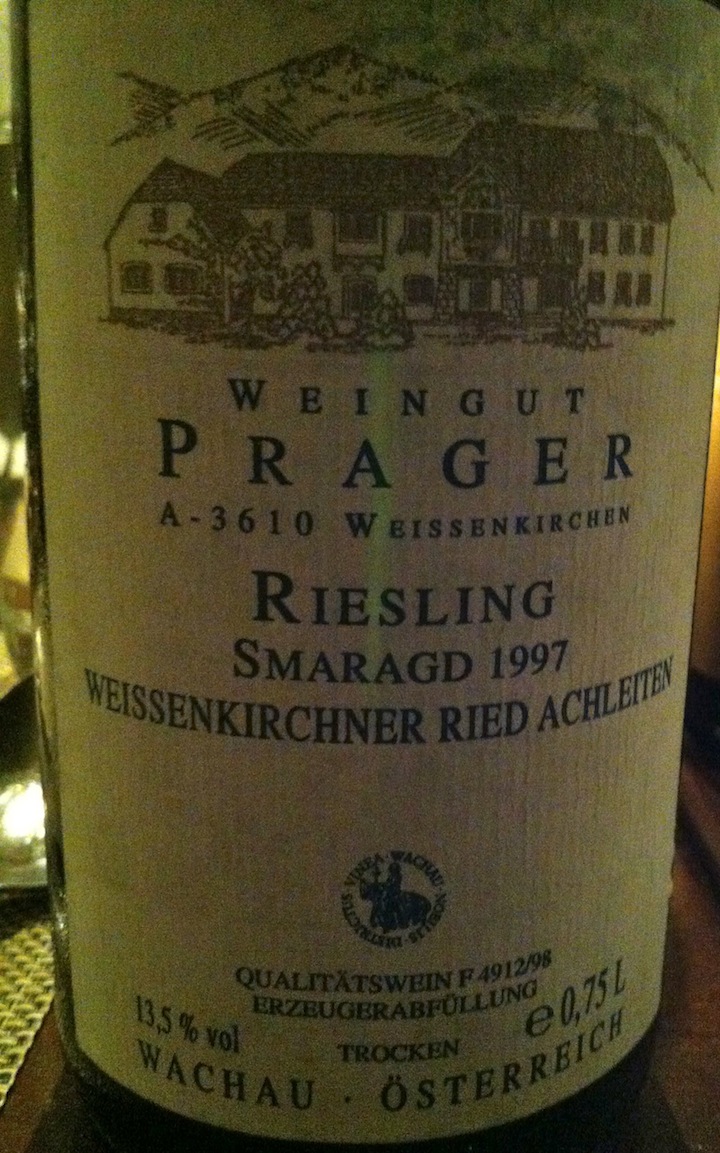
1997 Prager Riesling Smaragd Weissenkirchner Ried Achleiten. I don't know how (or if) Weissenkirchner Ried is different from the regular Prager Achleiten bottling. But this was as fine a wine as any that I tasted on this evening. Rocks, lemongrass, so subtle and wonderful.

2001 Prager Riesling Smaragd Klaus. Intense and very long, and shows how Klaus is so absolutely different in character from Achleiten. More lush in its fruit, more forward and generous.  

1997 FX Pichler Riesling Smaragd Kellerberg. Whoa, this wine floored me. Just beautiful wine, as fine as any on this evening, for me.

2002 Moric Blaufrankisch Lutzmannsburg Alte Reben. There were several Moric reds and for whatever reason, they didn't show as well as they might have. But this wine was great, so beautifully perfumed.

2001 Hirtzberger Riesling Smaragd Singerriedel. Intense and big, but harmonious. I loved this wine. I think I prefer the more gossamer style of Alzinger and Prager, but I love Hirtzberger's Singerriedel.

This was such a wonderful evening and I feel lucky to have been a part of it.

Wednesday, February 29, 2012

Good Things to Eat While Traveling

I like to travel within New York City, to explore the far away neighborhoods, and the not so faraway. There are so many ridiculously good things to eat here, we really are very lucky.

Just look at this bowl of Bun Rieu, the Vietnamese crab paste soup with vermicelli noodles that I recently ate in Sunset Park, Brooklyn. At Thanh Da, this soup is served with fried tofu, chunks of pork rib, tomatoes, and lots of mint. Pure savory satisfaction.

Not too long ago a good friend and I went on walkabout to explore the Forest Hills Gardens section of Queens. This is a neighborhood designed by Frederick Law Olmstead's son, and its streets are privately owned. They have their own garbage collection and security services, if I'm not mistaken. Anyway, I couldn't help but point out to my pal that Rego Park was within walking distance, and its incredible Bukharian restaurants.

We ate a memorable and very large meal at Restaurant Salute (108th street and 63rd Road). This is a kosher restaurant owned by Uzbek Jews. We began with a gorgeous plate of expertly made pickles, and two kinds of dumplings.

These are Uzbek dumplings called manti, filled with ground meat (lamb?) and spices. I love them at Salute. If they remind you of certain Chinese dumplings, that's because there was a lot of mixing of food and technique as people traveled along the silk road a long time ago.

On the Salute menu these are called "Juicy Crimean Dumplings," and I think the real name for them is Cheburek. They were delicately spiced with cumin, and were indeed very juicy and delicious.

We ate pilaf, rich with chunks of lamb, carrots, and cooked onions. Not a powerfully flavored dish, but savory and very comforting.

And we ate kabobs, of course, a skewer of lamb ribs and another of ground lamb and beef spiced with cumin. Both were expertly grilled and a with a little bit of the "sauce for meat," made of plums, dill, onions, chilis...wow, that's just good stuff.

I love to have a pot of green tea at Salute. Beautiful colors, delicious tea, and another reminder of how complicated the mingling of food and culture is all over the world.

Get ready for this last bit because if you live in New York, you're going to freak out a little. I was in Chicago recently and a colleague who lives there took me to a place for dinner in his neighborhood, called Humboldt Park. He had no idea that I'm into wine, he just likes this place called Rootstock. Whoa - what a find! This place simply couldn't exist in New York. There would be twice as many tables squeezed into the same space, and everything would need to be at least twice as expensive.

The food was delicious. A salad topped with pickled squash and sunflower seeds ($8) was refreshing and bright. I guess Portland and NYC are not the only places where anything can be pickled.

Chicken liver mousse with pickled cranberries and pink peppercorns ($6.50 !) was truly excellent, although served with rather uninspiring bread. But the mousse was so good that it almost doesn't matter. And that bottle you see there...it is the 2009 Alzinger Riesling Steinertal, and it cost all of $60 on the wine list!! This is a wine that typically costs more than that at a retail shoppe in NYC, if you can find it. The wine list was excellent, really really great. There were so many things that I wanted to drink, and the prices were great, from my NYC viewpoint. This is a place that serves Bernard Baudry Chinon Blanc by the glass. There are loads of interesting beers to try, the shelves were stocked with great spirits, and to top it off this place serves Sherry by the glass too - Gutierrez Colosía's lovely Oloroso called Sangre y Trabajadero, and El Maestro Sierra's Amontillado. I mean really, folks, this place is a gem and I would go back 10 times.

And by the way, the Steelhead Trout with lentils and grilled scallions ($13 !!)...not bad with Steinertal, not bad at all. Yes, it's probably 15 years too soon to get the most out of this wine, but a good decant and two hours in, this was singing a lovely tune.

Wednesday, September 21, 2011

Learning Enough to Know That I Don't Know Anything.

"I've learned enough to know how much there is that I don't know." This is an idea that I firmly believe in. When delving deeply into a complex topic one can reach this point that is both exciting and frustrating where one gains new appreciation for the body of experience and knowledge that exists. Regarding wine, I hit this point some time ago. The thing is, years later, many experiences later, I'm still here.

I am reminded of this by several recent experiences where my judgements about wine were entirely different from what I expected based on past experiences. Starkly different. This is what I'm talking about:

The other night after putting kids to bed I made a simple dinner of a pork chop and some vegetables. Burgundy...I hadn't drunk one in a while and I wanted it. But I don't have many bottles that are mature, and I didn't feel like opening a young bottle, or one of the few special older bottles that I own. I decided to open a bottle that isn't important to me, something that I would cull from my cellar. What would that be? I looked at what I have and decided on the 2005 Domaine des Croix Bourgogne, $25, Becky Wasserman Selections. I bought several bottles in early 2008 and loved when it was released, but found subsequent bottles to be too oaky. Look at my notes from Cellar Tracker and you'll see what I mean:

2/9/2008: up there with the very finest Bourgogne i've ever had. wide aromas of red and dark fruits, lots of earth, dark flowers and a mineral core. lovely medium bodied palate echoing the aromas with really persistent flavors on the finish, and a cool minty sensation. just great wine and a Bourgogne, no less. I am seriously tempted to explore the 1er Cru wines by this producer in this vintage.

4/24/2008: on this one, the oak was very powerful from the outset. after 45 minutes or so it calmed down a bit, but hard to evaluate. will check back tonight

2/11/2009: Not ready yet, and probably needs another 3-5 to integrate, if it's going to. The wood is pretty overpowering now. good underlying materials, but hard to discern the nuances of the wine right now. I wonder...will it be able to integrate all of the new oak?

11/2/2010: Oak oak oak oak. and i'm not at all anti-oak. this is not a judicious use, however. perhaps he got excited about the 2005 fruit and threw everything he had at it. in any case, even late on day 2, it's difficult to separate the wine from the vanilla influence of oak, and to see what its personality is. frustrating.

Seems like a solid candidate for cellar-culling, no? At least in the sense that it's not a wine that I believe in, as evidenced by my notes. The thing is, the bottle I opened, my last bottle, was really good. Here's my note on that one:

9/17/2011: a very good bottle, showing the power and depth of the vintage, and also detail of fruit and mineral. there is some oak but it is not intrusive here. There is also a definite sense of place - the wine is made from plots formerly classified as Pommard and Volnay villages, and the wine reminds me of those places. oddly, it doesn't hold up so well on day 2, very curious.

I had several experiences with the wine, and formed several opinions. Which of them is true? You know what - I think they are all true. I was a different taster in early 2008, and the wine changed too. All of these notes reflect one thinking person's real experience with this wine. If someone asked me today to write a review of 2005 Domaine des Croix Bourgogne I would say that it has good qualities, and it has qualities that had concerned me, but a recent bottle was very good. I would say that in the context of regionally classified Burgundy, I was disappointed with this wine for a few years, but a recent bottle was very encouraging.

Would that kind of review satisfy you?

Imagine having to review this wine for a magazine or some sort of publication, having to score it based on one experience in 2008. Or 2009. How can one bottle of a wine, never mind one sip and spit at a tasting, provide sufficient information to assign the wine an absolute rating, a set of tasting notes that readers should accept as truth? If I am the reviewer, it is clear that one bottle is not close to being enough.

A few more recent experiences, just to illustrate how often this sort of thing happens to me:

--I drank a bottle of 2009 Huet Vouvray Sec Clos du Bourg the other night, a bottle that a friend brought to a restaurant. It was great, everything you could want from a young Huet. The only other bottle I drank came from my own cellar a few months ago and was not good. Dan Melia drank it with me and we both thought it was overripe, not focused, and unsatisfying.

--I drank a bottle of 2008 Alzinger Riesling Federspiel Dürnsteiner the other night. It was fantastic. I decanted it, as I've learned is very important with basically any Austrian white wine, and left most of it alone for about two hours. Delicate fruit, very mineral, perfect balance, absolutely delicious. The bottle I drank three weeks ago, though, was nowhere near as good. I didn't decant it, and it showed big and ripe and without much detail. Disappointing enough so that only three weeks later I was ready to cull this bottle from my cellar. Turns out that I wasted the first bottle - the wine is excellent if you handle it correctly, which I didn't do the first time.

--I drank a bottle of 2006 Michel Gahier Savagnin the other night. A friend brought it to my house for dinner. We liked it, but didn't love it. It was tasty but not complex, constricted, without energy. We re-corked it and moved on to other wines, I stuck it in the door of the fridge and forgot about it. A week later I found it, poured a glass, and it was great! Detailed, expressive, vibrant, completely delicious and intriguing.

So what is there to take from all of this?

  1. Wine changes from bottle to bottle, and within the experience of drinking each bottle. We as tasters change and grow too. It is foolish to assume that one experience with a wine is the defining experience.
  2. Wine ratings that arise from one tasting probably should not be relied upon, unless the critic is one of the incredibly rare people who actually has the depth and breadth of experience to understand the wine in its current state, and extrapolate from that state something meaningful about the wine as a whole. Those people are out there, but they are few.
  3. Furthermore, reviews of wine that are based on tasting notes that describe specific flavors such as blackberry, smoke, peach, and things like that, those reviews are completely useless if you care about truly understanding a wine.
  4. We are going to like some of the wines we drink. And then we will not like those same wines as much when we drink them again, or vice-versa. This will be disappointing and thrilling, and frustrating.
Probably the best thing to do is to have an open mind, to expect your opinions to change, to experiment a bit, to invest in yourself as a learner. I'm still trying to find my way in all of this, and I'm fine with that.

Thursday, June 30, 2011

Hirtzberger, the Scandal of '85, and an Evening with Peter Liem

My good friend Peter returned from Champagne the other day and to my great happiness, he came for dinner that very night. I love hanging out with Peter because he's a truly remarkable guy, and then there's also the wine thing - spending an evening drinking wine with him is like being in graduate school (but without the annoying homework or the crippling debt). During our conversation on this night I learned a lot about Austrian Riesling and changes in the Austrian wine industry in the 1980's. All of this was new to me, and I found it so interesting that I will try to recreate the conversation here.

It began with lobster bisque that I brought back from Larson's Fish Market in Martha's Vineyard. What to drink with this very rich soup? I was thinking of Champagne, or maybe a Huet demi-sec, but I remembered the 1999 Hirtzberger Riesling Smaragd Singerriedel that I bought about a year ago, on Peter's advice actually. I saw it one day just sitting there for $67 in the cold room at Astor. Curious about Austrian wine, I had asked Peter to recommend a few things to try. He said that the blue-chip wines include Hirtzberger's Singerriedel, Nikolaihof's Steiner Hund, Alzinger's Steinertal, Pichler's Kellerberg and Loibner Berg, and Prager's Achleiten (and more recently Wachstum Bodenstein), and that Singerriedel might be the greatest of the vineyard sites.

We opened and decanted the wine. Peter generally does not decant wine, he prefers to experience its evolution from the bottle and the glass, but he told me always to decant Austrian white wines because they are made in such a reductive style. I thought the wine was gorgeous - rather full in body and quite ripe, but also entirely focused and under control, and as it interacted with air it became more and more detailed. Peter said the wine was great and that it was very modern, a fantastic example of the style.

Modern?!?

"What do you mean, modern," I asked.

"Well, the Austrian wine industry completely changed in 1985," he said. "You know about this, right?"

"Nope. Completely ignorant," my vacant expression conveyed.

"Austrian Riesling used to have residual sugar. If you drink wines from the 40's, 50's, and 60's, they all had residual sugar. Now some of the greatest wines are completely dry, but this is a relatively new thing. They were making late harvest wines and doing very well with them in the export markets. But you can't make late harvest Riesling every year, it requires certain climate characteristics. It turns out that when climate didn't cooperate, some producers were adding diethylene glycol (an ingredient in anti-freeze) to the wines to give them the texture resembling the late harvest wines."

"You've got to be kidding me," I said. I thought it was the French who used to add anti-freeze to wine.

Peter just shrugged. "When this was discovered, the Austrian wine industry died, literally overnight," he said. "There were a few growers who decided to change the course, to make great dry wines. They formed a private growers organization called Vinea Wachau, the organization that began using the Federspiel and Smaragd designations. And they weren't always called Smaragd, by the way. It was originally Honifogel but there was a woman whose last name was Honifogel who sued the group and they changed the designation name to Smaragd"

"Who were the growers who started it," I asked.

"It was four of them I think," Peter said. "Hirtzberger, the old Jamek, the old Prager, and FX Pichler. It took a little while, but the scandal was the greatest thing that could have happened for the Austrian wine industry in a Darwinian way - only the best survived. Overall quality is great now, in fact I would say that there is no where else right now where the median wine quality is equal to what it is in Austria."

"Wow, that's a big thing to say," I said. It was at this point when I noticed all of this light, this burst of knowledge, if you will, pouring forth from Peter's head.

"I'd love this to happen elsewhere," Peter said, laughing. "I'd love a scandal in Champagne."

We drank the wine and it was delicious with the lobster bisque. It was delicious on its own. Really a great wine, amazingly graceful and balanced, so expressive, a complete wine. And a great experience drinking it in the company of some one who can speak about it so intelligently and also so conversationally. Here's the wikipedia entry on the Austrian wine scandal, if you're curious.

Anyone out there around and remember interesting details from the Austrian scandal of '85? Fee free to share...

Monday, January 17, 2011

Cooking a Rabbit

The other night, I cooked a rabbit for the first time. My friend Peter was coming over for dinner and I wanted to try something new. We used a simple recipe from The Art of Eating #76 called Lapin à la crème, or Rabbit in white wine with cream. The first task was to butcher the rabbit.

I've become rather competent, if I may say so, at butchering a chicken. Rabbit - need more practice. You can see from the picture above that I was able to remove the hind and front leg portions without much trouble, but the loin is actually larger than what you see above. I left some meat on the ribcage and there were some thin flaps of muscle that I decided to remove from the main loin portions. When I looked at the Art of Eating photos afterward, those flaps were left as part of the loin. Live and learn...

The recipe calls for "stiffening" the rabbit in butter (cooking but not browning), sweating some aromatic vegetables, returning the rabbit to the pot and braising it with the aromatics in white wine and stock for 45-60 minutes until tender, removing the rabbit and then reducing the braising liquid. Then straining the liquid and adding some cream (although the recipe called for adding the cream before straining, but that didn't sound right to us). Then cooking some mushrooms - we used hedgehogs, returning the rabbit to the sauce with the mushrooms to marry the flavors, and adding white pepper and lemon. We substituted parsley for the white pepper and lemon.

I must say, the braising liquid and the rabbit smelled great. We plated our rabbit portions over a mound of plain white rice, spooned some of the sauce over the top, sprinkled with parsley, et voila.

Rabbit is a very lean meat, more gamy than heavy. This sauce is delicious, but not terribly pungent or complex. What to drink with this dish? James MacGuire in The Art of Eating writes "With the rich but not unusually flavorful sauce of rabbit with white wine and cream, you might drink a dry or near dry, fresh, aromatic Alsace Riesling or Pinot Gris." That sounded good to me, but I had no Alsace wine in the house. So I opened a bottle of the most aromatic Riesling that I had, the 2004 Alzinger Riesling Smaragd Loibner Steinertal, $30, Imported by Michael Skurnik Wines.

According to Peter, Alzinger's Steinertal is one of the absolute greatest white wines of Austria. So yes, it is possible to buy one of the greatest white wines in the world on closeout for $30, and the new vintage (2008) costs under $65, by the way. Anyway, this wine was vividly fragrant, delicate and finely focused, and very intense with a great presence on the palate and a lazy lingering finish. It was a lovely match with the rabbit. I thought it was just a spectacular wine. And it held up for next three days, too.

All of that said, I liked but didn't love my rabbit. I didn't achieve that falling off the bone texture that the recipe suggests. What do you think - have you cooked rabbit with any success? I'm willing to try again but I need a little inspiration. I might prefer simply to drink the Steinertal.