Showing posts with label Prager. Show all posts

Wednesday, May 29, 2013

Carbonara and the Search for the Perfect Wine

"I judge a chef based on their roast chicken."

"The best way to judge a sushi chef is to order one piece of tamago, or omelet sushi."

I don't know who said those things, but I understand the idea. Skilled preparation of the seemingly simplest dishes is one of the marks of a great chef. Carbonara might be the roast chicken of Italian cuisine. It is a dish comprised of no more than 5 or 6 ingredients and even the unskilled cook can make a decent version of the dish. But good ingredients and good cooking, as with roast chicken, can elevate carbonara to something spectacular.

Carbonara is simple, on paper, and apparently there is an argument about virtually every aspect of the preparation. Spaghetti? Bucatini? Egg yolks only or whole eggs? Onions or no onions? Guanciale or pancetta? Parmegiano or Pecorino? Good lord...

I've had spaghetti alla carbonara three times in the past week, and that's equal to the number of times I've had it in the past decade. So why now, with the carbonara? A good pal invited me to his out-of-town house for Memorial day weekend and he knows that I have a line on the good meats so he asked me to bring some guanciale, or cured pig's jowl. He had been working on his carbonara and wanted to make it for me during the weekend. Nice. I brought a bunch of wine for the weekend and tried to include things that would pair with carbonara.

In general, my pal makes his carbonara like this:

-Salted water, bring to a boil.
-Slice guanciale, fry in a pan to render the fat.
-Pour off some of the fat, add a good glug of white wine and cook down.
-Crack two very fresh eggs, beat.
-Add a generous amount of grated Parmegiano and chopped fresh parsley, beat some more.
-Take the cooked spaghetti out of the boiling water, allowing some of the pasta water to come along, and add it to the egg mixture, tossing all the while.
-Toss, toss, toss some more so the egg doesn't cook, but instead forms a sort of glaze on the pasta.
-Add the cooked guanciale and some salt and cracked black pepper to taste.

Our eggs were super fresh - local hens popped them out that very morning.

The guanciale was heavily seasoned and had a thick layer of fat. He sliced and chopped it into small thin pieces without removing much of the seasoning.

He beat the eggs and mixed in a handful of parsley from the garden. Some high quality grated Parmegiano too.

We curdled the eggs just a little bit when we mixed the pasta into the bowl. You can see this - the small solids in the picture above. This first version tasted quite good but it was not perfectly balanced. Too much black pepper and salt - we should have rinsed or maybe even soaked the Guanciale first. Still, it was delicious. I imagined a bright and acidic white wine would work well and opened something I'd been greatly looking forward to - 2001 Prager Riesling Smaragd Achleiten. This is a beautiful wine, fresh flowers on the nose and lovely delicate flavors, all carried through the palate on a wave of mineral and acidity. But it was simply no good with this carbonara. The pungency of the dish dominated the wine, there was no fruit at all and this dish needs a little fruit, and the acidity was too strong. We had to kind of set it aside, eat our pasta, and then come back to the wine.

Later in the weekend my friend made another carbonara and this one was perfect, to my taste. He rinsed off some of the curing seasonings before cooking the guanciale and added no black pepper or salt.
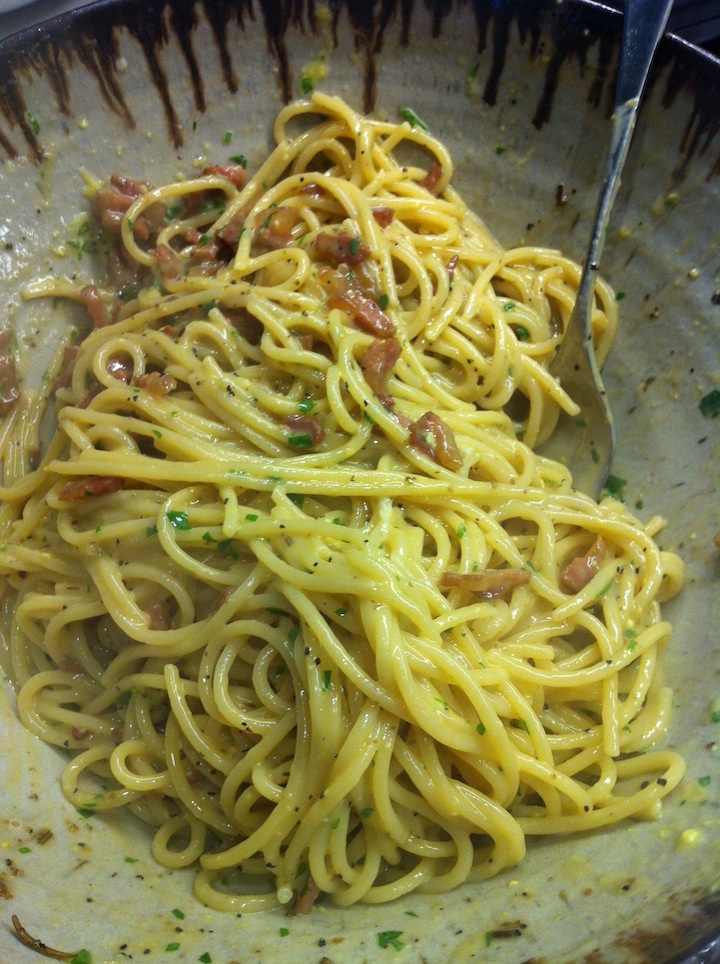
He managed to toss the pasta in the egg mixture with no curdling at all this time.
It looked beautiful and smelled great. He poured off most of the rendered fat this time too, freeing the aromatic porky pungency of the cured jowl meat to shine through unobstructed.This time I opened a bottle of 2007 Stony Hill Chardonnay. It was a much better pairing. The wine has good fruit that balances the acidity, and is fuller in texture than the Riesling. It's not a better wine, but it was a way better pairing with the carbonara. And yet, I was not convinced that I had found the best pairing. More research was needed.

So, when Peter and a few others came over for dinner earlier this week I knew that carbonara would be one of the things I would make. And I wanted to try another kind of wine. But what? I decided to ask friends for advice, friends who know something about Italian food and wine. Jeremy Parzen said that a slightly chilled Cesanese del Piglio, a peppery red wine, would be ideal. "It has just enough meatiness to complement the egg and lardons and its natural spice is great with the heat of the dish," he said. Jeremy also said that if I wanted to drink white wine he would recommend a Frascati, a Lazio Bianco, or an Orvieto. "Acidity obviously is a must but the wine needs some spiciness to go with the freshly cracked pepper of the carbonara," he said.

I asked Alfonso Cevola what he thinks is the perfect pairing for carbonara. "Something white and simple," he said. "Maybe a good Frascati or a Verdicchio like Bucci or La Monacesca. Coenobium is a bit out there but I'd try that for an exotic choice. From Abruzzo La Valentina makes a nice Trebbiano (not to be confused with the more expensive Valentini). Something interesting from Apulia is the Masseria Li Veli Askos Verdeca." Some similarities with Jeremy's recommendations, and although most of the wines these guys are recommending are unknown to this Italian wine ignoramus, I began to understand what they were getting at. "Essentially one needs something light with good acidity to cut through the fat of the dish, not too sweet but not lacking in fruit either, and not too dry," Alfonso said. Okay, makes sense.

The problem is, I own literally two bottles of Italian white wine and they are both from Friuli and made mostly of Friulano, and they are richer, more herbal wines. Not what those guys described. So I thought about my cellar. What do I have that is simple, fruity, and with good acidity, but not too much of either? Something dry, but not too dry. Something that would stand up to pungent guanciale and also be easy drinking.

Friends, I'm here to tell you that I served a Provence rosé with my first ever attempt at Carbonara. The incredibly reasonably priced and very delicious 2012 Domaine les Fouques Côtes de Provence Cuvée de l'Aubigue. And it was a very good pairing. WAY better than the Prager Riesling, which is a far better wine, objectively speaking. A better pairing also than the Stony Hill.

My carbonara wasn't bad either, although my friend's was better. I rinsed my guanciale well, removing almost all of the seasoning.

I sliced it too thickly though and it crisped up in the pan before all of the fat could render. Still, it was tasty and I managed not to curdle the eggs when tossing the pasta.

We ate our pasta and my friends were happy. While we ate I asked Peter, who knows a lot about all wine and food, what he thinks is the best wine to pair with carbonara. Now this is a guy who at home drinks almost exclusively white wine - Champagne and Sherry. "Carbonara is a good red wine pasta dish," he said. He has a friend out west who loves carbonara and who loves to open old Nebbiolo to pair with it. "Now that's good," Peter smiled.

Clearly, more research is needed. And by the way, does anyone know a good Brooklyn cardiologist?

Thursday, January 10, 2013

Some Recent Wines, VLM Style

The Vulgar Little Monkey, or VLM as many like to call him, is back writing on the internet. I like his writing because it's completely honest, because he is clear about his particular point of view, and because he makes me laugh. I recently read through his blog posts since he picked it up again in October and it's satisfying stuff. Most of the posts list wines he's had, along with tasting notes. This sort of thing can be uninspiring at best, but the VLM makes it rewarding, in my opinion.

I've stayed away from this sort of writing, the list of wines and tasting notes, for quite some time because I don't feel that it would be of much value. And maybe it won't be when I try it now. But I'm doing it anyway. Here are some wines I drank in the last few months that might be of interest:

2009 Bernard Baudry Chinon Franc de Pied, $26. This is Baudry's ungrafted vines cuvée from the sandy base of the Clos Guillot vineyard. I've heard that ungrafted vines make wines that should be consumed young, and I've heard the opposite too. This wine showed very well, but showed young. Not all wound up and tight, but young - all fruit still. The dark fruit was lovely and the mineral complexity was there, although just barely articulating itself. This wine is clearly of very high quality and is very well balanced, especially in the context of the warm 2009 vintage. Enjoyable now but I think worth leaving in the cellar too.

2009 Domaine Ganevat Côtes de Jura Cuvée de L'Enfent Terrible, $34.This is Ganevat's Poulsard. Ganevat red wines are almost always reduced and terrifically funky when first opened, and need a good decant to show well. To my taste, this is the finest Poulsard after Houillon/Overnoy. This was a great showing. I decanted it 5 hours before drinking and it needed every moment. When we drank it, it was clear as a bell, completely pure and harmonious and not at all overripe, although the ripeness of the vintage shows. Great complexity and balance. But the thing that makes it special is the purity of the focused red fruit - the crystalline nature of the wine is like that of a white wine. Very lovely, but now the price is closer to $50. If you love Poulsard, probably this is one to buy.

Cédric Bouchard Roses de Jeanne Champagne Inflorescence Blanc de Noirs (2008), $55. No surprise here - this wine is all 2008 fruit, a great vintage in Champagne, and Bouchard makes great wines. This was simply excellent - the purity of fruit rather startling. Saline and chalky, and the texture is all silk. It was still growing and improving when we finished it. Beautiful now, but certainly one to leave in the cellar too.

2007 Muhr-van der Niepoort Blaufränkisch Carnuntum, $18.I loved this wine a year ago and saved one bottle, hoping to leave it alone for a few years. I made it through one year, so I was partially successful. The wine was gorgeous on day one with broad and vibrant aromatics - flowers, various fruit, clean and very lovely. The palate wasn't as expressive, although there was an intriguing mineral floor and this was the main impression on the finish. On day two the wine lost some of its explosiveness on the nose, but was more complete on the palate, with clean, cooling, mineral-infused fruit. Worth the wait, and I should have bought more.

2007 Hirsch Riesling Gaisberg, $34. Hirsch is one of the better regarded producers in Austria's Kamptal region. Heiligenstein is considered to be the vineyard with the best potential, but I like the Gaisberg wines very much also. This wine showed beautifully. I decanted it at 4:00 and we drank it at 7:00, and it needed the time. Some found a bit of petrol on the nose, but I wasn't one of them. For me it is still about perfectly ripe yellow fruits and rock. There is lovely balance and harmony at 12% alcohol and it feels savory on the very long finish. Just excellent wine.

2007 Prager Riesling Smaragd Achleiten, $50. Also took many hours to open up, which I guess shouldn't be surprising. I love the 2007 vintage in Austria - it's my favorite of the recent vintages, but the wines are definitely in a closed phase. I decanted this for a few hours before pouring it back in the bottle and taking it to dinner, and it was still shut down for hours. That said, it opened eventually and the wine is excellent. Balanced, richly fruited, mineral, complex, and with a strong presence on the palate. A real beauty.

2006 Domaine de l'Anglore Côtes du Rhône Comeyre (magnum), $64. I loved this wine at a trade tasting maybe 5 years ago and I bought a magnum, thinking I would bring it to Thanksgiving dinner in a few years. It wasn't Thanksgiving, but I brought it to some dinner party, and wow, have my tastes changed. It is high quality wine, aromatic and tasty, but it smells more like !--Natural Wine--! than it does like old vines Carignan, and there is no sense of place whatsoever. Not a style of wine that interests or truly satisfies me.

2005 François Chidaine Montlouis-sur-Loire Les Choisilles, $28. I bought a few of these several years ago and first drank one only recently. This is one of Chidaine's dry wines and in the warm 2005 vintage it is 14% alcohol but seems lower because the wine is so well balanced, and the acidity keeps it bright and refreshing. Nose is just lovely, albeit a bit shy on day 1, and the aromas are perfectly delicate. Wool, beeswax, winter herbs like rosemary, yellow fruit, and all wispy and always moving. There is a lush feel to the palate but it is focused and essentially dry. Such lovely wine.

2005 Domaine de la Pépière Muscadet Clos des Briords, $13. I drank almost a case of this wine in 07 and 08, but saved a few bottles. Decided to check in on the wine, and time has clarified the aromas and flavors here. Especially on day two, there are lovely seashell aromas and citrus oils - grapefruit. The palate is balanced and has a bit of grain in the texture. A bit broad perhaps, not as focused I imagine as some other recent vintages will be as they age, but this is lovely wine.

Saturday, May 19, 2012

La Paulée de...Austria !

About 50 or 60 wine lovers came together to celebrate Austrian wine the other night at Seasonal Restaurant in midtown Manhattan. Stephen Bitterolf, the Wine Director at Crush, conceived of this event with an eye towards the famous La Paulée Burgundy dinners where everyone competes to bring the finest bottles and people walk from table to table tasting each others' wines. That's right - Austrian wine, La Paulée style.

It takes big bottles to put together the La Paulée of Austrian wine, and Stephen Bitterolf has them.

This was an incredible opportunity to drink so many of Austria's greatest wines. Okay, you don't spend an evening with a wine watching it unfold, and for me that's the road to understanding. But I've had barely more than a handful of mature bottles, and still haven't tasted some of the best sites and producers, and this was a great way to delve in a bit further.

Importer Carlo Huber and Seasonal Executive Chef Wolfgang Ban.

I could be wrong in saying this, but I think that Austrian wine is not something that most people understand, even in the wine-loving community. Stephen Bitterolf is a passionate believer in Austrian wine and has for a long time carried a wide selection at Crush, where Joe Salamone and others who work there also believe in the wines. And yes, there are serious collectors in the NYC area who have old bottles stored in their cellars.

Robert Dentice, a huge collector of Austrian wine, and his partner Renee Patronik. 

But I see German wines far more often at restaurants and when friends get together. Maybe this is because most Austrian wine is sold in Austria - the wines sell easily, right there at home. Maybe it's because the modern wines are dry, and a lot of Riesling lovers talk about how they prefer their wines to have a bit of residual sugar. It can't be the prices, because it's possible to buy some of the greatest Austrian wines for the price of a villages Burgundy. Whatever the reason, the wines are not as mainstream as they should be based on quality, price, and deliciousness.

Ray Isle of Food and Wine, and Joe Salamone of Crush, both enjoying Austrian wine.

So it was a great evening for Austrian wine lovers, and also an opportunity for some of the great Austrian wines to get some much-deserved attention in NYC. This is why several producers donated rare large-format bottles for the event, and why the Austrian Wine Marketing Board was so helpful in getting those wines quickly to NYC for the dinner. This is why Executive Chef Wolfgang Ban closed Seasonal and used the whole space for the event, and charged only $90 all-in for a fine 4-course meal (full disclosure - I was comped a ticket by Crush because they apparently have mistaken me for a wine writer).
Allan Roth and Gene Vilensky, a couple of guys who love Austrian Riesling. Don't let the wood-framed glasses fool you - they are not Williamsburg hipsters. Allan is in education and Gene is a mathematician. Regular folks like them love Austrian wine too.

It was an embarrassment of riches - the wines were great. Not every wine, but I was seriously impressed with so much of what I drank. Of the big name Wachau producers, Prager and Knoll seemed to be the most prevalent at this dinner. Most of the other big shots were there too - I saw bottles by Alzinger, FX Pichler, Hirtzberger, and Moric. I saw no Nikolaihof and no Rudi Pichler, which kind of surprised me. From the Kremstal I saw Brundlmayer and Schloss Gobelsburg, but no Hirsch or Nigl. And I don't think I saw anything from the Wagram, which makes sense on a night when people are bringing the fancy bottles. But there is plenty to love in the Wagram (I'm a little bit obsessed with Bernhard Ott right now, but that's another story).

Stephen hosted and spent the whole night pouring. I don't think he stopped to eat.

I didn't really take notes, but here are some of the wines that were memorable for me, in the order in which I tasted them:

1986 Alzinger Gruner Veltliner Mühlpoint Kabinett Trocken. A designation no longer used. A wonderful old nose.

2002 Bründlmayer Riesling Zobinger Heiligenstein Alte Reben. I've heard Heiligenstein described as the finest site in the Kremstal. This wine was in magnum format, and was beautiful in its lush fruit and its focused minerality.

1988 Alzinger Riesling Ried Loibenberg Kabinett Trocken. The wine was in excellent shape, despite the dodgy label. Complex, fresh, vibrant, a real treat and a great advertisement for storing these wines.

2000 Prager Riesling Smaragd Achleiten. I brought this wine and that's why I thought it was so interesting. But it was impressive in its balance and elegance, considering that it was a very hot vintage that in some cases produced some overly fleshy wines.

1997 Prager Riesling Smaragd Weissenkirchner Ried Achleiten. I don't know how (or if) Weissenkirchner Ried is different from the regular Prager Achleiten bottling. But this was as fine a wine as any that I tasted on this evening. Rocks, lemongrass, so subtle and wonderful.

2001 Prager Riesling Smaragd Klaus. Intense and very long, and shows how Klaus is so absolutely different in character from Achleiten. More lush in its fruit, more forward and generous.  

1997 FX Pichler Riesling Smaragd Kellerberg. Whoa, this wine floored me. Just beautiful wine, as fine as any on this evening, for me.

2002 Moric Blaufrankisch Lutzmannsburg Alte Reben. There were several Moric reds and for whatever reason, they didn't show as well as they might have. But this wine was great, so beautifully perfumed.

2001 Hirtzberger Riesling Smaragd Singerriedel. Intense and big, but harmonious. I loved this wine. I think I prefer the more gossamer style of Alzinger and Prager, but I love Hirtzberger's Singerriedel.

This was such a wonderful evening and I feel lucky to have been a part of it.

Tuesday, April 17, 2012

Yet Further Adventures in Blind Tasting

I love blind tasting. It's fun to drink wine without having any idea what it is, whether or not it's expensive, cult-ish and rare, common, glorified, or unknown. Without knowing whether or not I am intrigued by the producer, whether or not I've had it before, or any of the many other things that influence my expectations about a wine before I actually smell and taste it. I particularly love doing this over a meal with a relaxed group of people who will participate in the conversation and laugh with one another as we swing from kind-of-accurate to wildly wrong in our attempts to identify wine.

I did this last year at about this time, and now again. Eight of us at dinner, everyone brings one wine. I told everyone beforehand what we'd be eating, and randomly assigned two people to each of the courses. It would be fascinating also to see what sort of pairings these wine people would come up with.

We drank some truly interesting things - Zind Humbrecht Pinot Noir with roast chicken, 150 year old vines Hatzidakis Santorini Assyrtiko and 1988 Brundlmayer Gruner Veltliner Langenloiser Berg-Vogelsang (!) with carrot soup (and in the night's only tragic wine event, the Vatan Sancerre meant for that soup was corked), a seriously disappointing bottle of 1987 Joly Coulée de Serrant and a Japanese Madeira-style wine by Chuo Budo-shu (or the Grace Winery) made of Koshu and Muscat Bailey-A, both grapes indigenous to Japan. I learned something with every wine and very thoroughly enjoyed myself.

The first course was a Japanese-style savory egg custard with shrimp, shitake mushrooms, and scallions. We drank two fantastic wines with this course and I thought that both paired beautifully with the custard. The discussion around these wines was illuminating and funny, and I will share as best I can remember.

I sett two glasses in front of everyone, a Zalto Universal glass and a Schott Zwiesel Burgundy bowl. The first wine we drank granted me the opportunity to show just how good of a blind taster I am. My friend elected to pour it in the Burgundy bowls, as the other wine for this course was a sparkling wine, and he thought that the sparkling wine should be served in the Zaltos. We spent some quiet time with the wine, swirling, sniffing. It felt in the mouth like Chardonnay to me, and I got something like iodine on the nose. I began to think Chablis. And then I began to notice oyster shell and other marine scents. "I think this is Chablis," I announced. The fact that all 7 of the other tasters agreed that it was an Austrian wine made me feel just slightly less confident.

I keep hearing about how there are so many people in the wine world who cannot relax in this sort of situation, who are too competitive or aggressive with their opinions, people who will make you feel small for not knowing things, or for being wrong. I am so happy that I don't know or hang out with these people. Folks - I cannot recommend strongly enough that you spend your thoughtful wine drinking time with nice people, people who want to enjoy with you and learn together, not to compete and act like jerks. Sorry if this sounds obvious, but I don't think it's obvious. I know people who will go where there are good bottles, even if their owners are brutish wine-thugs who are not very pleasant to learn with.

Anyway...everyone else thought it was Austrian, and the questions were about Gruner versus Riesling (consensus was Riesling), region (no clear consensus, but leaning towards the Wachau), and the age of the wine (consensus was mid-2000's). And as I continued to smell and taste the wine, I knew it was true - it was an Austrian wine, not Chablis. Would I have come to that conclusion on my own, had others not been suggesting this? I really cannot say. But it was crystal clear to me, once the others said so.

Everyone agreed that it was lovely wine, the 2001 Prager Riesling Achleiten. This is a wine that I would love to drink again, and Prager is a producer who I haven't spent enough time with - the few wines I've had have all been excellent. My friend who brought the wine said that he finds that Austrian Riesling can show like Chardonnay when served in big bowl glasses. Maybe this is true, but I think he was trying to make me not feel like such a dope. But I really didn't feel like a dope. In blind dinners like this, I will get it wrong 8 or 9 times out of 10, and I'm fine with that. It was funny in the end, and the collective appreciation of my mistake reminded me of exactly how it is that I want to drink great wine - with good people.

The Champagne was fascinating too. I felt at first that it might not be Champagne, it had an herbal scent and I just didn't recognize the profile. It was heavily reduced upon opening, though, and it took a while to compose itself and be presentable. Even when it did, I wasn't sure. It felt like white grapes to me. If it were Champagne, then maybe something with the oddball grapes like Arbanne or Petit Meslier? But the wine had this mineral tang on the finish that reminded me of Huet, and I thought it was bottled at low pressure (I was wrong). Could we be drinking Huet Pétillant here? Other tasters thought there might be red grapes, some thought it was Champagne, others weren't sure.

First, we tried to resolve the main question - was it Champagne? Peter Liem thought it was and said something like "If this isn't Champagne, then it's really, really good." The texture was getting silkier by the minute, and the finish more and more saline. When the wine was revealed as the 2004 Agrapart L'Avizoise Extra Brut Blanc de Blancs, most of us were still a bit mystified. Peter cleared this up (he did not bring this wine), explaining that the wine is a Blanc de Blancs that is meant to showcase the clay soils of Avize (a village famous for Chardonnay grown on chalky soils), and this is what gives the wine its unusual character. By the way, the wine was compelling and delicious.

Listening to these experienced wine people, all of them professionals, some of whom I've seen perform amazing feats of blind tasting, hearing them discuss this wine...realizing that Peter Liem, one of the world's leading and most important Champagne experts, was not certain about this wine...It reminded me that if we are open minded and humble, we will never stop learning. I hope I will be so lucky.