Sunday Lunch for the Ages - A Guided Tour of the Early Days of Rosenthal Wine Merchant
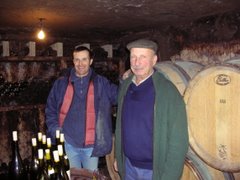
This past weekend I participated in one of the greatest wine events of my life. Neal Rosenthal and his wife Kerry Madigan made lunch for a group of people and opened a slew of wines to share. This was not a business lunch. The only wine business people in attendance were people who work for Neal and Kerry. Well, one wine business guy was there, Levi Dalton, but he was there to celebrate the wines and the company. His post about the event is far more poetic than mine, by the way. This lunch happened in part because Neal genuinely loves to share his old wines with people who will share his delight in them. For the lucky guests, it was a guided tour of the early days of Rosenthal Wine Mechant's French portfolio. Neal served the wines and we talked about them as we ate, thought about them, heard stories about the people who created them, about the different time in which they were made. The wines were very special. Old vintages, stored undisturbed in Neal's underground cellar. They showed what great wine is capable of when taken care of properly for 20-plus years.
 It is tempting to list the wines and to share notes with you - these are some of the greatest wines I've had. But that just doesn't feel like it's in keeping with the spirit of the event. Here's the thing - we crammed into several cars and drove from NYC where the snow was in gray and black piles against the parked cars, to the hilly horse farm country of mid-state New York. To an oasis of perfectly cellared wine and delicious wholesome food. Everything was covered in a pristine white blanket. The sun shone brightly, and the collective mood was high. We truly enjoyed each others' company and everyone there recognized how special of an experience it was. There was no note taking, point scoring, chest thumping, one-upping, well-I-once-drank-a-1952 recounting, check listing but not truly drinking and understanding, nonsense.
Here are a few of the things that I took with me:
We drank a mature Blanc de Blancs Champagne out of magnum, and it showed how majestic Champagne can be in the large format. The wine felt fresh and vibrant, as if it was still expanding. Amidst the honeyed tones there was a palpable richness in flavor and texture, not the elegant chalky sense one might expect. This is because the wine is from a place that actually favors and specializes in Pinot Noir, not Chardonnay. The terroir left a stamp here that after 25 years continues to speak as loudly as the grape. We drank several outstanding wines from the 1983 vintage, considered to be very difficult, an off year.
 The wines, though, were spectacular. A reminder to buy wines from the producers that you love, even if from the off vintages. Who knows what they will turn into when they're fully mature?
 We drank three mature white Burgundy wines, one from Meursault, one from Puligny, and one Corton-Charlemagne. In the hands of these producers, and after their long sleep in a proper cellar, they could not have spoken more clearly about their places of origin. Here is what they said to me: Meursault is a little bit oily in texture and smells a bit like hazlenuts, and the Perrieres vineyard is all about stones.
 Puligny is more elegant, lighter in body, but firmly structured, and can take on complex mushroom and incense aromas when mature. Corton Charlemagne takes a long time to come around, but then shows amazingly complex aromas, and minerality and acidity that seem never to fade.
 We drank a wine from the Gaudichots vineyard, the great vineyard that decades ago was carved up to create La Tâche. The aromatics were amazing, and reminded me of why if I had to take one and only one wine with me to a desert island, it would be something from Vosne-Romanée.
 We drank one wine blind and talked about it a bit. I thought it was an early '80s Barolo or Barbaresco. Someone else agreed that it was Italian. Another fellow disagreed, saying that the wine didn't have the mouth feel of Nebbiolo, that this was more Burgundy. Everyone enjoyed the wine, and everyone was surprised when it was revealed to be a California Pinot Noir from 1976, a time when a lot of great wine was being made in California in the gently extracted and low alcohol old-world style.
 We drank a first-growth Bordeaux from the 1978 vintage that Neal purchased upon release. The wine was delicious and it was fascinating for me to drink, as I had never before drunk a first growth Bordeaux with that kind of age. And no one felt guilty for saying that although it was undeniably excellent wine, it didn't make our hearts leap the way the nose on the 1983 Clos de la Roche did. Or any of the Burgundy wines did.
 We drank a wine from Hermitage from a producer I was unfamiliar with, and although I hesitate to make superlative statements, this was without question the finest northern Rhône wine that I have ever tasted in my life. It was the color of Poulsard, not really much more than rosé. This wine had the structural phenotype of Burgundy, but with entirely different aromatics. Such intensity - rose petals, peppercorns, herbs, and all infused with this persistent animale tone. An inspiring wine that made me feel a bit sad about the rather uninspiring state of the nothern Rhône today.
 We ate wonderful cheeses, various fruit tarts, and talked some more. Daylight slipped away and the sky turned a dusky cobalt blue. We drank strong coffee and found some or other excuse not to find our coats and shoes, not to leave this place and this magical afternoon. But leave we did, and we left grateful and elated. And we will see each other again.
 Thank you for a truly memorable afternoon Neal and Kerry, and everyone else too.
The wines:
1985 Lassalle Brut Blanc de Blancs
1996 Bitouzet-Prieur Meursault 1er Cru Perrières
1990 Carillon Puligny-Montrachet 1er Cru Les Champs-Canet
1983 Rollin Père et Fils Corton-Charlemagne
1992 Domaine Forey Père et Fils Vosne-Romanée 1er Cru Les Gaudichots
1989 Domaine Faurois Vosne-Romanée 1er Cru Les Chaumes
1983 Hubert Lignier Clos de la Roche
1976 Tulocay Napa Valley Pinot Noir Heinz Vineyard
1978 Château Latour
1985 Ferraton Père et Fils Hermitage La Cuvée des Miaux
1983 Bernard Levet Côte-Rôtie La Chavaroche