Showing posts with label Levi Dalton. Show all posts

Tuesday, July 17, 2012

Levi Dalton's Latest Podcast is up - our Conversation.

Whoa! Levi Dalton's podcast series continues and today's installment features our conversation. We talk about blogging and what motivates me, and all sorts of things. If nothing else, this offers proof that I am in fact a person who is capable of speaking.

Thank you Levi for including me in this ambitious and interesting project.


Here's how you can listen to the interview:

The I'll Drink to That website (for a few days).

The ITunes site, along with Levi's whole podcast series.

Tuesday, July 03, 2012

Artichokes - for a Few More Weeks Only

There are baby artichokes at the farmer's market right now (at Bill Maxwell's stand, anyway). There are never all that many so you have to get there pretty early if you want them. And you do, you want baby artichokes. They will be here for maybe another few weeks.

I love eating artichokes as much as the next guy but I've given up on cooking with the "adult" versions. Too much work for not enough gratification. I say this fully aware of the fact that I am not doing it right, but that's an issue for another day. The great thing about baby artichokes is that they require so much less prep work, and it feels like there is more to eat.

There is prep work, though. I trip the stems, but not all the way. I peel off the outer leaves that are pointy and tough and then I use kitchen shears to snip off the ends. Drop these in lemon water in order to prevent them from browning. Now there are choices to be made. You can slice them very thinly and eat them raw. You can slice them and cook them with any number of herbs or other vegetables. You can slice them coarsely and use them to top a pizza. For most preparations, I like to drop them in boiling water for a minute before cooking. This softens them a bit without robbing them of their fresh flavor (make sure to drop them in a cold water bath after the boiling water).

They look awfully cute at this point, don't they? You could slice them in half and fry them now, or put them in a jar with olive oil, vinegar, and salt. My favorite simple stand-by recipe involves slicing them somewhat thinly, cooking them with a bit of garlic, finishing with herbs like mint and rosemary, and then tossing this with spaghetti. Some grated Parmesan cheese for a bit of umami, and voila - delicious. And trust me on the rosemary here. It turns out that there is a wonderful synergy between rosemary and fresh artichokes.

What to drink with this dish? Some folks would have you believe that artichokes and good wine are mortal enemies, killing each other with reckless abandon. I've not had this problem, to be honest. Not that I'm opening my good Meursault here, but there are options. Acidic white wines work well. This time I went with rosé.

The 2011 Domaine les Fouques Côtes de Provence La Londe is a truly excellent rosé, and it costs $18 at Chambers Street Wines where it is imported directly by David Lillie. It's very tasty immediately, but it's sort of a shame to drink the whole bottle because the wine really comes to life on the second day with complex aromas, real depth of flavor, and a great texture that is both salty/grainy and silky at the same time. David Lillie, by the way, is a real wine pioneer, and he is interviewed by Levi Dalton on I'll Drink to That. Worth a listen.

Thursday, February 16, 2012

A Dinner Featuring Previously Unavailable and Utterly Brilliant Sherry Wines

Not long ago Joe Salamone and Levi Dalton put together a Sherry dinner at the wonderful Prune on the lower east side, and I was lucky enough to attend. Peter Liem was there too, and he indirectly helped to make this happen, as last summer Peter pointed Joe in the right direction when Joe visited Jerez. Joe drank some wines that he loved, some of which were not available in New York. He decided to import them to NYC so the rest of us can buy them. On this night Joe wanted to share some of these finds with a few friends, lucky us. This was a merry situation, we were feeling the love. Good friends, good food, and absolutely world class wines, wines that until recently were unavailable here. Joe and Levi opened the brown wines at least a day in advance and they showed incredibly well, the wines were stunning as a group.

Sherry is far more versatile with food than is commonly thought. I think that we in this country are still familiarizing ourselves with dry Sherry, and we tend to think that Fino style wines are for garlicky shrimp and other tapas. Fino wines go well with all sorts of food, actually. And brown Sherries - Palo Cortado, Amontillado, and Oloroso - I don't think there is a stereotypical pairing idea here because these wines are still so new to most of us. The brown Sherries we drank on this night, these are Sherries that can complement even the richest of meat dishes, as we proved to ourselves at this dinner.

Here were some of the highlights for me:

We drank Valdespino Amontillado Tio Diego, a great wine that is quite unusual as an Amontillado in that it shows a very pronounced Flor character - buttery like a Fino. Tio Diego is what happens when Valdespino Fino Inocente becomes an Amontillado and then ages for a bit longer. This is a young and fresh Amontillado, it is refreshing and delicious, not expensive at all, and in Jerez it's everywhere - on grocery store shelves. Frustrating not to be able to buy it here. But now in NYC, finally, you might be able to buy this wine at Crush, as Joe is bringing it in.

We then drank the Fernando de Castilla Antique Palo Cortado. This is just a beautiful wine. Focus and intensity, grace, detailed aromas and flavors, and a satisfying and complex finish. Pure pleasure, and improves over several days open. This wine goes so well with basically anything on the table. At this dinner, I loved it with shrimp in anchovy butter, and also with thinly sliced roast pork and kale.

We drank Valdespino Palo Cortado VORS Cardenal, a fine old Sherry that represents the end of the line for Inocente - it contains wines that long ago were part of the Inocente solera before the cellar master selected them out to become Palo Cortado.

We also drank Valdespino Amontillado VORS Coliseo, an equally rare and fantastic old Sherry that begins its life as a Manzanilla, actually. Imagine going to a dinner where you drink DRC Richebourg and La Tâche. That's what we drank, but in Sherry they're called Cardenal and Coliseo. These are such grand old wines and trying to describe them by naming aromas or flavors is silly. For me, they are show-stoppers, wines that make the table go quiet for a while as people take in what it is that's in the glass. Wines that achieve the pinnacle of complexity and character and deliciousness, things that you should find a way to taste, the way you should read Shakespeare's sonnets at some point in your life.

They were brilliant with an amazing dish of braised short ribs and Yorkshire pudding, something that used to be on the menu at Prune a while back. Braised short ribs and Yorkshire pudding...that's a rich plate of food, and I found these two grand old Sherries complemented it perfectly. Honestly, even though these are expensive in an absolute sense, maybe $140 for a 375 ml bottle, Cardenal and Coliseo are worth every penny. They are wines that expand and improve for a week after opening and you only need a small bit at a time, so your pleasure is spread over many evenings.

We also drank a vintage Sherry. That's right, a vintage Sherry. The 1975 Bodegas Tradición Oloroso. Imagine that - the solera system is part of what makes these wines so great, and here is a Sherry wine that never sees a solera. It is vinified and put in barrels, and that's it, as a wine would be in most of the world. I had a few sips of this rare wine at the Bodega in October, but it was at here at this dinner with this food when I understood its charms. This wine had such impeccable balance and harmony, and such clarity and focus. And although its been aged in barrels and exposed to oxygen without Flor to protect it for almost 40 years, it had no rough edges, not at all. Pure class, all silk, just amazing.

Valdespino Moscatel Toneles is, with Cardenal and Coliseo, the third wonder of the Valdespino Bodegas. There is one barrel of this wine in the solera row, another in the first criadera, and so on. There is very little of the wine and it is very old. Many serious Sherry devotees can tell you about why it is so special, and although I enjoyed drinking it, I will admit that I do not yet understand the wine and cannot easily differentiate between the old black sweet Sherries. i know there is something to it, I just haven't figured it out yet...

Keep your eyes open for these wines as they should be available here and there, whereas previously you had to go abroad to buy them. This was a truly amazing dinner and reminded me again that at this point in my drinking experience, I think that great Sherry is as great as wine can be.

Tuesday, January 03, 2012

How to Open and Enjoy an Old Bottle of Wine

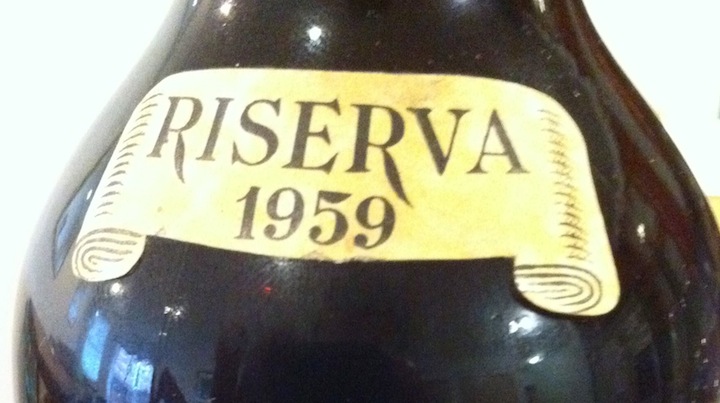
I was given an amazing birthday gift in November, an old bottle of wine by Produttori del Barbaresco, the 1959 Riserva. This is very exciting - how often does one get to drink a bottle that old? In my case, not very often. I've had a few old wines, but with the exception of a few cases, I haven't opened them myself. A more experienced friend or a sommelier typically has handled that part.

How do you open an old bottle of wine?

I knew that I wanted to drink the '59 Barbaresco over the holidays with friends. I asked Jamie Wolff, partner at Chambers Street Wines, what to do with the bottle (which was purchased at his shoppe). He told me to stand it up a week in advance, not to move it at all during that time if I could help it, as it would probably have a lot of sediment.

"But my wine fridge won't accommodate a standing bottle," I said. "How do I keep it at the proper temperature?" Jamie suggested finding the coolest spot in the house and standing it there. "And when you serve it," he said, "open it up four or five hours in advance and decant it carefully off the sediment."

As the Barbaresco evening approached, I began to wonder if an old wine like this would die with four or five hours in the decanter, so I asked another friend about how to deal with it, and his answer was entirely different.

That's when I realized that there are a lot of way to do this: to handle, open, and drink an old bottle of wine. And I don't know what I'm doing in this area at all. So I thought I would ask a few friends who are wine professionals what they do with old bottles. I wanted opinions from a variety of viewpoints, so I asked a great sommelier, a great wine buyer, and a great wine thinker and writer with a load of personal experience opening old wine. I'm talking about Levi Dalton the great sommelier, Joe Salamone the great wine buyer at Crush, and Peter Liem of broad and varied greatness. I wrote to them with the following questions:

1. How do you prepare an old bottle for drinking?
2. How far in advance of serving do you open the bottle?
3. Do you decant or not, and why?
4. How do you open an old bottle when the cork might be likely to crumble or break?
5. What should we look for when the bottle is first open - how can we tell if the wine is good or not?
6. Any general thoughts on evaluating an old wine - for those of us who don't often drink old wine, it can be confusing.
7. Do your ideas about pairing wine with food change if the wine is old?
8. Any other advice most appreciated.

And now, patient reader, I will share their thoughts with you (and I hope you're sitting comfortably, because this is a long post):

1. How do you prepare an old bottle for drinking?

Levi - Bottles should be left alone for as long as possible before opening. If you know in advance that you will be opening a bottle of wine a few days from now, I suggest standing it up vertically in the cellar to let the sediment fall to the bottom of the bottle. If you are storing the wine horizontally, I recommend not moving the bottle much while it is in storage. This usually becomes more of a problem with double deep bottle racking, where you have to move one bottle to get to another. Bottles can get moved a lot. I recommend putting the older wines in the back, so that they bottles that are getting jostled in the front are the younger wines.

If you are removing a bottle from horizontal racking, I recommend either using a bottle cradle or I recommend holding the bottle near horizontal, keeping the bottle in the same way as it was in the rack. In other words, don't spin the bottle around as you move it. The aim is to keep the sediment in the same place without moving it around into the liquid. I also recommend taking an elevator, if available, rather then walking with a bottle up stairs.

Joe - Stand it up in the morning if you’re drinking it at night. Let the sediment sink to the bottom.

Peter - It depends on what it is. If it's an old red wine with sediment, you ideally want to stand it up for several days, sometimes even a week, before opening it, to allow the sediment to settle. It's not just an aesthetic issue—the sediment can be bitter, and its presence definitely changes the flavors of the wine. You can decant a wine that's stored on its side if you need to (in a restaurant setting, for example), but you have to be careful. (I'll always remember drinking a 1964 Bartolo Mascarello at Valentino in Santa Monica that was virtually opaque with sediment due to utterly incompetent wine service.) If it's an old white wine or champagne, you need to chill it, of course. I have no scientific basis for it, but for whatever reason, I don't like shocking an old wine in an ice bath or the freezer or whatnot. I prefer to bring it down to temperature slowly in the fridge, which takes time. Maybe it's just a question of respect.

2. How far in advance of serving do you open the bottle?

Levi - Some cowboys, especially in the Nebbiolo set, open bottles way far ahead. I generally don't. I like to see how the wine changes in the glass.

Joe - It really depends on the bottle. A few years ago I had a 71 DRC Grands Echezeaux with questionable storage. It was popped and poured and it was glorious for fifteen minutes. After that, it faded hard. Someone at the table was smart enough to say that we should pop and pour. Otherwise, we would have missed out on it totally.

Peter - This is a tricky question, and one with no right answers. I've seen old wines continue to develop for three days, and others that have crashed within 15 minutes. It's true that old wines need time to emerge (you'd be out of sorts too if you'd been trapped in a bottle for 50 years), but personally, I tend to err on the side of caution, not because I'm afraid that the wine will die, but because I like to experience the evolution of the wine from start to finish. For a grand old bottle, I prefer to open it, take a small glass, and decide from there what to do with it. Having said that, I tend to do this in the afternoon, if I'm serving old red wines at dinner. But then afterwards, I'm always the guy who has like 12 glasses in front of him at the end of a dinner party, because I've been saving all these wines to watch how they grow over the course of several hours.

3. Do you decant or not, and why?

Levi - Old wines are candidates for decanting when they have thrown a good deal of sediment. But if you are dealing with a low tannin grape, I usually don't decant, even if they are throwing sediment. That is to say, I generally don't decant old Red Burgundy, I pour carefully from the bottle instead. Pouring into a decanter should be low, slow, and steady. This is not the "splash decant" that you might use for a younger wine. Do the decanting all in one go, with no fits, starts, or interruptions. Hopefully you won't sneeze during the operation. If you do stop and start the liquid will become muddy with sediment before it leaves the bottle. That being said, it is a great idea to "season" the decanter you intend to use with some of the wine in advance of pouring the rest in. Do this by pouring in a bit of the wine, swirling it around in the decanter, and then discarding. You can taste the discarded wine and test for TCA before pouring out the bottle as well. When you do decant the bottle, keep your light source behind the bottle neck, not behind the decanter lip. You want to stop pouring before the sediment leaves the bottle. Keep in mind that with sediment, there are many variations of the beast. Some are sludge like, some are flaky, some are like fine pebbles at the seashore. Each will move differently as you pour the bottle out.

In practice, I usually do not double decant old bottles of wine. Some people do this however, especially if they are attending a BYOB dinner. They double decant the bottle in their home beforehand and then bring the decanted wine in the original bottle to the dinner. If you do want to double decant a bottle, I recommend using hot water to clean out the sediment in the bottle. This is because hot water, unlike cold water, evaporates. Thus you will have less water to drain out of the bottle later, before you add the original wine back into the bottle. It is worth keeping in mind that hot water will make the bottle's glass warm, and that you should wait until it cools down before adding the wine back in. Also, very old bottles of wine may have thinner glass than is common today. In which case you might be careful about extremely hot water and the possibility of cracking glass as well as fragile bottle lips.

Say you don't decant the bottle of wine, but it has sediment on the bottle, what then? Well I recommend either pouring from a cradle, or holding the bottle by the bottom, with your fingers underneath. When you go around to the different glasses to pour, don't move the bottle up and down a lot. Try to keep the bottle neck at the same level. This is counter to what usually happens when pouring at a table, where the bottle gets raised back vertically a lot, and generally requires going slow and being careful. Sometimes it is easiest to pour all of the glasses away from the seated table, and then to hand the glasses out once poured. This eliminates moving the bottle between people at the table. If you are pouring from a cradle, which can be helpful, just remember that it is easy to bump someone with the cradle when you are pouring. Which defeats the purpose, really. Keep in mind that "The Hand That Rocks the Cradle" was a scary movie.

Joe - There are no hard and fast rules, but typically I would only decant to avoid sentiment. Otherwise, I have a sense that decanting is too aggressive for many old wines and would prefer to just pull the cork and let them aerate slowly. If I tasted an old wine that felt particularly tight, I would decant.

Peter - I decant less and less now. I almost think I decant more young wine than old wine nowadays, which is sort of ironic. But it depends. You decant for two reasons, right? It's to give the wine air and to take it off of its sediment. In the first case, as I said before, I prefer to watch the wine evolve slowly, so I don't really care. I'm patient. With regards to the second, it depends on the situation. If we're serving an old bottle in a restaurant to eight people, then yeah, it needs to be decanted. If it's just two of us drinking it at home, maybe, or maybe not. A friend and I have been thinking over the last few years that we like opening old bottles, say a 50-year-old Barolo, hours ahead of time but not decanting, just pouring a small glass at first to taste it, then letting it hang out all day until it's time to drink it. I feel that it preserves a silkier texture and better clarity of flavor than if you subject it to the oxidative shock of decanting. But that could just be my imagination.

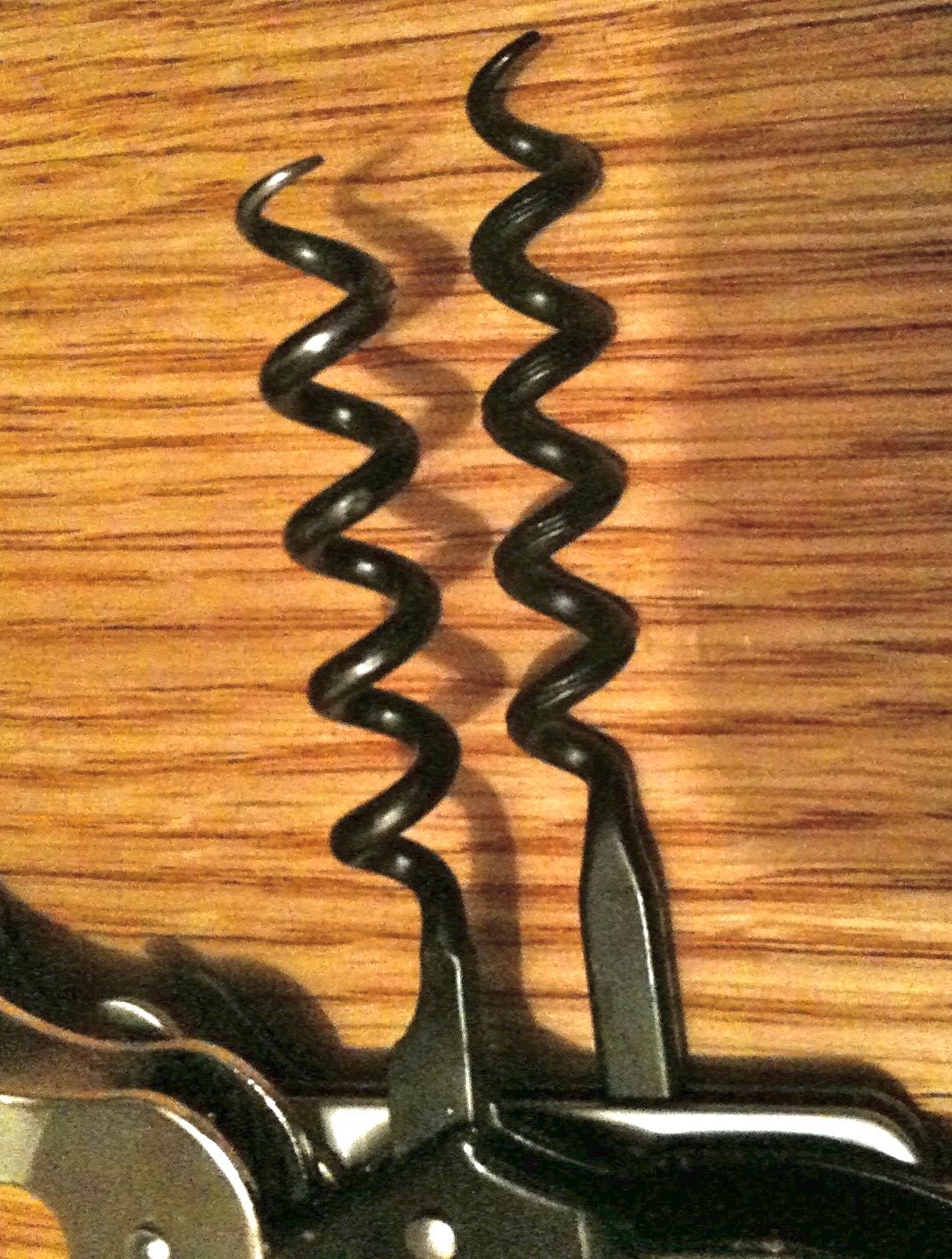
Corkscrew worms vary in length (photo courtesy of Levi).

4. How do you open an old bottle when the cork might be likely to crumble or break?

Levi - When you decide that you want to open up the bottle, you should do it on a flat, sturdy surface. Don't be a clown and try to open an old bottle of wine in the air. Not a good idea. You want to move the bottle as little as possible while opening it. One problem with this is that people in the room might want to see the label of the fantastically old wine and pick up the bottle from where you have it. That is a bad move. The less bottle movement the better, until the bottle is empty.

Sunken corks, that is, corks that are not flush with the bottle lip, present a problem. It is hard to get the right leverage with your corkscrew on sunken corks. This is especially a problem for single pull corkscrews. It is very easy to chip the glass around the lip in this instance, and that can lead to safety concerns. It is best to use a double pull corkscrew, and start with lifting when the worm is halfway in, and then drive the worm in further when you have lifted the cork a bit.

Another possibility is that a sunken cork might also slide right down the bottle neck when you start to press it with the corkscrew worm, which is usually a phenomenon that can accompany heat damage or oxidation. If the cork slides into the liquid, you can find yourself with a problem, because your first instinct may be to decant the wine, but the cork inside the liquid still covers the bottle neck at the bottom, and doesn't allow the liquid out steadily or at all. If this happens I recommend taking something long like a plastic straw and pushing the cork down with the straw while you decant. This will allow the wine out of the bottle.

Try not to pierce the bottom of the cork as you are getting it out of the bottle. If you go through a cork all the way with your worm, your will have better leverage for removal, but piercing an old cork will throw a lot of cork dust into the liquid.

Extracting cork fragments that are stuck flat on the bottleneck works better if you put tension on the corkscrew worm by holding it with two fingers against the bottle top as you turn the worm in. This also keeps the worm straight. If instead you are dealing with a cork that has hollowed out in the middle, but stuck to the walls of the bottle neck as you tried to remove it, then you are going to have to angle your corkscrew and pin the cork that is against with glass with the corkscrew worm, then pull up. You might have to do this a couple of times to get all the cork fragments out. You might think that something else besides a corkscrew will help you get those last bits of cork out of the bottle neck. I don't recommend experimenting with anything, like an oyster fork, unless it has an extremely long handle.

The Durand opener (photo courtesy of Levi).

Bottle openers vary a lot. For very old bottles, the best thing you can do is purchase a combination Ah-So and corkscrew worm, such as The Durand, which is available for sale at www.thedurand.com. These things really are genius, and will save you all kinds of problems.

Pieces of the Durand (photo courtesy of Levi).

It is also possible to make your own such combination, using a standard Ah-so and a separate T-Bar corkscrew worm. As far as stand alone corkscrews, I personally find that opening an older bottle is easier with a double pull corkscrew than a single pull. I usually use the Pulltaps corkscrew brand for double pulls. The problem with that is that the Pulltaps worm is not particularly long, and some old corks are. Also, the knife on a Pulltaps is pretty basic. You will often find a longer worm and a better knife, on a Laguiole or Chateau Laguiole. For this reason I try to keep a few different types of opener around, to help in different situations. Whatever you purchase it is very important to get a corkscrew without any kind of coating (besides paint) on the worm. You want a metal worm. The other types destroy old corks in a fashion that is fantastically disheartening.

Joe - Personally, I’ve had so many disasters with using a cork screw that I go straight for the Ah-So.

An Ah-So opener.

Peter
- High dexterity score is key. And an Ah-So. Last year, one of my friends bought this thing, which is awesome.

5. What should we look for when the bottle is first open - how can we tell if the wine is good or not?

Levi - How you handle the bottle can have a lot to do this. Murky, dull, and light colored red wine is a bad sign. But ultimately the test is the taste.

Joe - Check out the color and smell, especially to see if it’s maderized. Also, a lot of turbidity is usually a bad sign. Often wines will seem older when first poured and then will liven up. Wines, especially red Burgundy, can change color in the glass. Sometimes they can look more faded, but an old wine can actually becoming more youthful in appearance in the glass. They brighten up and darken.

Peter - Old wines are funny things—they don't necessarily reveal themselves right away. Sometimes with a very old wine it's even difficult to tell whether or not the wine is corked, as it can be musty and weird at first but then develop into something amazing later. You're looking first for flaws (i.e. TCA) and then for oxidation, but on the subject of the latter, it often pays to be patient. Many old wines actually feel fresher and more primary in flavor after 15 or 30 minutes than they do when they're first opened.

6. Any general thoughts on evaluating an old wine - for those of us who don't often drink old wine, it can be confusing.

Levi - The condition of a cork can tell you a lot about storage. First of all, once you get a cork out, it is worth checking to make sure what it says matches what the label of the bottle says. If not, that can mean that you a forgery on your hands. More generally, if the cork has a muffin top and flares out above the bottle lip, that can indicate that this wine has seen poor storage. Similarly if there is a visible line of dried wine stain down the cork length. Often enough, an very old cork will be completely soaked with wine stains, so this isn't a terrible, terrible thing, but neither is it desirable. On the other hand, a too perfect, pristine cork in a very old bottle often raises about possible recorking that might have taken place with this bottle. It is worth considering if the bottle is a recent release (however old the wine's vintage may be) from the winery, as the corks should then look pretty great.

Joe - Basics like looking at the fill and looking for seepage and things like the cork pushing up or receding are usually very helpful. Clumps of caked on sentiment in one area of the bottle can be a bad sign (but this isn’t always the case.) Also, look at the color in the light to see if whites look oxidized or reds look turbid and brownish. It really depends on the wine: Auslesen and old sweet Chenin Blanc can appear really dark and be perfectly fine, for instance.

Peter - There should have been a reason for aging it. Is it better in some way than a young version of that wine would be? Ideally, an old wine would have developed an inimitable complexity and character while fusing its components together into a more seamless harmony—the disparate parts of a young wine are now integrated into a complete whole. But just because it's old doesn't necessarily mean that it's better. Old wines can be mediocre too. And everybody has a different sort of threshold as far as maturity goes. I like mature flavors, and I tend to prefer my wines a little older than most people do. A wine should definitely retain vibrancy and energy—it shouldn't be dead or overly oxidized. But I don't always care about things like primary fruit. You drink old wine because you can't get the same experiences that you do in young wine, and drinking a grand wine in maturity is one of life's greatest pleasures.

7. Do your ideas about pairing wine with food change if the wine is old?

Levi - The adage is true: simple food is better with old wines. Steak. Squab. Mushrooms. Risotto. They are all on my old wine team.

Joe - The hope is that aging wines results in them stretching out, having integrated flavors and becoming more nuanced and complex. I want the wine to shine and take center stage without much interference. I like to keep things simple with straight forward, uncomplicated dishes. There’s nothing wrong with a perfectly roasted chicken (or guinea hen), leg of lamb, or fish. I try to avoid overly pungent and bright flavors that have the potential to cripple to the mature fruit on an old wine.

Peter - I generally think that the older the wine is, the simpler your food ought to be. I don't necessarily believe that the best setting for a great mature wine is a Michelin three-star restaurant. My favorite way to experience an old bottle is to drink it at home, making some food that complements it but that doesn't compete with its complexity.

8. Any other advice most appreciated.

Levi - Keep in mind that the kind of capsules you find on older bottles, say of Bordeaux before 1990, had lead in them. They are firm, often stick closely to the bottle neck, and tend to come off in long strips if you unwind them from a cut in the side of one. These kinds of capsules tend to leave a nasty cut on the finger if you aren't careful with their removal. You can always tell a sommelier who deals with a lot of older Bordeaux: they will have a bunch of small cuts on their index finger. It can be helpful to angle your corkscrew knife about 45 degrees into the groove underneath the top part of the capsule, cutting upwards. This will result in a clean line cut into the capsule, and also encourage the top part of the capsule to flair out at the cut edge, allowing for easier removal. When lead capsules are involved, I think that it becomes especially important to wipe with a wet, clean cloth the bottle top after the capsule has been removed (and before the cork is extracted). This prevents small particles of lead from getting into the liquid later as you pour. Older bottles may often have a bit of fungal growth under the capsule anyway, which should be removed in the same way, with a wet cloth.

If instead of a lead capsule you encounter a wax capsule, I recommend placing a napkin underneath the bottle before you open it. That way, the small bits of wax will fall onto the napkin instead of your table surface, and you can collect them all easily at the end of the process by gathering the napkin up. Some people scrap or bang away wax from the top of a bottle before opening. I think that in the case of older bottles, this only encourages the kind of vibration that moves the sediment around, so I don't encourage it. Rather, I drive my corkscrew worm directly into the bottle's cork, through the wax, and the wax comes away from the top as the cork is extracted. The only time you don't want to do this is when you might be dealing with a half-cork stopper, like in the case of certain Cognacs, for instance. In those instances there is no driven cork, for the corkscrew worm to meet when it goes in the bottle top.

(Photo courtesy of Levi).

There are broadly speaking, two kinds of wax that you will encounter, the hard flaky kind and the soft, pliable kind. If you want to remove the soft kind from the bottle neck side (to prevent pouring liquid over it), you can run your corkscrew lever up and down the side of the bottle, creating two long groves in the wax. You will find it easier to remove the soft kind of wax from the bottle if you then start pulling from where the grooves are.

Joe - Aged wine often seems like a fetish for people. People associate quality with ageability. They immediately want to know how long a wine can age, and the longer the better. Not all wines benefit from aging; and not all people enjoy mature flavors in wine. There’s something to be said for drinking wine in its sprightly youth. Don’t get me wrong, I really enjoy old wine, but I often worry that people are lead astray by thinking that older is better. Like people, there’s more that can go wrong with wine as it ages.

Peter - Always have a good alterations tailor. Don't use Microsoft products. Never trust a guy who doesn't look you in the eye when he's shaking your hand.

-----

By the way, I should have asked these guys before drinking my 1959 Barbaresco. I did not decant, but opened the wine at noon on the day I would serve it at about 9 in the evening. I used a double pull corkscrew, but the cork broke in half. When I tried to get in there again with the corkscrew, I just pushed what remained of the cork into the bottle, and there it sat, broken and dusty, in my lovely old wine. I tasted it about every two hours until we drank it. It was great to drink such an old wine, and it was very delicious, but not mind-blowing. In fact, one experienced taster suggested that it might have been better about 10 years ago.

Wednesday, April 06, 2011

An Evening with the Jura Wines of Domaine Ganevat

I was lucky to attend a dinner recently at which Levi Dalton poured a large selection of Jean-François Ganevat's wines. Domaine Ganevat is in the Jura, in a town called Rotalier. I could try to describe the estate for you, but I would just be sourcing Joe Salamone's excellent article on the Crush website. In a nutshell - this guy is a thoughtful farmer who makes very small quantities of more than 40 wines. His goal is to show the most specific expression possible of the many soils and grapes he farms.

Jean-François Ganevat doesn't have a computer, doesn't use email, has no website as far as I can tell, has never been to the US, and is not particularly interested in promoting his wines. Ganevat's US importer Jeffrey Alpert also has no website and doesn't shout about these wines. They are just beginning to become a regular presence on the shelves of those retailers who care about Jura wine, and this is a testament to how good the wines really are - it's almost as if they are being kept a secret, and yet people are finding them.

I've had only limited experience with the wines, but so far I'm a fan. I drank several bottles of Ganevat's Trousseau in the past two years and I like it very much, but it is very reductive upon opening and requires a serious decant. So do each of his reds actually, and of them it is the Poulsard (called Cuvée de l'Enfant Terrible) that I find most rewarding. The new vintage is 2009 and it's completely delicious.

At the dinner I tasted a red called J'en Veux for the first time. This is a field blend of 17 grapes, none of which are known to wine lovers or scientists. The 2009 happens to be the one estate wine that Ganevat de-stemmed entirely by hand. That's right - in 2009 he used a scissors to remove almost all of the stem from every grape that went into this wine. It is highly aromatic, with bright fruit and flowers, ample in the mouth, and it just feels good. Light in body, low in alcohol (11%), with lovely and intense flavors, this wine will fascinate and delight you if you can find it, and should cost about $30.

And by the way, shad roe with new potatoes and herbed mayonnaise was a great pairing with the red lineup. My first time eating shad roe (I know, I know) and it was an inspired pairing.

Until this dinner I'd had only a couple bottles of Ganevat white wine, and I must say that I was very impressed. Considering the lineup of whites as a whole, I think that they might be as good as any lineup of white wines that I've tasted from the Jura. There are wines made from Chardonnay, Melon-Queue-Rouge, and Savagnin, and there are ouille (topped up) and sous-voile (oxidized) styles.

Levi tested all of the wines before the dinner and at one point he said to me "The 2004 Les Chalasses...wow, it's drinking pretty well right now."

Levi has not had an easy go of it lately, with the closing of his restaurant Alto, but that hasn't impeded on his ability to organize one hell of a wine dinner.

And indeed it was. This is Chardonnay from vines of over 100 years old. The wine is topped up, but like many topped up wines, it has something of the same oxidative character that you find in the whites that are raised sous-voile. Or maybe, this character is actually a function of the Jura terroir, not a result of the type of elevage. Anyway, we drank Les Chalasses from 2004 and 2008, and I thought they were both excellent wines. The 2008 was vibrant and pungently mineral with great freshness and a core of energy that bodes well for the cellar. Several people preferred it to the 2004, but on that night I preferred the mature and elegant grace of the 2004.

I loved the 1999 Les Vignes de Mon Père, a Savagnin from Chalasses vineyard, normally topped up, but this wine felt like a sous-voile wine (and Joe's article mentions that is because the wine was actually not topped up at the end of its elevage). The sous-voile wines were excellent too, including a show-stopping 2002 Vin Jaune.

Jeffrey Alpert, Ganevat's US importer.

The thing to take away here is that there are still great wine makers who make great wines that are not yet or just beginning to make it into the US. Jean-François Ganevat is one of them, and if you like Jura wine, these are worth a special search.

Wednesday, January 19, 2011

Sunday Lunch for the Ages - A Guided Tour of the Early Days of Rosenthal Wine Merchant

This past weekend I participated in one of the greatest wine events of my life. Neal Rosenthal and his wife Kerry Madigan made lunch for a group of people and opened a slew of wines to share. This was not a business lunch. The only wine business people in attendance were people who work for Neal and Kerry. Well, one wine business guy was there, Levi Dalton, but he was there to celebrate the wines and the company. His post about the event is far more poetic than mine, by the way.

This lunch happened in part because Neal genuinely loves to share his old wines with people who will share his delight in them. For the lucky guests, it was a guided tour of the early days of Rosenthal Wine Mechant's French portfolio. Neal served the wines and we talked about them as we ate, thought about them, heard stories about the people who created them, about the different time in which they were made. The wines were very special. Old vintages, stored undisturbed in Neal's underground cellar. They showed what great wine is capable of when taken care of properly for 20-plus years.

It is tempting to list the wines and to share notes with you - these are some of the greatest wines I've had. But that just doesn't feel like it's in keeping with the spirit of the event. Here's the thing - we crammed into several cars and drove from NYC where the snow was in gray and black piles against the parked cars, to the hilly horse farm country of mid-state New York. To an oasis of perfectly cellared wine and delicious wholesome food. Everything was covered in a pristine white blanket. The sun shone brightly, and the collective mood was high. We truly enjoyed each others' company and everyone there recognized how special of an experience it was. There was no note taking, point scoring, chest thumping, one-upping, well-I-once-drank-a-1952 recounting, check listing but not truly drinking and understanding, nonsense.

Here are a few of the things that I took with me:

We drank a mature Blanc de Blancs Champagne out of magnum, and it showed how majestic Champagne can be in the large format. The wine felt fresh and vibrant, as if it was still expanding. Amidst the honeyed tones there was a palpable richness in flavor and texture, not the elegant chalky sense one might expect. This is because the wine is from a place that actually favors and specializes in Pinot Noir, not Chardonnay. The terroir left a stamp here that after 25 years continues to speak as loudly as the grape.

We drank several outstanding wines from the 1983 vintage, considered to be very difficult, an off year.

The wines, though, were spectacular. A reminder to buy wines from the producers that you love, even if from the off vintages. Who knows what they will turn into when they're fully mature?

We drank three mature white Burgundy wines, one from Meursault, one from Puligny, and one Corton-Charlemagne. In the hands of these producers, and after their long sleep in a proper cellar, they could not have spoken more clearly about their places of origin. Here is what they said to me: Meursault is a little bit oily in texture and smells a bit like hazlenuts, and the Perrieres vineyard is all about stones.

Puligny is more elegant, lighter in body, but firmly structured, and can take on complex mushroom and incense aromas when mature. Corton Charlemagne takes a long time to come around, but then shows amazingly complex aromas, and minerality and acidity that seem never to fade.

We drank a wine from the Gaudichots vineyard, the great vineyard that decades ago was carved up to create La Tâche. The aromatics were amazing, and reminded me of why if I had to take one and only one wine with me to a desert island, it would be something from Vosne-Romanée.

We drank one wine blind and talked about it a bit. I thought it was an early '80s Barolo or Barbaresco. Someone else agreed that it was Italian. Another fellow disagreed, saying that the wine didn't have the mouth feel of Nebbiolo, that this was more Burgundy. Everyone enjoyed the wine, and everyone was surprised when it was revealed to be a California Pinot Noir from 1976, a time when a lot of great wine was being made in California in the gently extracted and low alcohol old-world style.

We drank a first-growth Bordeaux from the 1978 vintage that Neal purchased upon release. The wine was delicious and it was fascinating for me to drink, as I had never before drunk a first growth Bordeaux with that kind of age. And no one felt guilty for saying that although it was undeniably excellent wine, it didn't make our hearts leap the way the nose on the 1983 Clos de la Roche did. Or any of the Burgundy wines did.

We drank a wine from Hermitage from a producer I was unfamiliar with, and although I hesitate to make superlative statements, this was without question the finest northern Rhône wine that I have ever tasted in my life. It was the color of Poulsard, not really much more than rosé. This wine had the structural phenotype of Burgundy, but with entirely different aromatics. Such intensity - rose petals, peppercorns, herbs, and all infused with this persistent animale tone. An inspiring wine that made me feel a bit sad about the rather uninspiring state of the nothern Rhône today.

We ate wonderful cheeses, various fruit tarts, and talked some more. Daylight slipped away and the sky turned a dusky cobalt blue. We drank strong coffee and found some or other excuse not to find our coats and shoes, not to leave this place and this magical afternoon. But leave we did, and we left grateful and elated. And we will see each other again.

Thank you for a truly memorable afternoon Neal and Kerry, and everyone else too.

The wines:

1985 Lassalle Brut Blanc de Blancs
1996 Bitouzet-Prieur Meursault 1er Cru Perrières
1990 Carillon Puligny-Montrachet 1er Cru Les Champs-Canet
1983 Rollin Père et Fils Corton-Charlemagne
1992 Domaine Forey Père et Fils Vosne-Romanée 1er Cru Les Gaudichots
1989 Domaine Faurois Vosne-Romanée 1er Cru Les Chaumes
1983 Hubert Lignier Clos de la Roche
1976 Tulocay Napa Valley Pinot Noir Heinz Vineyard
1978 Château Latour
1985 Ferraton Père et Fils Hermitage La Cuvée des Miaux
1983 Bernard Levet Côte-Rôtie La Chavaroche

Thursday, January 13, 2011

A Coteaux Champenois Tasting

Not all Champagne is sparkling wine. Peter Liem, many of whose comments and ideas are paraphrased within this post, told me that the modern history of sparkling Champagne is only 300 or so years old, and that Champagne used to be a still wine. Many Champagne producers continue to make small amounts of still wine, called Coteaux Champenois. If you've never heard of these wines or never tasted one, you are most certainly not alone. Not a lot is made, and most of what is made is consumed in Champagne. The grapes used to make Coteaux Champenois are the same highly valuable grapes that could be used to make Champagne - it just doesn't make good financial sense to divert production from a highly profitable wine that is in demand all over the world to a little known wine that is harder to sell at the same prices.

So why is Coteaux Champenois made at all, given that logic? Well, producers need still red wine if they make a rosé of Champagne by blending still red wine into sparkling wine. Also, people in Champagne enjoy drinking red wine from time to time and from what I gather, in much of France, you drink the local wine. Perhaps most importantly, Coteaux Champenois continues to be made because some producers want to honor the tradition and history of Champagne. "Take Larmandier-Bernier, for example," Peter said. "Pierre Larmandier wants to make red wine from Vertus Pinot Noir because he wants to preserve the history of Vertus."

Coteaux Champenois can be red, white, or rosé, although the red wines are by far the most common. The wines can be released as vintage wines or non-vintage wines, and do not need to be aged in bottle for three years, as sparkling Champagne does, in order to be labeled as vintage wines. The villages where Pinot Noir thrives are also the villages that make highly regarded Coteaux Champenois. Bouzy and Ambonnay are perhaps considered as the sources of the finest wines, but there are excellent wines made elsewhere too.

There are very few examples of Coteaux Champenois available at retail stores. Importers have trouble selling the wines, and so they don't bring them in. "I have trouble selling them, especially a non-vintage still red wine from Champagne that would retail for $50," said Kevin Pike, Director of National Sales and Marketing at Michael Skurnik Wines. There are retailers, however, who believe in these wines enough to keep them in stock. Joe Salamone at Crush in Manhattan, for example, has been selling Coteaux Champenois for years, when he can get his hands on it.

Last summer I drank a bottle of 2002 Larmandier-Bernier Coteaux Champenois with a few friends and absolutely loved it. I knew I needed to try more. A few friends agreed, and we decided to buy whatever we could and to hit up a few importers for bottles that are not (yet?) available in stores. We recently got together over a completely fantastic dinner at Prune and drank the wines. It was quite a crew, including the aforementioned Peter Liem, Joe Salamone, and Kevin Pike, and also Levi Dalton of Alto (where at least one Coteaux Champenois is on the wine list), Dan Melia, Clarke Boehling, and Keith Levenberg.

The results were mixed, I would say. The two wines that I have previously loved didn't show well on this night. Other wines were disconcertingly big and concentrated - stylistic decisions by top quality wine makers. But there were a few true gems. Here are the wines we drank in the order in which we drank them, along with a few notes:

2008 Roger Coulon Coteaux Champenois Blanc, $40-50, Rosenthal Wine Merchant. I found myself saying "this wine smells just like Champagne!" It really does, just like a Blanc de Blancs. Tastes just like one too. Feels entirely different, obviously, and it was a strange sensation. This was the very first Coteaux Champenois Blanc I've ever tasted, I think I need more experience before saying much.

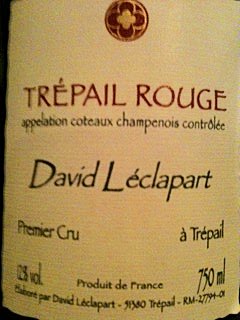
2008 Léclapart Coteaux Champenois Trépail Rouge, $55, Imported by Jandell Selections. Very fragrant, fresh red berries and flowers with woodsy undertones, very persistent. There is a "natural streak" here, as there often is in Thierry Puzelat's wines, for example. Bottle variation is significantwith this wine, apparently. This was a good bottle, the one I drank a few months ago was not as good.

2008 Egly-Ouriet Coteaux Champenois Ambonnay Rouge, $95, Imported by Michael Skurnik Wines. The nose is dominated by oak right now, and I found it hard to enjoy at this early stage, even harder to evaluate. Peter Liem told us that among many people in Champagne, this wine is considered to be the best Coteaux Champenois. I'd love to taste the '08 again in 5 or 10 years.

2001 Marie-Noëlle Ledru Coteaux Champenois Ambonnay Rouge, not imported (kindly donated for this tasting by Charlie Woods, whose company Bonhomie Wine imports Ledru's sparkling Champagnes). Still shows freshness, there is complexity on the nose, which becomes more layered and detailed with air, perfectly harmonious on the palate. Delicious, and one of my favorites of the tasting.

2004 René Geoffroy Coteaux Champenois Cumières Rouge, $55, imported by Michael Skurnik Wines. The nose is spicy, rich, voluptuous, and also energetic with dark fresh fruit. This is a powerful wine that doesn't lack for concentration, but still offers god detail and balance. I like Geoffroy's wines very much, and this was no exception.


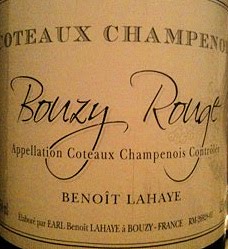
2003 Benoît Lahaye Coteaux Champenois Bouzy Rouge, not imported (kindly donated for this tasting by Jeffrey Alpert, whose company Jeffrey Alpert Selections imports Lahaye's sparkling Champagne). "Bouzy Rouge" has got to be one of the best names in the world of wine. My favorite wine of the tasting. The nose opens slowly (as with all of Lahaye's wines) but shows real elegance, especially in light of the very warm 2003 vintage. Mineral infused spicy red fruit on the nose, and a harmonious palate whose delicate red fruit shows a bit of maturity and although reflects some of the opulence of the vintage, for me didn't cross into over-done territory. Delicious wine, and Lahaye is an absolute star, in my book.

2000 Jean Vesselle Coteaux Champenois Bouzy Rouge, $41, Dionysos Imports. This wine showed a candied aspect that I didn't care for, and I found it to be a bit one-dimensional, uninspiring. But there were others who enjoyed it, so grain of salt here.

2002 Paul Bara Coteaux Champenois Bouzy Rouge, $40, Imported by Jandell Selections, although bara's sparkling Champagne is imported by Kermit Lynch. This wine was corked, which is a shame because in an odd coincidence I happened to drink a glass the night before this tasting, and it is wonderful wine, very intense but also very light in body, a truly excellent Coteaux Champenois.

2002 Larmandier-Bernier Coteaux Champenois Vertus Rouge, $40, Louis/Dressner Selections. This bottle did not show as well as the others that I've had. It was very reduced, even after an hour open, so we decanted it and it was much better. Similar in style to the Bara wine - purity, finesse, freshness, lightness in body. The fruit is rich and vibrant and the wine is well balanced, but it never became as good as other bottles that I've had. This bottle notwithstanding, this particular wine is the finest Coteaux Champenois that I've had.

2002 Bollinger Coteaux Champenois La Cote aux Enfants, $120, Imported by Terlato Wines International. Shows nothing of what makes Coteaux Champenois appealing. Overripe grapes, rasiny, too concentrated, chunky and not graceful, jut not enjoyable wine. I normally wouldn't condemn a wine like that, but I believe that everyone at the table felt approximately the same way, and so it's safe to say that my take on the wine is not an outlier. Bollinger is so great too, so this wine was quite confusing.

Tuesday, December 07, 2010

Two Excellent New Wine Blogs

Looking for something new to read about wine? Something very smart?

Here are two new wine blogs, one called Cellar-Book by Keith Levenberg. Keith used to write The Picky Eater, and this is his new site.

The other is called So You Want to be a Sommelier, and is written by Levi Dalton.


These are two incredibly smart fellows, and their writing is excellent too. If you like wine, and blogs, you should check these out.

Monday, November 22, 2010

What Makes a Good Vintage?

Thanks to my then girlfriend, now wife BrooklynLady, sometime in 2004 I rediscovered wine. I had no idea, really, of what it was that I liked (and I'm still figuring it out). I mostly bought daily drinking wines, but I also made the occasional purchase of a special bottle, something a bit more expensive. I didn't yet know where to look for meaningful information about wine, but I wanted to spend my money wisely.

One of the things I used was a vintage chart. I still have it, actually.

Think about it - there are so many bottles on the shelves, so many choices on auction sites. How can some one who is serious about getting into wine, and on a limited budget, sort through it all? The vintage chart is such a helpful tool, like a cheat-sheet. Before buying a special bottle I always made sure that the vintage received a high rating on my sheet. And if it got a low score, or if the vintage wasn't listed on the sheet, I would pass.

I know now that this is an absurd way to buy wine - to think about wine, even. But that's only because I now know enough to understand how much I don't know. When you're starting out, a vintage chart helps to make sense of the enormous set of wine choices. Then you learn aphorisms like "good producers make good wine in all vintages," and perhaps you focus more on terroir and producers. And one day you spend $75 on a great producer's villages Burgundy from 2004, and you realize that it might be true that good producers make good wine in all vintages, but there are better ways to spend $75. It's all part of learning about wine. I won't understand the mistakes I'm making now for a few more years.

I think about vintage now when I buy a special bottle of wine, but I think about them according to my own taste and experience. Because I am attracted to wines made in a lean and graceful style, I find that I prefer wines that come from quiet vintages that don't attract attention. For example, I really like the Loire red wines from 2007. This was a typical year with a typical set of problems, and no one declared it to be a blockbuster vintage. 2005, on the other hand - a vintage of the decade. I would bet huge sums of money that I will prefer the 2007's in 15 years, but time will tell.

I don't know a lot, but I'll tell you this: when it comes to "great vintages," it's better to decide for yourself. And who cares if you wind up liking a vintage that the critics deride? You'll enjoy your wine and pay less for it too.

I was reminded of all of this the other night when I had the good fortune to attend an amazing wine dinner at Alto put together by the inimitable Levi Dalton. You may have heard about this, as my pals at Do Bianchi, McDuff's Food and Wine Trail, and Rockss and Fruit were also in attendance and have already written a bit.

We drank Nebbiolo made by Peter Weimer of Cascina Ebreo in Novello. His flagship wine is called Torbido!, although it is made in a place and in a style so that would normally be called Barolo. We drank several vintages of Torbido!, beginning with the first ever vintage of 1997, and including 1998, 1999, 2000, 2001, and 2004. We also drank the 2002, although it was released as Limpido!, not Torbido!

Jeremy Parzen of Do Bianchi told me, "Peter Weimer allows the vintage to express itself, he doesn't force the wine to become something it isn't." Drinking these wines, then, was an amazing opportunity to learn something about vintages in Barolo. Which ones would I prefer?

Take another look at the vintage chart. 2000 and 1997 are rated as essentially perfect vintages. Everything, in fact, with the exception of 2002, is supposed to be very good. My experience was a bit different.

I liked most of the wines very much, although there was one that I found essentially undrinkable. That was the 1997. To me, it was a shapeless wine with no focus, and the fruit had an oxidized character. It had no energy, and seemed out of balance to me. I would drink the passable 2002 over the '97 every time. But there were at least two other people at the table who preferred the 1997 to any of the others.

I did like the 2000, the other blockbuster vintage according to my chart. It was not as profound as other wines on the table, but it was balanced and somewhat expressive, and entirely drinkable. I didn't like the 1999 so much at first, as it had a diffuse and overripe character on the nose that was very similar to the 1997. But I came back to it later on and it was truly a lovely wine - good energy, clean ripe fruit, good acidity, and quite harmonious. Jeremy said that it was the most classically styles of the wines, and I think I understand what he meant. My personal favorite was the 1998. I loved the pungent truffley aromas and the fine grained tannins, the intense and yet graceful character of the wine. The 2001 was clearly a beauty, but like the 2004, it was showing only a little bit of itself at this early stage of its life. Who knows what they will become?

This was a solid reminder for me that regarding wine vintages, as with most everything else, I'll always be happiest when I do my own thinking.

Sunday, October 31, 2010

When All the Wines are Noble, Old, and Glorious (Except for the one that I Brought)

I went out to dinner with my buddy Levi the other night and it turned out that I brought a proverbial knife to a gunfight. It was a "soft" opening for a new Thai restaurant downtown in the old Cru space. Thai food for the western palate. I figured that I'd bring something tasty that would go with the food, we'd have a few glasses and enjoy our meal, nothing terribly fancy. It turned out to be one of those nights where everything you drink is noble, old, and glorious.

As we sat down I took out the wine I brought along, the 2008 Pierre Gonon St Joseph Blanc Les Oliviers, $32, Fruit of the Vines Imports. But that bottle waited in the corner of the table, as a magnum of 1996 Bollinger Grande Année appeared. So that's how it's going to be. I was surprised by how open and utterly drinkable the wine was, as you hear about how acidic and closed down the 1996's can be. Not this one - it was generous and just lovely, very much a wine of finesse. The finish was delicate and intense, with this kernel of floral fragrance that left a great impression. I don't know how long this bottle had been open - perhaps it was shut tight 6 hours prior to me drinking a glass, but in any case, certainly a compelling case for 1996 Bollinger.

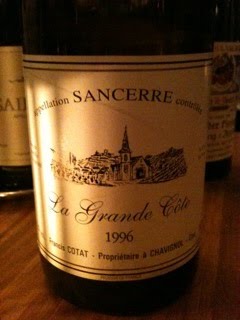
Then Levi pulls out a 1996 Francis Cotat Sancerre La Grande Côte, Michael Skurnik Imports. Yes, Francis, not his son François (I think it's his son, anyway). This is a phenomenal wine, and one of the interesting things about it is that honestly, served blind, there would be no way to peg it as Sauvignon Blanc. We agreed that it smelled, tasted, and really felt like Chenin Blanc - an old Montlouis, Levi said. In any case, it is beautifully and energetically aromatic, perfectly balanced, rich with baked apples, and it expanded and changed quite a bit over the course of an hour. A great argument for cellaring high quality Sancerre.

If my night had ended there, I would have had plenty of wine to think about. But Levi works most nights and doesn't himself get to go out to dinner very often. So he couldn't stop himself from bringing along a bottle of old Riesling, the 1976 H. Josef Fries Noviander Honigberg Riesling Auslese, Savio Soares Selections. The first surprise about this wine - it was very fresh and vigorous. The wine is 34 years old. One of the very kind servers appeared with a wine by the same producer, but from the 1992 vintage, "just to compare," he said. That wine was also delicious, and it seemed like a newborn baby in the company of the golden rich 34 year old wine. In the 1976 there was a little petrol hint, but for me the overall sensation of the wine was this slow-creeping herbal honey over rocks. It drank dry, by the way, and I didn't know it was an Auslese until I looked more carefully at the label.

By the way, as I was putting my coat on to leave, the Gonon St Joseph had finally opened up and was a delicious blend of flowers, white fruit, and stones. If you happen to have any of this, seems like it's worth leaving it alone for a few years, at least.

That should be enough, and I should be winding up this post up, but Levi suggested as we were leaving that we go to Babbo, just to drink this wine he had been wanting to drink for 6 months, a wine that no one else sells. And so we did. It is a solera wine from Sardinia, the 1987 Attilio Contini Vernaccia di Oristano Riserva. This is the kind of wine that really makes you wonder about things. Why solera wine, in Sardinia? How does it taste at the same time like Manzanilla sherry and also like the orange bitters and spice of Chinato? Does 1987 refer to the youngest wine in this bottle? Will I ever feel as though I actually know anything about wine? Probably not.

I've never before tasted anything like this wine. I guess it's considered to be a dessert wine, but I cannot imagine drinking it with sweet food. Certain cheeses, maybe, like something hard and salty made of sheep's milk. I would love to drink it again as the focus of an evening, but apparently there really isn't any more of it to be had in these parts.

I often dream about moving with my wife and small kids out of New York to some smaller and more manageable place. This kind of evening, though, reminds me of how amazing it is to be here in that without expecting it, you can experience several different esoteric and beautiful things from all over the world, with friends, in one night.