Tidbits
Been busy and not able to write as often, but please don't think that means I've been starving and not drinking anything interesting. Oh no, my friends, I've been a very lucky Brooklynguy lately, in large part due to the generosity of friends. Here are some tidbits, things from the past few weeks that are worth mentioning: Slope Farms sells pork now. I cannot tell you how excited I am about this. Ken and Linda Jaffe (former Brooklynites who moved to the Catskills) are dedicated to farming healthy cows, and theirs is my absolute favorite beef. I'm not sure of the details on this new pork venture, but I hear they have an elder and respected neighbor who advised them as they set up their farm. This neighbor raises pigs. The Jaffes now sell their neighbor's pork. Look at the marbling on the meat, and the beautiful color. I've tried the chops and a rib roast so far, and WHOA, this is very very good pork.
 And on the other end of the food spectrum, processed food, I've discovered what I now believe to be one of the finest canned food products - Heinz baked beans, the kind they sell in England. These are done in tomato sauce, not in that cloying brown sugary sauce that our baked beans swim in. If you see these, try them. Okay, they're canned, but they're actually not that bad for you. And they taste so very good.
Some wine too... 2001 was not a very good vintage in Champagne. Not many vintage wines from that year - it was rainy, especially in the weeks leading up to harvest, there was a lot of rot, and it was a challenge for the grapes to ripen. I know from reading ChampagneGuide.net that this is considered to be one of the most challenging vintages of the past 20 years. So it was fascinating to have the opportunity to try a vintage wine from 2001, Jean Vesselle's Brut Prestige. This wine is all Bouzy, a blend of 70% Pinot Noir and 30% Chardonnay, but it reminded me of a wine I tasted a few years ago by Moutard that is made with the obscure grapes of Champagne, things like Arbanne and Petit Meslier. The wine had overt notes of green herbs and leafy vegetables, and I think it would have benefited from a few grams more of dosage (it was dosed at 3 grams, I believe). But really, it was good wine, well balanced and particularly lovely on the nose. I cannot say that it is what I dream of when I want Champagne, but it was a very good wine, and a reminder that it is possible to enjoy well-made wine from bad vintages.
I had dinner with a few friends and we each brought wine to the restaurant. These were good wines, on paper anyway. We arrived at 7:00, opened everything, and it was clear that nothing was showing very well. After a little while, I don't know how long exactly, but probably an hour or so, all of the sudden everything was fantastic. I'm talking about a bottle of 2000 Vincent Dauvissat Chablis Les Clos that was butterscotch pudding for a while, and then turned into this detailed and focused thing of beauty. Some caramel notes, but also a bunch of freshly picked white honeysuckle. Pungent, long, and intense with a saline edge to the finish, this was a beautiful wine, a very special treat.
 And the 1990 Robert Ampeau Volnay Santenots, a wine that began better than the others, but still was a tangled mess. And an hour later it was gorgeous - a complex and beguiling nose that had that vibrant mature-wine-pungency thing. Flowers, musky and gamy, but in the end, very much about stone. And it is the texture that gets you - the wine couldn't be more silky, and this silk surrounds what essentially is a wine about rock. Textbook Volnay, and a truly compelling and lovely wine.
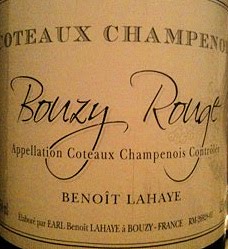
 And the 2002 Paul Bara Bouzy Rouge Coteaux Champenois, a wine that was probably the messiest of all when we first opened it, all bramble and pitch black fruit and very disjointed. But later on, I swear this wine was the freshest and most detailed wet stone basket of ripe strawberries, so pure and elegant, light as a feather. And the 1999 Eric Texier Côte-Rôtie, a wine that fooled all of us. It was a red fruit mash at first - I would have guessed a Grenache heavy wine from further south had I tasted it blind. This one took the longest to come around, but when it did it was a classic old school bloody, meaty, black olivey, and very mineral northern Rhône Syrah.
Can I tell you that the next day I learned that our dinner occurred on a flower day...but only after 8:00 PM. Why do these annoying coincidences keep happening with the confounded biodynamic calendar and the way wines taste? At a restaurant in Boston I drank a bottle of 2007 Didier Dagueneau Blanc Fumé de Pouilly. The wine was beautiful, a perfect mingling of freshness, tension, elegance, and quiet intensity. It was not in any way showy, and was amazing in its perfect harmony, not for any one particular characteristic of aroma or flavor. Wow, I wish I had more experience with Dagueneau's wines. They are awfully expensive now.
 I recently drank an Emidio Pepe wine for the first time, the 2001 Montepulciano d'Abruzzo. It had been open for hours before we drank it with dinner. I loved it, really loved it. Such interesting and delicious wine. Jet black fruit, very brawny, but detailed and fresh, with cooling herbal aromas, and a streak of something like tar and leather. It was lovely with the aforementioned Slope Farms pork roast, and I must find a way to drink this iconic (and expensive, and apparently very variable) wine again.
 Lastly, look at this nice list of white wines by the glass. This is at the restaurant Herbsainte in New Orleans. I was down there recently for work, and stopped in to have a cocktail before retiring to my hotel room. But before I could order, I overheard the bartender telling another man that there was a buttermilk fried Louisiana frog legs special that evening. Hmmm.
 Forget the cocktail - I ordered a glass of El Maetsro Sierra Fino (!) and the frog legs. Well that whole situation was so delicious, that I decided to keep going, and drank a glass of the 2010 Domaine du Closel Savennières La Jalousie with a little plate of Gulf shrimp and grits with okra. Even more delicious! You know, I used to love Closel but I kind of gave up on the wines after not liking anything after 2002 (and after the last of my 2002's showed oxidized). I told friends that I was done with the wines. Well, I have no idea what's really going on with Closel, but honestly, this 2010 was just excellent - fresh, pure, balanced, showing typical wooly and waxy notes and lots of minerality. A reminder to me not to make pronouncements about wine. I just don't have the years of drinking experience to make pronouncements.