Showing posts with label Benoît Lahaye. Show all posts

Thursday, December 12, 2013

An Evening with the Champagnes of Benoît Lahaye

Benoît Lahaye is probably the best grower/producer in Bouzy right now. I use "probably" because I haven't sat down recently with a bottle of Champagne by Camille Savés or Paul Bara. But I feel pretty confident on this one. Lahaye is making excellent wines, mostly of Pinot Noir from Bouzy.

Lahaye is a smart winemaker, strategically varying in his use of wood for fermentation, using naturally occurring versus selected yeasts, cork or crown capsules for secondary fermentation, presence or absence of malolactic fermentation, and deftly blending wines. There are 8 cuvées, I think, which sounds like a lot for a guy who owns fewer than 5 hectares of land. There's just not a large supply of any of the wines. He is also ultra-conscientious as a grape farmer. The first paragraph of Peter Liem's profile of Lahaye on ChampagneGuide.net describes this:

A passionate advocate of natural winegrowing, Benoît Lahaye took over his family’s estate in 1993 and has been bottling wine under his own label since 1996. He became interested in natural viticulture early on, and inspired by Patrick Meyer in Alsace, Lahaye completely stopped using systemic herbicides in 1994. By 1996 he had begun to work organically, in addition to using cover crops in the vineyards and experimenting with biodynamic treatments; the estate was fully converted to organic viticulture in 2003, and certified organic in 2007. Lahaye has noticed a pronounced difference in his wines since the transition to organic farming. “It’s not really a question of being better,” he says, “but my wines attain higher levels of ripeness now, while retaining the same level of acidity.”
I first tasted a Lahaye wine on the same day that I first met my good friend Peter - he brought a bottle of the 2002 vintage wine back from France and shared it over dinner in Portland. Since that day I drink the wines at every opportunity. Bottles are not easy to find, but there were always a few places. I used to drink the rosé off the list at Vinegar Hill House when it was something like $55. I could find a bottle here and there at places like Chambers Street and Crush. Peter always told me that a decade from now there are a few Champagne producers who will be widely recognized as superstars, and Lahaye is one of them. buy the wines now, while you can, he said.

I am not an expert with Lahaye wines. But here is my take: like many Champagnes, they show better when they are opened well ahead of drinking them. I've never had a mature bottle, so I have no idea how they age. But the young bottles - open them a few hours before you want to drink them, if you can. And if you cannot, consider decanting, although that can change the texture of the wine. Lahaye's wines generally show great intensity of character, as opposed to opulence or overt richness. The best bottles show vivid and detailed aromas and flavors, and provide hours of interest and deliciousness. I find these to be particularly food-friendly Champagnes, too, working well with a good variety of dishes.

All of that said, I've never tasted the lineup of wines in one sitting. I've never opened more than one Lahaye bottle at a time - I've never done anything with Lahaye wines other than to enjoy them bottle by bottle. Not that there's anything wrong with that. But I was excited, then, when a few friends agreed that it would be good fun to find as many bottles as we could and to drink them all together, over dinner.

We did this on a recent night and it happened that the weather turned entirely weird, reaching over 60 degrees on a December day, and poured rain in buckets. There are some evenings when the wines show beautifully. This was not one of them, my friends. The wines were fine, but did not show much of the intrigue and beauty that made us fans in the first place. There were things to appreciate and I very much enjoyed them. But some of the folks at the table who had not previously had a lot of Lahaye wine - those folks perhaps think that the rest of us are weird for loving this producer.

Here are the wines we drank, along with some notes (we found everything except for the Brut Nature and the Blanc de Noirs):

Benoît Lahaye Champagne Brut Essential (I'm not sure of the base year here, but I believe it was 2009) - as one might expect, this turned out to the the most accessible of the wines on the table, but hours later as we revisited the wines, it was the one that held up the best on this evening of strange fluctuations in humidity and air pressure. This is a blend of mostly Pinot Noir (85%) and Chardonnay and it is overtly delicious, although less complicated than the other wines on the table. But it is a good example of what Lahaye wines tend to be - ripe but entirely focused, vinous and intense and with a certain purity of expression.

Benoît Lahaye Champagne Naturessense Brut - this is made of equal parts old vines Pinot Noir and Chardonnay, from a blend of vintages. It is unusual in that it is vinified entirely in wood, and on this night the immediate impression of the wine reflected this. It was distinctly woody in the first half an hour, and although there were nice aromas of creamy lemon and stone in there somewhere, I found the wood to be distracting. But then 90 minutes later when I came back to the wine, the wood was much better integrated and the wine showed much better. I enjoyed the merging of the influences of red berry and lemony fruit, creamy richness, and focused minerality here, and I would like to drink this again on another night soon. I'm not convinced that our experience was representative of the wine.

Benoît Lahaye Champagne 2007 Brut - One of the great values in Champagne right now, Lahaye's vintage wine showed well even on this poor night. This wine is also vinified in barrel, although I find no real wood influence in the wine. It took a while to unfold on this night, and I doubt we experienced it at its best, but I love this wine in general for its deep darkly intense Bouzy fruit, its elegant balance, and its almost vicious minerality. There is a lot of material here and this seems like something to forget about for a while in the cellar.
Benoît Lahaye Champagne (2009) Violane Brut Nature - This is the newest of the Lahaye wines,  and this one based on 2009 is the second release. This is a Champagne made without the addition of sulfur. Okay, I'm not a fan of "natural wines" just because they are "natural." This one, however, is compellingly delicious. It was immediately and entirely apart from the other wines on the table in its fruitiness. Grapey, almost. In a good way. Clean and pure dark fruit really vibrates here, and underneath that, chalk. But on this evening, it didn't hold up well, and the thread that held the wine together began to come undone. But I know this to be a great wine and I think it just showed very poorly on this night.

Benoît Lahaye Champagne Brut Rosé de Macération (2009, I think) - Lahaye's rosé has been available here in NYC for longer than many of his other wines. It seems to be a polarizing wine. I've drunk bottles with wine lovers who simply do not enjoy it, and on this recent evening I heard one person say that it has an unpleasant yeasty sense to it. I love the wine, unabashedly. It is made using whole clusters in fermentation. Yup, like some Burgundy producers do, including Dujac and Chandon de Briailles. It is dosed at a very low level - 3 grams here, if this was in fact based on 2009. The wine just doesn't play like a typical rosé of Champagne. It takes hours to open up after pulling the cork (what would it be like if I left a bottle in the cellar for 10 years?). It is vinous and intense, and I think sometimes it drinks more like a light red wine than a rosé. After an hour or two, I thought our bottle was drinking beautifully. Other folks did not love it the way I did.

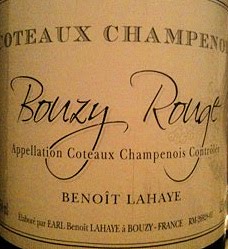
Benoît Lahaye 2007 Coteaux Champenois Bouzy Rouge - One of the great names in wine, Bouzy Rouge. Lahaye's is considered to be one of the great red wines of Champagne. On this night, this bottle also was somewhat controversial. I am a fan of red wine from Champagne. When well made, it is a special and delicious thing that is uniquely expressive. This bottle was fascinating to me, with aromas that were darkly mineral and savory, and with a sort of primal forest-y sense. The palate, however, felt constricted and a bit simple, and the wine probably needs more time in the cellar in order to show its best, as might be expected with Pinot Noir from good terroir. Five or six is probably not a good age for a wine like this. Go younger or older, I would think. Still, I liked the wine and would be curious to drink it again in another 5 years. Others felt that they would have liked it more if it cost $25. Fair enough, although I think that part of the point of the wine is lost when thinking about it in those terms.

So, that's it - our evening with Benoît Lahaye's Champagnes. Although this was not a great night for the wines, I heartily recommend them if you like soil-expressive red grape heavy Champagne.

Friday, May 04, 2012

Whoa!

Been so busy lately with work that I just haven't had time to write here. But I want to share some recent "Whoa," wine and food that really knocked me out.

1999 Clos Rougeard Saumur Bréze, Louis/Dressner Imports, price unknown. Whoa, this is just amazing wine. Clos Rougeard's rare (and pricey) Chenin Blanc is one of the most intriguing white wines of the Loire Valley. I've had three bottles in my life, including this one, and this was the best of them. Such wonderful freshness and purity on the nose, such well articulated aromas and flavors. Beautifully balanced, deep, complex, so very delicious. More, please.

 Have you ever been to City Island? I grew up here in New York, my parents both grew up in the Bronx, and I had never been until a few weeks ago. Among other things, we ate this plate of Little Neck clams. Briny. Cold. Refreshing. Whoa.

 2009 Chateau Pradeaux Bandol Rosé, Imported by Neal Rosenthal Wine Merchant. I bought two bottles last spring and never got around to drinking one of them. Whoa! I need to remember to put some good rosé away and forget about it for a while. Well made Bandol rosé definitely improves with age. This Pradeaux rose is only a year old, but already offers a glimpse of what time in the cellar will do. Mellow, incredibly mineral, very complex, flashes of the savory. Truly lovely.

This is William Mattiello, one of the owners of Via Emilia, in the Gotham City section of Manhattan, pictured with a bottle of Vittorio Graziano's white Lambrusco. William's wife is the owner of Lambrusco Imports, a small company that brings some very special wines to NYC, among them the very fine wines of Vittorio Graziano. At Via Emilia you will spend $36 for Graziano's red Lambrusco, the best that I've ever had. Initially the wine smells like a barn but it does beautifully with air (and with age, says the wise Levi Dalton). Try the white wine too, called Ripa del Bucamente, made mostly of Trebbiano. Oxidative, herbal, fresh, delicious. And $34 on the wine list. Whoa!


Crabby Jack's in (just slightly out of, actually) New Orleans. Do you like a po'boy? I do. I had the half and half, with fried shrimp and oysters. Very good. My friend had roast beef. Whoa.

2006 Benoît Lahaye Champagne Millésime, $68, imported by Jeffery Alpert Selections. I haven't seen Lahaye's vintage wine in the states, ever. I drank the 2002 in Portland on the day that I met my good friend Peter Liem, back in August of 2008. Always wanted to be able to buy the wine here, and now Chambers Street has a few bottles. Whoa, the 2006 is drinking so well right now, such a silky texture, so well balanced, so graceful, and with such wonderful finesse, and such a skilled bit of blending. At this price, it is among the very best Champagnes available in NYC.

I used to make fish soup all the time. It's been two years now, I think, but I made fish stock from a black fish rack the other day, and then fish soup. Whoa, one of the best I've made, if I may say so. Made an aioli to go with it, with green garlic pounded to a paste with a mortar and pestle, and hot paprika. Tried a few different wines with it this week. Best was a Provence rosé, the 2011 Domane les Fouques Côtes de Provence La Londe, $18, Direct Import of Chambers Street Wines. On day two the wine has distinct licorice notes. Lovely.

I have a good friend who loves Bordeaux wines. He's younger than me, so it's not that he grew up in the glory days of Bordeaux. He just loves the wines, that's it. He likes to open one when I'm over for dinner, and he's gotten quite good at picking one that I might also enjoy. Recently it was the 1995 Calon Segur, whoa. Tobacco leaves, mellow, honestly a lovely wine. Very, very young, and also very enjoyable on this early spring evening.

Monday, December 26, 2011

Memorable Pairings of 2011

Well, of the last few months anyway. There have been a few truly memorable drinks and eats in the past months that I never found a way to write about here. So I'll compile them in a best-of-the-unposted list from the last part of 2011.

I was in Jerez in October, and one night I had dinner at La Carbona with Peter Liem and Eduardo Ojeda, the cellar master at La Guita and Valdespino. Eduardo brought several ridiculous bottles to this dinner, one of which was a bottle of La Guita Manzanilla Pasada...but from the mid 1970's! That's right, a Manzanilla Pasada that had spent the past 40 years in bottle. I'm telling you, the idea that Fino wines cannot age is simply wrong. When they are well made and stored properly they can be wonderful. This wine was stunning in its complexity, and also in its freshness.

We drank it with a perfectly grilled bone-in strip steak (I think that's the cut, anyway - you butchers out there can correct me based on the photo if need be). This steak would fare well against anything served at steak temples in NYC - seriously. And La Carbona is by not even a steakhouse. The pairing was fantastic - the umami depth of the wine complimented the meat and the freshness of the wine enlivened and cleansed the palate. An experience I must repeat at some point.

And more Sherry...Joe Salamone was also in Jerez in October, and he returned with a very fine bottle that as of now is unavailable in the States, a special Palo Cortado from Gutierrez Colosía, the very fine producer in El Puerto de Santa María. The average age of these wines is at least 40 years and the wine is a complexly concentrated elegant thing of finesse and beauty.

We drank this wine with home-cooking style Japanese food. It was great with everything, but drinking it with these fried oysters with miso and seaweed was among the most thrilling and delicious pairings I experienced all year. Savory briny sweet complex harmony.

I ate dinner with a few friends at Prune in the fall, and one of them drove in from Rhode Island with several absurd bottles in tow, one of which was the 1972 Leroy Gevrey-Chambertin 1er Cru Lavaut St Jacques. The wine was closed down hard at first, not so unusual for a wine that's been under cork for the past 40 years. But it opened up and showed beautifully, with savory earthy tones and even a bit of very gently stewed fruit. Such a great treat, to be able to drink a majestic old wine like this. We ate all sorts of good things at Prune, and I am not sure, but I think we drank this wine with lamb sausages and all of us were swooning.

Peter generously brought a bottle of Selosse Champagne from France for my birthday in the fall. It is a new release called La Bout du Clos, a wine made entirely from that same vineyard in Ambonnay, from the 2004 vintage. This wine was a bit more quiet than other bottles of Selosse that I've experienced, the oxidative streak not as strong, the supple fruit and saline minerality of the wine doing the talking. It was a special treat.

Peter made a lovely dish of Champignon mushrooms and daikon radish simmered in dashi to go with it - a perfect harmony of savory flavors and aromas. And a concrete reminder, if we needed one, that Champagne is a great table wine.

Why, on Christmas eve my friend Dan Melia opened an absolutely gorgeous bottle of 2006 Marie-Noëlle Ledru Saignée Rosé, and we drank it with excellent grilled cheese sandwiches and various pickles. An unusual pairing, maybe, but Champagne is great with fried food, and the pickles didn't intrude at all. Ledru's Saignée is so very vinous, it's like drinking red wine that happens to have a few bubbles. The wine unfolded slowly and gracefully and was best right as it vanished, a compelling merging of fruit and mineral concentration with textural finesse and grace. Note to self: buy everything Marie-Noëlle Ledru makes before she stops making Champagne.

I've never had Violane before, the sans-soufre cuvée by Benoît Lahaye. This bottle comes entirely from 2008 and is a blend of equal parts Pinot Noir and Chardonnay. I love Lahaye's wines, I love their clarity and focus, their delicate yet powerful expression of Pinot Noir from Bouzy. I loved this wine too, although it is definitely different from the other Lahaye wines I've had. First of all, there is no sulfur, and the wine shows an oxidative undertone that frankly reminded me of some of the Selosse wines I've had (yes, the wine is that good). There is an intense concentration of fruit aroma and flavor and the finish never really ends. We drank this wine on its own, and it was a wonderful pairing. I am drinking the dregs on day two as I write this, and gnawing on a piece of country wheat bread, and it is good.

I haven't had a wine from Santorini in over a year now, as after an initial love affair, I had a group of wines that showed too much sulfur and not enough deliciousness, and I kind of retreated. Not sure what I will do now, after this wine. Peter and I were trying to decide what to drink the other night with a dinner of breaded and fried veal cutlets, cauliflower with cumin, king oyster mushrooms, and garlicky greens. He saw a bottle of 2007 Sigalas Barrel Fermented Assyrtiko in my wine fridge and asked that we open it. I would never have picked that wine, and wow, was it a great pairing.

We decanted the wine about two hours before drinking it, and it was fantastic. The aromas were clear and fresh, vibrant. The wine has a unique aromatic profile, and now that it is maturing, it is articulate and detailed. For me the primary aroma is pumice - the volcanic rock. There is citrus fruit too, something floral, a Burgundian barrel-influenced sweetness, and all infused with this lovely slightly smoky savory-ness. Great freshness and acidity on the palate, balanced, and expressive. Simply delicious wine, and seems like its only beginning to grow into itself. The wine went so well with the veal cutlets, which I topped with a little deglaze of butter, lemon and chopped salted capers. It worked with the earthy cumin notes of the cauliflower and the savour of the mushrooms too. It was surprising to me how this wine offered enough richness to pair with everything on the plate, but also the brightness and refreshment to balance the meal.

This last one reminds me, as a new year approaches, of the value of being open minded, of welcoming new experiences, of being informed by and considerate of what I've learned to be true, but also of wanting to be wrong about things - of learning continuously. I hope that your 2011 ends in a lovely way, and that our 2012 is filled with happiness and learning and many exciting new pairings.

Wednesday, August 24, 2011

Some of my Favorite Champagnes with Fried Food...Who Knew?

Apparently a lot of people know about this combination, this antithetical pairing of delicately nuanced Champagne with the greasy heavy fist of fried food. I remember reading Peter's post about this a while back, and thinking, "Hmmm, I'd sooner take a bottle of Champagne to drink at a monster truck rally." But as with so very many other things, my friends, I was wrong. Champagne and fried food do somehow go together very well. And fried food, when well made, doesn't even overpower the wine.

I recently happened to have the opportunity to drink several absolutely excellent Champagnes with skillfully fried food, with delicious results. At a dinner put on by Charlie Woods of Bonhomie Wine Imports, we ate large plates of fried oysters with aioli. They were plump and briny, encased in some sort of lightly seasoned cornmeal mixture, and carefully deep fried. I say carefully, because careless deep frying results in greasy food, over or undercooked food, or food that tastes more of the fryer than of itself. These oysters were pretty perfect. There were several Champagnes on the table, as Bonhomie brings in a small but wonderful group of Champagnes, wines that you should unhesitatingly seek out if you enjoy Champagne.

With the oysters I drank a relatively unknown but incredibly delicious and interesting wine, the 2004 Michel Loriot Pinot Meunier Vieilles Vignes Brut, $75. According to ChampagneGuide.net, Loriot's estate is located in Festigny, a village in the quiet (read: backwater) Flagot Valley, at the western edge of wine production in the Marne Valley. Meunier does very well in this part of the Marne, and Michel Loriot makes several Meunier-based wines. From what I've tasted, this one is the most special, from vines that are over 40 years old. I absolutely love this wine, with its great intensity of flavor, its sharp focus and balance, and its harmonious expression. It doesn't feel like Meunier - it has not the slightest hint of rusticity, none of that roundness, the cashew-inflected fruit. Not that those things are bad, but this wine is a unique expression of Meunier, and it was fantastic with fried oysters. Loriot's wines are not so easy to find, and this one particularly rare. If you want to try it, Astor Wines has it on the shelves right now, and I hear that a few other shops are considering carrying it - in a few weeks try Uva or Slope Cellars in Brooklyn. It's distributed by David Bowler, so you can always check there.

At the same dinner we drank several wines by Marie-Noëlle Ledru, one of my favorite producers in Champagne. The whole lineup here is great, one wine better than the next. The non-vintage Extra-Brut we drank was based on wines from 2007 and 2006, but because of the ripe richness of the wine, I guessed it was based on 2008. In any case, it's delicious, zesty and fresh, perfectly balanced, and with surprising intensity. Ledru's top wine, the 2006 Cuvée du Goulté (best of the best) of Ambonnay, was constricted and tight on this evening, as might be expected in its youth. Still, its character and class show through clearly, and it will be great in time. My favorite on this night was the 2002 Brut Nature with its beautiful red fruit that really lasts in the nostrils, its vibrancy and clarity. It also happened to be wonderful with french fries. Ledru's wines have become easier to find, as word is out - these are some of the finest, and also the least expensive (!) wines from Ambonnay. You should try one if you haven't already, and all of the usual suspects in NYC carry them.
At lunch one recent day, also with fried oysters, we drank a beautiful bottle of NV Benoît Lahaye Grand Cru Brut Nature, $45, Jeffrey Alpert Selections. Peter Liem put it bluntly: "Lahaye is now the best producer in Bouzy, and in 10 years everyone will know that he is an absolute superstar." I have yet to encounter the Lahaye wine that I don't love. This wine is based on 2008, and it's vibrant and graceful, very pure and fresh. That it is Brut Nature is almost beside the point - it is perfectly ripe and balanced - it just happens not to be dosed. Lahaye's wines, sadly, are almost impossible to find. Joe Salamone at Crush has been stocking them for a while now though, so you might try there if you're looking. I hope that these wines become more readily available, and that the whole lineup makes it to the States, not only the non-vintage wines. The NV Brut Nature, by the way, was great with fried oysters, which brought out the wine's salinity and mineral undertones.

Thursday, January 13, 2011

A Coteaux Champenois Tasting

Not all Champagne is sparkling wine. Peter Liem, many of whose comments and ideas are paraphrased within this post, told me that the modern history of sparkling Champagne is only 300 or so years old, and that Champagne used to be a still wine. Many Champagne producers continue to make small amounts of still wine, called Coteaux Champenois. If you've never heard of these wines or never tasted one, you are most certainly not alone. Not a lot is made, and most of what is made is consumed in Champagne. The grapes used to make Coteaux Champenois are the same highly valuable grapes that could be used to make Champagne - it just doesn't make good financial sense to divert production from a highly profitable wine that is in demand all over the world to a little known wine that is harder to sell at the same prices.

So why is Coteaux Champenois made at all, given that logic? Well, producers need still red wine if they make a rosé of Champagne by blending still red wine into sparkling wine. Also, people in Champagne enjoy drinking red wine from time to time and from what I gather, in much of France, you drink the local wine. Perhaps most importantly, Coteaux Champenois continues to be made because some producers want to honor the tradition and history of Champagne. "Take Larmandier-Bernier, for example," Peter said. "Pierre Larmandier wants to make red wine from Vertus Pinot Noir because he wants to preserve the history of Vertus."

Coteaux Champenois can be red, white, or rosé, although the red wines are by far the most common. The wines can be released as vintage wines or non-vintage wines, and do not need to be aged in bottle for three years, as sparkling Champagne does, in order to be labeled as vintage wines. The villages where Pinot Noir thrives are also the villages that make highly regarded Coteaux Champenois. Bouzy and Ambonnay are perhaps considered as the sources of the finest wines, but there are excellent wines made elsewhere too.

There are very few examples of Coteaux Champenois available at retail stores. Importers have trouble selling the wines, and so they don't bring them in. "I have trouble selling them, especially a non-vintage still red wine from Champagne that would retail for $50," said Kevin Pike, Director of National Sales and Marketing at Michael Skurnik Wines. There are retailers, however, who believe in these wines enough to keep them in stock. Joe Salamone at Crush in Manhattan, for example, has been selling Coteaux Champenois for years, when he can get his hands on it.

Last summer I drank a bottle of 2002 Larmandier-Bernier Coteaux Champenois with a few friends and absolutely loved it. I knew I needed to try more. A few friends agreed, and we decided to buy whatever we could and to hit up a few importers for bottles that are not (yet?) available in stores. We recently got together over a completely fantastic dinner at Prune and drank the wines. It was quite a crew, including the aforementioned Peter Liem, Joe Salamone, and Kevin Pike, and also Levi Dalton of Alto (where at least one Coteaux Champenois is on the wine list), Dan Melia, Clarke Boehling, and Keith Levenberg.

The results were mixed, I would say. The two wines that I have previously loved didn't show well on this night. Other wines were disconcertingly big and concentrated - stylistic decisions by top quality wine makers. But there were a few true gems. Here are the wines we drank in the order in which we drank them, along with a few notes:

2008 Roger Coulon Coteaux Champenois Blanc, $40-50, Rosenthal Wine Merchant. I found myself saying "this wine smells just like Champagne!" It really does, just like a Blanc de Blancs. Tastes just like one too. Feels entirely different, obviously, and it was a strange sensation. This was the very first Coteaux Champenois Blanc I've ever tasted, I think I need more experience before saying much.

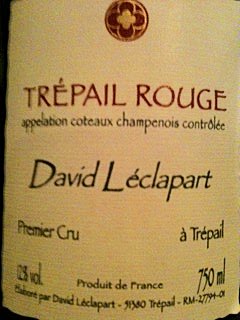
2008 Léclapart Coteaux Champenois Trépail Rouge, $55, Imported by Jandell Selections. Very fragrant, fresh red berries and flowers with woodsy undertones, very persistent. There is a "natural streak" here, as there often is in Thierry Puzelat's wines, for example. Bottle variation is significantwith this wine, apparently. This was a good bottle, the one I drank a few months ago was not as good.

2008 Egly-Ouriet Coteaux Champenois Ambonnay Rouge, $95, Imported by Michael Skurnik Wines. The nose is dominated by oak right now, and I found it hard to enjoy at this early stage, even harder to evaluate. Peter Liem told us that among many people in Champagne, this wine is considered to be the best Coteaux Champenois. I'd love to taste the '08 again in 5 or 10 years.

2001 Marie-Noëlle Ledru Coteaux Champenois Ambonnay Rouge, not imported (kindly donated for this tasting by Charlie Woods, whose company Bonhomie Wine imports Ledru's sparkling Champagnes). Still shows freshness, there is complexity on the nose, which becomes more layered and detailed with air, perfectly harmonious on the palate. Delicious, and one of my favorites of the tasting.

2004 René Geoffroy Coteaux Champenois Cumières Rouge, $55, imported by Michael Skurnik Wines. The nose is spicy, rich, voluptuous, and also energetic with dark fresh fruit. This is a powerful wine that doesn't lack for concentration, but still offers god detail and balance. I like Geoffroy's wines very much, and this was no exception.


2003 Benoît Lahaye Coteaux Champenois Bouzy Rouge, not imported (kindly donated for this tasting by Jeffrey Alpert, whose company Jeffrey Alpert Selections imports Lahaye's sparkling Champagne). "Bouzy Rouge" has got to be one of the best names in the world of wine. My favorite wine of the tasting. The nose opens slowly (as with all of Lahaye's wines) but shows real elegance, especially in light of the very warm 2003 vintage. Mineral infused spicy red fruit on the nose, and a harmonious palate whose delicate red fruit shows a bit of maturity and although reflects some of the opulence of the vintage, for me didn't cross into over-done territory. Delicious wine, and Lahaye is an absolute star, in my book.

2000 Jean Vesselle Coteaux Champenois Bouzy Rouge, $41, Dionysos Imports. This wine showed a candied aspect that I didn't care for, and I found it to be a bit one-dimensional, uninspiring. But there were others who enjoyed it, so grain of salt here.

2002 Paul Bara Coteaux Champenois Bouzy Rouge, $40, Imported by Jandell Selections, although bara's sparkling Champagne is imported by Kermit Lynch. This wine was corked, which is a shame because in an odd coincidence I happened to drink a glass the night before this tasting, and it is wonderful wine, very intense but also very light in body, a truly excellent Coteaux Champenois.

2002 Larmandier-Bernier Coteaux Champenois Vertus Rouge, $40, Louis/Dressner Selections. This bottle did not show as well as the others that I've had. It was very reduced, even after an hour open, so we decanted it and it was much better. Similar in style to the Bara wine - purity, finesse, freshness, lightness in body. The fruit is rich and vibrant and the wine is well balanced, but it never became as good as other bottles that I've had. This bottle notwithstanding, this particular wine is the finest Coteaux Champenois that I've had.

2002 Bollinger Coteaux Champenois La Cote aux Enfants, $120, Imported by Terlato Wines International. Shows nothing of what makes Coteaux Champenois appealing. Overripe grapes, rasiny, too concentrated, chunky and not graceful, jut not enjoyable wine. I normally wouldn't condemn a wine like that, but I believe that everyone at the table felt approximately the same way, and so it's safe to say that my take on the wine is not an outlier. Bollinger is so great too, so this wine was quite confusing.

Tuesday, December 21, 2010

Great Champagnes, Under $50

It's the time of year for lists of Champagne's greatest hits. Today alone, Eric Asimov of the NY Times published an article reviewing his tasting panel's thoughts on sparkling wines not from Champagne, and also a blog post listing some of his favorite Champagnes.

Well, I want to add my .02 cents. Here are some of my favorite Champagnes that cost $50 or less before sales tax:

Blanc de Blancs.

Pierre Gimonnet Selection Belles Annees Brut Premier Cru, $34, Terry Theise Selections/Michael Skurnik Imports. Bright fruit, a graceful style.
Jacques Lassaigne Les Vignes de Montgueux Brut Blanc de Blancs, $47, Jenny & François Selections. Richer and more robust, from the Aube.

Pinot Noir-heavy wines.

René Geoffroy Empreinte Brut Premier Cru, $48, Terry Theise Selections/Michael Skurnik Imports. This is always based on a single vintage, and is usually about 90% Pinot Noir. Fragrant and vivid, well balanced.

Benoît Lahaye Brut Essentiel Grand Cru, $40, Jeffrey Alpert Selections. About 90% Pinot from the village of Bouzy. Simply excellent.

Pinot Meunier-heavy wines.

Françoise Bedel Cuvée Origin’elle Brut, $45, JD Headrick Selections. About 80% Meunier, slow to unwind, quite rich, made in a slightly oxidative style, lots of soil.

Blended Wine.

Chartogne-Taillet Brut Cuvée St Anne, $38, Terry Theise Selections/Michael Skurnik Imports. For me, a classic Champagne.
Rosé Wines (Tough, because there are few choices at $50 and under).

Margaine Brut Rosé Premier Cru, $50, Terry Theise Selections/Michael Skurnik Imports.

Brut Nature/Non-Dosé Wines.

Raymond Boulard Mailly-Champagne Grand Cru Brut Nature, $43, Imported by Selected Estates of Europe. Complex wine that is more about soil than about fruit, but still feels ripe and delicious.

Tarlant Brut Zero, $45, JD Headrick used to handle Tarlant, and I'm not sure who does now. Spicy and vibrant.


So...what do you think? Suggestions welcome. There is still time for us all to blow some dough on Champagne before the big eves and days arrive.

Thursday, December 17, 2009

Blind Tasting 15 Champagnes

Alex Halberstadt, a Brooklyn-based writer who covers wine for The Faster Times, an online newspaper, recently invited me to his house to participate in a blind tasting of Champagne. There were 9 of us in total, and 15 wines. Not bad for a random Monday night.

The point of tasting blind is to remove information that can bias the taster during the experience of tasting. But how much information should be removed? Obviously, tasters do not know the identity of the wines they taste. But there are varying degrees of "blind." Imagine, for example, that you wanted to do a tasting of Pinot Noir with friends, and your idea is to compare new world wines to old world wines. Do you tell people the theme and ask them to categorize the wines as they taste? Do you instead tell them only that it is a Pinot tasting, and see where the discussion goes? Do you tell people that they are drinking two types of Pinot, but not tell them what types? There are many ways to do this, and each has its merits.

We knew nothing whatsoever about the Champagnes we tasted - Alex decided to share the theme of the tasting only after we discussed the wines. We went through all 15 wines and then discussed each one. As you would expect with a group of 9 people tasting of 15 wines, there were many different opinions. But there were a few things that everyone seemed to agree on: no one loved the wines as a group. Everyone found a few wines to like, but as a group, no one was overly excited. When asked what we thought of the overall quality of the wines, Garrett Oliver, the brewmaster of the Brooklyn Brewery, said "They were fine, but I drank some great Champagnes last week, and none of these stands up to any of those."

I felt the same way - there were several wines I liked, but as a group I was not terribly impressed. I felt that the wines lacked any kind of soil character. None of them were chalky. And none of them showed any real individuality. They actually resembled each other a lot in terms of character and flavor profile. Maybe this was a symptom of drinking 15 Champagnes in a row, maybe not. What had Alex done, here? What were we tasting?

I had an idea about halfway through, but I wasn't sure. At the end of the discussion, Alex said "Bloggers and wine writers all seem to be writing about grower Champagne now, and you never read anything about the other wines. I thought it would be interesting to do a tasting of the Grand Marque Champagnes, the wines you are most likely to encounter in any given store." I understood immediately why Alex kept the theme a secret. If I knew that I were tasting these 15 wines, I would have been biased. Not that I would dislike them automatically - I'm a more honest taster than that, but I would have approached them differently, with low expectations. Alex wisely allowed us to approach these with whatever expectations we as individuals bring to a tasting. I, for one, want to like the wines at a blind tasting. And I found some things to like in this tasting.

Here are the wines we tasted, all non-vintage wines, presumably disgorged and released recently:

1) Piper-Heidsieck
2) Henriot
3) Deutz
4) Pol Roger Pure (this was a mistake - Alex meant for this to be Bollinger)
5) Gosset
6) Taittinger
7) Pol Roger
8) Delamotte
9) Lanson
10) Veuve-Clicquot
11) Laurent-Perrier
12) Charles Heidsieck
13) Louis Roederer
14) Moet Brut Imperial
15) Alfred Gratien

I liked the first wine I tasted better than anything else, the Piper-Heidsieck. It felt like it had been bottled at low pressure, it had lovely dark fruit, it had finesse, and it was very expressive. I loved it. I remember thinking, "Could this be a Cedric Bouchard wine?" I wonder if this wine been the 8th wine in the lineup, whether or not I would have liked it as much. By wine #8, I understood that I wasn't crazy about whatever it was we were tasting - the "I'm about to taste 15 Champagnes, and I love Champagne" magic had worn off. But I liked it enough during this tasting so that I will make a point of drinking it again.

My other favorites included Roederer, Henriot, Pol Roger, Taittinger, and Lanson. I would gladly drink a glass of any of those wines, should they be offered to me. But I don't think that I'm ready to start using any of my already meager Champagne budget to buy these wines. Before doing that, I'd like to do a blind tasting that includes these wines and an equal number of wines from producers like Boulard, Billiot, Diebolt-Vallois, and Brigandat. That would be most interesting, especially if I didn't know the theme while tasting.

I will also confidently tell you that the worst wine of the tasting, and almost everyone agreed on this, was the Moet White Star. It was just very bad.

I'm so glad to have participated in this - it was a great idea, Alex. It's silly to dismiss wines because they're not popular (an odd thing to say about Grand Marque Champagne, but I mean popular among the wine circles I hang out in), but I think we all do it. I tend to be dismissive of exactly these Champagnes, and perhaps I shouldn't be. I really liked that Piper-Heidsieck. Maybe I'll buy one and drink it next to a comparable grower Champagne, both served blind.

Saturday, December 12, 2009

Lot 2 - a Restaurant that's Worth the Trip

The other night a friend and I went to Lot 2, a new-ish restaurant in a very quiet (read - middle of nowhere) part of Brooklyn. I love this area, actually, the stretch of 6th avenue between the Gowanus expressway and Greenwood Cemetery. Disingenuous realtors call this the South Slope, but I think Greenwood Heights is more accurate. Anyway, this is a quiet residential stretch of town. There is a public school, a few bodegas, a furniture design store, a coffee house, and not a lot else - nothing that inspires a special trip. There used to be a destination-worthy BBQ place on 20th and 6th, but it closed last year. Now, in the storefront right next door, Lot 2 is open. And it's worth a special trip.

Here are some things you will NOT find at Lot 2:

  • A bartender sporting a little mustache and arm garters who looks like he stepped out of a 1890's saloon.
  • A discourse on butchering technique.
  • Anything that has been "deconstructed," any kind of "foam," or "gelée."
  • Attitude of any kind.
Not that there is anything wrong with those things - I enjoy them from time to time. But Lot 2 isn't about pretension or culinary pyrotechnics. Lot 2 is about excellent ingredients and simple but highly skilled preparation. The servers are very kind and competent, the space is attractive and homey, and the prices are reasonable. If none of this sounds special enough to make Lot 2 a destination, there is one other thing that might sway you: the incredibly high quality of the charcuterie. Lot 2 was opened by the guy who did the charcuterie at Grammercy Tavern, and charcuterie should be part of a meal at Lot 2. They also demonstrate a deft hand with pickles.

We couldn't decide on appetizers (called small lots) because we wanted to taste them all. So we did, almost. We began with the pork jowl, and this was utterly fantastic, the best plate of food I have been served at a restaurant in a while (grain of salt - I don't go out that much). Think of that ubiquitous pork belly, in terms of presentation - a large square of meat with a ribbon of crusty fat on top. But this is jowl, and the meat is meatier than a belly cut. The accompanying Brussels sprouts were very good, and there were little pancetta croutons, as if the jowl might not be porky enough. It is this dish that will make me walk all the way down to 20th street on a snowy night in January.

We also had cured lamb neck and cured pork neck served with house pickles and warm olives. The paper-thin slices of meat were subtly perfumed with spices, and although both were rich and delicious, we preferred the lamb. And because pork jowl and two kinds of neck really aren't enough in the way of charcuterie, we also had the lardo bread, a piece of crusty bread smeared with lardo butter and topped with Brussels sprouts leaves. This was the only thing we ate at Lot 2 that wasn't so great, and I suppose the owners felt the same way, as I notice that it is no longer on the menu. Although lardo still appears with the potato skins that come alongside the burger, in what I am sure is a winning combination.

We tried two salads, and both were excellent. Shaved fennel with radishes and walnuts was a perfect rendition of this dish, and it was a great companion to the charcuterie. My friend Clarke and I were essentially jousting with our forks over the last bites. Chicory with pickled pumpkin was also delicious - bitter greens with sweet and sour pickles, very refreshing. We enjoyed this salad with the one entree (called big lots) we had, itself a story. Let me tell you how difficult it was not to order the lamb ribs with chickpeas, olives, mint and lemon. But we ate the better part of a pig to begin the meal, and it just seemed excessive. So we ordered pasta - garganelli with cauliflower, mint, capers, and romanescu. As Clarke said, "This dish has no business being this good." It was delicious, truly. Garganelli are kind of like large penne with deeper striations to hold the sauce. The seasonings were perfectly balanced and there was a spark from red chili flakes, but it is the texture of this dish that really got me. The pasta (which I think may be home-made) was cooked until just tender, and the whole dish was tossed with toasted bread crumbs, which gave every bite just the slightest gritty crunch. A real winner, this dish.

And what about the wine list? It is small, but filled with interesting and inexpensive bottles that would be great to drink with this food. Savio Soares has a few wines on the list (Mouressipe from the Languedoc, Marcillet from Savigny-Les-Beaune, Héaulé from the Loire). Jeffrey Alpert has two fantastic wines here - the beautiful NV Benoît Lahaye Champagne Brut, mostly Pinot Noir from Bouzy, and fairly priced at $72, and the ethereal and gamy 2006 Ganevat Trousseau "Plein Sud" at $55. There are several interesting Italian wines too - you can see the list here. We decanted and drank the Ganevat Trousseau, and its progression from horse stable to rose garden with rabbits was perfectly harmonious with our food. If you are a beer person, they have several interesting craft brews too.

We ended our meal with two cheeses, both from Jasper Hill Farms. Bayley Hazen is their excellent Stilton-esque blue cheese, and the cloth-bound Cheddar made by Cabot Creamery and aged in the cellars at Jasper Hill. I still don't like the cloth-bound Cheddar. I didn't like it the first time I had it, and I've had it several times since then and I just don't get it. But that's just me - it is a high quality cheese that everyone else loves, so trust me, everyone else is probably right.

Lot 2 is well worth the trip. Go with a friend, go on a date, go for communal Sunday supper. Go check it out.

Lot 2
687 6th Avenue (near 20th street), Brooklyn.
718.499.5623

Friday, March 06, 2009

Friday Night Bubbles

NV Benoît Lahaye Brut, $40, Jeffrey Alpert Selections. Last summer I was in Portland with my wife on a quick vacation and we had dinner with Peter Liem and some of his friends. He brought a few truly special bottles of wine from France for this dinner, one of which was the 2002 Benoît Lahaye Brut Champagne Millésime. This wine was so delicious that I made a promise to myself to buy Lahaye's wines whenever I could find them.

Turns out that finding them is no small feat. I do not mean to say this rudely, but have you ever heard of Jeffrey Alpert Selections? I haven't. There is no website for the importer that I could find - an interweb search turned up more Herb Alpert (the genius musician behind, among other things, the cantina scene music from Star Wars, at the bar in Mos Eisley) than Jeffrey Alpert. But I finally found a NYC store that sells the NV Brut and I pounced. The vintage wine, the Brut Nature, and the other cuvées - nope, not to be found around here, which is such a shame.

Benoît Lahaye's estate is located in the village of Bouzy in the Montagne de Reims, in Pinot Noir country. There are some great growers and producers in Bouzy, such as Andre Clouet, Camille Saves, and Paul Bara. Among wines that I've had at home with dinner (where you can linger over a meal and watch the wine grow up over the course of an evening), this NV Brut from Lahaye is the finest Bouzy wine that I've ever tasted. I've never had a Paul Bara wine, and I haven't tasted the entire lineup of wines from Saves or Clouet, but I've drank some of their wines, and I think that Lahaye's NV Brut is just better. This version is, anyway, which I am guessing is based on 2005 grapes, bottled in 2006, and disgorged in August of 2008 based on the hard-to-spot code on the back label that reads "08 2008." Again - give us more info on the labels please...

The best description of Benoît Lahaye is again on Peter Liem's website, but I will summarize: Benoît Lahaye's vineyards are farmed organically and his wines are made naturally with minimal intervention. The estate is small at under 5 hectares, and yet Lahaye vinifies individual parcels seperately in order to produce the best possible blends. This wine is 85% Pinot Noir and the rest Chardonnay, using 30% reserve wines. It is such a beautiful wine, really stunning. The nose is airy and pure, very gentle, and reveals layers of ripe fruit, roast nuts, and minerals. It is vinous and intense, round and rich, ever so slightly smokey. This is one to get lost in, and I refused to drink the last bit so I could keep smelling it. The fruit is generous and ripe on the palate - anyone who thinks that grapes don't ripen in Champagne should drink this wine. The fruit is completely infused with chalk, and there is a racy streak of acidity that cuts through and cleanses the palate. The finish is fragrant and long, and tickles the cheeks. And it's clear that I opened it too young, as there is ample structure and acidity and although the wine is completely delicious, it seems like it hasn't fully discovered its inner harmony.
If it sounds like I'm waxing rhapsodic about this wine, I am. It's a true beauty, one of the best NV Pinot Noir based Champs that I've had. And it's interesting to compare this to, say the NV Billiot Brut from the neighboring village of Ambonnay, also a grand cru village. I love Billiot's wines, but whereas they seem more exuberant and muscular to me, Lahaye's wine seems more controlled, with more finesse, yet equally intense. I'll have to test that theory one day by drinking them together.

Tuesday, August 26, 2008

Dinner with Peter Liem and Friends

Brooklynlady and I left the little daughter with her grandparents in San Diego and went to Portland for two days and one night. It was a real treat to spend adult time together visiting such an interesting city. And by coincidence or supernatural power (you decide), Peter Liem happened to be in Portland for his friend's wedding. Our visits overlapped, and so along with a few of his friends, we met for dinner at the excellent restaurant called Three Doors Down.

Peter's friends are also serious wine folk, so there were several amazing wines on the table. Three Doors Down has a great wine list, but they are friendly with Peter and his group and allow them to bring in their own wine.

When you dine with Peter Liem you can expect to drink good Champagne. We began with the 2002 Champagne Raymond Boulard Extra Brut Les Rachais. Peter brought this over from France, as it is not available yet in the US. This is Boulard's first wine made from biodynamically farmed grapes, and although it's a mere child, it is obviously an incredible wine. The nose is so very delicate with lovely floral and mineral aromas, and beyond that a tightly coiled core of energy that demands many a quiet year in the cellar before it will reveal its true nature. I hope I have the opportunity to revisit this wine one day, it is a sheer and elegant thing of beauty.

We then opened the 2002 Benoît Lahaye Champagne Millésime (another bottle checked in his suitcase). I won't try to summarize Lahaye as a grower and wine maker, as Peter did this so well a few months ago. After the Boulard wine, this one was powerful and intense, but in a good way. The aromas and flavors really spread out and fill the nostrils. This is red fruited juicy deliciousness with a great acidic and mineral spine, and I bet it would be beautiful with something like duck breast and confit. I left this one standing in the glass for a little while and it opened up quite nicely - another one to lay down for some years.

BrooklynLady and I brought along a bottle of 1998 Vilmart & Cie Cuvée Création. We opened this bottle just before our appetizers arrived and much to my dismay, the wine was a bit of a mess. It was positively funky - cheesy, really. Yes, this wine smelled like ripe cheese. We waited a few minutes and aerated, but still pretty funky. Is this normal? Apparently not. The wine was showing "far more evolved than previous bottles I've tasted," according to Peter. That's probably polite for "this is usually very good wine, but this bottle kind of sucks." It was only at the conclusion of our meal when people were chit-chatting over a shared Tiramisu (honestly - the finest that I have ever tasted) that the wine began to show well. Pete (not Peter) poured himself some and said it was terrific. And he was right. The nose was now a generous and clean basket of roasted hazlenuts, maybe some marzipan too. And it crept gently across the palate, elegant and noble. Delicious, and yet very confusing on the whole. Here is Peter's profile of Vilmart, by the way.

And now, red wine. We started with an old wine from northern Piedmont, the 1961 Vallana Spanna Podere Tre Torre di Traversagna. Not a typo - that's 1961. This wine was born 47 years ago. I have no idea how to decipher Italian wine names, so I'll share what I learned about this wine: Vallana is the producer, Spanna is another name for Nebbiolo, and Traversagna is one of the crus in which this producer grows grapes. Thinking about it afterwards, I realized that this might be the oldest wine that I've ever tasted. But in the glass it felt vibrant and young. It had such a lovely perfume, so clean and well defined. Elegant chamomile aromas mingled with well-worn road tar, and beyond that there was something on the nose that the next wine also shared, something that for lack of a better word I will call poignancy. By this I mean that the essence of the wine burst forth from the glass as if it had something incredibly important to say, and it must have your attention. It was just delicious and thought provoking, and I remember what it smells like right now as I type this.

We ended our meal with a Grand Cru Burgundy from my birth year, the 1971 Prince de Merode Corton Clos de Roi. I got lost in this wine - I forgot to eat. BrooklynLady too. She tasted and spat all night like a cautious pregnant lady, but with this wine she drank. And how could she not? It had that same sense of poignancy to the aromas with penetrating animal, caramel, spice, and surprisingly fresh and youthful fruit. So graceful on the palate, such a textural joy. An entire story in the mouth with a strong plot, good character development, and a gentle and profound denouement. This is the whole point of cellaring good red wine from Burgundy, I suppose. A reminder not to touch my 2005's for a long time.

It got late in a hurry and we all had important appointments in the morning, so we agreed to shelve the 1985 Diebolt-Vallois that had been patiently waiting for its cue. We thanked each other for the company and the wine, and careened off to our beds with cherries and earth still tickling our nostrils.