Showing posts with label Salon. Show all posts

Tuesday, February 15, 2011

Visiting Champagne Salon in Le Mesnil-Sur-Oger

My final visit of the Champagne trip was also one of the grandest, a visit to Champagne Salon. It was getting dark when we arrived but Export Director Jean-Baptiste (Tista) Cristini walked us out the back of the house and into a vineyard called Le Jardin.

Most of it was replanted in 2003 and none of the grapes have been used in Salon vintages since then. Still, it was a rush to be standing in one of the 20 vineyards that Salon uses to make their wine.

Salon has been around since the early 1900's, but there isn't a lot of wine to be had. They make one wine and one wine only, a vintage Brut Blanc de Blancs made entirely of Le Mesnil Chardonnay. And they don't make it very often. In the years since 1905 there have been only 37 vintages of Salon to come on the market.

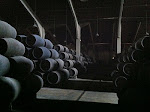
For a Champagne house of such stature, it was a bit startling to see how little wine there is in the cellar. All of the Salon wine from the 1999, 2002, and 2004 vintages - all that there is for the whole world, is in this cellar (that looked kind of like a garage). And there are incredibly few bottles that remain of older vintages.

Walking through the cellars and looking at the few bottles of old wine, I had an experience that brought me quite close to forever etching my bad name in the collective memory of the Champenois. I was marveling at how few bottles there were of some old vintage and Tista spoke to me in a tone that I know well, as I use it when I'm trying to keep calm when, for example, asking my two year-old to put the scissors down. "You might want to move forward a little," he said. Calm, cool, collected. But I sensed the unspoken urgency in his voice and stepped forward, slowly. "You almost just knocked over our last 8 bottles of 1943 Salon, the year of the death of Mr. Salon himself." I honestly felt the bottles touching my coat as I stepped away.

Sighs of relief, nervous laughter. Tista decided to offer us a special treat, and picked out a bottle of 1982 Salon to disgorge right then, à la volée. Then we went upstairs to the tasting room.

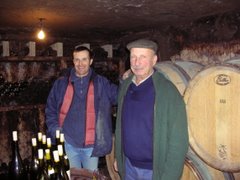
Tista, by the way, will be married in a matter of two weeks, to his girlfriend of at least ten years. He will not wear the odd hat in this photo, made of white flowers and wire to his wedding. He will, however, be completely charming, as he always is. Congratulations on your wedding Tista, and all the best to you and your soon-to-be wife!

All together we tasted five vintages of Salon, including the 1999 which will be released in May of 2011. I have so little experience drinking Salon wines that my notes are useless, lacking in context. But I will tell you that each of the wines showed a regal presence, amazing depth, and sheer class of raw material. The 1982 was interesting because it was quite reductive at first. I enjoyed it anyway, its richness and class not completely obscured. We drank it hours later at Tista's house with dinner and it opened up beautifully, showing lovely mushroom notes, a palpable chalkiness, and great balance and finesse.

This was a wonderful way to close out my first visit to Champagne, by tasting the storied wines of Salon.

Monday, February 07, 2011

A Trend Toward Single-Vineyard Wine in Champagne?

The hills of Champagne, as in Burgundy, are divided into many individually named vineyards, some containing more than one lieu-dit, or named parcel. In Burgundy the decision was made a long time ago to bottle the wines from each vineyard separately, and we can compare Vosne-Romanée 1er Cru Les Suchots to Vosne-Romanée 1er Cru Les Beaux-Monts, or to any other of the 14 or so 1er Cru vineyards in that village.

Champagne houses, in general, followed a different path. Champagne is a blended wine, mostly. Wines from different vineyards within a village, and from different villages altogether, wines from different vintages are blended. Although this tradition clearly hasn't hurt the quality of the wines, their reputation around the world, or the price they command, it is probably one of the issues that create questions for some people about the degree to which Champagne expresses terroir.

I am certainly not the person you should look to for the latest news in Champagne, but it seems to me as though there is a trend towards single-vineyard wines, particularly among young producers. Makes perfect sense, when you think about it. As grower Champagne continues to gain in popularity, the producers of these wines can offer new products to their expanding audience, especially when those products further extend part of the grower ethos - that of expressing terroir.

I began to think about this during our visit with Alexandre Chartogne of Champagne Chartogne-Taillet. After lots of tasting in the cellar we were back in the comfortable and warm reception room, tasting through the current lineup of wines. I remembered that Chartogne-Taillet makes a Blanc de Blancs, but we weren't drinking it. When I asked if he still makes it, Alexandre said that it is now bottled as Les Heurtebises, the vineyard it comes from.

The next morning I thought of this again with Vincent Laval in the cellars at Champagne Georges Laval, as Vincent told us about the conditions in Les Chênes and Les Hautes-Chèvres, the vineyards that produce his single-vineyard Chardonnay and Pinot Noir. Laval's estate is tiny, producing no more than 10,000 bottles per year, and yet he bottles these wines separately. And they command very high prices - at least $150 per bottle.

I thought of this again later that day, tasting with Raphaël Bérèche. Beginning with the 2007 vintage, he makes an old vines Pinot Meunier from the vineyard of Les Misy in Port à Binson. It is called Vallée de la Marne Rive Gauche, and Bérèche's intentions are clearly announced on the wine's label, as the place of origin is far more prominent than the family name. The back label, by the way, contains information on the vineyard, disgorgement date, and everything else that we might want to know.

Around this time I asked Peter what he thinks of this trend, if it is in fact a trend. "I've been meaning to write something about that," he said. That's fine - we can wait together to read whatever it is Peter has to say on this issue.

The next day I thought of this again, but in an entirely different context. At Philipponnat, a larger house, we drank Clos des Goisses, one of the most celebrated wines of Champagne, and also a single-vineyard wine. The house could theoretically blend much of the grapes into non-vintage wines, use some for a vintage wine, and sell many more bottles much more quickly than they do with Clos des Goisses, which ages on its lees for way beyond the required three years. But Charles Philipponnat and the others at the house understand how special the vineyard is, and bottle it separately.

And later that day at Salon, when Export Director Jean-Baptiste (Tista) Cristini showed me around the gorgeous house and property. We looked at a picture frame that contained a menu from Maxim's in Paris, from 1928. It reads "Salon 1921 - Mesnil Nature, cuvée pure de raisins blancs." This means "Pure Mesnil, Blanc de Blancs." There were other wines offered on the menu, but none of them mentioned the place of origin. I guess Mesnil has been considered great terroir for a long time, and Salon recognized the power of marketing the single village wine.

My point, I guess, is that perhaps this is nothing new, this trend toward single-vineyard wines in Champagne. If it is, in fact, a trend. Maybe it's a cycle and we're approaching a single-vineyard section of the wheel. The real question, in the end, might be why are there more single-vineyard wines appearing in Champagne, and what impact will they have? As I mentioned before, we can wait together for Peter on those questions.

Tuesday, September 08, 2009

Two Weeks of Incredible Champagne

I used to write about sparkling wine every Friday in a sets of posts that I called Friday Night Bubbles. Every week for over a year, typically alternating between Champagne and other sparkling wines. It got expensive, but what made me stop this series was the fact that I wasn't satisfied with the quality of most sparkling wines at the $20-$25 price point. I decided that I'd rather spend my $25 on whatever wine I think is best, not necessarily a sparkling wine.

And so my sparkling wine consumption has gone way down, Champagne obviously included. In the past two weeks, though, I've had more top notch Champagne than in all of the past year, I would say. These things come in waves, I guess. I know it's boring to read lists of "The Great Wines I Just Drank," but please - allow me to share about some of these. These are rare and expensive wines that I may never have another chance to drink, and they are worth talking about.

I was in Seattle last week for work (thanks for having me back here, by the way). I know no one in Seattle, and I had business all day but nothing at night. I did take myself out to dinner one night at this place, and it was quite nice. But a million times more fun was dinner at my new friend Brian's house, a guy I met through another friend I met because of this blog. And they say that sitting in front of your computer is anti-social! Brian works for Triage Wines, one of the better importer/distributors on the west coast. He invited a few other Seattle wine-types, made a beautiful dinner of schnitzel and other goodies, and we opened what might in some circles be called an excessive amount of wine. I could tell you about the three 1998 Rieslings we had with dinner, including the FX Pichler Unendlich, but this is supposed to be about Champagne. So instead I'll tell you about Sugot-Feneuil, a producer I had never heard of. Brian served the 1998 Brut Blanc de Blancs as an aperitif, and it was just lovely, so full flavored, and also so elegant. But this was a fleeting experience, as apparently the grower is deceased and the vines have been sold to a big house.

That was only the beginning. One of Brian's friends brought a bottle of 1997 Larmandier-Bernier Special Club, I think the last Special Club vintage that Larmandier-Bernier did. This wine took a while to open up, but when it did it was a well balanced wine with rich nutty fruit and a mouth-coating texture. I think that it was starting to truly shine after we had moved on to other wines. And how about this - Brian went downstairs to his cellar (normal people can afford to live in houses in Seattle, apparently) and returned with not one, but two bottles by Vouette et Sorbée. We drank the Saignée de Sorbée (photo courtesy of Peter Liem) and the Blanc d'Argile, both 2006's, although they are not labeled as vintage wines. Both of these wines were entirely remarkable, impossible to overstate the level of quality here. The fruit in the rosé was utterly beautiful, almost impossibly fresh and alive, sweet and perfumed with subtle spices. Like all Vouette et Sorbée wines, this has no dosage - imagine how perfectly ripe these grapes must be! The other thing that I found striking about the rosé was its texture - full and rich, but exquisitely detailed and fine. Such a joy to drink. Peter and I drank the 2005 Saignée de Sorbée merely days before this Seattle dinner, and it was also a great, but an entirely different wine. The 2005 was not as much about fruit, it was completely saline and pungently rocky and earthy, and it was great with our roast bonito. The 2006 was a far more hedonistic wine that offered immediate and intense pleasure, but I wonder which wine will be better in 10 years...The Blanc d'Argile was also great, with that same brilliant fruit and texture, but I was so smitten with the rosé that I could barely pay attention to anything else. Thank you again Brian, and your welcoming and generous friends too.

The funny part is, you probably think that's all the great Champagne I've had recently. Not at all true, friends. I went to Alice Feiring's house the other night for her Champagne tasting, a semi-blind (we saw the list of wines, but drank them blind) look at a handful of wines with the idea of discussing whether or not they represent good value. I'll leave the results of the value discussion for Alice to print in her upcoming Wall Street Journal article, but I'll tell you that the wines in general showed tremendously well. I learned that Drappier makes very good wines - the nose on the 2002 Grande Sendrée was fantastic, rich and nutty with a focused depth of clean fruit, intriguingly orange-y in character. And I confirmed for myself that I am a huge fan of both Billiot's and Lallement's basic NV cuvées. That Larmandier-Bernier's Terre de Vertus smells and tastes of seashells, and that the 2004 Raymond Boulard Les Rachais Extra Brut will be excellent in about 8 years. Boulard's wines, in my humble opinion, might be the best value in the NYC Champagne market.

The three "S"s - a part of any balanced diet.

Alice somehow stocked her Blanc de Blancs lineup with 1997 Salon, and two different Selosse wines, Substance and VO. Yes, I drank Substance twice in two weeks - very extravagant. When I drank the VO I thought it was Substance, as the nose was immediately reminiscent of the wine I drank with Peter the week before. Wine maker's stamp, I guess. The '97 Salon took a while to unwind, but when it did it was just gorgeous, so expansive and richly satisfying in the mouth, and so perfectly balanced.

Alright, that's enough, I'm running out of gas - just excited to be back, I guess.

Sunday, May 10, 2009

Overachievers and Underachievers

Last week I had the opportunity to drink some pretty fancy wine. BrooklynLady and I had some out of town (out of country, actually) friends over for dinner and we opened a few nice bottles. And my pal Bruce had a bunch of people over for dinner and selected Burgundy as his wine theme, and he was quite generous with the bottles he opened.

I don't often drink wine of this caliber and I think it can be tricky to evaluate. High expectations can color things. If I'm tasting blind, I can give you my thoughts and there's nothing tricky because I have no idea whether or not I'm supposed to like the wine. But if I open a bottle of 1978 Domaine Dujac Clos de la Roche with you over dinner, evaluating the wine would be tricky. I hardly ever drink wine of that caliber and I would so very much want to like it. And yet I would have such high expectations, the wine might have to be perfect in order to live up to them. This is purely hypothetical by the way, because I possess no such bottle of '78 Dujac. But you get my point.

Since I am only an occasional drinker of fancy wine, I think it's easiest to evaluate by simply classifying it as an overachiever or an underachiever, or as a wine that performs exactly as it should. The simplicity of this helps me avoid some of the over-thinking and the hype. Here are the fancy bottles I'm talking about from this week, and by fancy I don't necessarily mean expensive, by the way. For me, fancy wine can also be a bottle by an iconic producer whose wines I simply do not often have the opportunity to drink.

Overachievers:

1999 Domaine Leroy Meursault - Tough to get a handle on, but with time to re-taste and to think about the wine, it kind of blew me away. It's still a baby with a somewhat disjointed feel, and with almost too-intense acidity. But the fruit is so absolutely crystalline and pure, and the sense of mineral soil is so complete. The wine simply has incredible presence. This is Leroy and it's supposed to be among the very best wines of Burgundy. Is there a finer drinking villages Meursault right now? I don't know. But this one is fantastic, and it will get better. Would I feel the same way If I tasted it blind? I don't know. Not everyone at Bruce's house liked it. In fact, I liked it more than everyone else. I'd take a half case for the cellar and re-visit in 5 years. Provided that I find a thousand dollars on the street, that is.

1997 Champagne Salon
Brut Blanc de Blancs - I drank this at the recent Wilson Daniels tasting. Before I drank it I asked my friend Tista who directs the estate's exports if it is surprising that Salon would make a 1997. "Not at all," he said. "Many top producers in the Côtes des Blancs made vintage wine in 1997." Shows you what I know. Anyway, this is supposed to be great wine - it is Salon. And it really was great - just amazing, with astounding complexity, layers of mineral and fruit, and a truly regal and graceful presence. I'm not sure what could happen to Blanc de Blancs so that it would be better than this. Tista poured me first the wine from the bottom of a bottle that had been open for a few hours, and then sent me off to sit with a glass from a fresh bottle. That was a good morning.

Wines that performed exactly as they should:

1981 López de Heredia Rioja Gran Reserva Viña Tondonia - this noble white wine was served blind, as I served all of the wines blind for our out-of-town friends. I was the only one who knew what it was. This was incredibly fresh, utterly defying its 28 years of age. There was a complex interplay of fruit and secondary flavors, a slightly saline and nutty note, and a persistent finish that seemed to offer a replay of each sip in its entirety. Great wine, and it's wine that is supposed to be great. Worth every penny.

2002 Domaine Leflaive Puligny-Montrachet 1er Cru Clavoillon - Bruce opened this wine alongside the Leroy, and it was more open and ready to drink. It was clean cut and lovely with ripe fruit and bracing acidity, and a strong mineral sense. It is an elegant wine with delicious fruit and bitter herb flavors, and a stony finish that really persists. Which is exactly what I would expect from such an exalted producer.

NV Jose Dhondt Brut Blanc de Blancs - Served blind at our dinner. Tista actually nailed it as being from Oger, which is a little scary. Chalk infused citrus fruit with a lovely sheer texture, great acidity too. Delicious wine, exactly as it should be.

Underachievers:

1998 Chateau Simone Palette Blanc - Served blind at our dinner. From the iconic producer in Provence, this wine is a blend of about 47 different grapes. Okay, five grapes, maybe. Not a terribly expensive wine (although Simone has recently gone up in price), but not an easy find either. This was described by one guest as "a good wine, but not a great Simone," and that makes sense to me. I've only had one other Simone Blanc, and I was much more excited that time. This one was so fresh and youthful that it didn't really offer the nuance and complexity that one might want from a 10 year old white wine. It was perfectly good, but not exceptional, and it's supposed to be exceptional.

2002 Nicolas Potel Vosne-Romanée 1er Cru Les Suchots - Let me tell you firstly that everyone else at Bruce's house really liked this wine. And it was, in fact, delicious wine - the nose was quite shy, but the fruit was ripe and dark with lovely floral notes and there was good acidity and balance. What's not to like? Nothing - I liked it too. But to me it is an underachiever in the sense that it just wasn't very complex, and there was little about it that spoke of Vosne-Romanée. That doesn't make it bad wine - as I said, a crowd of people really liked it. But when I spend that kind of dough on a bottle of red Burgundy I'm looking for more of a terroir stamp. I know, I'm a wine curmudgeon.

NV Champagne Lallement Cuvée Réserve Brut Grand Cru - Served blind at our dinner. Perhaps the top producer in Verzenay, Lallement makes tiny quantities of superb wine, based mostly on Pinot Noir. Cuvée Réserve is made from the estate's older vines, 80% Pinot Noir and the rest Chardonnay, and is a blend of at least two vintages. Which vintages in this case I cannot tell you, as there is no indication on the bottle (honestly - I am SO DONE with producers that will not provide me with proper information on the bottle). I've had great bottles of this wine, and poor bottles, and this was a poor bottle. As Peter Liem, Champagne guru succinctly put it when it was unveiled, "this bottle did not show well at all."