Showing posts with label Philipponnat. Show all posts

Sunday, May 05, 2013

My San Francisco Restaurant Experience

Thanks again to you all for your thoughtful recommendations. General impressions? From the very small sample I experienced, SF chefs are clearly concerned with the freshest and most seasonal of produce, and they clearly have access to high quality material. Seafood was uniformly excellent. Service was uniformly friendly and competent. Reservations were uniformly hard to come by. Wine lists were not terribly exciting, but there was almost always something good to drink. Very high quality food is available, and if it were NYC, it would be two-three times more expensive and created in a far more precious atmosphere. Overall, I had a great eating experience and look forward eagerly to the day I can go back.

I ate dinner at Bar Tartine and it was outstanding. It's a comfortable and stylish space without any pretense. We tried 8 dishes and all but one was excellent, a few were superb. The assortment of pickles was skillfully done - the apex of pickling, if you will. Red cabbage, for example, was enlivened with just the right touch of ginger. Mushrooms were toothsome and not oily at all, chioggia beets were draped in buttermilk and the result was thick but lively, and completely delicious. Terrine of beef tendon with horseradish and fresh greens was complex and delicious. Raw halibut with seaweed was excellent, so was fisherman's stew with green chili, so was spätzle - the lightest I've ever had. We drank two excellent wines with this feast. 2004 Karthäuserhof Eitelsbacher Karthäuserhofberg Riesling Spätlese was in a great place for drinking, so balanced and lovely, so good with the food. And 2010 Knoll Riesling Smaragd Ried Schütt, which was young, reduced, and altogether reticent, but still after 45 minutes showed how good it's going to be. We loved our dinner at Tartine and I would recommend it to anyone without hesitation, and I cannot wait to go back myself.

I ate lunch at Hog Island Oyster Company before heading to the airport on a Sunday, and it was outstanding. Now, none of you mentined Hog Island in your recommendations - you said Swan Oyster Depot (which I drove by one evening and looked great). But I met a guy who left NYC in '06, a guy who had been one of my closest friends and who I haven't seen since then. We were near the Ferry building and that's where we went.

We ate oysters - couldn't tell you what kind, other than that some were Kumamoto. They honestly were as fine as any oysters I've had. So fresh and briny sweet. There was nothing terribly compelling to drink. I went with a bottle of Henriot NV Blanc de Blancs, and I must say that it was great. Focused, chalky, classic. Clam chowder was delicious too. This was a lunch I would happily eat once a week for the rest of my life, and my excitement would never ebb.

That same buddy and I ate an impromptu early dinner at Commonwealth one night. We tried to go to State Bird Provisions, but could not get in. We arrived at 5:07, the restaurant opens at 5:30, and there was already a line of about 24 people in front of us, none with reservations. That place must be interesting, and probably quite good, and one day I will try again. Commonwealth was a fantastic replacement. Okay, so I was with a good old pal and we would have had fun wherever we went, but Commonwealth really delivered. So comfortable and airy, everything so beautifully presented, so fresh and balanced in flavor. We had the tasting menu and it was a perfect meal. Yup, I said perfect and I mean it.

Not a whole lot of wine that I wanted to drink, and I was warned that this would be the case. But then I noticed they had Philipponnat Champagne NV Brut Royale Reserve, the entry level wine from this great house. I'm pretty sure this was based on the excellent 2008 vintage, it is predominantly Pinot Noir and like the Henriot, it was a reminder of how great even basic "big house" Champagne can be, when made by the right folks. This wine was excellent, something to seek out and drink for yourself. The commonwealth folks put a bowl of homemade potato chips sprinkled with seaweed in front of us as the wine was opened. Not an entirely bad combination. Then they came with an amuse of raw yellowtail with thinly sliced jalapeno, also pretty good with the Champagne.

And then another amuse of lovage stems with some sort of whey/herb frothy situation, and it was very, very good. And only after these items did our 6-course tasting menu ($70, $10 of which is donated to charity !) begin.

We ate smoked sea trout with trout eggs and horseradish buttermilk powder - chemical cookery there, and quite delicious. These portions, by the way, were generous. This meal would have cost $175 at least, before wine, in NYC. I hate that.

Then we ate what I would say is the single best thing I ate in SF, called eggs and asparagus on the menu, but it was about the sea urchin. Served atop a seaweed brioche with asparagus, egg mousse, pickled horseradish leaves, and whey foam - I think it was whey foam.

The salad of mizuna, black radish, and goat cheese with green strawberries (the new hottest food item?) and fennel pollen was mild, earthy, and delicious. My friend didn't love it, and I can see how that is possible, as it wasn't a viscerally delicious thing. But I thought it made sense in its own composition, and in the place it was served in our meal - after the amuses and the seafood courses, almost to calm us down, to recalibrate us, before the sweetbreads.

Which were excellent, perfectly cooked, served on fava and nettle porridge and topped with pickled mustard seeds. I'm not a huge sweetbread fan, but I was sold on these. And this was followed by the most perfect small glass of celery sorbet. I don't even need to describe it further - perfect. The peanut butter ice cream bar with salt caramel sauce and "frozen popcorn" was seriously excellent too, but the sorbet stole my heart, in the sweet department. Wow - Commonwealth.

I took a long walk from the Embarcadero to the Mission one day and ate lunch at Local's Corner. Everyone I mentioned this to said they like Local's Corner, and I liked it too, but I didn't love it. There was no wine I wanted to drink and the beer taps were down, but my lemonade was very good. People were genuinely friendly, and it felt good to be there.

The pickles I ordered were excellent, but mostly it was the tart, sweet, green strawberries - filled with fresh strawberry taste, but green and pickled. Spring garlic soup was the emperor's new clothes, so mild and milky that there was nothing to latch onto. And trout with spring peas and pea tendrils was admirable in its simplicity and freshness, but was under-seasoned. Salt would have been enough (but there was none on the table, of course). The earnest chefs in the open kitchen looked like they stepped right out of Taconic on Bedford, so that's something. I would go back if some one else suggested it, but I doubt I would return on my own.

Zuni Cafe was a bit disappointing.The food was tired, that's the best way to describe it. Nothing was plated in a terribly attractive way, salads were overdressed, lamb was underwhelming, but none of this mattered one bit because I was with good friends and had a ball. I don't remember what I had for dessert but it was delicious. But I suspect that this place is past its prime. One thing - we drank very well at Zuni - Larmandier-Bernier Blanc de Blancs was delicious, as was 2010 Roulot Meursault (!). We had a weird experience with our red wine, but that's a story for another time.

Oh, and by the way, I stopped by Terroir one late afternoon, not having planned to, but I was 3/4 of the way through a tremendous walk, and it was relaxing and nice. The dudes who worked there were friendly and there was a load of enticing wine on the wall. Not a lot of which was actually for sale at Terroir, but that's fine. After asking for 5 different wines that turned out not to be available, I took the guy's recommendation and drank a glass of 2009 Puffeney Savagnin. It was delicious and I enjoyed taking it upstairs and lounging on a comfy club chair, leafing through Jay McInerney's wine book.

Local's Corner and Zuni aside, it's obvious to me from Tartine, Commonwealth, and Hog Island that there is fantastic eating to be had in SF. Thanks again for your recommendations.

Friday, August 10, 2012

Whoa!

You know how sometimes you eat a wonderful dish or drink a great bottle with friends and although you want to share the joy, you just never seem to work it into a post on your blog? Me too, I know exactly how you feel. Here are some things from the past few months that I haven't managed to write about, but are worth sharing:

Earlier in the summer in a Japanese restaurant I ate this small appetizer plate of young bamboo shoots. They were probably simmered first, or maybe parboiled, and dressed with a Japanese herb the name of which I do not know. And the rest of the dressing - I have no idea. I have felt frustrated that I didn't ask more about the dish, but I didn't - that's that. I still think of it though because whoa, it was so good. Next year early summer I will go back and in general, I will eat more bamboo.

I know I just mentioned Bodegas Tradición Palo Cortado last week, but that was a glass pour at a restaurant. Thinking that the wine is not imported to the US (the Oloroso and Amontillado are, but not the Palo Cortado for some reason), I brought a bottle home in my luggage last October. I opened it when some one was over for dinner, and then had a small glass every day for a over a week - you don't need a lot in one sitting. The wine is great, my favorite of the Bodegas Tradición wines, but it takes a few days to unfurl after the bottle is open. There is almost none of this wine in the US, and I'm telling you, if you like Palo Cortado comprised of very old wines, you should try this. It's amazing in it's richness and depth, and whoa - it has so much finesse. A bottle will run you $90 but think for a moment before you say "no way." You're going to have 10 glasses minimum, so it actually becomes cheap considering what it is you are drinking. Crush has 3 bottles as of this writing, for the few and the bold among you.
A generous person brought this bottle of 2000 Philipponnat Clos des Goisses to a dinner, just to get things started properly. This was a Barolo dinner and there were a few blue chip wines on the table, including wines by Giuseppe Mascarello and Francesco Rinaldi. The Clos des Goisses was the wine of the night for me. It clearly showed the ripeness of this very fine vineyard, and also its elegance and detail of flavor. Whoa, a special treat.

Recently I decided to drink red wine while having dinner at home, a rarity these days. I opened my last bottle of 2007 Filliatreau Saumur-Champigny La Grand Vignole, and it benefited well from a scant few years in the cellar. I love this wine with a couple years on it, particularly in the vintages that are not 2005 or 2009 hot. Whoa, the 2007 is in a great spot right now, very fresh but there are prominent leathery and earthy notes too, and the minerality is strong on the finish. A lovely under $20 wine and a great candidate for mid-term cellaring.

This is bluefish crudo. Whoa, raw bluefish. I ate this not long ago on Martha's Vineyard at a dinner hosted by Chris Fischer, the former chef and current farmer who I believe sells produce to several hip Brooklyn restaurants, including the Andrew Tarlow joints. Anyway, bluefish is oily and very strongly flavored and isn't something that I think of eating raw. But this fish had been caught earlier in the day and it was beautiful, simply served with lemon, olive oil, salt, and herbs - full of fresh and complex flavors. Memorable.

Peter came for dinner one night and brought these two 375 ml bottles of Manzanilla: Equipo Navazos 'I Think' and Valdespino Deliciosa. Drinking these bottles next to one another, whoa - that is a particularly interesting experience in that it highlights the impact of filtration on Manzanilla Sherry. Deliciosa is bottled from a solera in the great Sanlucar bodega called Miseracordia. 'I Think' is a blend of selected wines from that same solera, including barrels from earlier criaderas. It is bottled unfiltered. I think both are great wines and drinking them together like this was fascinating. Deliciosa has a fineness that 'I Think' does not achieve, and 'I Think has a complexity and depth' that Deliciosa does not achieve. You can perform this little experiment yourself for less than $40 at Tinto Fino, the shop devoted to Spanish wines in the East Village. They are the only retailer to carry 'I Think,' and they also carry Deliciosa.
A friend had a BBQ the other night and one of his pals brought this fine old bottle of 1987 Quintarelli Valpolicella to share. Whoa! I've had Quintarelli maybe three times in my life and this is by far the oldest bottle. It was wonderful wine. So much to say, and although much of it was in a language that is foreign to me, there is no mistaking the quality here. The wine is detailed and expressive and fresh as a daisy at 25 years old. After some time I began to notice what I thought might be dried grape flavors. Should that be - isn't the Valpolicella the dry wine in the stable? I contacted my buddy Jeremy who sent me an informed and amusing set of messages about the wine and the idea that dried grapes could have made their way in there. I could almost hear him laughing as he discussed this, and it seemed to me as though he was saying that there are rules against this, but who knows what really goes on sometimes. "The Valpolicella can be made with up to 70% ripasso wine, wine that has been aged on the lees and solids of Amarone" Jeremy wrote. "So the answer is yes, although not directly." Jeremy also said that wine originally destined to become Amarone was blended into the Valpolicella in some vintages. And as he said, "who's complaining?" 

Lastly, I just want to share the wonder of this old bottle of Cream Sherry. Not old as in old wines at bottling. Old as in Whoa, I found it in my parents' liquor cabinet and my mother maintains that she bought it over 10 years ago and periodically uses it for cooking. It has not been refrigerated in that time and it was a little more than half-full. I had to try it. It was actually not so bad, I enjoyed a glass. I swear, I'm not kidding.

Wednesday, February 16, 2011

Champagne - Some Last Tidbits

Some odds and ends to wrap up my recent trip to Champagne:

First of all, I was wrong when I said that Peter Liem hasn't yet written about single-vineyard wines in Champagne. He wrote an article that appeared in the San Fransisco Chronicle a few years back, and like everything he writes, it's worth reading.

And speaking of Peter...he was a great host. Our first night in Dizy, after a day of driving from Paris and through the Marne to visit a couple of growers, Peter whipped up quite a dinner. He likes to cook Japanese food and we ate simmered Sea Bream, age-dashi tofu, bok choy and mushrooms, miso soup with enoki mushrooms, pickles, and rice that he prepared in a clay pot.

And we drank a delicious bottle of 1999 Marie-Noëlle Ledru Brut, and then an absurdly good bottle of 1976 Diebolt-Vallois Blanc de Blancs. Amazing wine - must age more Champagne.

We also drank a fair bit of Brandy de Jerez, including the rich and concentrated Equipo Navazos La Bota de Brandy Nº 13 and the deeply satisfying Gutierrez Colosía Brandy de Jerez Juan Sebastián Elcano Solera Gran Riserva.

Peter and I drank lots of other interesting things in the late evenings, including a pair of rare Amaro that are not imported to the US. With each sip I could feel the growing outrage and resentment from my friend, the writer of the Amari file.

I got a kick out of the lunch that Alexandre Chartogne served after tasting through his wines. The terrine with the aspic ring around it was good - pork head on top, a strip of blood sausage in the middle, and other parts on the bottom. But the one that looks like a loaf of bread, the terrine with fois gras and pastry around it, that one was truly memorable. A glass jar of fois gras too, in case we wanted to sample it without the bothersome pastry around it. There was cheese too. There were no vegetables. Everything was delicious, but I hope that his diet is typically more varied. I was assured that it isn't.

I had my first taste of Bordier butter. And I got to eat it several times, actually. With sea salt, with seaweed, and plain unsalted - each one a special treat with layers of flavor and texture that I didn't know could exist in butter. It reminded me of how simple things are usually not as simple as we think they are.
I listened to Charles Philipponnat talk for a while, and he is as knowledgeable as they come. Friendly and charming, too.

I drank more Georges Laval wine in one sitting than I am likely to in the next few years.

Including his great 2009 Coteaux Champenois, from the tank.

I walked by the old vertical press at Champagne Pierre Peters. It's no longer in use, but it is a beautiful thing.

I stood mid-slope in the Clos des Goisses and looked down at the village of Mareuil-sur-Aÿ.

It was an amazing and unforgettable trip, but beyond the wine and the food and everything else, the best part was that I got to spend so much time with my good friend.

Monday, February 07, 2011

A Trend Toward Single-Vineyard Wine in Champagne?

The hills of Champagne, as in Burgundy, are divided into many individually named vineyards, some containing more than one lieu-dit, or named parcel. In Burgundy the decision was made a long time ago to bottle the wines from each vineyard separately, and we can compare Vosne-Romanée 1er Cru Les Suchots to Vosne-Romanée 1er Cru Les Beaux-Monts, or to any other of the 14 or so 1er Cru vineyards in that village.

Champagne houses, in general, followed a different path. Champagne is a blended wine, mostly. Wines from different vineyards within a village, and from different villages altogether, wines from different vintages are blended. Although this tradition clearly hasn't hurt the quality of the wines, their reputation around the world, or the price they command, it is probably one of the issues that create questions for some people about the degree to which Champagne expresses terroir.

I am certainly not the person you should look to for the latest news in Champagne, but it seems to me as though there is a trend towards single-vineyard wines, particularly among young producers. Makes perfect sense, when you think about it. As grower Champagne continues to gain in popularity, the producers of these wines can offer new products to their expanding audience, especially when those products further extend part of the grower ethos - that of expressing terroir.

I began to think about this during our visit with Alexandre Chartogne of Champagne Chartogne-Taillet. After lots of tasting in the cellar we were back in the comfortable and warm reception room, tasting through the current lineup of wines. I remembered that Chartogne-Taillet makes a Blanc de Blancs, but we weren't drinking it. When I asked if he still makes it, Alexandre said that it is now bottled as Les Heurtebises, the vineyard it comes from.

The next morning I thought of this again with Vincent Laval in the cellars at Champagne Georges Laval, as Vincent told us about the conditions in Les Chênes and Les Hautes-Chèvres, the vineyards that produce his single-vineyard Chardonnay and Pinot Noir. Laval's estate is tiny, producing no more than 10,000 bottles per year, and yet he bottles these wines separately. And they command very high prices - at least $150 per bottle.

I thought of this again later that day, tasting with Raphaël Bérèche. Beginning with the 2007 vintage, he makes an old vines Pinot Meunier from the vineyard of Les Misy in Port à Binson. It is called Vallée de la Marne Rive Gauche, and Bérèche's intentions are clearly announced on the wine's label, as the place of origin is far more prominent than the family name. The back label, by the way, contains information on the vineyard, disgorgement date, and everything else that we might want to know.

Around this time I asked Peter what he thinks of this trend, if it is in fact a trend. "I've been meaning to write something about that," he said. That's fine - we can wait together to read whatever it is Peter has to say on this issue.

The next day I thought of this again, but in an entirely different context. At Philipponnat, a larger house, we drank Clos des Goisses, one of the most celebrated wines of Champagne, and also a single-vineyard wine. The house could theoretically blend much of the grapes into non-vintage wines, use some for a vintage wine, and sell many more bottles much more quickly than they do with Clos des Goisses, which ages on its lees for way beyond the required three years. But Charles Philipponnat and the others at the house understand how special the vineyard is, and bottle it separately.

And later that day at Salon, when Export Director Jean-Baptiste (Tista) Cristini showed me around the gorgeous house and property. We looked at a picture frame that contained a menu from Maxim's in Paris, from 1928. It reads "Salon 1921 - Mesnil Nature, cuvée pure de raisins blancs." This means "Pure Mesnil, Blanc de Blancs." There were other wines offered on the menu, but none of them mentioned the place of origin. I guess Mesnil has been considered great terroir for a long time, and Salon recognized the power of marketing the single village wine.

My point, I guess, is that perhaps this is nothing new, this trend toward single-vineyard wines in Champagne. If it is, in fact, a trend. Maybe it's a cycle and we're approaching a single-vineyard section of the wheel. The real question, in the end, might be why are there more single-vineyard wines appearing in Champagne, and what impact will they have? As I mentioned before, we can wait together for Peter on those questions.

Wednesday, February 02, 2011

Storing Champagne

Did you know that there are several types of closures used for secondary fermentation in Champagne? And several closures used by producers to store Champagne as it ages? I suppose this is not shocking, but I hadn't really thought about it until I saw bottles in cellars and started asking questions. Here are some of the things I found out.

Vin clair, the base wine of Champagne, undergoes secondary fermentation in bottle. Typically the bottles are closed with capsules, like with a soda bottle.

The bottles in this photo are Vincent Laval's, of Champagne Georges Laval. Non-vintage wines must be stored on their lees for a minimum of 15 months, vintage wines for a minimum of three years, and then they are disgorged and closed with a cork (and there are several types of corks used here, but that is a different story), and shipped out for the world to drink.

There are producers who prefer to ferment their wines under cork. Raphaël Bérèche of Bérèche Père et Fils is one of them. The cap does not allow for any appreciable exchange of gases, and Bérèche feels that his wines are better when fermented and aged under cork, allowing minute quantities of air to enter the bottle.

I asked him if he has compared cap and cork fermented wines with a decent amount of post-disgorgement aging, and he has. "They evolve differently," he says, and he prefers cork. Fermenting under cork requires much more work in the cellar, however, and Bérèche currently ferments only the top wine created by his father called Reflet D'Antan, and his own new wines called Instant and Vallée de la Marne Rive Gauche. The rest of the range is fermented under capsule.

Champagne producers, like most wine producers anywhere I would imagine, hold back wines for themselves to watch their progression over time. Sometimes these wines are disgorged and then aged as you or I would age Champagne (except our cellars are not underground and cavernous) - in a cool dark place, sealed with a cork and a wire cage. I saw plenty of these bottles as I toured various cellars. Some are really quite old, and preserve the history of their family's work as wine makers. These are bottles made by Marie-Noëlle Ledru's father Michel (I think that was his name) in the 1950's.

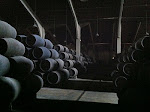
Some producers store old wines that have not been disgorged. They are sealed under caps and kept fully inverted, stored sur pointe, as these bottles of 1982 Réserve Millésimée in the Philipponnat cellars.

The interesting thing with bottles stored sur pointe is that the lees remain in the bottle for the length of storage. Think about that - if the wine in question is from the 1982 vintage, the wine has had 28 years of lees contact. That would probably be too much lees contact, except that the bottles are riddled and the lees is collected in the neck before the bottles are stored sur pointe, so that the lees have far less surface area and they simply protect the wine from oxidation.

Drinking a bottle of old Champagne that has been disgorged and stored on cork is as as simple as removing the cork and pouring the wine. On this trip we were lucky enough to drink several old wines that had been stored this way. Rodolphe Péters of Champagne Pierre Péters was absurdly generous and opened several old bottles for us.

The 1990 Pierre Péters Blanc de Blancs Brut Millésimé was delicious and showed intriguing mushroom and sous-bois aromas, and felt young and energetic on the palate. It was perfectly balanced and seemed like it could live on for another decade at least, probably longer. The 1973 Pierre Péters Blanc de Blancs Brut Millésimé was one of the finest old bottles of Champagne that I have ever tasted. The wine had a beautiful orange color, and incredibly vibrant aromas and flavors. Chamomile, mandarin, honey, flowers...but those are just words that don't really do the wine justice. It was a tremendously beautiful old bottle.

Then Rodolphe Péters, for reasons that I still do not comprehend, decided to open a bottle of 1921 Camille Péters Champagne Demi-sec. This was the last bottle in his family's cellars. It was dark amber in color and tasted like the freshest Madeira, which is to say, delicious.

The cork was a work of art.

Drinking a bottle of old Champagne that has been stored sur pointe is a bit more difficult. The wine must be disgorged first, a process made to look simple by the producers, but I have no doubt that I would destroy a wine attempting to disgorge it. A wooden and metal tool that is probably exactly the same as it was 75 years ago is used to pry off the capsule.

First the bottle is held upside down, and obviously it is a good idea not to disturb the lees in the neck.

As the bottle is tilted upward the capsule is pried off and the pressure in the bottle forces the lees plug to fly out of the bottle. A little bit of wine is lost too. This process is called disgorging à la volée. No dosage is added to wines disgorged à la volée and from what I am told, the wine is best when consumed immediately. On this trip we drank several bottles that were disgorged à la volée, including the bottle being disgorged by Charles Philipponnat in the above photos, the 1979 Philipponnat Grand Blanc, a Blanc de Blancs made from Côte de Blancs and Montaigne de Reims grapes. The wine was just delicious, complex and deep, and I don't know if it is because it is a little younger, because the 1979 vintage ages differently, or if storing sur pointe is the reason, but it felt structurally younger than wines that had been disgorged long ago, as if its inner core had not aged as quickly as its outer flavors and aromas.

It would be fascinating to one day drink examples of wines aged on cork compared to the same wines disgorged à la volée. I suppose that means I will have to go back to Champagne some day.

Monday, January 31, 2011

Vin Clair and Champagne Terroirs

To really know the taste of wines from a certain place - this is not an easy thing for most of us. If you are fortunate enough to drink many examples over many years, it becomes possible. When trying to learn about terroir, Champagne presents challenges that Burgundy, for example, does not. Although the majority of Burgundy wines are of the regional or villages classification, single vineyard bottles are so widely available that your local wine shop doesn't have to be particularly creative to stock them. There are nowhere near as many single vineyard Champagnes on the market, although the number is growing. Most often when we drink Champagne, we drink a blend of wines from several parcels of several vineyards, perhaps even from several different villages and vintages. Add that to the fact that Champagne must be crafted in the cellar in a way that most still wines are not, it is easy to understand why some people do not consider Champagne to be a wine of terroir.

It may be understandable, but it is simply wrong. Just because it is challenging to discern Champagne terroir does not mean that Champagne is not a wine of terroir. It requires more experience, and I would say more commitment on the taster's part, to understand Champagne terroir. I most certainly do not understand it and I drink as much Champagne as I can. One of the best things about being in Champagne recently was that I had the opportunity to vastly accelerate my learning about the different terroirs.

Vincent Laval of Georges Laval pouring vin clair - Chardonnay from Les Chênes.

If you visit a Champagne producer a few months after the harvest but before the following spring, and if you are lucky, you will have the chance to taste vin clair, the base wine that eventually becomes sparkling wine. Some producers vinify all of their parcels separately and you might taste them one after the other, listening as they describe the characteristics of that particular place, comparing the taste of a Chardonnay from an the middle of an east-facing slope with hardly any topsoil to a Chardonnay from the same village, but from a sandy parcel lower down on a south-facing slope. The wines smell, taste, and feel different from one another.

Tasting and then blending of vins clair has typically been the purview of the wine maker and his or her team, a behind the scenes affair. Peter Liem told me that it was only about ten years ago when critics began to taste vins clair. "I want to truly understand the wines," he said. "To do that I need to taste them from the beginning as vin clair, before following their development in bottle." Peter's post on his old Besotted Ramblings blog demonstrates the kind of learning one can do when tasting vin clair.

The first estate that Peter and I visited last week was Chartogne-Taillet in Merfy, and the first thing we did was taste vins clair. Alexandre Chartogne dipped a pipette into a barrel of Chardonnay from Les Heurtebises, a vineyard of sand and limestone. This is the base wine that becomes Chartogne-Taillet's Blanc de Blancs.

We tasted Pinot Noir from Les Orizeaux that is eventually blended with Chardonnay from a great vineyard called Chemin de Reims to make the house's prestige wine, Cuvée Fiacre. And most instructively for me, we spent a lot of time with the Meunier from Les Barres. This wine comes from 55 year old ungrafted vines on sandy soils, and I found it to be highly distinctive. The aromas reminded me of Tarlant's La Vignes d'Antan, another wine made from ungrafted old vines on sandy soils. Sounds reasonable enough until you consider that Tarlant is located in Oueilly in the Marne Valley and Chartogne-Taillet is way up north in the Montagne de Reims. And La Vigne d'Antan is made of Chardonnay, not Meunier! Maybe there is something about ungrafted vines on sandy soils...

I had a similar experience when tasting vins clair at Champagne Philipponnat in Mareuil-sur-Aÿ. Philipponnat is the sole owner of one of the most famous vineyards in Champagne, the Clos des Goisses.
Clos des Goisses is a very well exposed severely steep vineyard and is one of the warmer sites in Champagne. Export Manager Vianney Gravereaux said that the grapes regularly achieve 12% potential alcohol, compared with between 10 and 10.5% in most of Champagne. It is a large vineyard at 5.5 hectares, long and narrow with many different parcels, a bit more than half Pinot Noir and the rest Chardonnay. There is not much topsoil over the abundant chalk.

We were lucky enough to taste two vins clair from the Clos des Goisses, a Pinot and a Chardonnay. Although the character of the grape was discernible in both wines, they shared a powerful floral fragrance and an exquisite depth and richness while maintaining great detail and finesse. This, not the grapes, defined the character of both wines.

All of this said, what strikes me the most in reflecting on these experiences is that in the end, I learned how much that I don't know. For example, how to translate this new understanding of certain Champagne terroirs via vin clair, to understanding what I am tasting and smelling when drinking a bottle of the finished product?