Late Spring Lunch


Because much of what actually happens in the world is random and unpredictable, after years of drinking essentially no mature German Riesling, in the past few weeks I've had maybe 20 mature wines. This is due to the generosity of friends - dinners and things like that. What I'm about to tell you might be old news to you, but WHOA, these wines can be great.
When the wines are great, what really gets me is the seamless combination of impossibly wispy delicacy and focused pungency. How can a wine be so incredibly delicate and wispy, and yet so powerful? Well, some wines can do both. The power and lightness idea is not new to me, but it feels like it might reach its apex with some of these old wines. Here are a couple from the past few weeks that really blew me away:


Take a look at some of the lovely spring vegetables that my favorite farmer Bill Maxwell had last weekend:


Here are some notes on great wines that I was lucky to drink in July, mostly because of the generosity of friends: Equipo Navazos La Bota de Fino Nº 24, $60, Eric Solomon Selections/Imported by European Cellars. This is what we drank with the pasta and artichokes in the previous post, and it was a shockingly good pairing with the pungent dish. Deep golden in color and showing both flor character and the rich and slightly oxidative notes of a young Amontillado, the wine is beautifully harmonious and made me think of the best salted caramel. It is actually a Fino/Amontillado, a wine that is old en0ugh so that the flor has started to die and the wine is beginning to become an Amontillado. Fino/Amontillado is not allowed to be labeled as such, and so the wine is called Fino. It comes from an old solera at Bodega Perez Barquero in Montilla-Moriles, further inland than Jerez and a place where Pedro Ximenez is used to make Sherry, not Palomino. Fantastic wine and worth searching out.
 Valdespino Palo Cortado Cardenal, price unknown, not imported. Valdespino makes several special Sherries from extremely old wines, and this very fine Palo Cortado is one of them. The wines are at least 80 years old, and began life in the Inocente solera. As they aged and moved toward Amontillado they were selected out of the solera, ironically because of something that indicated to the cellar master that they would not be typical and great Valdespino Amontillado. But they are still great wines and become one of the absolutely iconic Palo Cortados in all of Sherry. Peter Liem tells me that this wine is rare and highly regarded enough that if you were to open a bottle for a Sherry lover in Spain, their eyes would bulge in anticipation. Cardenal is a 375 ml bottle and it takes time to truly open up, perhaps several days. I can tell you that on the fourth day it was majestic, and it would be silly for me to try to describe the aromas and flavors. All I can say is that it was among the most complex and fascinating Sherries that I have ever had.
 Bodegas Hidalgo Manzanilla Pasada Pastrana, $24, Imported by Classical Wines. Single vineyard Manzanilla Pasada from the house that produces La Gitana. This can be very lovely wine, and this bottle was excellent, with brisk fresh flavors and prominent minerality. It is complex and pairs very well with a variety of foods, and the saline finish is very refreshing. I have experienced some bottle variation, however, and it's probably a good idea to buy when your retailer has a fresh batch.
 2006 Rudi Pichler Riesling Federspiel, price unknown ($59 on a restaurant wine list). Absolutely delicious and memorable to me because of the incredible clarity with which it tasted of fresh juicy yellow plums. Clean and very pure, a bit waxy, very mineral, very graceful and balanced, a true pleasure to drink. And perfect with weisswurst. Why don't I have wine like this in my cellar?
 2003 Willi Schaefer Graacher Himmelreich Riesling Spätlese, price unknown, Terry Theise Selections/Imported by Michael Skurnik Wines. This was simply delicious wine, and as my experienced Riesling friends who shared it with me explained, in the context of the very hot 2003 vintage, this wine is remarkable. I loved the tactile sensation I got on the palate, and the very pretty floral aromas, like violets or geraniums. Intense wine, and still gentle. I'd like to taste a version of this from a more "normal" vintage.
 2009 Guy Bossard Muscadet Sèvre-et-Maine Expression de Granite, $18, Chartrand Imports. At this point, my favorite Muscadet of the 2009 vintage. This wine is just so good! A bit rich, but that's the vintage, and the wine handles it perfectly, with well defined aromas of anise seed, citrus, and stone. Great balance and already showing some complexity on the palate, the wine is very delicious and shows good acidity and a lovely lingering finish that comes back to anise seed. One of the under-appreciated wines of the world, I would say.
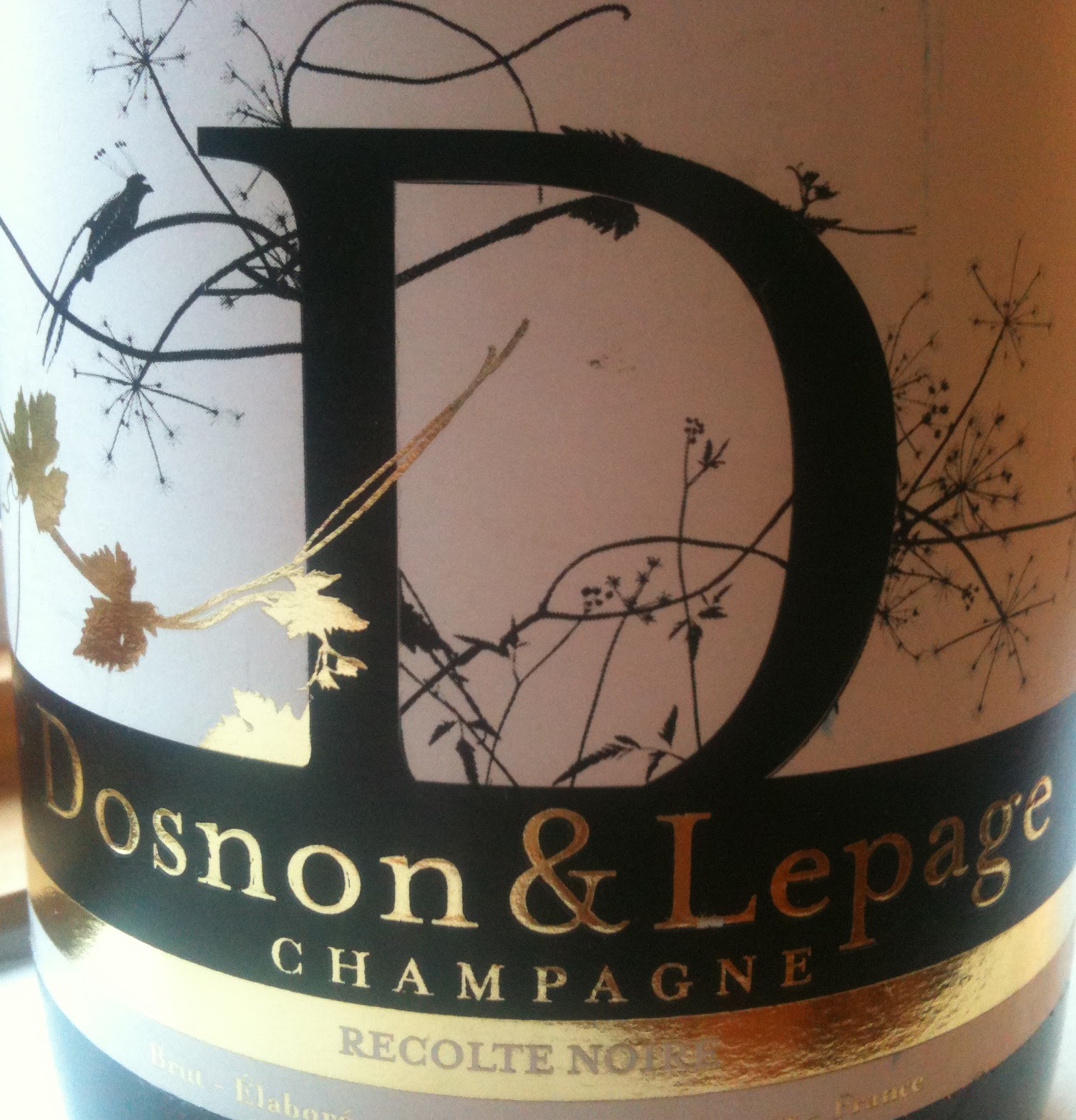 NV Dosnon & Lepage Champagne Brut Recolte Noire, about $55, JD Headrick Selections. I was shocked at how good this wine was. Not because I had low expectations, but because I thought it was pretty fantastic wine. This producer and this particular wine was recently lauded by Eric Asimov in an article about the wines of the Aube. Vibrantly aromatic red fruit with earthy bass notes, great balance, very long and vivid on the finish. Absolutely delicious and I would say a terrific value in the world of Blanc de Noirs Champagne. Honestly, if you like Champagne, try this wine.
 NV Jacques Selosse Aÿ La Côte Faron, price unknown, not imported (I think). Very lucky to have the opportunity to drink this wine, a single vineyard wine based on 2003 but containing 60% of wines from vintages back to 1994 from something of a mini-solera. There are producers who make wine in the Selosse style, but the more experience I have with these wines, the more clearly I see that Selosse's wines cannot be imitated. A complete wine - rich and ample, brilliantly detailed, fresh and lively, oxidative and mature, deeply complex and very mineral. It feels both dry and sweetly fruited at the same time, if that makes any sense. Compelling and delicious wine.
I'm a German wine neophyte, but over the past year I've started poking around a bit, drinking Riesling here and there. I like the wines very much in general, but I'm still a bit intimidated. There are several regions and many producers, sweet wines and off-dry wines and dry wines, wines that were harvested at spätlese must weight but fermented dry, and all sorts of other complications. Some of the labels indicate the relative sweetness (trocken, halbtrocken, feinherb, etc.), some do not.
How to really begin learning about the wines, approaching them in a sensible way? There are many answers to this question, but I decided that I would use basically the same approach that I use with Burgundy wine. Drink the basic wines by a variety of producers and see whose wines I like, and go from there.
In Burgundy it's this is relatively straight forward - the basic wines are regional wines, Bourgognes and the like. But what are the basic German Rieslings? Knebel makes a wine that is simply called Riesling Trocken. It is not classified using prädikat language (kabinett, spätlese, etc.), it is a blend from several vineyards, and is the most inexpensive wine in their portfolio. Sounds like a basic wine. But wait - Knebel also makes the Von den Terrasen Riesling Trocken, also a blend from a few vineyards, also without prädikat language, and only a few dollars more. Are they both basic wines?
Perhaps these things are a bit silly to focus on, but it became an issue when I decided to convene the Brooklyn Blind Tasting panel to sample a load of "basic" German Riesling from the 2009 vintage. Which wines should be included, which should not? I very much wanted to include the wonderful Immich-Batterieberg Mosel Riesling CAI, but I didn't because the wine is a kabinett. It didn't have to be labeled this way, but it was - see importer's explanation in the comments on this post. Anyway, I bought some wines for the tasting, and when I asked a few Riesling importers for donations, they were all a bit confused. "What exactly do you want," they would ask. "Do you want dry wines or sweet wines, and what about prädikat language? And what if a producer makes more than one of these 'basic' wines, as you call them?" Reasonable questions, indeed.
But I was determined to do this tasting for a couple of reasons. Firstly, I haven't done one of these in a long time and I really enjoy blind tasting. Also, I wanted to learn more about the producers. And lastly, I had this idea that "basic" German Riesling can compete with the best white wines of the world, say Muscadet, at the under $20 price point. So flawed definition and all, I convened the panel and we tasted 2009 "basic" German Riesling. For this tasting I was joined by some serious Riesling people: Rubén Sanz Ramiro, Head Sommelier at Veritas Restaurant, Stephen Bitterolf, Wine Director at Crush Wine & Spirits, and Eric Asimov, wine critic at The New York Times.
We tasted 9 wines in two flights, discussed the wines, and everyone selected two favorites. We then drank the wines with dinner. I must say, I was quite disappointed with how the wines showed, as a group. There were a few bright spots, but a few dark spots as well, and unless it was a root day or something, my theory about the great value of this category of wine was basically blown. The way I see it now is this: there are some producers whose "basic" wines are utterly fantastic, and might qualitatively equal a great Muscadet, for example. But if this tasting is representative of the wines as a group, then perhaps Eric Asimov was right when he said after hearing about my theory, and I'm paraphrasing here, "Hmm, I don't think I agree. After all, great Muscadet is made with the region's best grapes from its most interesting terroirs, and it sells for $16. Basic German Riesling, whatever that is, is made from the region's least interesting grapes and from its least interesting terroir, and it sells for $20. You have to buy up to get the best German wines."
Here are the wines we drank, along with some notes: 2009 Willi Schaefer Mosel Riesling Qualitätswein, $18, Terry Theise Selections/Imported by Michael Skurnik Wines. Rubén, Eric, and I selected this as our favorite of the tasting, and Stephen had it as his second favorite. I liked the subtlety and harmony of the nose, and the faint sponti whiff that darted in and out, and that the palate was so well balanced, although very much off-dry. It was clean and pure, and just delicious. Rubén thought it was a classic wine in the off-dry style of the Mosel. He said that it wasn't terribly concentrated, but he liked the vibrancy and focus, and he found that it improved over the course of the evening. Eric felt that it had good presence, texture, focus, balance, and acidity, and that it was simply very pleasing. He said that it was the most complete wine of the tasting. Stephen enjoyed the contrast between the fresh tart nose and the sweetness of the palate, and he thought it was a well-done wine. He did say, however, that there was something that bothered him about the midpalate, that it was a bit glossy, too giving, not enough cut.
2009 Reichsrat Von Buhl Deidesheimer Herrgottsacker Riesling trocken, $16, Rudi Wiest Selections/Imported by Cellars International. This wine was donated by the kind folks at David Bowler. This was Stephen's favorite wine. He said that it was the tartest, the most curt, and the shortest wine, but he liked the bitterness and acidity and suggested that this wine speaks more to the German palate. He said that it felt as though it has more ambition than some of the other wines, and that he wanted to check back in 5 years. I also liked this wine, particularly the mineral character, but I was put off by what I thought was the canned character of the fruit. Neither Eric or Rubén were terribly impressed.
 2009 Weingut Keller Riesling trocken, $20, imported by Petit Pois Corp. Rubén and I both picked this as our second favorite wine. Rubén liked the midpalate concentration, although he noted that the alcohol stuck out a little and clipped the length a bit. I liked the nose a lot, with subtle pineapple fruit and minerals, and I found the palate to stand out among the wines for its mineral and acid drive. Clean and pure with some hints of baking spices, I wanted to eat with this wine. Stephen, by the way, identified it as a Rheinhessen wine, but didn't love it, wanting more tension in the wine.
2009 Fritz Haag Riesling, $18, Rudi Wiest Selections/Imported by Cellars International. This was Eric's second favorite wine. He felt that a touch of sulfur made it opaque, but he liked the texture and the presence, and he thought it had good length and lots of character. He said that it was identifiable as a Mosel Riesling in a classic way. Stephen found the wine to be confusing - he couldn't get much from it, finding it ornery and restrained. But he liked the green apple fruit and slightly salty taste, and the minerality. In the end, he thought that it never really came together. Rubén was on the fence, liking the ripeness, but he felt that the wine lacked concentration and length. I wanted to like the wine but I found the sulfur on the nose to be off-putting.
 2009 Weiser-Kunstler Mosel Riesling feinherb, $19, Mosel Wine Merchant selections. This wine was kindly donated by the folks at Mosel Wine Merchant. Eric really liked this wine, finding good character and lovely apricot and peach fruit, some ginger, and minerals. He liked the succulent texture and called it one of the more complete wines of the tasting. I really liked this wine and second favorite was a toss up for me between this and the Keller. I thought the nose was subtle and harmonious, and I liked the hints of baking spice and earth. The off-dry palate was nicely balanced with good acidity and there was a lovely bitter pit finish. Stephen liked the fresh nose, the sweet palate and thought it was a well put together wine, but found it to be unidimensional. Rubén liked it initially, but going back to it he found it a bit mute and without complexity. There were leftovers of every wine except for Willi Schaefer's, and this one improved a lot on day 2, by the way.
2009 Schäfer-Fröhlich Nahe Riesling  Medium-Dry, $19, Rudi Wiest Selections/Imported by Cellars International. This wine was donated by the kind folks at David Bowler. During the tasting this wine did not show very well, but it improved a lot on day 2. Stephen liked the clean mineral nose but found the wine to be closed down, or maybe reductive. He liked the pear and apple fruit but thought the wine was short and rough without much distinction. Eric didn't like the wine at first, finding it bland, but with air he liked the mineral character. In the end, though, he thought it was fairly simple. Rubén felt the same way. I liked the spices and the ripe orchard fruit but I thought it was reductive and not entirely balanced. Again, much better the next day.
 2009 Müller-Catoir Riesling trocken, $18, Terry Theise Selections/Imported by Michael Skurnik Wines. This wine was donated by the kind folks at Michael Skurnik Wines. Although we were divided on this wine, no one thought it showed very well. Stephen found it bizarre but enjoyable, with ginger and mandarin, but he also thought it was lean and difficult. I thought it was basically a balanced wine and I liked the mandarin fruit and the acidity, but I thought it felt a bit candied. Eric and Rubén really did not like the wine. I heard things like "bland, dull, without character, too much malic acid, out of balance, short, over-cropped cheap Riesling."
2009 Peter Lauer Riesling Barrel X, $17, Mosel Wine Merchant. This wine was donated  by the kind folks at Mosel Wine Merchant. This was an off bottle, and I say this because I've had a couple of bottles over the past few months, and this one was entirely different. Eric and Stephen literally said the same thing upon smelling - "Prum?" This wine was dominated by sulfur, overwhelmed by it. Sad too because Eric said that underneath the sulfur it seemed as though there was a very interesting wine with intriguing aromas and flavors.
  He wanted to check back in a few years. Stephen thought it was serious wine with freshness and a real core, very solid. He said that it wasn't a sulfur screw-up, that there was a lot of tension and the wine was built to age.
2009 Weingut Josef Leitz Riesling Eins Zwei Dry "3," $16, Terry Theise Selections/Imported by Michael Skurnik Wines. This wine was donated by the kind folks at Michael Skurnik Wines. I liked this wine more than the others, finding a rich ripe nose and palate that was almost balanced by the acidity, but I found something honeyed in there that was distracting. The others really disliked the wine. I heard things like "artificial, disjointed, thin, and dilute."