Monday, March 18, 2013

The Ability to Withstand Magnification

The other night a friend came over for dinner and he brought with him a bottle of white Burgundy, a wine that reminded me why it is that I love white Burgundy. Not that I needed a reminder - some of the finest wines I've ever drunk have been white Burgundies. I'm not put off by the bottles that don't live up to expectations, even though these can be costly disappointments. Wine in all categories can be disappointing, and I don't buy the cliché about Burgundy being "hit or miss." All wine is hit or miss when you get right down to it. Storage, bottle variation, and many other factors can reduce the experience of any given wine. And when white Burgundy is on, it is as thrilling as wine can be, to my taste.

The funny thing is, on paper this wine didn't have to be so good. 1994 is not considered to be a good vintage, for one. And this wine comes from Puligny, but the producer is better known for white wines from Meursault. That said, the 1994 Robert Ampeau & Fils Puligny-Montrachet 1er Cru Les Combettes was a very good wine. Not the greatest of white Burgundies that I've had, even recently, but very good, particularly considering the difficult vintage. And the wine made me think quite a bit.

We opened it and tasted, maybe a half hour or so before we would begin drinking it. My friend who brought the wine was not terribly impressed, and I understood why - it seemed dilute, without much concentration. But we had graduated college in 1994, and we also were probably not terribly concentrated in 1994, needing time to gain complexity and become more serious. We have since done that, and with a little air, the wine did too. It never fully lost that dilute feeling, but it did blossom aromatically and although not a wine with much sap or richness of body, it absolutely and clearly articulated itself and showed a very lovely delicacy to its aromas and flavors. That's not a cop out way of explaining away a mute wine. It is a truthful description of the wine's character.

Not every wine will be powerful, rich, and with concentrated flavors. You already know that, but I'm just saying. Mature white Burgundy can be great and can do so in the character of something light in body, delicate, almost fragile. I've not had other vintages of this wine so I don't know, maybe this is always the character of Ampeau's Combottes. Somehow, I doubt it. 1994 was not an easy year, with lots of rain and other problems. Many people wrote off the vintage, and today's prices for '94s are lower than any other vintage in the '90s. But I've had several examples of 1994 Burgundy in the past months and have really enjoyed them.

So, what about this particular wine: I loved the clean and pure articulation of aroma, incense and stone and spring water. And I loved the delicate way those aromas tranlslated on the palate, finishing with some pungency, leaving a lingering incense and mineral essence that didn't so much stain the palate, but left an impression nonetheless.

In his classic book Making Sense of Burgundy, Matt Kramer writes about Puligny-Montrachet:
The goût de terroir of Puligny seems somehow more sharply etched than elsewhere. The fruit is defined and powerful yet restrained, like the musculature of a martial artist. Its perfect composition is revealed by its ability to withstand magnification. As you increase resolution, from commune level Puligny to premier cru and then zoom to Batard-, Chevlalier- and Le Montrachet, you find no blemishes, no distortions in taste or balance.
I hadn't read this section of the book in a while and the day after drinking this wine, went back for a look. This paragraph struck me in its description of Puligny's restrained character, something that I am learning to see in the wines, especially in relation to the brawnier wines of Meursault, Puligny's neighbor to the north. Combettes is a vineyard that borders on the Meursault appellation, and probably has more flesh than some Puligny wines (which may have something to do with why Ampeau's Combettes in 1994 is as successful as it is). And still, the character of this Combettes, to me anyway, was unmistakably Puligny.

Kramer also talked about the ability to withstand magnification, and I like thinking about this. Maybe the idea can be extended to vintage. In a riper vintage like 2003 for example, the essential restraint should still be evident. And in 1994, for example, a lesser vintage, there is no distortion in taste or balance.

Maybe this sounds like a simplistic thing to say, but maybe it would be easier for those of us who love Burgundy if we stop hoping that every bottle will be a great thing, if we let go of our ideas of the heights a bottle should ascend to. I'm not saying that we should dumb it down or stop expecting the wines to be great. But that it's also nice to allow a 1994 to be a 1994, and to appreciate it for whatever its charms may be.

Tuesday, March 12, 2013

Quick Radish Pickle

So apparently you can pickle vegetables merely by adding salt and then waiting a little while as the water is drawn from the cells. This quick pickling method can take as little as 5 minutes if you are David Chang, or it can take longer, but my sense is that it's up to the pickler to decide how long the pickling will take.

Not long ago I ate dinner at a friend's house and he served napa cabbage quick pickled in salt, and it was delicious. I resolved to do some quick pickling of my own. And so the other day I found myself with a trio of radishes, and tried my first quick pickle. I used one each of daikon, the large and somewhat mild carrot-shaped radish, watermelon radish, which is a colorful and very mild radish, and the very pungent green meat radish. I harbored the secret hope that the bright colors and taming effect of pickling might induce my children to try the radishes.

I peeled them and sliced them in half and quarter moons, and added maybe a bit more than a tablespoon of coarse kosher salt. Tossed well, and let them sit for a half hour. They were delicious immediately, so this actually was not so easy to do.
A half hour later the radishes had lost some of their luminous color and their firm crunch, but were delicious in a different, mellower way.

I served them as a side dish with a dinner of breaded and fried chicken thighs and soba noodles. Both daughters tried them - they went for the watermelon radish, which shouldn't be a surprise. My younger one may actually have liked it, although she elected to mimic her older sister in expressing her dismay at the radish's flavor. I thought they were delicious. The next day I tossed the leftovers in a few drops of sesame oil, and that was some serious deliciousness. There will be more of this quick pickling happening in my house.

Sunday, March 10, 2013

Happy/Sad Cheverny

Supposedly there are more words in the English language than in most other languages. And yet it feels as though we are limited in our ability to discuss some of the more important ideas - there just aren't enough words. I've read that there are over 40 words for snow in one of the Inuit languages. Makes sense - there are many different types of snow and if this is an important part of daily life, differentiating between these kinds of snow, it's natural that different words wold emerge so that people can communicate clearly.

Although there apparently are a lot of words in English, we have only two that I can think of to describe warm feelings towards another person - "like" and "love." Shouldn't there be more than that? Aren't there gradations that we aren't giving efficient voice to? Same with "happy." There are many different kinds of happiness, but we have few words to differentiate here. There is the kind of happy you feel when a puppy bounds up and starts licking your face or the kind of happy you feel when holding a 6 month old baby. The kind of happy you feel when you've stepped inside from a soaking rain, or finally made it through security after a long line at the airport. The kind of happy you feel when you're finished taking a final exam, or the kind you feel when your test results are negative. The kind you feel when you get to the BBQ and open the back door to the yard, see everyone there talking and eating and having fun, and you haven't yet but are about to join the fray. There's even the weird kind of happiness you (or maybe just me?) feel when you are depressed about something, but finally give in and allow yourself to wallow in it in the comfort and safety of your own home - an exquisitely sad kind of happy.

Where am I going with this. A fair question indeed, patient reader.

Well, if a puppy licking your face is Beaujolais Nouveau, I think I've found a wine that for me best expresses the exquisitely sad kind of happy. I'm talking about 2010 Domaine de Veilloux Cheverny Rouge. I opened a bottle a week ago or so and it was really difficult at first, loaded with reductive funk. But there was something accessible in there, a very lovely note of dried roses. The next day the wine retained a tannic edge, but it showed such pretty fruit and floral tones, satisfying kernels of happiness inside of a challenging package.

The wine is a blend of many grapes - Cabernets Sauvignon and Franc, Malbec, Gamay, probably Pinot too and I don't know what else. I do know that the wine is farmed biodynamically and organically and that 2010 is my favorite recent vintage for Loire wine. I also know that it is a selection of Michael Wheeler (a friend of the Dressners and much of the NYC wine world who moved out west) and Michael Foulk - their company is MFW Wine Co. This is a relatively new company, I think based in Portland Oregon, and their book includes some lovely wines that are direct-imported in NYC by David Lillie at Chambers Street Wines. There are some other wines too, things I've not heard of, including a lovely little Barbera called FUSO, made by Walter Massa - it's surprisingly good wine for $13.

Veilloux Cheverny Rouge is an excellent argument for blended red wine, a complex, expressive, and delicious wine, but a wine whose happiness does not come easily. You need to wallow in in a bit first. It sips well on its own, but really shines with all sorts of food. It sells for something like $15-17, and it's worth looking for. I got mine at the excellent Slope Cellars in Park Slope, Brooklyn. Try it, if you're looking for that exquisitely sad/happy feeling.

Thursday, February 28, 2013

Comfort Food

You've noticed that I've been busy lately, sorry to drop out like that. Lots of work and some work travel, and things just pile up.

I'm trying to get better about work travel, as it has become an inescapable fact of life for me, and it seems like it will get worse before it gets better. There are a few simple things I'm trying to do now that make it easier.

1) Travel light - sounds obvious, but I've begun taking it to the extreme. I pack almost nothing, try to fit whatever I need into a large laptop shoulder bag. Yup, I'm that guy with underwear in his computer bag. I cannot bring myself to wear lace-less shoes, and it's not for lack of trying. They just look so dorky on me.

2) Leave the house clean - coming home to a clean house just feels better.

3) Leave something easy and comforting in the fridge to cook when I get home. It cam be tempting to go out to eat after work travel because it's easy, but it's so much nicer to put on some music and make something at home, and to open a pleasing bottle.

Upon returning from a recent work trip I made the simplest of comforting meals - steak and mashed, and a salad. I feel like people think there's some sort of trick to making good mashed potatoes, and I just don't see it. Why is this tricky? I peel and coarsely chop a couple of russets (they cook quickly and have the right texture when mashed), put them in a pot of salted water, bring to a boil, reduce to a simmer, and test them until they give easily to a fork. Then it's through the potato ricer, and here is where the magic happens. The still hot but now ground potatoes are begging for seasoning, and they will readily accept whatever you give them. I keep it simple, with a glug or two of buttermilk, a pat or two of butter, a shake or two of salt, and a grind or three of black pepper. Honestly, it's hard to argue with the results.

Although I am still a believe in this method of cooking steak, the just-returned-from-work-travel mood doesn't allow for 25 minutes in the oven. I just pan fried this baby, let it rest, sliced it thick, whisked a little sherry vinegar and soy sauce into the pan juices, and went to town.

This has got to be one of the easiest dishes as far as wine pairing goes, it's hard to go wrong. This was comfort food night for me, after work travel. I wanted something familiar that would offer a pure form of pleasure.

The problem is, the wine just wasn't very satisfying. I drank the 2007 Coudert Fleurie Cuvée Tardive on only one other occasion, about 5 years ago at a friend's house. I remember thinking that it was entirely closed aromatically and on the palate, which is to be expected at that stage (and perhaps still now), but I also remember thinking that the wine just didn't feel right.  It had a murky quality, a lack of clarity that bothered me. But this is 5 years later and 2007 shouldn't be the type of vintage that requires a million years to reveal its charms. Shouldn't this be approaching drinkability now?

Who knows? The wine was still tight as a drum aromatically and on the palate - I mean nothing doing. Dark, dark, dark, and impenetrable. And then three hours later, the sun shone in and the veil lifted, and the wine showed lovely fruit and a nice clarity of flavor. Okay, I thought, this wine is just too young. And it probably is too young to drink now. But it never really stayed clear and bright - the darkness returned, especially on days 2 and 3, and by day 3 it seemed to be going downhill.

I am not familiar with the aging curve of Cuvée Tardive, and maybe I made a classic mistake in opening the bottle at this age. But I also think that the wine has a murky quality, a blurriness to the flavors that isn't terribly appealing. It's hard to accept that from a producer that I know and love - could it really be a not-so -great wine in 2007?

No matter. My dinner was comforting, and even though I didn't love the wine, it was comforting too. A familiar drink can be comforting even when it's not as delicious as it usually is.

Wednesday, February 13, 2013

Japanese-style Food, and Fino Sherry

I've been trying to cook Japanese food lately, and I've succeeded in cooking Japanese-style food. It's amazing how far you can get with a couple of miso pastes, some kombu (dried kelp) and dried shaved bonito flakes, some mirin and shoyu.

Here is one recipe that my daughters and I have been enjoying - Japanese-style stew with beef and potatoes. Disarmingly simple, and very satisfying, especially in this cold weather. You are essentially braising beef and potatoes in a mixture of Japanese sweet rice wine and shoyu. Here's what you do:

1) Watch the Shogun miniseries in it's entirety. This is 10 hours of your life well spent. And it gets you into the right frame of mind, as a foreigner attempting to do something Japanese.
2) Slice against the grain 1 pound of flank steak (but you can use other similar cuts) into pieces 1 inch thick, but leaving them the width of the steak. Brown the meat and remove from the pot.
3) Cut a large onion in half and slice it with the grain into long thin strips.
4) Peel two russet potatoes and cut them into chunky half moons, chunky enough to hold together in a braise. 
5) Peel a decent sized knob of very fresh ginger and grate it finely.
6) Mix together a quarter cup of good quality mirin with a quarter cup good quality shoyu, and 1 cup of good quality hand-poured water. This is the ratio that I like, but you can add more shoyu or mirin - they are strong flavors though and this combination is nicely balanced.
7) Saute the onions in the beefy pot, but don't brown them. After they have cooked for a few minutes, add the ginger and mix well.
8) Add the braising liquid and bring to a simmer.
9) Add the beef and the potatoes, bring to a boil and immediately turn down the heat to a simmer.
10) Cover with a Japanese drop-lid, or if like me, you don't have one, cover the pot with a damp piece of parchment paper and a tight-fitting lid. Every 15 minutes or so move the stew around the pot to make sure that all the meat and potatoes have a turn being submerged.
11) When the meat is very tender, maybe 90 minutes, turn off the heat and let the whole thing rest for 10 minutes or so.
12) Top with scallions and serve over rice.

Would it surprise you if I tell you that this dish is fantastic with Fino Sherry? A lot of Japanese food is great with Fino Sherry. There is the umami factor - Japanese home cooking and Sherry both have it, and they compliment and elevate each other tremendously. But it's more than that. As I understand it, one of the ideas in Japanese cooking is to bring out the essence of the ingredient, to accentuate the beef's beefiness, or the radish's radishiness, if you will. Fino Sherry, with its very pure chalky saline and savory flavors somehow enhances the purity of the flavors in Japanese dishes.

One night I drank Emilio Hidalgo's beautiful Fino called La Panesa with this dish, and I swear to you it was as good a pairing as any I've had in a very long time.
On another evening I made a simple Savoy cabbage, daikon radish, and pork dish, simmered again in a light mixture of mirin, shoyu, and water. First of all, this is seriously delicious. My young daughters were happily eating Savoy cabbage, that's how good it was. There was half a bottle of La Panesa leftover, and surprise surprise, it was a wonderful pairing.

Tonight I made tofu with snap peas, carrots, and onions simmered in a mixture of red and light miso pastes, mirin, and water. Again, the daughters lapped it up - these girls like the savory.

And I drank the old reliable Valdespino Inocente, a spirited little half-bottle. I'm telling you, if you're into Sherry and you haven't tried it with Japanese (or Japanese-style) food, you really should.

One day I will learn to make oden like this. Probably not, actually. But at least I had the sense at this restaurant to pair it with the very grand La Bota de Manzanilla No 22. As Morgan Freeman said at the beginning of the movie Se7en, "This isn't over - there are going to be more of these."

Friday, February 08, 2013

I Might be Corked

I'm stuck in the middle of a tough streak right now, friends. Be very careful sharing your good wine with me, as since early January there have been some incredible disappointments. Lately, every bottle that should be great is corked or flawed in some other way. It's starting to spread now to the daily bottles too, which is alarming.

It began with a bottle of 1988 Drouhin Musigny at the annual Burgundy Wine Club dinner in early January. Should have been a brilliant bottle, but it smelled and tasted like roasted peat.

This established the tone for the next month. I opened a bottle of 2006 Marquis D'Angerville Volnay 1er Cru Les Fremiets one night and it was corked. That teasing kind of corked, too, where you keep drinking it because you haven't had the wine before and it's not the stinky vicious kind of corked. It was the kind that wisps in and out in a subtle way, gradually building, until eventually it can no longer be denied.

And then this majestic bottle was corked. Again, it wasn't immediately clear (except to one very experienced drinker). Everyone agreed that something was wrong with the wine, but we all fought as hard as we could to deny reality, for obvious reasons. Seriously, this is tragic, isn't it? When am I ever going to drink 1989 Gentaz again?

Then one evening last week I decided to try the 2011 Domaine de la Pépière Muscadet Clos des Briords, always exciting to try the new vintage. Corked. Not hard to replace, but still frustrating.

Then on Friday last week my good friend brought a special bottle to my house for dinner, a bottle he bought a year or so ago at my encouragement. 1987 Domaine Terrebrune Bandol, which I've actually tasted before and I'm a sucker for Bandol from those years, when the wines were less bombastic and lower in alcohol (although this one was 13.5%). The problem was, the wine was corked. And in that especially annoying subtle way that took us 30 agonizing minutes to recognize. Was it taking its time opening up, was it a little heat damaged (yes), was it corked, why was it so muted and weird...because it was corked.

And on Super Bowl Sunday my good pal very generously opened a great bottle to share, the 1998 Giacosa Barbaresco Rabaja. The Bud Light ads were tempting, but this wine had us way more excited. He decanted it for a while and we were ready to go, but the wine was heat damaged. We drank some anyway because it was possible to see the potential of the wine underneath, but I could tell he was frustrated, and I didn't have the heart to tell him that these days, I bring this plague with me wherever I go.

My friend Peter said to me recently, joking around, but not entirely, that no where else would consumers allow this sort of failure rate in the products we buy. "Imagine buying a new car," he said, "turning the key and finding that it doesn't go. And then the salesman smiles sadly and says 'Yeah, sorry, that one doesn't go, that happens sometimes and you'll have to live with it.'"

Okay, a new car is a bit more expensive (unless we're talking about corked Jayer or DRC). But his point is interesting. Why have we accepted the fact that 1 of 8 or 9 bottles of wine is corked? We are told that we have to accept this, that it's part of the game. Maybe so. It still stinks, and can be soul crushing if you've invested cellar time and/or a lot of money in the bottle.

My friend Lee Campbell who used to sell the Dressner portfolio of wines and now is the wine director at Reynards, among other things, once had me guffawing as we complained about corked wine. She said that she's convinced that lots of things can be corked. There is a small park near her house that she thinks is corked. Certain television shows are corked (I think she said that Glee is the most recent offender), a diner near her office is corked, North Korea is corked.

I am worried that I might be corked.

Monday, February 04, 2013

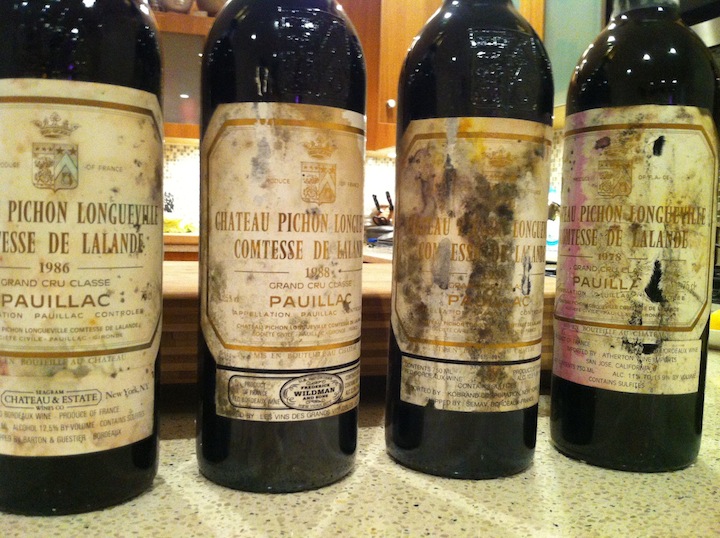
Drinking Four Wines by Château Pichon-Lalande

Not long ago I had the opportunity to drink four bottles of very fine Bordeaux, wines by Château Pichon-Lalande. A good friend was in NYC for the weekend and he brought these from his cellar - lucky me! I've had mature Bordeaux before but one bottle at a time, and quite infrequently. This may not surprise you, but I don't have any old Bordeaux in my cellar. Here's another thing that might surprise you - I truly wish that I did.

There are few wines that could be considered less hip and cutting edge than Bordeaux right now. And rightfully so, in a way. The modern wines tend to be over extracted fruit bombs with little to offer in the way of terroir articulation, never mind detail or elegance. They are big, artificially made wines, in most cases. And they are hugely successful, making tons of money for everyone involved.

But like most things that are classic, old Bordeaux is classic for a good reason. They are made from noble grapes and come from interesting terroir, and when well made they combine brawn with detail, complexity, and grace. Many wine lovers of my generation and younger may not have had a great old Bordeaux - it's not something that gets much attention anymore. I think that those of us who haven't had a great old Bordeaux are missing out, not only on beautiful experience, but also on a vital piece of wine appreciation and history. How can we even approach having an understanding of why wine is great without knowing what a grand old claret tastes like?

Pichon-Lalande is one of the top second growths, and comes from Pauillac, a terroir that apparently gives some of the brawnier wines of the region. You can almost see this in the color - look at that inky purple!

My friend generously brought wines from 1978, 1985, 1988, and 1989. Although the youngest was 23 years old, none can really be considered old by Bordeaux standards. My pal Peter says that you shouldn't bother opening good Bordeaux before it hits 20 years old, and that's probably just the beginning of its maturity.

I roasted a leg of lamb over potatoes, and we went to town. The wines were amazing, all four of them. They continued to evolve over many hours, and were delicious and deeply satisfying throughout. In general, I appreciated the raw power of the wines, and this was easy to do because they also showed such detail and complexity. There was power, but that was only part of the package. There was also balance - these were wines that showed lovely and refreshing acidity, and great complexity of aroma and flavor. Inspiring, really. Not in the way that I felt like going out and buying the current vintage, because as I understand it, the new wines will not become like these wines, even with 25 years in the cellar. They are made differently now. But inspiring nonetheless. If you have any old Bordeaux and you want some one to appreciate it with, I will make dinner.

The 1989 was a wonderful wine, Peter said that it was the grandest wine of the four, and that it had years, maybe decades of life in it. It was the most complete wine on the table, but I found it hard to compare the wine from 1989 to the wine from 1978 - I just don't know enough to be able to understand where the 1989 is in the context of the evolution of Bordeaux. Will it shed some weight and feel like the 1978 in 10 years? Will it always feel this full bodied, but become more gentle and mellow, and offer even more complexity with further maturity? I would guess, yes.

I found the 1978 to be the most rewarding on this evening, with its mellow and gentle nose of tobacco and leather, its complex and long cedary finish. It felt like being inside a log cabin in the woods. Still plenty of energy, an elegant structure, very long and plain and simple - absolutely delicious.

The 1985 was the most approachable right after we opened and decanted the bottles, and was perhaps the most fruit forward of the wines. I enjoyed it tremendously, but in the end we found the other vintages to be more compelling. The 1988 felt more mature than I might have expected, but in a good way, and showed ripe fruit that was thoroughly infused with earth. I loved this one in particular with the lamb, and it seemed to have a lot to offer even as we finished it. This one might, sneakily, be a wonderful wine.

There are plenty of reasons to ignore modern Bordeaux, I get it. The wines can be bombastic and overbearing, and the story of the Bordeaux region seems to be one of opulence and privilege, there is no struggle, no individuality. People in meticulously hip Brooklyn restaurants want to drink wines made without sulfur by scruffy guys or gals living in ramshackle trailers on lonely hillsides. Those wines have their place, I guess. But that's not Bordeaux.

But there is something to this, to old Bordeaux wine. Don't believe me? Get your hands on an old bottle by a good producer - you and three of your friends can do this and spend less than $50 per person. And really, this is history, and it's worth knowing for yourself.

Would you ignore The Police because Sting was kind of lame later in his career? Would you dismiss Woody Allen because Scoop kind of sucked? Are you not going to drink the one bottle of 1976 Lynch-Bages that Chambers Street is selling for $115 because 2010 Lynch-Bages costs $150 and will never be as good? Seriously, what kind of person are you, anyway?