Showing posts with label Pierre Morey. Show all posts

Thursday, September 17, 2009

Wine of the Week - Pierre Morey Bourgogne

There were some thought-provoking comments on my post from earlier this week about, among other things, whether or not it is possible to predict a producer's overall level of quality based on the quality of their Bourgogne. A few people raised the issue of whether or not Bourgogne as a category of wine is worthwhile, based on quality to price ratio. I don't have a definitive stance on the subject - I can make a case for both points of view.

Bourgogne from top producers such as Ghislaine Barthod or Sylvain Cathiard costs upwards of $35. Dugat-Py Bourgogne goes for over $50. If you're talking about Leroy or Coche-Dury, you're closer to $100. Are those wines "worth it?" Are there great Bourgognes? That question must be answered on an individual basis. I can tell you that I do not purchase those wines, and the reason is simply because there are wines for $35, $50, and $100 that I would much rather have. There are great Burgundy wines that cost $35, $50, and $100, but I don't believe that they are Bourgognes.

Still, I wouldn't say that Bourgogne is a worthless category. What if you want to spend $25 or less, and drink red wine from Burgundy? You're drinking regional wine - Bourgogne or Hautes-Côtes de Beaune/Nuits. There are producers making very good Burgundy wine at this price point, but most do not, and I would rather buy great wines from other places for $25 than merely pleasant Bourgogne. I'd rather buy Coudert Fleurie Cuvée Tardive, anything by François Chidaine, Luneau Papin's Excelsior Clos des Noelles, Terrebrune's Bandol Rosé, Puffeney's Poulsard, Bernard Baudry's Les Grezéaux, and many, many, many other wines that, in my opinion, are amongst the finest wines of their type. Even though there are some great regional Burgundy wines, none of them are among the finest red wines of Burgundy.

So what are the best regional Burgundy wines at about $25? Everyone has their own opinions on this. My list includes Simon Bize's Perrieres, Sylvie Esmonin's Cuvée Sylvie, Maréchal's Cuvée Gravel, Rene Leclerc's Bourgogne, Lignier-Michelot's Bourgogne, and Michel Lafarge's Bourgogne (although that one is probably more expensive now). For a while my list was growing. Now it's actually shrinking, as I become more knowledgeable about what I like.

Although I am more picky now, I still like to try regional wines from great producers when I can, and this week, thanks to a sale, I was able to buy a bottle of 2006 Pierre Morey Bourgogne Pinot Noir for $22, Imported by Wilson Daniels. Pierre Morey, for many years the wine maker at the venerable Domaine Leflaive, is famous for making thrillingly precise and terroir expressive white wines. I wish that I could have done this little experiment with his Bourgogne Blanc, but we've been talking about red wine so far. And as I learned when I visited him in Meursault in December, Morey's reds are also quite good. What about this, his most basic of red wines in 2006? Would it be a worthy regional wine, or a missed opportunity to buy a bottle of great Cru Beaujolais?

Pierre Morey is a great master, and I say this will all due respect - this particular wine is not a good argument for spending money on Bourgogne. The nose has some nice floral aromas, some dried leaves, and some dark pinot fruit, but this wine is not easy on the palate. The tannins are drying and there is a prominent stems and underbrush sensation. The overall feeling is rustic, a rug of dried leaves. Four hours in the wine is a bit more tame, but it is what it is - decent Bourgogne from a great producer in a pretty good year. I'd rather have a bottle of Baudry Les Grezéaux.

Tuesday, July 07, 2009

Burgundy Thoughts, Episode 42

I recently had the distinct pleasure of participating in the Wine & Spirits Burgundy tasting panel. There were several days, each with more than one session of tasting. I participated in two of them. In one session we tasted Meursault, 21 wines from the 2007 vintage. There were also some reds from the Côte de Beaune during that session, but really it was about 2007 Meursault. In another session we tasted 40 red wines from the 2006 and 2007 vintages, all from the Côte de Nuits.

I love the Wine & Spirits tasting format. Wines are served blind - you know it is a 2007 Meursault, or perhaps a 2007 Meursault 1er Cru, but that's it. You taste in flights of anywhere from 2 to 7 wines, make notes on your own, and then discuss with the panel. I learn so much from these things, I cannot even tell you.

Here are some of the things I learned about Meursault in 2007:

--Surprise, surprise...I like Pierre Morey's wines. I also like Thierry et Pascal Matrot's wines. Domaine Leflaive's too. And I learned that I like the old school, piercing and earthy Meursault of Domaine Faiveley, in 2007 at least.

--These wines are not easy to taste. 2007 was a classic (read - normal) vintage in Burgundy, and the acid levels are high. My teeth and gums, my whole mouth really, was a stripped down bloody mess after this tasting. Okay, no blood, but you get my point.

--I tasted all of the Pierre Morey 2007's out of barrels in December of 2008. They were utterly gorgeous. In the bottle they are not as lovely. Not yet, at least. I also found this to be true in early May when the Wilson Daniels tasting roadshow stopped in New York. Pierre Morey poured his wines and I was shocked at how difficult they were, unruly in their acidity, their gawkiness of fruit, their total lack of serenity. I have no doubt whatsoever that these wines will be completely beautiful given time and proper cellaring. But this was a valuable lesson for me in the difference between tasting from a barrel, and tasting the same young wine from a bottle.

Here are some of the things I learned about the Côte de Nuits in 2006 and 2007:

--The wines of Bouchard Pere et Fils, Drouin, Louis Jadot, Laboure-Roi, and Louis Latour are not the wines that make me love red Burgundy so deeply. I was worried because there honestly was only one wine in the entire tasting that I found to be remarkable, and only a few that I really liked. But when the wines were unveiled, there was no Fourrier, no Mugneret-Gibourg, nothing remotely like that. Basically all big négoce houses. Nothing wrong with that, but that part of Burgundy not what captivates me, and a blind tasting bore this out.

--We tasted 10 wines from Nuits St. Georges, 4 from Chambolle-Musigny, 4 from Vosne-Romanée, 16 from Gevrey-Chambertin, 3 from Clos de Vougeot, 2 Bonnes Mares, a Chapelle-Chambertin and a Chambertin Clos de Beze. It was enlightening and so gratifying to see the differences between these amazing terroirs. Even though we're talking about big négoce houses, there were distinct differences in the general character of the wines from Nuits St. Georges and Vosne-Romanée, for example. And the three Clos Vougeot wines all had a certain potent muskiness that united them. Even the big houses in Burgundy makes wines of terroir, I guess.

--The 2006 Louis Jadot Bonnes Mares is a beautiful wine, with characteristic umami notes, great depth, and layers of deeply pitched and classy mineral-infused fruit. The palate is a bit backward, but the materials are all there, and there is great structure. At about $180, there are other wines I might buy instead of this one, but I would leap at the chance to drink this wine again.

Sunday, January 18, 2009

Final Burgundy Trip Tidbits

I'm having fun with these but I'm guessing that you've had your fill. I'll wrap it up with a few random tidbits. Here are some interesting quotes by Mounir Saouma, wine maker at Lucien Le Moine:

On his wine making style - "I'm trying to make wine with no defects."

On minerality - "Minerality in wine begins with water on rocks."

On whether or not I could photograph him in his cellar - "What are you, Japanese?"

On his 2007 Chambolle-Musigny 1er Cru Les Amoureuses - "Amoureuses is one of the finest Crus in Burgundy. This wine is nowhere, this wine is everywhere."

On Chambertin Clos de Beze - "If you close your eyes, this is like a white wine. Clos de Beze is all limestone, like in Puligny."

On Le Montrachet - "There is no acid, there is low alcohol, yet Montrachet ages forever. This is one of the mysteries of wine. Montrachet doesn't need these things, that's just the way it is."

On the uniqueness of terroir, even if vineyards are adjacent to one another, separated by only a few meters - "Please do not make me tell you a most vulgar story about two things that are incredibly close to each other, yet smell and taste entirely different."

Thanks Mounir! Check out the "About us" page on Le Moine's website for some genuinely interesting facts about the wine making.

Here are a few photos that haven't made it into the other posts:

Château de Chambolle-Musigny, home of Domaine Jacques-Frédéric Mugnier.

The photo below depicts some of what we drank with dinner at Jeremy Seysses' house. There is no label on the 1978 Domaine Dujac Gevrey-Chambertin 1er Cru Aux Combottes. Behind it on the left is the unlabeled 1975 Sigolas-Rabaud Sauternes. To the right is the 1992 Pousse D'Or Pommard Jarolières. To the left is the 2001 Bernard Moreau Chassagne-Montrachet 1er Cru Les Grand Ruchottes. That unlabeled half bottle behind the decanter is the 2005 Domaine Dujac Clos St. Denis, and the 1996 Noël Verset Cornas is sitting up in the front decanter, trying to open up a bit. By this time the 2001 Domaine Dujac Morey Saint Denis 1er Cru Monts-Luisants was drained and gone. Maybe we're not such lushes as you think - each of these bottles and decanters still has wine remaining, and dinner is over.
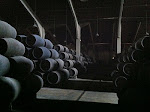
Magnums gathering mold in the cellars of Pierre Morey.


Alright, that's it. Thanks for reading through these Burgundy 2008 posts, I hope you enjoyed them. One day I'll go back and you may have to do this all over again...

Monday, January 12, 2009

Domaine Pierre Morey, Meursault

Perhaps the finest and most memorable lesson that I received in Burgundy terroir came at the hands of Pierre Morey. We tasted through a large range of 2007 wines from Meursault, each with its own distinct personality. It was easy even for a novice like me to understand the differences - the 2007 vintage offers nothing if not transparency. A vintage like 2007 in the hands of Pierre Morey, who farms organically and biodynamically (since 1997), and who vinifies all of his wines in an ultra-clean style - this makes for absolutely thrilling wines. And we were thrilled and awed. Peter, Tista, and I walked out from our morning visit and sat in the car for a few moments in stunned silence, the experience sitting there making its own noise.

Peter, Tista, and Pierre Morey walking in Meursault.

Pierre Morey is considered to be one of the very finest wine makers in Burgundy. Although he started his own Domaine in 1971, he was for many years the quiet force behind the wines of Domaine Leflaive. He also makes the wines of Morey-Blanc, a négoce operation he created in 1992 order to work with an expanded group of vineyards. He works with farmers who employ largely the same vineyard practices that he does.

And you know what else - Pierre Morey was so immediately likable, so genuinely pleasant. Humble and soft spoken, earnest and curious, warm and gracious. A real gentleman and clearly a scholar. He should probably be nominated for France's version of "Living National Treasure."

We began in the cellars of Morey-Blanc, tasting through the lineup of reds. We then moved on to Morey-Blanc's whites, and then drove several blocks to Domaine Pierre Morey's cellars to taste his whites.
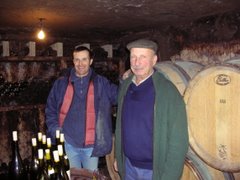
Pierre Morey in his cellar.

The first thing I can tell you is that the reds are really quite good. Who thinks of red wine when they think of Meursault or of Pierre Morey? Well, these were lovely. I liked the simple 2007 Bourgogne very much, and of course the 1er Cru Pommard Grands Epenots was great. I can also tell you that the wines from St. Romain, Auxey-Duresses, and St. Aubin were quite good, particularly in my opinion the Auxey-Duresses. I would eagerly drink any of these wines. And as good as they were, the wines of Meurault were a serious step up - even the villages Meursault.

According to my own very unofficial talley, there are more wines labeled as lieux-dits (single vineyard wines, but from villages-level vineyards) than in any other Burgundy village. Perhaps this came about because there are no Grand Cru vineyards in Meursault (although most people acknowledge the Grand Cru-esque quality of 1er Cru Perrieres) and so the quality of 1er Cru and villages-level vineyards is emphasized this way. Perhaps it is because many producers feel that singular wines can be crafted from villages-level vineyards such as Les Narvaux, Les Tessons, and Les Chevalières.
Green is villages-level, yellow is 1er Cru.

Here are some tasting notes from the 2007's in barrel. Morey poured them basically in north to south order. The first several wines showed the richness baked apples, and as we moved south the wines took on a more mineral and citrus character.

Morey Blanc Meursault - the nose integrates fresh apple fruit, spice, and mineral. The palate is graceful and balanced, there is nice acidity, and the finish is long with apple skins and pie crust. This is a great villages wine that should drink well when young.

Morey Blanc Meursault Les Narvaux - similar aromatic and flavor profile as the above wine, but denser, spicier, and more intense. And somehow, leaner.

Morey Blanc Meursault 1er Cru Les Bouchères - leaner nose than Les Narvaux, yet richer on the palate. Dense and muscular with rich fruit, great acidity, and a frangrant finish. Delicious wine.

Morey Blanc Meursault 1er Cru Les Charmes - the most elegant nose so far, very mineral, with clean and focused fruit. The palate is a bit closed, but there is a nicely herbal finish.

Morey Blanc Meursault 1er Cru Les Genevrières
- density again on the nose with prominent lemon peel. Lots of stuffing, a bit creamy on the palate, and a long minty finish.
The Meursault 1er Crus.

Pierre Morey's Cellars are deeper underground than those of Morey-Blanc, and perhaps this is why some of the wines were not as forward and open as the above wines.

Pierre Morey Meursault - smokey herbal nose and a rich palate with precise flavors of apple skins, lemon, and stones. Another lovely villages wine.

Pierre Morey Meursault Terres Blanches - apple skins, herbs, brown sugar, and earth on the nose. Palate is already well integrated light and energetic fruit flavors, great acidity, and a long prickly finish.

Pierre Morey Meursault Les Tessons - very reduced, and hard to get past that on the nose. Seems like there is nice fruit here, but I'm still no good at tasting reductive wines.

Pierre Morey Meursault 1er Cru Les Perrieres - also a bit reduced, but less so. Herbs, lemon oil, stones, and lovely white flowers on the nose. Rich and deep in the mouth but in a piercing and economical way, nothing is wasted. Balanced and long, just so obviously a beautiful wine. If I am lucky enough to see this in a store someday, and lucky enough to have the approximately $130 it will cost, I will buy a bottle and put it to sleep for my older daughter, who was born in 2007.

Pierre Morey Bâtard-Montrachet - resinated layers of fruit on the nose, very noble, a bit closed, but still expressive. Pear and honeyed nuts in the mouth, great acidity and length, very complex. Beautiful wine, certainly one of the finest whites that I've tasted.