Showing posts with label Bordeaux. Show all posts

Saturday, January 25, 2014

More Thoughts on Quality.

First class seats on an airplane are better than the seats in coach. There is no question that this is true. They are more comfortable to sit in, they offer more space, they come with better food and drink, and also with the privilege of getting on and off of the plane before everyone else. They are the best seat on an airplane. They also cost a lot more than any other seat. Whether or not they are worth the expense is a decision that is our own, made according to our own individual calculus. That we have this decision and can opt not to buy first class seats does not imply, though, that there is some question about whether first class are best.

Wine is like this too - some are better than others. But it's much more complicated of a thing to appreciate this in wine and I think that there are three major reasons for this:

1) It's easy to for anyone, even a person who has never been on an airplane before, to understand why first class seats are better. Appreciating why one wine is better than another wine is not as straightforward.

2) We develop personal preferences, we find styles of wine that we like, prefer one kind of wine over another. It is easy and self-serving, even, especially as we gather more wine drinking experience, to assume that our personal preferences are in line with an objective truth about quality.

3) We get confused by price. We buy coach seats when we fly because, well, who can afford to fly first class? And no one wants to waste their lives wishing for what they cannot have. The $12 bottle of Château Peybonhomme les Tours Blaye Côtes de Bordeaux is delicious, terroir expressive, and entirely worthy of our attention. It might be among the best red wines at $12 in NYC today. But it is not better than first class, no matter how many bottles I can buy for the same price. It's more fun (or less unsettling, anyway) to think that we've struck gold in the high quality $12 bottle than it is to think about how much better Léoville-las-Cases is.
-----
If it sounds like I'm saying this from somewhere on high, I don't mean it that way at all. It's the opposite, actually. I've been trying to learn as much as I can about wine (while also enjoying drinking it) for the past ten years, and the point is, I'm still scratching the surface when it comes to any real knowledge of what is great wine and what is not. I simply am not exposed to enough wine, I cannot build the necessary context. I have come far enough, though, to know how much there is that I don't know.

Occasionally I do get to have an experience where I learn something real about quality. Here are two such recent experiences.

Right before Thanksgiving a friend and I drank the 2004 Éric Texier Côtes du Rhône-Brézème Domaine de Pergault. I bought three bottles on release in 2007 and this was my last bottle. Three years ago I drank a bottle and was not thrilled, but SF Joe, a guy who knows the wines pretty well suggested in the comments that I should give it a bit more time, perhaps three years more, in the cellar. He was absolutely right.

The wine was so much better three years later. Here is my note on drinking this wine in late November:
Just lovely, glad I waited for this. I caught the previous bottle too soon, as someone else suggested. Now this is mellow and alluring, with a rusty hue to the color, peppery, bloody, and floral aromas that are soft and gentle. Balanced and lovely on the palate too. The wine shows its class, but it also shows the limitations of the terroir - this is gorgeous wine, but it doesn't achieve the complexity or grandeur of great Syrah from a more illustrious site.
You can probably see where I'm going with this. Although the wine showed better three years later, and although it was delicious and I loved drinking it, it was not great wine. I was reminded of this the other night when I had dinner with a few friends that I haven't seen in a while and we drank a great Syrah by the culty Rhône producer Noël Verset. It was a wine made in what I understand is the worst modern vintage for northern Rhöne wines - 2002. It was lighter and perhaps even more rustic than Verset wines are in more typical vintages. But it was undeniably great wine. Two months later it became clear to me, this idea that Verset Cornas is better than Texier Côtes du Rhône. Really, is that such big news? No. I wonder though, what it means, to know this. If I were a rich person, would I buy and drink only Verset Cornas and the few other Syrahs of similar quality? If money were no object, would I make room for Texier Côtes du Rhône also, even if I could afford first class any time I wanted it? 

Recently a very generous friend opened a few mature first and second growth Bordeaux wines for a group of friends at dinner. He decanted them and we actually drank them without knowing which was which. We all thought that the same two wines were the best of the group, and that one of the two was better than the other. They turned out to be 1979 Latour and 1979 Pichon-Lalande, and the Latour was the better of the two. It's "supposed" to be better - it's a first growth wine and Pichon-Lalande is a second growth. But these wine classifications are not always accurate. In this case, if these wines are representative, the classification is spot on. Both wines were wonderfully aromatic and complex, and both were delicious and classic in their Bordeaux character, even if they came from an off vintage. But the Latour just was a more complete wine on the palate, it maintained a better presence through the midpalate and showed more complexity and depth on the finish. 

I read in Alexis Lichine's Guide to the Wines and Vineyards of France that Latour's vineyards literally abut those of Pichon-Lalande in Pauillac, and that Pichon-Lalande's vines spill over into St. Julien. The map in the book makes it look as though Latour's vines are closer to the river. As in many other places in France, and throughout the wine world, the distance of a stone's throw separates vineyards that are truly different in their potential. It's one thing to "know" this because others tell me so, or because the producers are classified as one thing or another. But to drink these wines side by side, with friends and over dinner - differences in quality become immutable, even to a relatively untrained eye like my own.

Thursday, August 22, 2013

Rhode Island Wine Weekend, Part II

We drank Bordeaux on the first night, and it was a first growth kind of evening. This is because the guys we were hanging out with have been collecting wine for a long while, and they are generous people who derive pleasure from sharing cellar gems with friends.

The lineup:

1994 Château Laville Haut-Brion.
1966 Château Haut-Brion.
1970 Château Haut-Brion.
1975 Château Mouton Rothschild.
1980 Château Margaux.

Are you kidding me? Fugedaboudit.

I have so little experience with wines like these - with every sniff and sip I am experiencing new thoughts. And on this night, we also drank a great California wine. A bit younger than the Bordeaux wines, but a great wine nonetheless. The 1991 Dunn Vineyards Howell Mountain Cabernet Sauvignon. If California used such a system, this surely would be a first growth wine. We drank it last, and it was fascinating to compare it with the other wines.

First, there was this utterly stunning white wine. White Bordeaux is not something that I come across very often. This is as good as White Bordeaux gets, according to the Bordeaux cognoscenti. I've had Laville Haut-Brion one time before, the 1993 vintage, and it thrilled me. This one, the 1994, equally so. It really takes a while to open up and get going though. We saved a third of the bottle and 2 hours or so later on went back to it, and the wine was so much more energetic, pungent in its aromas, and vibrant on the palate. The particular combination of smells and tastes are unfamiliar to me - things like honeycomb and orange oil and lemon sherbert, all atop a subtle backbone of stone. Semillon is a strange grape. And this expression of Sauvignon Blanc, this is not something that you'll find elsewhere. The wine was fantastic, and a rare and true joy to drink.

We drank 1980 Château Margaux. It was ridiculously good. One of our party was absolutely smitten with this wine, and he smiled and said to everyone who walked by, including waitstaff and other random patrons of the restaurant, "Hey - want to taste the best wine in the world?" It was sweet, because when they inevitably said "well, that does indeed sound good," he would pour them a taste.

This wine was 33 years old, give or take, and it was fresh as a daisy. The fruit is still vibrant and sweet. The wine was knit together perfectly, with a rich bouquet of fruit and flowers, and although it felt exuberant, it was also entirely focused and perfectly harmonious in its balance.

We drank the 1970 Château Haut-Brion. The 1966 was flawed. Not corked, but green and weird and entirely unappealing. But let's focus on the good news though, shall we? The 1970 was as great a Bordeaux wine as any I've ever tasted (not that that's saying all that much). There was less fruit, which makes sense - the wine is 11 years older. But somehow the wine felt more complete to me, even more perfect, if possible. The nose was just a grand thing, pointless to try and describe it. Full of energy, great depth and complexity, and a minerality that was so intense it practically shimmered. I know why our pal at the table was calling the Margaux "the best wine in the world." And I cannot say that one was better than the other because I do not possess the experience necessary to make such a statement. But I did agree with one friend at the table who said "I might have an affair with the Margaux, but I would marry the Haut-Brion."

1975 Château Mouton Rothschild was a very fine wine, but it suffered for its company. Next to phenomenal wines like the Margaux and Haut-Brion, to me it simply was outclassed. Not that Mouton wasn't good, it's just that those other two were ridiculously great. I would be curious to drink it again on its own (or next to some less illustrious wines), as in this company it seemed to have less breadth, less overall impact.

By the way, the chef prepared Beef Wellington for us to enjoy with our fine old clarets. I'm still not sure how this happened, but I now speak with a British accent. Could you tell from reading this that I have an accent now?

And then, we drank 1991 Dunn Vineyards Howell Mountain Cabernet Sauvignon. It was my first taste, as far as I can recall, of Dunn. Everyone at the table - everyone, spoke very highly of the producer, saying that the wine maker Randy Dunn does everything the right way, and that this is one of the great wines of California. And the wine was great, it really was. And I loved it. Again, I cannot say anything worth listening to about relative quality, that Dunn was better or worse than Haut-Brion, for example. But I can tell you what I learned by drinking them together.

Haut-Brion's beauty, to me, comes from its complete and perfect harmony. The component parts are gorgeous - the fruit is pure and delicious, and musky in its age. The minerals shimmer, the finish has a life of its own. And the overall effect is of great intensity, showcasing all of the component parts, and also somehow this quiet sort of harmony. Dunn, and we are talking about a wine that is twenty-one (21) years younger here, does not feel to me as though it will ever have a quiet aspect to it, the way Haut-Brion, or even the more seductive and charismatic Margaux, are quiet.

Dunn's fruit was darker, more brambly, and the acidity was younger, more intense. The thing that stuck out for me, however, was the structure - Dunn was structured differently from the Bordeaux wines. It has bigger bones, literally. The wine is built on a larger frame and then the fruit that goes on that frame is bigger. It's like comparing an offensive lineman with a tight-end. They play the same game, and at times perform similar functions. They can both be great football players. But in the end, they are best at doing different things, and maybe this fascination with declaring one as better than the other is misguided. We are luckly to have both. Especially on a gorgeous summer night in Rhode Island, with friends.

Monday, February 04, 2013

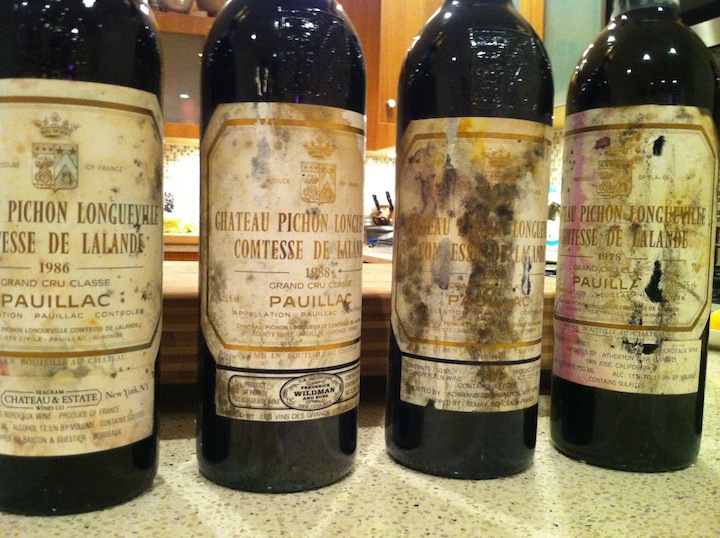
Drinking Four Wines by Château Pichon-Lalande

Not long ago I had the opportunity to drink four bottles of very fine Bordeaux, wines by Château Pichon-Lalande. A good friend was in NYC for the weekend and he brought these from his cellar - lucky me! I've had mature Bordeaux before but one bottle at a time, and quite infrequently. This may not surprise you, but I don't have any old Bordeaux in my cellar. Here's another thing that might surprise you - I truly wish that I did.

There are few wines that could be considered less hip and cutting edge than Bordeaux right now. And rightfully so, in a way. The modern wines tend to be over extracted fruit bombs with little to offer in the way of terroir articulation, never mind detail or elegance. They are big, artificially made wines, in most cases. And they are hugely successful, making tons of money for everyone involved.

But like most things that are classic, old Bordeaux is classic for a good reason. They are made from noble grapes and come from interesting terroir, and when well made they combine brawn with detail, complexity, and grace. Many wine lovers of my generation and younger may not have had a great old Bordeaux - it's not something that gets much attention anymore. I think that those of us who haven't had a great old Bordeaux are missing out, not only on beautiful experience, but also on a vital piece of wine appreciation and history. How can we even approach having an understanding of why wine is great without knowing what a grand old claret tastes like?

Pichon-Lalande is one of the top second growths, and comes from Pauillac, a terroir that apparently gives some of the brawnier wines of the region. You can almost see this in the color - look at that inky purple!

My friend generously brought wines from 1978, 1985, 1988, and 1989. Although the youngest was 23 years old, none can really be considered old by Bordeaux standards. My pal Peter says that you shouldn't bother opening good Bordeaux before it hits 20 years old, and that's probably just the beginning of its maturity.

I roasted a leg of lamb over potatoes, and we went to town. The wines were amazing, all four of them. They continued to evolve over many hours, and were delicious and deeply satisfying throughout. In general, I appreciated the raw power of the wines, and this was easy to do because they also showed such detail and complexity. There was power, but that was only part of the package. There was also balance - these were wines that showed lovely and refreshing acidity, and great complexity of aroma and flavor. Inspiring, really. Not in the way that I felt like going out and buying the current vintage, because as I understand it, the new wines will not become like these wines, even with 25 years in the cellar. They are made differently now. But inspiring nonetheless. If you have any old Bordeaux and you want some one to appreciate it with, I will make dinner.

The 1989 was a wonderful wine, Peter said that it was the grandest wine of the four, and that it had years, maybe decades of life in it. It was the most complete wine on the table, but I found it hard to compare the wine from 1989 to the wine from 1978 - I just don't know enough to be able to understand where the 1989 is in the context of the evolution of Bordeaux. Will it shed some weight and feel like the 1978 in 10 years? Will it always feel this full bodied, but become more gentle and mellow, and offer even more complexity with further maturity? I would guess, yes.

I found the 1978 to be the most rewarding on this evening, with its mellow and gentle nose of tobacco and leather, its complex and long cedary finish. It felt like being inside a log cabin in the woods. Still plenty of energy, an elegant structure, very long and plain and simple - absolutely delicious.

The 1985 was the most approachable right after we opened and decanted the bottles, and was perhaps the most fruit forward of the wines. I enjoyed it tremendously, but in the end we found the other vintages to be more compelling. The 1988 felt more mature than I might have expected, but in a good way, and showed ripe fruit that was thoroughly infused with earth. I loved this one in particular with the lamb, and it seemed to have a lot to offer even as we finished it. This one might, sneakily, be a wonderful wine.

There are plenty of reasons to ignore modern Bordeaux, I get it. The wines can be bombastic and overbearing, and the story of the Bordeaux region seems to be one of opulence and privilege, there is no struggle, no individuality. People in meticulously hip Brooklyn restaurants want to drink wines made without sulfur by scruffy guys or gals living in ramshackle trailers on lonely hillsides. Those wines have their place, I guess. But that's not Bordeaux.

But there is something to this, to old Bordeaux wine. Don't believe me? Get your hands on an old bottle by a good producer - you and three of your friends can do this and spend less than $50 per person. And really, this is history, and it's worth knowing for yourself.

Would you ignore The Police because Sting was kind of lame later in his career? Would you dismiss Woody Allen because Scoop kind of sucked? Are you not going to drink the one bottle of 1976 Lynch-Bages that Chambers Street is selling for $115 because 2010 Lynch-Bages costs $150 and will never be as good? Seriously, what kind of person are you, anyway?

Wednesday, November 14, 2012

You Cannot Predict Baseball

In early spring of 2006, my wife at the time (we are now divorced) got me a lovely gift for our first anniversary, a leather-bound journal. The idea was that we would both write in it, describing the wines we drank together and the circumstances in which we enjoyed them. I hadn't yet begun writing this blog - that happened in October of 2006. 

I stumbled upon this leather journal the other day while rummaging around in the closet. There are fewer than 10 entries in it, the book is mostly empty. But the wines are interesting: 2001 Clos Rougeard Les Poyeux, 2002 Breton Bourgueil Perrieres, 2004 Closel Savennieres Clos du Papillon, 2001 Lafarge Volnay, 2004 Baudry Clos Guillot, some Oregon wines. We were drinking good stuff. There is one entry in there about a wine that is different from the others, something older, something we drank on a special occasion.

I remember that I wanted to buy a special wine for our first wedding anniversary dinner. I went into Chambers Street Wines and spoke with David Lillie. After some discussion, I emerged with a bottle of 1986 Chateau Sociando Mallet. I spent something like $80 on the bottle, way more than I had ever before spent on a bottle of wine. David cautioned me to stand the bottle up 3 days or so before opening it, to open it carefully so as not to disturb the sediment, and to decant the bottle if I could. I followed David's advice and we loved the wine with our dinner. I'm not going to reproduce my part of our journal entry on this wine, but here is the first thing I wrote: "This is beautiful wine. I understand now why Bordeaux is so beloved."

Look at that last sentence. I love how exuberant I was, how eager to experience this new pleasure. I can't say that I remember the wine but I'm sure it was very good. Sociando Mallet is a respected estate making high quality wine, but it's not considered to be one of the great wines of Bordeaux. No matter, I didn't understand that then and I was falling in love with wine, details like that would not have reduced my visceral pleasure anyway.

A lot has happened since then. I have two wonderful children, but I am no longer married. I work at a different job and I live in a different place. Many of my friends are different. I have grayer hair, and depending on your eyesight and on the relative humidity of the day, 10 or 15 pounds that I should lose. I have a different set of worries and problems that I deal with on a daily basis, and also a different set of joys. It's a strange road, this life we lead, and as John Sterling, the stalwart radio voice of the New York Yankees likes to say, "You can look at all the statistics you want, and they tell you what this guy did in that situation a thousand times in the past, but they don't tell you what's going to happen right now. You cannot predict baseball."

Holiday season is approaching, the end of the year draws near, and I was thinking the other day about some of the great wines I drank this year. Gentaz Côte-Rôtie, early '80s DRC Grands-Echezeaux, late '80s and early '90s Montrachet, Coliseo, the grand old Amontillado by Valdespino, and more. And that's just the fancy stuff - there were so many more great wines that are easier to locate, and easier on the wallet.

I loved drinking many of these wines and the experiences that came with them, but it was only a few days ago when I drank the wine that made me fall in love with wine again. I was at a good friend's house and he made a lovely dinner that included a beautiful butterflied leg of lamb, pungently seasoned with ground black olives, fennel seeds, dried chili flakes, and all sorts of other goodies. With this dish he generously opened a bottle of 1985 Chateau Leoville Las Cases, a grand wine, from a very good year, and a classic pairing - lamb and Bordeaux. Exciting!

The wine was awesome, really. It took about an hour to flesh out, but it was SO good when it did. The thing that killed me about this wine was how absolutely clearly it spoke of the place it is from, and how it expressed itself with such profound finesse, and also how completely and purely delicious it was. The fruit was lush and ripe, and it was textbook dark cassis. Not sweet fruit, dry. And the minerals - all pencil lead and gravel and dried tobacco. And there was that cedar smell too that people speak of when they talk about Bordeaux. I felt while I was drinking this wine how different it is to drink Cabernet - I almost never drink it. Honestly, it felt like close to a perfect wine, and I fell in love with wine again.

Not that I had stopped loving wine, but it had been a while since something really moved me. I drank things I enjoy, tried some new things, definitely experienced pleasure. But it had been a while since I felt truly moved, and I had kind of drifted into this complacency, this place of moderately lower expectations. What a wonderful way to be shocked, to wake up and remember with full appreciation what it feels like to be moved again.

It reminds me that I value being open to this sort of pleasure, from wherever it may come. Some people can get lost as they try to stay current on the wines that they should be loving. I will never do that, lucky for me. As I get excited about Champagne or Sherry or Austrian Riesling, or whatever it is I learn about and have new experiences with, I will never be closed to something as elemental and viscerally thrilling as a plate of well-prepared lamb and a grand old bottle of claret. Stodgy? Who cares. You never know where you will find the thing that makes you fall in love again. You cannot predict baseball.

Wednesday, March 07, 2012

The Worst Wine and Food Pairing in History?

Got home late at night from a business trip. Tired, malnourished, mal-slept, dirty from airplanes. Hungry, very hungry, and thirsty too.

In the fridge - leftover spaghetti and meatballs. I made this, but it was four days earlier. Still pretty good. Served with the final third of a 375 ml bottle of 2003 Chateau Rieussec. This was opened three days earlier when a friend brought it over for dinner, and since then it sat in the door of the fridge, uncorked.

That's right...spaghetti with meatballs and Sauternes. Perhaps the worst wine and food pairing in history. If you think you can do better, let's hear it.

Probably the spaghetti would have benefited from being warmed up.

Monday, June 13, 2011

When I'm 65

The other day I had a somewhat startling realization - when I buy a wine today with the plan to age it for a long time, say 25 years, if I am successful in holding it for that long, I will be something like 65 when I drink the wine. Simple math, you say, and you're right. But the point is, 25 years is a long time - what if I'm not drinking wine when I'm 65? It must be hard to sustain a hobby for 25 years. Honestly, who out there has purchased a wine on release, and then cellared it for 25 years before drinking it? Not many of us, I bet.

So, why do I so eagerly buy wines that, based on my tasting experience, will show best after long-term cellaring? Well, here is one reason - the hope that the wine turns into something like this:

My friend Keith very generously served this the other night with a lovely dinner of roast lamb. There were five of us at the table and I didn't really check in with other people about the wine, I was too busy with my nose in the glass, too busy tuning into the amazing feeling of the wine in my mouth. I thought this was a truly phenomenal bottle of wine, I think the finest bottle of red Bordeaux wine that I've ever had.

There were two things about the wine that got me: first, the nose was absolutely pure in its expression of tobacco leaves. I experienced them as fresh leaves, leaves that had been cured in a warehouse in Cuba, but still vibrant and fresh. There were other things happening on the nose too, but it was this amazing fresh tobacco aroma that moved me. And then, there was the texture of the wine, the silky smooth mouth feel. Not glossy, not artificial smoothness in any way, and there was still plenty of structure by the way - just a beautifully textured wine. A pillow of fresh tobacco leaves, with a finish of gravel and faded potpourri. A memorable wine.

And the thing is, Keith didn't buy this wine on release - he wasn't born when this wine hit the shelves. I don't know when he bought it, but he said "I bought it back when it was affordably priced. I can't buy Chateau Haut-Brion now."

I wonder, will any of the wines that I've been buying be as good as this wine in 25 or 30 years? Will I be around to drink them? One can only hope...

Tuesday, January 04, 2011

December Wines - a Laundry List

December tends to be a good month for wine drinking. Everyone reaches into the cellar for the good bottles to help celebrate the passing of another year. Here are the wines I drank in December that have not, even in passing, appeared recently on this blog. Usually I put them into groups - excellent, very good, and so on, but I had so many great wines in December that I will simply list my favorites without any qualification.

1993 Chateau Laville Haut-Brion Pessac-Léognan Blanc, price unknown, Chateau & Estate Wines. My generous friend Adam shared this treasure with me over his tasty braised veal shanks. First of all, I've had maybe two or three white Bordeaux wines in my life before this one, and none of them were terribly exciting. This one, however, was thrilling. The Wine Doctor profiles the estate here, so you can read up on the details if you like. In short, Laville Haut-Brion is owned by the same people who own Haut-Brion, but the Laville vineyards and wines are distinct. They are made from old vines, mostly Semillon and the balance Sauvignon Blanc. Pungent and still very graceful aromas of orange peel, wax, menthol, and honey. A mesmerizing nose, and one that grew in detail and breadth over the hour or so in which we drank it. Youthful acidity on the palate and perfectly balanced at only 12% alcohol (!), with a dazzling combination of richness and delicacy to the flavors. Memorable wine, and I suspect that it is a wine that might not exist in this style these days.

(2000) Tarlant Champagne La Vigne d'Antan Extra Brut Non-Grefée Chardonnay, $65, was imported by Jon-David Headrick Selections, not sure who imports it now. As described by Peter Liem on ChampagneGuide.net, this wine comes from un-grafted French rootstock in the sandy phylloxera-resistant soils of a vineyard called Les Sables. This is just the second release of this wine (Benoit Tarlant began making it in 1999) and already it is one of my favorite Champagnes. It expresses with incredible clarity the sandy brown tones of the soil. The fruit is piercingly clear, although the fruit plays a secondary role. The fruit and the soil work together so harmoniously, and the wine is both fascinating to think about while drinking, and also just plain delicious.Well worth seeking out.

2002 Domaine Huet Vouvray Demi-Sec Clos du Bourg, $33, Imported by Robert Chadderdon Selections. Such an incredibly beautiful wine, and so accessibly priced. Crystalline purity, elegance and energy, rocks, herbs, honey, and stone fruit are all in perfect balance. The wine is delicious now although it is probably showing only a little of itself. It started to show a spearmint kind of herbal complexity on the finish only after an hour open, and the texture became more energetic and almost grippy after that hour. I'm sure this will last forever but it will be delicious at any point between now and forever.

1981 López de Heredia Rioja Gran Reserva Viña Bosconia, price unknown (but you'd have to pay over $100 in NYC to buy this now), imported by Polaner Selections. A very generous host at a holiday party opened this and also the 1985 and 1991 Gran Reserva Viña Tondonia. They were all great wines and it was interesting to drink them next to one another. The 1991 was just too young, I thought. The 1985 was utterly lovely, but the star of the show was this wine, and it was all class and grace, with deeply complex aromas and flavors, an incredibly elegant mouth feel, and a finish that just didn't quit. Awesome wine, and it's the same price as a newly released 1er cru red Burgundy from a good terroir. One of the best ways to spend $100 on wine, in my opinion.

2004 Henri Prudhon Chassagne Montrachet 1er Cru Les Chenevottes, $47, Imported by Neal Rosenthal Wine Merchant. White Burgundy is tough to buy, I think. I want to buy good bottles, but there have been oxidation problems so it's a dicey proposition to cellar them. But the really good bottles take time to fully express themselves. Prudhon's wines are a safe bet, I would say. The range includes some very good terroirs and the wines are made in a classic understated style. Perhaps not the very finest that Burgundy has to offer in white wine, but delicious and expressive of place, and accessibly priced. This bottle was very good when we opened it, but it was day two when it really shined. Slightly smokey and marine inflected aromas that mostly feature stones and rocks. The palate is all elegance and finesse, with good intensity and a grippy finish that smacks of the ripe raw material. And the thing is, this wine is completely light in texture and weight, almost sheer - you have to pay attention to get it. Very impressive.

2007 Bernard Baudry Chinon Cuvée Domaine, $18, Louis/Dressner Selections. This is one of baudry's two "entry level" wines, and it can be simply fantastic. I love it in 2007, and it's drinking better than ever. Showing a mineral pungency and lovely floral tones that weren't there earlier in its life, a bit musky too on the nose. The fruit is a bit less pronounced and the dry leathery earth components are more prominent. Well balanced and great wine and year in, year out, one of the finest red wines that can be purchased for under $20. Yup, I said that.

2002 Louis Boillot et Fils Pommard 1er Cru Les Fremiers, $52, Imported by Neal Rosenthal Wine Merchant. Louis Boillot is Ghislaine Barthod's husband and they will star together in a new MTV reality based mini-series on wine making spouses, their trials and tribulations. Keep an eye out for it. This wine is still young, but certainly showing good detail in aroma and flavor and the minerality is prominent. The fruit aromas are dark and brambly and with air, completely infused with wood smoke. Plenty of extraction here, but the palate is still balanced and lively and with air the minerality takes on a pungency that for me, defines the wine. Very lovely.

NV Jacques Lassaigne Champagne Cuvée Le Cotet Extra Brut Blanc de Blancs, $70, Jenny & François Selections. 45 year old vines planted in 10 centimeters of topsoil over chalk in an east-facing vineyard in Montgueux. This is a laser beam of chalky Chardonnay, and because it is farmed so well and grown in such a ripe climate, you'd never guess that it is dosed at merely 2 grams and is technically an extra brut wine. So good, and with an hour of air, terrific.

NV Billecart-Salmon Brut Rosé, $75, T. Edward Wines. So silky and refined, such finesse. This wine has earned its reputation as one of the finest NV rosés in Champagne.

1997 Chateau Pibarnon Bandol, about $25 on release, but $54 a few years ago, Imported by Michael Skurnik Wines. Absolutely classic Bandol, with lots of animale inflected tobacco and earth. Offers a lot of pleasure, and it is perhaps just approaching middle age. Very well balanced and the acidity is strong. The tannins are dusty and pretty fine, and the whole package is very attractive and typical of the place. Very strong wine.

2009 Immich-Batterieberg Riesling Kabinett, $23, Mosel Wine Merchant. I'm just beginning to start attempting to engage in trying to begin learning about Riesling. This is one of my favorites so far. I love how it is almost extreme in its focus, but its also so pretty and generous in its flavors. At first it's all orchard fruit but with air time the earthy notes emerge. There are fleeting sponti whiffs, the palate is very mineral, and the wine is well balanced and expressive. Hard to argue with that.

Thanks for indulging me in this very long laundry list post. December was a good month and I wanted to share...

Tuesday, March 23, 2010

How to Buy Excellent Cheap Wine

Is it possible to drink great wine on a daily basis if you're not rich? I'm talking about wines that cost between $8 and $12 a bottle? I think it it is possible, yes. I've been thinking about this lately because my wine buying budget has been cut in the past year, but also because Eric Asimov has written about this several times, most recently pointing to Mike Steinbergers' article in Slate that discussed inexpensive wines he recently drank with mixed results.

I can (and will) name some cheap wines that I think are excellent wines. But before that, I want to explain my general approach to this problem.

First of all, I reject the notion that as a consumer I should forgive a wine for being inexpensive and expect little of it. Regardless of the price point, if I buy a wine I want it to be excellent. Sure, a liter of Hofer Zweigelt and a magnum of Barthod Chambolle Les Cras are excellent in different ways. But for me to buy the Hofer Zweigelt, its excellence must derive from the smell and taste of the wine, and from its expression of place, not from the mere fact that it is palatable and costs $10.

Secondly, I don't think $10 is a rational way to define cheap wine anymore. You know this already - the dollar, although stronger right now, has been weak against the Euro for years. European wines cost more now that they did 5 years ago. That great Beaujolais that sold for $12 in the 2002 vintage costs $17 now. For me the new cheap wine cutoff is something like $12 or $13. Buying a mixed case allows me to buy $14 or $15 wines and pay $12.60 or $13.50 for them, essentially eliminating NY State's drastic liquor taxes, and keeping my average bottle price in that $12-$13 range.

Thirdly, the best way to get excellent cheap wine is by choosing your retail store carefully, not by identifying the best individual wines and then buying them wherever you can find them. I don't want to buy a case of any one cheap wine - who wants to drink the same wine on Tuesday, Wednesday, and Thursday, and then again the following week? And I don't want to buy a bottle here and there and pay full retail. I'd rather buy a mixed case, enjoy a greater selection, and pay a little less.

So how do you buy great cheap wine in NYC? Here's how I've been doing it lately. I've been putting together mixed cases at one of my favorite retail shops, Chambers Street Wines. There are other stores I like that stock great wines at the $12-$13 price point, but so far I haven't found another store where I can buy 12 wines in different styles, all of them excellent. Chambers actually has many more than 12 - the wines below are only some of the goodies that you'll find there for $12-$13. Here are my favorites right now (prices are with the 10% mixed case discount):

Whites

2008 Benaza Monterrei Godello, $11.70, Jose Pastor Selections, Vinos & Gourmet Imports. Chris, the Spanish wine buyer at Chambers has been filling my ear about Galicia for a while now. "Galicia is the new frontier for inexpensive great wine," Galicia this, Galicia that. If this wine is representative of what the region has to offer, then I wholeheartedly agree. Use this wine wherever you would use Sauvignon Blanc, but instead of being annoyed at how mediocre your Sauvignon Blanc is, you'll be thrilled with this wine. Godello is the grape and this version is fresh, balanced, and just delicious. Grapefruit and pith, spring water, coriander? Once I forgot a half-drunk bottle in the fridge for 3 days, and it was even better, completely harmonious.

2007 Domaine des Pothiers Vin de Pays d'Urfé Fou de Chene, $12.60, Fruit of the Vines Imports. This is Chardonnay, technically from the Loire Department, but we're talking closer to Lyon and Burgundy than to Vouvray or Chinon. Perhaps not terroir specific in the sense that the wine would be identifiable as a Loire Valley wine, but that's okay in this case. It's not easy to find delicious, varietally correct, old school Chardonnay at this price. Here is one. Ripe lemony orchard fruit infused with minerals, well balanced and fresh. The finish is surprisingly long and stony.

2008 Knebel Mosel Riesling Trocken, $12.60, Mosel Wine Merchant, USA Imports. An expressive and unmistakably Mosel wine that treats you gently but also cuts like a knife. I've been drinking a lot of this wine lately and I love it every time. We did split pea soup - very good. Crab boil, not as much, as the wine is lean and got a bit lost amidst the Old Bay. Pork cutlets with mustard and kale - excellent.

2009 Weingut Hofer Grüner Veltliner Wienviertal, $10.80 (1 liter), Michael Skurnik Imports. This delicious Grüner is a bit simple on day 1, although it is well balanced and shows some of the lemongrass lift that is typical of the grape. On day 2 (get your own stopper, this is a crown cap) the wine shows more complexity and harmony, with herbal tones, more depth of fruit, and an intriguing sour cream like note on the finish.

2007 Laurent Barth Pinot Blanc, $12.60, Louis/Dressner Selections. This is the delicious Alsace Pinot Blanc I drank the other day with a Vacherin-style cheese. Such an expressive and delicious wine, focused and mineral driven.

2008 Michel Brégeon Muscadet Sèvre et Maine Sur Lie, $12.60, Kermit Lynch Imports. I really like the '08 Muscadets so far. This one is quite intense with citrus and creamy lees on the nose. The palate is piercing with minerals and acidity, but is approachable with lovely herbal and citrus flavors. Quintessentially Muscadet, we had it the other night with cornmeal crusted fried flounder and it was great.

NV Pedro Romero Manzanilla Sherry Aurora, $10.80 (500 ml), Frontier Wine Imports. This wine offers a combination of brisk salty tang and the rich vinosity of very old solera wines. It feels weightless but is quite intense, especially on days 2 and 3. I've yet to encounter the food that this wine doesn't compliment.

Reds

2009 Weingut Hofer Zweigelt, $10.80 (1 liter), Michael Skurnik Imports. I've gone through almost a case of this wine since November. Beaujolais starts at $15 now, and this wine, although most certainly not Beaujolais, fills the cheap Beaujolais role these days in my house. It has the texture and body of a well made Beaujolais, and like Beaujolais, I prefer this wine served cool. It shows smokey, medicinal, and herbal flavors. There is fruit in there too, black currants maybe, but this is not a fruit-driven wine. We've enjoyed it with mushroom omelets, with a spicy tofu dish, with turkey burgers, and all by its lonesome. You could have this wine with lighter fish dishes.

2008 Domaine Guion Bourgueil Cuvée Domaine, $9.90, Fruit of the Vines Imports. I've actually not had this vintage yet (my bottle waits for the right meal in the fridge), but I like this wine each year. This is slightly rustic Cabernet Franc. Typically everything you'd expect in a red wine from this place - pure ripe fruits, earth, mineral, raspy tannins that are easily tamed by whatever food you're eating.

2007 Château la Grolet "G" Côtes de Bourg, $12.60, Fruit of the Vines Imports. This wine is 90% Merlot from Bordeaux. I'm going to let that sink in for a moment. On a recent trip to San Diego my interest in Bordeaux was piqued, and if David Lillie says he has a couple of excellent and cheap Bordeaux wines, I'll try them. Honestly, this wine is great. Gravel, tobacco, damp soil, pure dark fruits. fresh and balanced, just delicious wine, and improves on the second day, becomes very harmonious. Not a light wine - think roasts or a steak or a burger, but not in any way overwhelming.

2008 Domaine Rimbert Saint-Chinian Les Travers de Marceau, $13.50, Jenny & François Selections. This is a blend of Mourvedre, Carignan, and Grenache from the western Languedoc. For a leathery and dark wine that sheds grains of soil with every sip, this wine manages to have great purity and poise. Think thinly slices dry sausages, or roast chicken with potatoes and mushrooms.

2008 Clos la Coutale Cahors, $13.50, Kermit Lynch Imports. I always enjoy this wine, a meaty Malbec with a bit of Merlot in the blend. It offers lovely fragrance and texture, and achieves an elegance that I find lacking in most Cahors. Of course it's great with beef, but there's something about the way it works with duck that really pushes my buttons.

Sunday, February 21, 2010

How Long Should a Wine Age?

I've always been attracted to things that are defined by a concrete set of rules. What attracts me most is when, given a thorough understanding of the rules, it is possible to be creative in solving problems within that system. Chess, baseball, music, poker...these are some of the things I'm talking about.

Wine fits in here too. There are plenty of rules one can use in understanding the universe of wine - places, grape varieties allowed, methods of elevage, and so on. There are people out there, you've probably met them too, whose appreciation of wine seems to derive from an elevated level of scholarship - they treat it like a science. And that's fine. But there is loads of room for creativity too. How long a wine should age, for example - I've been thinking for a while now about this problem, and to me the answers involve creativity, not a set of rules.

I wish there were a set of rules to follow, some sort of list I could use to answer this question. But there just isn't. Imagine:

Vouvray sec - 8 years
Vouvray demi-sec - 14 years
Anything by Huet or Foreau - 23 years
And so on...

Obviously the vagaries of vintage quality, producer quality, terroir quality, vine age, wine making technique, and countless others make it impossible to make such a list.

Yet, you have, if not a list, something in your mind that guides your hand when making decisions about aging wine. How did you form your set of rules? I am still in the process of forming mine. I began by reading and talking to friends, and this definitely served me well. But I'm committed now to experimenting for myself, building my knowledge through trial and error and through the generosity of others. After all, my preferences might not be the same as yours, so just because you say that Fourrier's wines need at least 10 years in a typical vintage, shouldn't I try to find out for myself?

And take a step back for a moment - what does it even mean to say "needs at least 10 years?" Needs 10 years in order to be what, exactly? Ready to drink? Fully mature? Less tannic and in a better state of balance? I read statements like "needs at least 10 years" all the time, and it's not that I think that they're wrong, bad, or silly. But I read them and can accept them as truth, and yet I sometimes have no idea what they're referring to - I've never had a 10 year old Fourrier, for example.

How often do you drink old/mature wine? Unless you often buy at auction, or have been buying and cellaring wine for a very long time, you're probably like me - you drink scores of younger wines for every truly mature bottle you drink.

If I'm buying an age worthy wine, a good red Burgundy, for example, I'm a believer in buying three bottles and drinking one when young in order to know the wine in that phase of its life. That way I will better understand the changes when I next drink it, whenever that is. But when should that be? I remember asking my friend Peter about this as we drove from one cellar tasting to another in Burgundy a little over a year ago. He said "If you're talking about the top wines, good 1er Crus and Grand Crus, things like that, when in doubt, use the 12 year rule. Try a bottle in the 12th year out from the vintage - drink a 2002 in 2014, for example. It's unlikely that a really good wine would be tired or dead at that point, and there's a good chance that the wine will be drinking well."

Hmmm, the 12 year rule. I know I began by saying that the answer involves creativity, not rules. But Peter was suggesting 12 years as a guideline to use when in doubt, and he meant that the drinker should evaluate the wine at that point and determine whether or not it requires further time.

But what about good villages wines, does the 12 year rule apply to them as well? I asked him this recently and he said that the reasoning behind the 12 year rule is the fact that most good Burgundy wine can be quite drinkable in its youth but then a few years out from the vintage it shuts down and becomes quite closed. At 12 years, give or take, it emerges as a mature wine. With villages wine, it might not take 12 years. With great wine in a vintage like 2004, it might not require 12 years. In a high-acid vintage like 1999, it might take more than 12 years for a great wine to mellow and show at its best. So that one bottle of 1999 Lafarge Clos des Chênes I have, I'm going to give it a few years past 2011. In 2009 Peter and I drank a bottle of 1995 Mugneret-Gibourg Echezeaux and it was good, but the wine wasn't fully resolved - the structure was still too prominent, and we both felt that with a few more years it would have shown better. But in 2009 we also drank a bottle of 1995 Chandon de Briailles Corton Clos du Roi and it was a thing of beauty, in a perfect place. Again, even when trying to apply the 12 year rule, the answers require creativity.

Last week in San Diego I had the chance, thanks to the generosity of my father-in-law, to drink a few old wines and I learned a tremendous amount from them. I already told you about the 1986 Margaux, but on another night we drank a 1988 Château Léoville Las Cases and it was superb, I preferred it to the Margaux. It was full of tobacco and leather, the only fruit really was a bit of dark cassis on the finish. There was a tactile texture to the wine and the acidity was still vibrant - the wine was nowhere near tired, it was very much fresh and alive. If I had more of this I would drink it now, it's delicious and what would I be waiting for? So my new rule - good Bordeaux needs exactly 22 years. A joke, friends, a joke. But really, I learned that good old Bordeaux is really good wine, and perhaps it isn't made the same way it was in the '80's and before that, but it's too easy to write off Bordeaux as spoof-city over-priced silliness. My guess is that it once was a great thing.

And how about this - on our last night we drank a 1977 Ruffino Chianti Classico Riserva Ducale. Pop-pop brought this wine back from Italy a long time ago. I know nothing about Chianti, and my association with Ruffino wasn't great. But I loved this wine, loved it. So leathery and earthy, but with lots of sour cherry too, and all of the aromas and flavors were crystal clear. There was still structure too, and good acidity. And the finish was glorious, this unending wash of cherry and leather fragrance. So, what would happen if I aged a bottle of the 2007 Pian del Ciampolo for 33 years? My guess is it would be awesome. Or maybe it would be tired and brown. Who knows.

I hope I have the patience to cellar wines for decades like this. The rewards can be so great.

Sunday, February 14, 2010

San Diego Bordeaux

We're in San Diego for a little while visiting BrooklynLady's parents. The weather here is a little bit different from what we've had in NYC.

Eucalyptus tree in the backyard, bright sunny day.

My father in-law, or pop-pop, as my daughter calls him, has a nice collection of wine, mostly California wine and Bordeaux. He reads this blog and so he knows that BrooklynLady and I love wine. On the first evening of this visit, as I came down the hallway into the kitchen, pop-pop said to me "Why don't you go to the wine fridge and pick something really good for us to drink tonight. Nothing is off limits, pick whatever will make you happy." How generous is that?

Even though most of pop-pop's wine is different from the stuff I usually drink, I still felt like a kid in a candy store. Here are some of the things I didn't pick for the evening meal (a delicious turkey meatloaf with roasted potatoes and baby golden beets):
  • 2001 Lafite
  • 2001 Mouton
  • 1988 Château Léoville Las Cases
  • 1994 Cheval Blanc
  • 1997 Montrose
I've never had any of the above wines, no matter what the vintage. It's iconic wines like these that define the top echelon of Bordeaux, and to have the chance to drink any of them is to expand one's knowledge of wine. It was a difficult decision, and in the end I picked this wine:

1986 Château Margaux, Imported by Kobrand. We opened it about a half hour before dinner and didn't decant it. There was no primary fruit at all, as one would expect from a 24 year old wine. The nose showed a restrained delicacy - there was some pencil lead and gravel, but it was less about specific aromas and more about an overall sense of refinement and elegance. The palate was remarkably young and fresh, and still showed plenty of ripe red fruit. It was the texture that I found to be most striking, though. There were layers of fruit and gravelly earth, very intense and focused flavors, and at every point the wine felt silky smooth. Not in an artificially polished way, it just unfolded gently and felt right in the mouth.

What a treat - thanks again pop-pop!

Sunday, October 25, 2009

What I Drink Makes the Yankees Win

They say that one of the first signs of insanity is the belief that one can somehow influence completely random events. I will stand in exactly this spot with my feet angled at 45 degrees, and when the subway stops the doors will line up with my feet and I will get on first, and perhaps get a seat - that kind of thing.

Maybe I am going insane, but I like to think of it as healthy superstition. It's October, the time of baseball playoffs, and the Yankees are back in it. It is clear to me that my own beverage consumption while watching the games is impacting the results. If you can decipher the pattern, please feel free to indicate as much in the comments. I think I've got it figured out, but I will test my theory tonight during game 6. Here's what's happened so far:

Game 1 (Yankee Stadium) - I brought a 6-pack of Weihenstephan weiss bier, or wheat beer, to a friend's house. The beer is excellent - fruity, clean, thirst quenching, bitter and sweet at the same time. The Yanks play well, the Angels play poorly and make key errors, Yanks win.

Game 2 (Yankee Stadium) - I bring a bottle of Claux Delorme to another friend's house. We decant it, it's delicious. When it's gone we enjoy the previous night's leftovers - 2002 Stony Hill Chardonnay. The game goes into extra innings, and we drink a 375 ml of 2003 Suduiraut Sauternes. The Yanks dramatically tie the score in late innings during the Stony Hill, and win a thriller in the 13th inning.

Game 3 - (Anaheim) - I have the remnants of a cold, I stay home and listen to the game on the radio (we are prehistoric and do not have a television), I drink nothing. The Yanks waste a great pitching performance by Andy Pettitte and lose a game they could have won - key mistakes killed them.

Game 4 - (Anaheim) - I again bring a bottle of Claux Delorme, this time to a third friend's house. We begin by drinking his 2007 Pinon Vouvray Silex Noir leftovers, and then drink the Delorme, again, just delicious. The Yanks dominate the Angels, winning 10-1.

Game 5 - (Anaheim) - I go back to game 2 friend's house. Deetrane comes over too. I bring Delamotte Brut Rosé Champagne and we drink it as the Yanks quickly fall behind by 4 runs. My friend opens a 1995 Château Lafon-Rochet, from St. Estèphe. I'm skeptical of all things Bordeaux, but the nose is really lovely - very pure, which is not what I've come to expect. Bright red fruit on a cedar plank, vibrantly perfumed, really enticing. The palate is not as strong, a bit dilute in the middle and just not all that complicated, but at least it's not some spoofed up fruit bomb. Very drinkable and pleasing indeed. The Yanks stage a dramatic rally and take the lead in the 7th inning. The pennant is immanent. We finish the Lafon Rochet and Deetrane opens up a 2002 Panther Creek Pinot Noir Bednarik Vineyard. It's fine, but too much on the cherry cough syrup tip. The Yanks lose the lead, and then the game.

So what, I ask you, should I bring to my Bordeaux-loving friend's house tonight for the terribly important game 6? Suggestions welcome, although they will be Monday-morning -quarterback suggestions, as you'll probably read this Monday morning. Suggestions welcome anyway, and I'll let you know what we did tomorrow in the comments.

Wednesday, September 17, 2008

Brooklynguy's Blockbuster Trade

I was recently given the gift of two Grand Crus and two 1er Crus, both by excellent producers in Burgundy. That's what it feels like, anyway. I traded for them.

Back in early 2006 I paid good money for a case of 2005 Bordeaux futures. Back then I guess I thought I would want to cellar and drink this wine 20 years down the road. I know my palate better now, and it doesn't tilt in that direction. So when the store contacted me to tell me that my case is here, I asked if I could swap out the bottles I am no longer interested in. To my surprise, they agreed. Too quickly, maybe.

So I thought about it - I paid 2006 dollars for wine that the store now sells, if they still have inventory, at higher prices. If they can sell my 2005 easily at those higher prices, they're coming out ahead. Maybe you could argue that with inflation, return on investment, blah blah blah, that I'm coming out behind.But in the end, I decided to think about it in altogether a different way. The wine that I now owned has almost no value at all to me. If I can trade it for wine that does have value, I'm doing a smart thing. Since I spent this money over two years ago, anything I gain here feels like something for nothing. And that, friends, as you well know, rarely happens.

Problem is, Sherry Lehman doesn't offer many of the wines that I love the most. Little to no grower Champagne and nothing whatsoever that I wanted from the Loire. What an opportunity this would have been to grab a load of "free" Clos Rougeard! Plenty of Burgundy, but lots of Faiveley, Jadot, Bouchard, and other negociant bottles, not what I usually go for.

In the end I found some great stuff, wines that I will cellar for as long as I would have the Bordeaux. Wines that I will look forward to with great anticipation.

Check out this trade:

Brooklynguy gives up -
2005 Château Smith Haut Lafitte - 2 bottles
2005
Château Monbousquet - 2 bottles
2005
Château Lagrange - 2 bottles

Brooklynguy gets -
2005 Chandon de Briailles Grand Cru Corton Bressandes - 2 bottles
2004 Sylvain Cathiard Nuits St. George 1er Cru Aux Murgers - 2 bottles
2006 Domaine Weinbach Riesling Cuvée Théo - 1 bottle

I could have gone all Corton, as they are about the same price, but I believe in diversification. Even though that 1971 Corton I had in Portland recently convinced me that this is the little Grand Cru that could. And Chandon de Briailles...so good. The Cathiard wine should be great too, as long as I'm patient with it. The Weinbach comes highly recommended, and seemed like the way to go as I'm trying to learn about Alsace wines. Think of it as "the player to be named later."

Sunday, August 24, 2008

What I Drank on my Summer Vacation

Do you realize that in New York City in just over a week from now, about 400,000 kids, literally, are going to write short essays with almost the exact same title as this post? Another summer comes to an end.

I love summer in New York City. Yeah, it's hot and humid and the streets can get a bit smelly, but it's beautiful in the evening, especially from our deck, with the light coming through the leaves. On the weekends it can get eerily quiet though, as people flee for the country. We were lucky enough to get out of town twice in August - a long weekend in Vermont and more recently, a week in San Diego and Portland.

Here are some of the wines we drank in Vermont with my pal Deetrane and his family:

2007 Domaine de 2 Anes Vin de Table Rosé, $14. This is my favorite rosé of the season at the under $15 price point. It's a deliciously fruity wine that retains interest and drinkability because it's also lively with acidity. This is a Grenache blend, a natural wine from the Jenny & François Selections portfolio. 2 Anes (2 Donkeys) is in Corbières in the Languedoc, although for some reason this wine doesn't have AOC status.

2004 Château Pontet-Canet, $41. Decanted for about 90 minutes and served with a beautiful porterhouse steak. People salivate over this stuff in their CellarTracker notes. I just don't get it. It's perfectly pleasant dark, rich and ripe wine, with nothing particularly interesting about it, no distinctive character. You're going to tell me that it needs 20 years in the cellar, that I drank it too young. Maybe it will improve with age, but it wasn't a knot of tannic structure or anything when we drank it. It was open and showing its primary fruit. And that's all there was.

1997 Chapoutier Côte-Rôtie, price unknown. Deetrane says that '97 was an off year in the northern Rhone. I really liked this wine - it was light in color and in texture, a highly perfumed jumble of floral and earth aromas. So much better with the porterhouse than the Pontet-Canet, in my opinion.

2005 A. et P. de Villaine Bouzeron, price unknown. This was a lovely gift from Joe when he visited a little while ago. I drank the 2006 and wasn't crazy about it, but this was delicious. Incredibly full bodied and loaded with sweet lemon fruit, and cut with good acidity. Very nice indeed, although it bares little resemblance to any Aligoté I've had - this is much fuller in body and in flavor. Yes, this is the DRC wine maker.

2000 Voirin-Jumel Champagne Millésimé, $37. This is a crazy price for this wine, or for any vintage grower Champagne, really. Gotta love Astor Wines. This is a rich Blanc de Blancs with mature notes, but it hasn't lost its youthful fruit yet. With a little bit of airtime there are broad aromas of roast nuts and biscuits and the palate is deeply mineral with good acidity, nicely focused. Astor still has a few bottles too...

On one of our nights in San Diego, BrooklynLady and I drove out to Bird Rock, just south of La Jolla to have dinner with Jeremy Parzen, the professor of Italian wine, and a few of his pals. What a night! I'm telling you, if you have the opportunity to meet up with a fellow blogger, to share a meal and some wine - do it. Some think it odd to meet in person with people you only know from the internet. There are times when it is weird, but this isn't one of them. You already know each other, in a way. And Jeremy and I slipped naturally into conversation as if we'd been hanging out together for years. A gentleman and a scholar, and his friends are nice too. We enjoyed some very tasty seafood at taqueria Bahia Don Bravo, along with a smattering of interesting wines. Here are notes on some of them:

2007 Robert Sinskey Vin Gris of Pinot Noir, price unknown. Each year this is without question my favorite American ros
é. It's well balanced with delicious stone fruit and good acidity. Great with shrimp ceviche tostadas.

NV
Guy Charlemagne Champagne Grand Cru Blanc de Blancs Brut Réserve, $40. Salty minerals all the way, great focus and acidity, fresh and light, almost sheer. Just delicious.

2000 Dessilani Ghemme Riserva, price unknown. Dr. J calls this "an outer-borough Barolo." I guess he means that Ghemme is close to Barolo the way the Bronx is close to Manhattan. And that you can eat good Italian food on Arthur Avenue in the Bronx for half what you'd pay in Manhattan. This wine was soft cherry earth deliciousness, so nicely balanced and food friendly. I enjoyed the complexity of aromas - smoky, fruity, earthy...excellent wine, and completely new to me.

1996 Fleury Champagne Brut Millésimé, $56. This is a crazy price for a wine of this caliber. I found it on the shelves at a place called Meritage in a mall near Encinitas. I doubt that they raised the price over the years that they stocked this wine. Live in or near San Diego? Like Champagne? This one is worth the drive, especially at $56. Beautiful mature nose of roast nuts, honey, and bitter minerals. Let this one air out a bit and it becomes truly beguiling. So elegant and poised on the palate, soft and creamy, but still very focused with powerful acidity. Just delicious wine.

Then there's the amazing dinner in Portland with Peter Liem and his friends. This post is long enough already though, so tomorrow you'll hear about the ridiculous wines we drank that night.

Tuesday, August 12, 2008

Overheard in the Wine Storage Warehouse

I finally got my act together and found a place to store my wine. It had been sleeping in a friend's basement cellar, but he sold his house. Based on my own research and on a reader's recommendation, I chose Acker Merrall & Condit. We drove out there the other day with a load of wine and everything was very smooth, excellent service so far, except for a few minor and easily corrected mistakes with inventory. Advice: keep careful inventory yourself before putting wine into storage.

The warehouse is the size of an airplane hangar. In the receiving area there are stacks of wine boxes and many tables with individual bottles standing like flags waving in the breeze. I saw about 12 wooden crates of Screaming Eagle, and what looked like half a shipping container's worth of Krug boxes.

A double magnum of 1990 DRC Romanée St.Vivant caught my eye. "That's going up for auction," said our guide. A bottle of 1947 Musigny, a 1962 Latour, all sorts of of big-name wines just lounging around on these tables waiting for service.

"What's new in business?" I asked.
"The Chinese are huge buyers right now," he said. "They won't touch anything except for first growth Bordeaux, but they're buying loads of it. LOADS. They don't go for anything else, not even the great Burgundies."

Interesting, right? What do you make of that? If this is true everywhere, and not just in the world of Acker Merrall, does this mean that newly wealthy Chinese folks are buying wines as trophies? Or, are they starting to learn about wine and opting to begin with what's supposed to be the very best? Is this about saving face, and buying whatever their wealthy friends and colleagues also buy? Is it simply a lack of creativity? It made me sad to think about this.

But only for a moment. Then I realized...

Thank goodness it's first growth Bordeaux that they're after. If it were Loire wine, grower Champagne, or Beaujolais, it would really wreck my life. And I couldn't just sit around and watch it happen.

I would have to secretly enlist a few folks like McDuff, Lyle, and Alice, spend time in intense training on a unknown island, and then embark on stealth mission to China, our own sort of Enter the Dragon thing. We would visit their compounds under the cover of night and do whatever is necessary. This, of course, would jeopardize US/Chinese relations and cause all sorts of problems, maybe even war. So we should all be grateful that they're buying first growth Bordeaux. Yes, wealthy Chinese business people - be warned. Hands off Clos Rougeard, Geoffroy, and Foillard. There will be very serious consequences.

Wednesday, February 27, 2008

My Bordeaux One Night Stand

I know it's a touchy time to talk about Bordeaux, but I'm going for it anyway. I'm not trying to stoke the fires of the debate. I just want to share a recent experience I had with one bottle over a special dinner.

I thought it would be fun to open a bottle of Calon-Ségur with dinner on Valentine's Day. As you know, we don't drink a lot of Bordeaux in our house, and I thought it would be a nice change of pace. It seemed like a perfect match for the beautiful rib eye steaks we treated ourselves to. BrooklynLady feels proud when we drink good wine that's made by women, and Madame Denise Gasqueton makes this wine. But best of all - the label is perfect for Valentine's Day. It features a very sweet heart that surrounds the name Calon-Ségur and St-Estèphe. And yes, I am definitely capable of being that cheesy.

We kept it super simple - just salt and pepper on the steaks, mashed sweet potatoes, salad with a bright tarragon vinegar dressing. I read somewhere that the wines of Calon-Ségur require about 86 years of cellaring before they drink well, so I decanted almost four hours in advance and kept my fingers crossed. We drank a 2004, a vintage that might not need as much time to unwind as say, 2000, 2003, or 2005.

Side note - I cannot keep my fingers out of the cookie jar when decanting wine. I have to go take a sniff and a tiny taste every 45 minutes or so. I mean, how else can you see the evolution of the wine, see WHY you are actually decanting it? Do you do that? Don't lie, you know you do.

Anyway...We were both extremely impressed with this wine, and I say this having no idea whatsoever whether or not this is a spoofulated wine, or if 21 consultants helped to create it, or if Madame Gasqueton took the must, allowed gravity to run the juice into enamel-lined steel tanks and the oak barrels, adding nothing except a bit of SO2. Is this wine "cool" within the Bordeaux world? I have no idea. It was classified as a 3rd Growth back in 1855, if that matters.

2004 Calon-Ségur, St-Estèphe, $40 when I bought futures almost three years ago, and only a few bucks more now. This wine was powerful yet elegant and graceful. Dark cassis tones and lots of herbal character, and some bright red fruit too. A bit of spice for good measure. This stuff is well balanced and delicious and it worked great with our dinner. How nice to try a wine that is mostly Cabernet Sauvignon (70% in 2004) and at merely 12.5% alcohol - it is actually refreshing. The one negative thing I can say is this: the wine doesn't have the same energy that I experience in my favorite wines from Burgundy, Beaujolais, or the Loire Valley. It's as if it sits still on the mantel, as opposed to running around with the kids, enjoying the fire. Whatever that means.

Wednesday, October 17, 2007

Sauvignon Blanc - a Mini Blind Tasting

Good friends NorthCarolinaGuy and Gal were in town for a few days and what better reason to have a wine tasting? The tasting gang hasn't been together for a while now - April was the last time we really did our thing. I tried to do a Beaujolais tasting over the summer but lots of people actually came and the tasting became eating and drinking a load of Beaujolais instead. That's a fun thing to do on a summer evening though, so no complaints.

Why Sauvignon Blanc this time around? Because there are many great wines to be had in the $12-30 range, from many wine regions, and also because I think Sauvignon Blanc can be a great late summer and fall food wine. Tangy, citrusy, sort of grassy, minerally, light, lip smackingness that goes well with most fish and chicken dishes, and late summer vegetable dishes too, like a squash and roasted tomato tart, for example.

Everyone brought one bottle of Sauvignon Blanc, we bagged 'em, tagged 'em, and tasted 'em. Each taster noted their top three favorites, in order, and we added up the scores to pick a winner (first place vote=3 pts; second place vote=2 pts; third place vote=1 pt). After that we spent the evening drinking the wines with a variety of goat cheeses, a classic pairing. And if this evening proved anything to me, it is that Sauvignon Blanc goes GREAT with goat cheese, the creamy young ones, the chalky older ones with an ash coating, and the really old hard ones too.

A couple of general thoughts: the Loire wines kind of blew the others away. Not only to my tastes, either - they were the top scoring wines. Granted, we only tasted 6 wines, but I thought that they were just better than the rest. Could be our small sample, but this reiterated for me that France continues to make some of the finest under $15 wine in the world. There was no New Zealand wine in this tasting, which is a shame. And no Long Island wine either. Another time...

The 2006 Domaine du Salvard Cheverny, ($14 at Prospect Wine Shop and readily available at other stores) received 5 out of 7 first place votes! This is the same wine that I went nuts for almost a month ago. It really is that good, and at about $14, it's a steal. Happily for consumers, there are many producers making great wine in Touraine, Cheverny and other parts of the Loire, many of the wines at this price. This one, like all Cheverny, is actually a blend, with about 10% Chardonnay in the mix. People liked the balance of this wine, the clean aromas and flavors. NorthCarolinaGuy said it smelled like dandelions.

Strangely, I was not one of the 5 people who picked it as their favorite. I preferred the wine that took second place, the 2005 Lucien Crochet Sancerre La Croix du Roi (about $23, available everywhere). I was the only one who put it in first place, but 2 people picked it second, and 2 more as their third favorite. I thought this wine was excellent, with inviting and warm citrus oil aromas, some grass and herbs, and wet slate minerality. It really drew me in, and the palate was so nicely textured, medium bodied and well balanced. A nice choice from NorthCarolinaGuy and Gal.

A wine from Graves in Bordeaux took third place, getting the final first place vote from Mike (a true Bordeaux-phile) along with 2 second place votes. Like the Cheverny, Bordeaux blanc wines tend to be blended, in this case with Semillon. Many whites in Bordeaux are oaked, but I am not sure whether or not this is. I would bet that it does see some oak. The 2006 Château Graville-Lacoste Blanc ($12 at Wine Library in New Jersey, about $15 everywhere else) had a lovely nose of flowers and citrus, with good acidity and balance on the palate. It lacked the focus and definition that I found in the Loire wines, but it was very good, and I think a good value.

Next comes a Deetrane special, a wine he bought somewhere on the gray market, that even had we loved, we would never be able to find for purchase. From northern Italy in the Fruili region, the 2003 Vie de Romans Fruili Vieris Sauvignon (price unknown, unavailable) was just strange. 2 people liked it enough to put it in second place, and 2 more people put it in third place, so it definitely appeals to some palates. Not mine though. Here are my notes from the tasting:
"What an intense tropical nose, like pineapple candy. Overwhelming, and not natural, in my book. The palate features pineapple, red ruby grapefruit, and other fantastically candied flavors. Interesting, in the way pop rocks are interesting - you're happy you tried them, but you don't really want more than a taste." But remember, some folks liked this wine, so don't write off Fruili Sauvignon Blanc just cause I thought it sucked.

The two wines pulling up the rear, so to speak, were both from California. The 2006 Honig Sauvignon Blanc ($12-15, available everywhere) had a positively green tint to it, and although it is unoaked, it had a distinctive creaminess to go with the grass and lemons. But it was not very focused, and there was not enough acidity to balance the wine. It got a second place vote and a third place vote.

The 2006 Stag's Leap Wine Cellars Sauvignon Blanc Rancho Chimiles (about $27, unsure about availability) did not show well in the blind tasting, getting only 1 third place vote. Maybe it needs more time in the bottle? I found it to be a bit dull. Cat pee nose and a creamy palate but with a bitter quinine type of edge to the finish. Guarantee you that had we not done this blind, this wine would have scored much better.
Okay, that's the word on our tasting. I learned that I need to explore the inexpensive Sauvignons of the Loire, and also that I may be missing something by not drinking Sancerre more often.