Showing posts with label Paul Pernot. Show all posts

Monday, December 13, 2010

Mid-term Cellaring Results

Not too long ago I retrieved some wine from off-site storage, things that I meant to drink at about this point in their lives (and in mine), and also a few things to check in on. The results have not been terribly impressive so far. These are wines that I liked very much several years ago, enough to send several bottles to off-site storage. It's interesting to see the way your own tastes change, to put yourself back in the mindset of making these decisions. Kind of like reading an old journal entry.

Anyway, here are the wines, along with a few notes:

2006 Marcel Lapierre Morgon, $22, Imported by Kermit Lynch Wine Merchant. This is absolutely and utterly delicious, and I only wish I had socked more away. Now there is an earthy complexity to the nose, although there is still plenty of dark fruit. There is also a pungency to the palate that is truly compelling. Great balance, vibrant acidity, lovely finishing perfume, just great wine - a joy.

2004 Éric Texier Côtes du Rhône-Brézème Domaine de Pergault, $29, Louis/Dressner Selections. I'm glad I have another because I have mixed feelings about the bottle we drank, and I want to drink it again. The nose was lovely and detailed, with lots of black olives and some floral hints, but the wine felt rather dilute on the palate. It never really filled out, although after it had been open for almost 2 hours it did put on a bit of weight. Perhaps I opened this one too young, or maybe I should have drunk it several years ago when I loved it. I have one more and I'm thinking that I should put it away again for another 5 years.

2005 Paul Pernot Beaune Clos du Dessus des Marconnets, $23, Fruit of the Vines Imports. Boy, did I love this wine a few years ago. I still like it fine, but it has not developed any kind of complexity - it's a lovely, fruity wine. There is nothing whatsoever that is exciting about it, though. Live and learn...

2004 Domaine du Closel Savennières Clos du Papillon, $26, Louis/Dressner Selections. There was a time when I loved this wine, LOVED it. And I don't think I was wrong - when it was young, this was a delicious wine. Only a few years later, though, and something is dreadfully wrong. The nose is beeswax and lots of alcohol (14.5%), and that's it. Two hours later, that's it. The palate is a disaster - way too evolved, no definition, not flawed, but unpleasant. So much so that we decided not to drink it. I think that this was good once, and has not aged well. But I have a couple more, so hopefully I'm wrong.

Isn't it interesting how things turn out?

Wednesday, November 18, 2009

By the Glass - Domestic Cheese Edition

We've been delving further into domestic cheeses lately with some very good results, mostly. It continues to fascinate me, the challenge of pairing wine with cheese. In my opinion, which in this case is even less well informed than most of my other opinions, red wine is just too difficult to pair with cheese. They both tend to have such powerful aspirations, how can they avoid doing battle with one another? I find myself wanting to drink whites with cheese, the only question being whether or not the wine should have residual sugar. We've tried the cheeses I mention below several times, with various wines. Here are a few recent pairings that worked. Please feel free to chime in with any suggestions of your own.

Jasper Hill Farm Bayley Hazen Blue Cheese, paired with 2002 Domaine du Closel Savennières Moëlleux Les Coteaux, $28, Louis/Dressner Selections. Jasper Hill Farm might be the last great hope for artisanal cheese in Vermont. Mateo and Andy Kehler raise their own cows and make their own cheeses, but they also cellar small-batch cheeses made by other dairy farmers, including the famous Cabot's Cloth Bound Cheddar. Their Bayley Hazen Blue is a raw milk cheese that's aged for at least four months, and it is distinguished by its great balance. Not too salty, not too sweet, this cheese tastes of fresh butter, with herbs and roast nuts. It is crumbly and dense, not creamy like St. Agur. There are many wines that would be great with this cheese, but after one nibble, I knew that I wanted something sweet. The wines of the Savennières appellation are typically dry, but in 2002 the Domaine du Closel made a sweet wine. It was a great match, the herbal flavors of the wine enhancing the same flavors in the cheese. The rich, somewhat viscous texture of the wine enhancing the cheese's lean and sprightly characteristics. I've had this wine as an apértif in the past year, and it was far better with cheese than it was on its own.

Jasper Hill Constant Bliss, paired with 2007 Paul Pernot Bourgogne Blanc, $18, Jean-Marie de Champs Selections. This is a Chaource-style (in the Champagne region) cow's milk cheese. It is aged longer than Chaource cheeses (thank you, flavorful bacteria-averse FDA regulations), and the Jasper Hills folks say that it doesn't really resemble the cheeses of Chaource. This is delicious cheese, plain and simple. The best wine pairing I've found so far is the fabulously over-achieving everyday Bourgogne by Paul Pernot, which in the classic vintage of 2007 manages to be both lighthearted and serious. It shows hints of everything that makes white Burgundy wine so great - ripe fruit, delicate floral and stony aromas, and inner layers of texture that fade in and out.

Scholten Family Farms Weybridge, paired with 2007 Agnès et René Mosse Anjou Blanc, $18, Louis/Dressner Selections. This cheese is aged at the Cellars at Jasper Hill. It is a pasteurized cow's milk cheese with a bloomy rind, aged for 20-30 days. It quite sensibly ripens from the outside in, offering a lovely contrast between the creamy outer layer and the more chalky inner paste. I found the texture to be the most interesting thing about this cheese. The flavors are nice too, but more simple. The Mosse Anjou Blanc was nice here, its earthy and woolly notes adding complexity that I found the cheese to lack. Somehow, though, the wine showed almost no acidity when paired with the cheese. Strange...

Meadow Creek Dairy Grayson, paried with 2006 Pierre Frick Sylvaner Cuvée Classique, $13, Fruit of the Vines Imports. This is a raw milk washed rind cheese from the mountains of south-western Virginia, made somewhat in the style of the classic Italian Taleggio. Meadow Creek Dairy practices an earth-friendly form of cattle farming and cheese making. I have no data to back this up, but I hereby assert that Meadow Creek dairy is partially responsible for the fact that in the recent Presidential election, the great state of Virginia voted Democratic for the first time since 1964. In any case, this is delicious cheese. It is not a runny washed rind cheese, it retains its bouncy form even after several hours at room temperature. It is pungent, but not at all overpowering, with grassy and fruity flavors. Better to cut around the rind though, in my opinion, as it offers little to no flavor, and it adds an unpleasant brittle, waxy texture. Frick's bone-dry Sylvaner is great with this cheese. The floral aromas bookend the pungent, buttery cheese perfectly, and the almost startlingly dry wine accentuates the cheese's clean grassy flavors.

Saturday, October 17, 2009

Blind Tasting and Scoring 2004 White Burgundy

A friend recently hosted his tasting group and invited me as a stand-in. They were blind tasting 2004 white Burgundies, a great theme in and of itself. A difficult year in most of Burgundy, particularly for red wines. How would the whites show five years on? But the group added a fascinating wrinkle to this tasting. In addition to writing notes about each wine, we would also assign each wine a point score using a version of the 100 point scale. The idea was to test the notion that wine can be numerically rated in a reliable and sensible manner when tasting many of them somewhat quickly. There were 7 of us participating, we each brought one wine, all of the wines were served blind. Would the "best" wines get the best scores? Or would our diverse palates and preferences lead to unpredictable or inconclusive results?

We first spent some time discussing how to rank the wines. We agreed on the following method: 96-100 is a wine that is the very best of its class, and therefore quite rare. 90-95 is a wine that is exceptional, worth seeking out and buying. 85-89 is a very good wine, 80-84 is a good wine, and 79 or below is not good. We agreed not to discuss during the tasting, and we got to work. I tasted in reverse order, and I'll share my notes before revealing the wines.

Wine 7) Creamy leesy lemon cake icing, smoky. This is super extracted and huge, not a style that I care for. But it's not bad wine, there is a mineral character, and it is actually somewhat balanced considering that it seems to be going mostly for power and muscle. Showy, not elegant, but well made, and within that style it is very good wine. I scored it an 88.

Wine 6) Mushroomy earth, smoky, very mineral, delicate citrus on the nose - a gorgeously expressive nose, airy and elegant. Great texture - ample and tactile, graceful. Purity, ripe fruit, great length, piercing flavors and acidity with a perfumed finish of herbs and flowers. This wine has great core intensity without being overly extracted or ripe. I thought it was beautiful and exceptional wine, something I wanted to seek out and buy. Not at the top of that category, but not at the bottom either, so I scored it a 92.

Wine 5) Nose is mute, perhaps some minerals are hiding somewhere in there. Kind of flat on the palate too. Certainly correct wine, some citrus, some minerals, austere, good balance. But unexciting. I got involved in conversation and sat there swirling this wine for a few minutes, and this is why this whole point thing is precarious, at best. What if the critic stops here and doesn't re-visit the wine, moving instead through the remaining 35 glasses that require tasting? Five minutes later this wine was beautiful and very expressive, with deliciously clean and pure notes of citrus, stones, and flowers. Great understated acidity, great balance, and a lovely lingering perfume, this is great wine, absolutely delicious, and with an elegant and understated character. I preferred Wine 6, but if money were not a factor I would eagerly buy this wine also. I scored it a 91.

Wine 4) Reductive nose that required serious aeration, and then there is a whole lot of oak. This is not an appealing nose to me. The palate is better, with some citrus and mineral flavors, but there is nothing complex about this wine and it is kind of thin in the mid-palate. It is perfectly good wine, but I found it hard to get by the nose. I scored it an 84.

Wine 3) Reduction on the nose, again lots of aeration needed, but then reveals a lovely and focused nose of minerals, very clean and pure, with ripe but delicate citrus fruit. Good balance, a soft and almost plush texture that is lifted by good acidity, lovely herbal notes on the finish. Excellent wine, worth seeking out and buying. Without the same intensity of Wines 6 and 5, and with a bit more fat, but excellent nonetheless. I scored it a 90.

Wine 2) I thought this was flawed. Not corked, but completely wrong. Heat damaged maybe? I got nothing but resin and rubber tires on the nose, some rotting leaves. And it tasted awful too. I wasn't sure how to score flawed wine, so I gave it a 79.

Wine 1) Reductive nose, took longer than seemed reasonable to blow off - I had almost given up. But it did blow off, and revealed elegant airy mineral and herbal aromas. An intense core of lemon on the palate, good length. This is very good wine, but it is not entirely harmonious, it seems kind of herky-jerky to me. I scored it an 88.

As we discussed the wines we realized pretty quickly that everyone has their own understanding of "exceptional" and "very good," and that some tasters are extreme in their scoring, others more even-handed. We decided to drop the highest and lowest scores when calculating the average, in order to do away with some of the random noise generated by very high or very low scores. Okay, now to reveal the wines and calculate the average scores:

Wine 7) - Hubert Lignier Fixin - 86.2 avg., 88 my score.
Wine 6) - Louis Carillon Puligny-Montrachet 1er Cru Champ-Canet - 92 avg., 92 my score
Wine 5) - Paul Pernot Puligny-Montrachet 1er Cru Les Folatières - 87.8 avg., 91 my score
Wine 4) - Patrick Javillier Bourgogne Blanc Cuvée des Forgets - 88.4 avg., 84 my score
Wine 3) - Henri Prudhon Saint-Aubin 1er Cru le Sentier de Clou - 91.4 avg., 90 my score
Wine 2) - Génot-Boulanger Savigny-lès-Beaune - 82.2 avg., 79 my score
Wine 1) - Hubert Lignier St. Romain Sous le Château - 88.6 avg., 88 my score


Interesting results, I think. The wines showed very well overall, I would say. I was secretly gratified that my scores were in line with the relative nobility of the various terroir - I scored the Pulignys the highest, then the 1er Cru from Saint-Aubin, and so on, the Bourgogne lowest. Not that this should always be the case, but it felt right to me looking over the wines. It is also clear that subtle wines can be underrated in tastings like this - the Pernot wine is a good example. Also, to my astonishment, some people liked Wine 2! Half of us thought it was flawed, and some liked it, and that shows how fallible point scoring can be. If one critic is responsible for assigning a score, that person might like wines that I don't, or vice-versa.

I don't think our experiment broke any new ground, but it reminded me that the only way I find point scores useful is when I know and trust the scorer, and when I know the details about where our palates intersect and where they do not.

Sunday, December 10, 2006

Tasting at Domaine Paul Pernot

The Domaine Paul Pernot was the largest producer we visited, although Pernot is middle sized by Burgundy standards. I have been looking through pages of search results and I cannot find anything informative about this producer to share with you, so I will do the best I can on my own.

I first tasted a Pernot wine a little over a year ago and it was a 2003 Bourgogne red wine. I was not terribly impressed and I didn't seek more of the wines. Who knows...maybe I just needed more experience with Burgundy, or maybe 2003 Bourgogne is just not going to be that impressive in general. But I have a true appreciation for Pernot wines now.

First of all, the wines show real balance and purity. They are not blockbusters (I cannot talk about the two Grand Crus as I have never tasted them), but are somewhat austere and subtle. I found that the aromas in the young wines were quite reserved, but that might be because there is not as much new oak used in most cuvees as other producers use. The aromas of the grape take a little whie to reveal themselves. Secondly, this is a producer whose 1er Cru wines will not destroy your wallet. The 2005 Puligny-Montrachet1er Cru les Folatieres retails for about $40, and its really good!

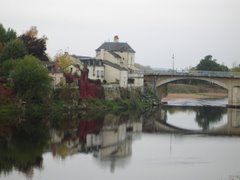
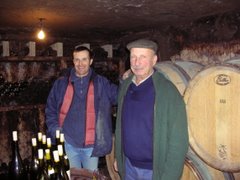
It was raining quite hard when we arrived in the beautiful village of Puligny-Montrachet. We ran up to the cellar door and knocked, holding our coats over our heads. After a few moments the door opened and a small gray haired man welcomed us inside. Paul Pernot is a caricature of a winemaker. Small but quite stout, completely gray and into his 70s, he wore a pageboy cap, a rumpled apron over his canvas workpants and shirt, and an old blue cardigan sweater to protect against the cellar's chill. BrooklynLady is convinced that the Institute des Vignerons in Beaune issues this outfit to all winemakers when giving out licenses.

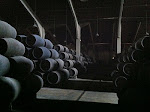
We went to a corner of the cellar used for tasting, a dimly lit area with a barrel for a table, several glasses and unlabeled wine bottles waiting to be opened. There were a few notable empty bottles on a shelf above the door: a 1945 Cos D'Estournel among them. As he began to uncork bottles, I noticed that his hands were huge and scratched up - he looked as if he had just finished throttling a horse.

He began a somewhat combative conversation with Jeanne Marie, asking her if she was discounting his wine, and she was promising that it was not her. Pernot sells wine to a few exporters, including Dressner and Jeanne Marie de Champs, and he was upset because he heard that someone was selling them too cheaply. This conversation persisted for the duration of our tasting so BrooklynLady and I contented ourselves with tasting on our own. Here are a few notes:

Whites:

2005 Bourgogne. Straightforward and pleasing, some citrus smells. Nice medium bodied texture, hints of vanilla and stone fruits. More elegant than the other 2005 Bourgogne whites that I tasted.

2005 Puligny-Montrachet. Citrus and flowers on the nose, pretty tight in the mouth, but with some swishing about there are clean citrus and white fruit flavors, and a definite mineral sense too, like wet stones.

2005 Puligny-Montrachet 1er Cru les Folatieres. Smells were hard to make out, although the nose was very pretty. Just a bit jumbled. Some lemon balm, a touch of honey? Tightly coiled and pure flavors of cirtus and white flowers, a little toastiness to it, and a piercing finish, as if the flavors were ready to uncoil after spitting the wine (yes, we learned to spit in Burgundy). I think this wine is a great value, and if I can find it in NYC I will buy a few bottles for cellaring.

Reds:

2005 Beaune Clos de dessus les Marconnets. Austere smells of raspberries and stems, still quite tannic, in the mouth too. Too early to tell what's going on with this wine, although it was light on its feet and pwerful too - seems to have potential.

2001 Beaune Clos de dessus les Marconnets. WOW! We both loved this wine. Drinking perfectly right now, lovely perfume of dark flowers, red fruits, and earth. Silky texture, all velvet in the mouth. Light feeling, but pure and piercing flavors of red and black cherries with a perfumey and earthy backbone. Just lovely - I would pour this for any Burgundy lover. And if I can find it I will grab a few bottles for drinking over the next few months.