Showing posts with label Closel. Show all posts

Thursday, February 02, 2012

Tidbits

Been busy and not able to write as often, but please don't think that means I've been starving and not drinking anything interesting. Oh no, my friends, I've been a very lucky Brooklynguy lately, in large part due to the generosity of friends. Here are some tidbits, things from the past few weeks that are worth mentioning:

Slope Farms sells pork now. I cannot tell you how excited I am about this. Ken and Linda Jaffe (former Brooklynites who moved to the Catskills) are dedicated to farming healthy cows, and theirs is my absolute favorite beef. I'm not sure of the details on this new pork venture, but I hear they have an elder and respected neighbor who advised them as they set up their farm. This neighbor raises pigs. The Jaffes now sell their neighbor's pork. Look at the marbling on the meat, and the beautiful color. I've tried the chops and a rib roast so far, and WHOA, this is very very good pork.

And on the other end of the food spectrum, processed food, I've discovered what I now believe to be one of the finest canned food products - Heinz baked beans, the kind they sell in England. These are done in tomato sauce, not in that cloying brown sugary sauce that our baked beans swim in. If you see these, try them. Okay, they're canned, but they're actually not that bad for you. And they taste so very good.

Some wine too...

2001 was not a very good vintage in Champagne. Not many vintage wines from that year - it was rainy, especially in the weeks leading up to harvest, there was a lot of rot, and it was a challenge for the grapes to ripen. I know from reading ChampagneGuide.net that this is considered to be one of the most challenging vintages of the past 20 years. So it was fascinating to have the opportunity to try a vintage wine from 2001, Jean Vesselle's Brut Prestige. This wine is all Bouzy, a blend of 70% Pinot Noir and 30% Chardonnay, but it reminded me of a wine I tasted a few years ago by Moutard that is made with the obscure grapes of Champagne, things like Arbanne and Petit Meslier. The wine had overt notes of green herbs and leafy vegetables, and I think it would have benefited from a few grams more of dosage (it was dosed at 3 grams, I believe). But really, it was good wine, well balanced and particularly lovely on the nose. I cannot say that it is what I dream of when I want Champagne, but it was a very good wine, and a reminder that it is possible to enjoy well-made wine from bad vintages.

I had dinner with a few friends and we each brought wine to the restaurant. These were good wines, on paper anyway. We arrived at 7:00, opened everything, and it was clear that nothing was showing very well. After a little while, I don't know how long exactly, but probably an hour or so, all of the sudden everything was fantastic.

I'm talking about a bottle of 2000 Vincent Dauvissat Chablis Les Clos that was butterscotch pudding for a while, and then turned into this detailed and focused thing of beauty. Some caramel notes, but also a bunch of freshly picked white honeysuckle. Pungent, long, and intense with a saline edge to the finish, this was a beautiful wine, a very special treat.

And the 1990 Robert Ampeau Volnay Santenots, a wine that began better than the others, but still was a tangled mess. And an hour later it was gorgeous - a complex and beguiling nose that had that vibrant mature-wine-pungency thing. Flowers, musky and gamy, but in the end, very much about stone. And it is the texture that gets you - the wine couldn't be more silky, and this silk surrounds what essentially is a wine about rock. Textbook Volnay, and a truly compelling and lovely wine.

And the 2002 Paul Bara Bouzy Rouge Coteaux Champenois, a wine that was probably the messiest of all when we first opened it, all bramble and pitch black fruit and very disjointed. But later on, I swear this wine was the freshest and most detailed wet stone basket of ripe strawberries, so pure and elegant, light as a feather. And the 1999 Eric Texier Côte-Rôtie, a wine that fooled all of us. It was a red fruit mash at first - I would have guessed a Grenache heavy wine from further south had I tasted it blind. This one took the longest to come around, but when it did it was a classic old school bloody, meaty, black olivey, and very mineral northern Rhône Syrah.

Can I tell you that the next day I learned that our dinner occurred on a flower day...but only after 8:00 PM. Why do these annoying coincidences keep happening with the confounded biodynamic calendar and the way wines taste?

At a restaurant in Boston I drank a bottle of 2007 Didier Dagueneau Blanc Fumé de Pouilly. The wine was beautiful, a perfect mingling of freshness, tension, elegance, and quiet intensity. It was not in any way showy, and was amazing in its perfect harmony, not for any one particular characteristic of aroma or flavor. Wow, I wish I had more experience with Dagueneau's wines. They are awfully expensive now.

I recently drank an Emidio Pepe wine for the first time, the 2001 Montepulciano d'Abruzzo. It had been open for hours before we drank it with dinner. I loved it, really loved it. Such interesting and delicious wine. Jet black fruit, very brawny, but detailed and fresh, with cooling herbal aromas, and a streak of something like tar and leather. It was lovely with the aforementioned Slope Farms pork roast, and I must find a way to drink this iconic (and expensive, and apparently very variable) wine again.

Lastly, look at this nice list of white wines by the glass. This is at the restaurant Herbsainte in New Orleans. I was down there recently for work, and stopped in to have a cocktail before retiring to my hotel room. But before I could order, I overheard the bartender telling another man that there was a buttermilk fried Louisiana frog legs special that evening. Hmmm.

Forget the cocktail - I ordered a glass of El Maetsro Sierra Fino (!) and the frog legs. Well that whole situation was so delicious, that I decided to keep going, and drank a glass of the 2010 Domaine du Closel Savennières La Jalousie with a little plate of Gulf shrimp and grits with okra. Even more delicious! You know, I used to love Closel but I kind of gave up on the wines after not liking anything after 2002 (and after the last of my 2002's showed oxidized). I told friends that I was done with the wines. Well, I have no idea what's really going on with Closel, but honestly, this 2010 was just excellent - fresh, pure, balanced, showing typical wooly and waxy notes and lots of minerality. A reminder to me not to make pronouncements about wine. I just don't have the years of drinking experience to make pronouncements.

Monday, December 13, 2010

Mid-term Cellaring Results

Not too long ago I retrieved some wine from off-site storage, things that I meant to drink at about this point in their lives (and in mine), and also a few things to check in on. The results have not been terribly impressive so far. These are wines that I liked very much several years ago, enough to send several bottles to off-site storage. It's interesting to see the way your own tastes change, to put yourself back in the mindset of making these decisions. Kind of like reading an old journal entry.

Anyway, here are the wines, along with a few notes:

2006 Marcel Lapierre Morgon, $22, Imported by Kermit Lynch Wine Merchant. This is absolutely and utterly delicious, and I only wish I had socked more away. Now there is an earthy complexity to the nose, although there is still plenty of dark fruit. There is also a pungency to the palate that is truly compelling. Great balance, vibrant acidity, lovely finishing perfume, just great wine - a joy.

2004 Éric Texier Côtes du Rhône-Brézème Domaine de Pergault, $29, Louis/Dressner Selections. I'm glad I have another because I have mixed feelings about the bottle we drank, and I want to drink it again. The nose was lovely and detailed, with lots of black olives and some floral hints, but the wine felt rather dilute on the palate. It never really filled out, although after it had been open for almost 2 hours it did put on a bit of weight. Perhaps I opened this one too young, or maybe I should have drunk it several years ago when I loved it. I have one more and I'm thinking that I should put it away again for another 5 years.

2005 Paul Pernot Beaune Clos du Dessus des Marconnets, $23, Fruit of the Vines Imports. Boy, did I love this wine a few years ago. I still like it fine, but it has not developed any kind of complexity - it's a lovely, fruity wine. There is nothing whatsoever that is exciting about it, though. Live and learn...

2004 Domaine du Closel Savennières Clos du Papillon, $26, Louis/Dressner Selections. There was a time when I loved this wine, LOVED it. And I don't think I was wrong - when it was young, this was a delicious wine. Only a few years later, though, and something is dreadfully wrong. The nose is beeswax and lots of alcohol (14.5%), and that's it. Two hours later, that's it. The palate is a disaster - way too evolved, no definition, not flawed, but unpleasant. So much so that we decided not to drink it. I think that this was good once, and has not aged well. But I have a couple more, so hopefully I'm wrong.

Isn't it interesting how things turn out?

Sunday, December 05, 2010

Osso Bucco

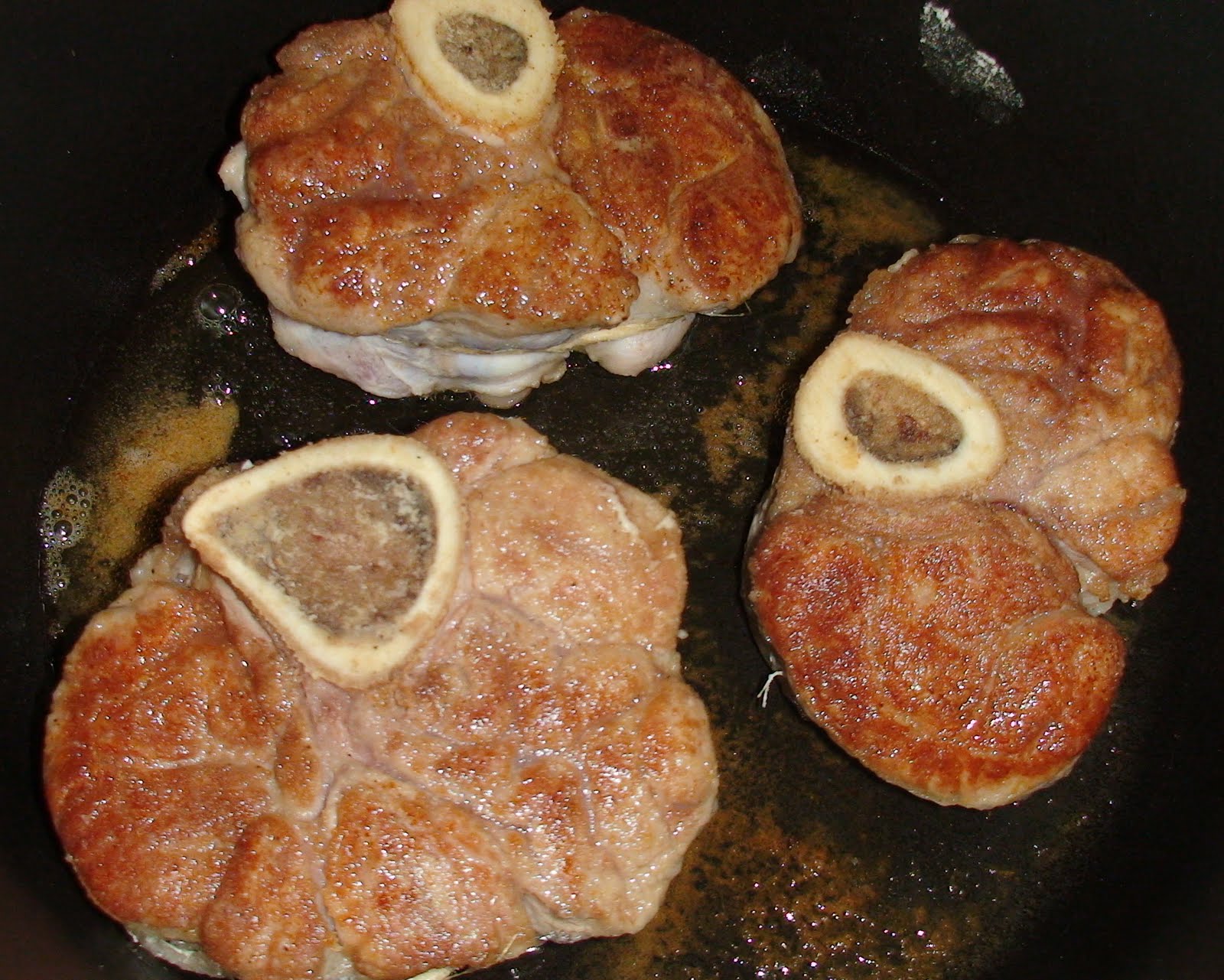
I've made Osso Bucco before, but with beef shanks, never with veal. The other day prowling the meat case at the coop, I saw three shiny and beautiful veal shanks sitting there, and so I pounced.

Osso Bucco is braised shanks, a humble cut of meat, and yet there is something celebratory about it. It's no more difficult than any other braise, and if you're having trouble thinking of something yummy to serve for the holidays (that might impress your guests), consider Osso Bucco. You can create your own recipe, in a way - you need to brown and then braise the meat, and you should probably add some vegetables. I braised mine in a mixture of chicken stock and fresh squeezed orange juice, and added sliced fennel and carrots. You can use tomato, wine, stock, any kinds of vegetables, whatever. The point is, brown the meat, cook it in the oven low and slow. Here's a bit more on how I did mine, which were pretty darn tasty, if I say so myself.

I usually season braising meats with salt and pepper at least 24 hours before I plan to cook them, but I didn't do that with this veal. I guess I figured that the meat would be rather delicate, and that I didn't want to over-season it. Veal and beef shanks have a white membrane on the outside that holds everything together. You should use kitchen shears to cut through it in a few places, and then some cooking twine to hold them together. I've skipped that step before, and for some reason the meat curls and twists while braising. It's worth using twine.

Dredge the shanks in flour seasoned with salt and pepper, and then brown them on all sides in a heavy bottomed braising pot. Remove the meat, pour out the fat from the pot, and pour in a bit of acidic liquid. I used some orange juice. You can use wine, vinegar, whatever. Scrape the browned bits off the bottom of the pot, and then add 2-3 cups of liquid - I used a mixture of chicken stock and orange juice. Probably it's best to use veal stock. Good for you if you find veal bones and make veal stock.

Bring the liquid to a boil, add the meat back to the pot, cover with a damp sheet of parchment paper and a tight lid, and into the oven at 300 degrees for an hour. If you want to eat the marrow, turn the meat so the wider end of the bone is facing up.

Then add your vegetables - I used a fennel bulb that I cut into half in slices, and two big carrots. I also added a bay leaf, a few black peppercorns, and a bit of salt. Cover again with damp parchment paper and a tight lid, another hour in the oven, and life should be good. If you're using beef shanks instead of veal, you might add 30 minutes to each cooking segment, by the way.

While the veal was braising with the vegetables, I made a gremolata, a mix of chopped citrus zest, herbs, and garlic. I used orange zest because I used a bunch of oranges for the braising liquid, and I used those wispy fennel tops that look like dill, because I used a fennel bulb in the braise. You could use parsley and lemon zest, whatever you like. I also used just a little bit of garlic, less than a teaspoon, and some salt.

When the veal is as tender as you want it to be, remove it and the vegetables from the pot. Now you decide what you want to do about sauce. I simply turned up the heat on the stove top and cooked down my braising liquid until it was reduced by a bit more than half.

On a bed of rice, with some of the vegetables, the sauce, and topped with gremolata...yum. We spread the marrow on toast too, just because we could. And by the way, although my kids didn't eat it in this form, I shredded some of the leftover meat for them, mixed it with the chopped vegetables and even some gremolata, and they both ate it all up.

What to drink with this dish? I used orange juice and stock, and after reducing like that, there was an unmistakable orange scent to the sauce. I wanted a full bodied white wine, something with plenty of acid to cut through the rich meat, but also something with herbal flavors, maybe, to play with the fennel? Since I have no Italian white wine in the house, I opened a 2005 Domaine du Closel Savennières Clos du Papillon, $33, Louis/Dressner Selections, which worried me with its alcohol and bulk two years ago, and has not improved, I'm sorry to say. If I could go back in time and prepare better, I'd open a Tocai from Friuli, perhaps by i Clivi.

Osso Bucco, baby! Don't even be a little bit scared, because you should definitely make this dish.

Wednesday, November 18, 2009

By the Glass - Domestic Cheese Edition

We've been delving further into domestic cheeses lately with some very good results, mostly. It continues to fascinate me, the challenge of pairing wine with cheese. In my opinion, which in this case is even less well informed than most of my other opinions, red wine is just too difficult to pair with cheese. They both tend to have such powerful aspirations, how can they avoid doing battle with one another? I find myself wanting to drink whites with cheese, the only question being whether or not the wine should have residual sugar. We've tried the cheeses I mention below several times, with various wines. Here are a few recent pairings that worked. Please feel free to chime in with any suggestions of your own.

Jasper Hill Farm Bayley Hazen Blue Cheese, paired with 2002 Domaine du Closel Savennières Moëlleux Les Coteaux, $28, Louis/Dressner Selections. Jasper Hill Farm might be the last great hope for artisanal cheese in Vermont. Mateo and Andy Kehler raise their own cows and make their own cheeses, but they also cellar small-batch cheeses made by other dairy farmers, including the famous Cabot's Cloth Bound Cheddar. Their Bayley Hazen Blue is a raw milk cheese that's aged for at least four months, and it is distinguished by its great balance. Not too salty, not too sweet, this cheese tastes of fresh butter, with herbs and roast nuts. It is crumbly and dense, not creamy like St. Agur. There are many wines that would be great with this cheese, but after one nibble, I knew that I wanted something sweet. The wines of the Savennières appellation are typically dry, but in 2002 the Domaine du Closel made a sweet wine. It was a great match, the herbal flavors of the wine enhancing the same flavors in the cheese. The rich, somewhat viscous texture of the wine enhancing the cheese's lean and sprightly characteristics. I've had this wine as an apértif in the past year, and it was far better with cheese than it was on its own.

Jasper Hill Constant Bliss, paired with 2007 Paul Pernot Bourgogne Blanc, $18, Jean-Marie de Champs Selections. This is a Chaource-style (in the Champagne region) cow's milk cheese. It is aged longer than Chaource cheeses (thank you, flavorful bacteria-averse FDA regulations), and the Jasper Hills folks say that it doesn't really resemble the cheeses of Chaource. This is delicious cheese, plain and simple. The best wine pairing I've found so far is the fabulously over-achieving everyday Bourgogne by Paul Pernot, which in the classic vintage of 2007 manages to be both lighthearted and serious. It shows hints of everything that makes white Burgundy wine so great - ripe fruit, delicate floral and stony aromas, and inner layers of texture that fade in and out.

Scholten Family Farms Weybridge, paired with 2007 Agnès et René Mosse Anjou Blanc, $18, Louis/Dressner Selections. This cheese is aged at the Cellars at Jasper Hill. It is a pasteurized cow's milk cheese with a bloomy rind, aged for 20-30 days. It quite sensibly ripens from the outside in, offering a lovely contrast between the creamy outer layer and the more chalky inner paste. I found the texture to be the most interesting thing about this cheese. The flavors are nice too, but more simple. The Mosse Anjou Blanc was nice here, its earthy and woolly notes adding complexity that I found the cheese to lack. Somehow, though, the wine showed almost no acidity when paired with the cheese. Strange...

Meadow Creek Dairy Grayson, paried with 2006 Pierre Frick Sylvaner Cuvée Classique, $13, Fruit of the Vines Imports. This is a raw milk washed rind cheese from the mountains of south-western Virginia, made somewhat in the style of the classic Italian Taleggio. Meadow Creek Dairy practices an earth-friendly form of cattle farming and cheese making. I have no data to back this up, but I hereby assert that Meadow Creek dairy is partially responsible for the fact that in the recent Presidential election, the great state of Virginia voted Democratic for the first time since 1964. In any case, this is delicious cheese. It is not a runny washed rind cheese, it retains its bouncy form even after several hours at room temperature. It is pungent, but not at all overpowering, with grassy and fruity flavors. Better to cut around the rind though, in my opinion, as it offers little to no flavor, and it adds an unpleasant brittle, waxy texture. Frick's bone-dry Sylvaner is great with this cheese. The floral aromas bookend the pungent, buttery cheese perfectly, and the almost startlingly dry wine accentuates the cheese's clean grassy flavors.

Monday, December 01, 2008

Loire Chenin Blanc Wine Dinner

I'm in a really great wine group now, and great ones are hard to find, trust me. This is a great one because the people are intelligent, easy going, and excellent company. And because our wine tastes are quite diverse. And also because we came up with a nice system for running the group. We rotate as hosts and the host provides everything. All the wine, all of the food, everything. The host picks a theme and decides how to explore that theme.

I like this system because it allows the host lots of freedom but also gives them lots of responsibility when it's their turn. It's also an egalitarian system - the host who feels flush can select 2002 Vosne-Romanée 1er Cru wines as the theme. The host whose employer is requesting a 20 Billion dollar bailout from the Feds, and who is not feeling flush, can select Muscadets young and old as the theme. Although vastly different in necessary expenses, both themes are fantastic in the hands of our capable hosts.

We've had a great time so far but I haven't been writing about it because, frankly, who wants to invite someone for dinner knowing that the dinner and wine will be dissected in a forthcoming blog post? When I host, I'm allowed to write about it. Recently it was our turn to host wine group and I chose Loire Chenin Blancs as the theme. I looked through my "cellar" and decided to go with the following wines:

Sparkling
2004 François Pinon Vouvray Brut (Magnum)

Dry
2005 Huët Vouvray Sec Le Mont
2002 Domaine du Closel Savennières Clos du Papillon
2000 Clos Rougeard Saumur Brézé (by generous gift of Joe Dressner, just for this dinner)

Off-Dry
2005 François Chidaine Montlouis-sur-Loire Clos Habert
2002 François Pinon Vouvray Cuvée Tradition
1996 François Cazin Cour-Cheverny Cuvée Renaissance

Sweet
1998 Domaine des Baumard Quarts de Chaume

I went with roast striped bass with oyster mushrooms for the dry wines and a pheasant pâté plate of sorts, including a dollop of home made quince paste, for the off-dry wines. Pear and honey cake for dessert. It pretty much turned out okay.
This night for me was further proof for me that the Loire Valley offers truly profound white wines at reasonable prices. Overall, the wines showed fantastically well. The exceptions for me were the Pinon wines - the Brut was fine but the 2002 Vouvray Tradition was just no good. Other people liked it, so it's just my opinion, but I found the seaweed/dried mushroom umami aromas to be extremely off-putting. And the 2005 Chidaine Montlouis-sur-Loire Clos Habert, one of my favorite demi-secs of the vintage, was in an awkward and closed phase on this night.

Here are some quick notes on the wines:

The Pinon Vouvray Brut was fine and lots of fun out of magnum, but objectively it just wasn't special wine. Other than H
uët's, I have yet to be truly wowed by any Loire sparkling wine, I must say.

The dry wines were fantastic, each with its own distinct personality. The Huët ($26 in early 2007, decanted 3 hours ahead) was the most delicate of the three, and although it was lovely during the dinner, it was utterly gorgeous the next day. Makes sense - the dry wines need time to develop. The Closel wine ($24 a few years ago) was in my opinion at the peak of drinking. Perfectly mature at only 6 years old (odd for a Savennières, but whatever), it was full of waxy ripe fruit, herbal, honey, and mineral flavors. Beautiful stuff. And the Clos Rougeard (over $60), which I decanted almost 6 hours ahead of time, was incredibly deep, although even with the decant, painfully young and during the actual dinner, not all that approachable. It's funny because about a half hour after decanting it was pretty fantastic. It goes through phases I guess. I wish I had saved some for the next day.

The weakest flight was the off-dry wines, although the 1996 Cazin ($26) was, for me, the wine of the night. And this is an interloper, a wine made from the Romorantin grape, not a Chenin Blanc. So sue me. It was gorgeous and completely harmonious, really in a great place. Mature and regal nose of ripe fruit with some interesting petrol and earthy notes. The palate was perfectly balanced with great depth of fruit and a great vein of acidity, and there was real viscosity here - this is dense without being heavy, long without being ponderous, just elegant and deep wine. Although I am not a fan of the 2005, my commitment to cellaring my '02s and '04s is renewed.

The 1998 Baumard Quarts de Chaume ($39) showed very well too. Incredibly beautiful nose of ripe orchard fruit, dripping with mineral intensity, and so fresh and youthful. This wine has a long life ahead of it. On the palate it's a wash of apricot and herbal honey supported by crackling acidity, loads of minerals, and a finish that lingers and changes, becomes pleasingly bitter. This wine had a cleansing effect on the palate, so different from most of the dessert wines I come across.

Tuesday, October 28, 2008

Dressner Portfolio Tasting Notes

So after the hard and wonderful work of the Terry Theise Portfolio tasting, we rushed over to the east side for Louis/Dressner tasting. There was simply no way to taste everything, even if this were the only tasting of the day. There were 250 wines, and I don't know about you, but I can't thoughtfully taste more than about 50 wines in one session.

I had to narrow the field, and so very sadly, I decided to taste mostly the new vintages of old and familiar wines. The Italian wines - I didn't taste 'em. Wines of the Savoie - didn't taste 'em. Burgundy, Jura, and Muscadet...nope.

Did I taste anything, you might be wondering, or did I just mingle with the wine stars? Oh, I tasted, buddy, and some great wine at that. I went for the Bubbles, the Beaujolais, the Cab Franc, and the Chenin Blanc. I had an hour - that's all I had time for.

First, I have to tell you about the 20 year table. In honor of their 20th anniversary, the Dressner folk dug into the cellar and set out a load of wines from their inaugural vintage. How thoughtful is that? And what a great opportunity for those of us (like me) who haven't tasted many of these wines with bottle age. I missed some of these wines, much to my dismay. Breton's Bourgueil Perrières, Chateau d'Oupia Cuvée les Barons, Pepière Clos des Briords...gone. And the Clos Rougeard Le Bourg - corked (but even so the fruit was young and lovely). The 1988 Closel Savennières Clos du Papillon was complex and beautiful, and the Chidaine Montlouis Clos Habert and the Pinon Vouvray Moelleux were great too. And as far as I know, 1988 wasn't a particularly great vintage - just a normal working class year in the Loire Valley. I'm more determined than ever to let my bottles sleep in peace...

Bubbles first, and what bubbles! Larmandier-Bernier wines are so different from the wide open style of much of the Theise portfolio. These wines are not generous, they are cautious and they'll hold back on you. There is nothing similar in style in the Theise portfolio except maybe Gimonnet, and those wines, if I may say so, do not have comparable depth or focus. These are piercing wines of great definition, and they can seem like turtles, just their head visible underneath all of that shell.

The Blanc de Blancs was opened as I was standing there and needed time to come together. But this bottle of Terre de Vertus showed better than any other I've tasted - richly fragrant with broad mineral flavors and ripe fruit. A memorable wine, and well worth the price (about $75). The 2004 Vieille Vignes de Cramant was focused and lovely with floral notes, although quite closed. There was no Rosé de Saignée left, which is tragic, as I have never tasted this legend of a wine.

Right near the Bubbly table sat two unattended bottles of Dard et Ribo white wine, both from 2006, a Crozes-Hermitage Blanc and a Saint-Joseph Blanc. I've never tasted a Dard et Ribo wine but I'd heard very good things, and these were better than very good. Fresh and pure with beautiful fruit and floral aromas, and great texture - voluptuous without that viscosity that find distracting in white Rhone wines.

Next was Beaujolais. This is such an impressive aspect of the Dressner portfolio. We're talking about many of the finest producers - Desvignes, Descombes, Brun, Tête, and Roilette, all at the same table. The wines that I liked the most on this day were the 2007 Clos de la Roilette Fleurie for its grace and purity of fruit, and the 2006 Desvignes Morgon Côte du Py for its depth and brambly intensity. There were many other excellent wines, but these are the two that I wanted to take those home with me.

The 2006's from Chidaine are quite good, although if you're used to the 2005's they will seem light. The 2006's are probably typical and the 2005's are probably extra rich and intense. My favorite was the 2006 Clos Habert, a demi-sec wine that I also love in 2005. The 2007 Pinon Vouvray Cuvee Silex Noir is just a great wine too, and a very good value at about $25. It was the temperamental 2006 Anjou Blanc from Agnès et René Mosse that I liked best of the current Chenin Blancs, with rich fruit on top of a pool of minerals, and a great underlying streak of acidity. At about $23, this is another excellent value. Rich enough to drink with a hangar steak, relaxed enough to enjoy with a bowl of vegetable soup.

I took a brief Burgundy excursion at this point and tasted through the Philippe Pacalet wines. Pacalet has a cellar in Beaune proper and buys grapes from various growers, often tending the plots himself. His wines are made in the classic style, focusing on purity, grace, and expression of terroir (read - not overly extracted and dark). Although these are not among my favorite red Burgundies, tasting Pacalet's 2006's was as fine a lesson in terroir of the Côte de Nuits as I've ever had. The Nuits-St-Georges was earthy and had wild game on the nose. The Pommard was muscular and dense, almost a bit clunky. The Gevrey-Chambertin was also muscular but with higher toned fruit. The Chambolle-Musigny was silky and more elegant. The Gevrey-Chambertin 1er Cru Perrieres (about $125) was in my opinion the finest of the lineup with great depth and intensity to compliment the ripe fruit and the firm structure. The Chambolle-Musigny was, as advertised, silky and more elegant.

And last for me were the great Loire reds, and what a way to end the day. I'm talking about Breton, Baudry, Raffault, Filliatreau, Clos Roches Blanches, and Clos Rougeard. I think the 2007 Baudry Les Granges is the best Les Granges since 2004. My first time tasting the 2006 Croix Boisée and I'm not sure where I stand. It had nice fruit, but it was so tannic and muddled that I couldn't decide whether or not I would buy it for myself. I need to taste this again. I was super impressed with how well the Raffault wines showed - all of them. The 2005 Chinon Les Picasses was ripe and expressive, but restrained and elegant too, and complex with herbal and earthy flavors. And under $25. The 2002 was a bit more awkward at this stage, but also shows elegance and balance to go along with the silky fruit. The 1990 was gone, but the 1989 was smooth and well balanced, and seemed quite youthful, nothing secondary about it.

All three Clos Rougeard wines were excellent - 2004 was an under appreciated year for red wine in the Loire, I think. Le Clos, the "entry level" wine, was ripe and delicious, and all elbows and knees right now. And by the way, this wine now costs about $60. Les Poyeux used to cost $50. These wines have become too expensive for most of us, sadly, as they represent some of the finest red Cabernet Franc wine from anywhere. Les Poyeux was delicious and oddly more accessible than Le Clos, and Le Bourg was your high school friend's huge but gentle older brother, more into math than football.

An amazing tasting that showcased the work that Louis/Dressner has done over the past 20 years to bring natural wines to the US. Next year if I am invited, I don't care if Barack Obama's white house tasting is the same day, I'm spending the day with Dressner.