Showing posts with label Larmandier-Bernier. Show all posts

Thursday, January 13, 2011

A Coteaux Champenois Tasting

Not all Champagne is sparkling wine. Peter Liem, many of whose comments and ideas are paraphrased within this post, told me that the modern history of sparkling Champagne is only 300 or so years old, and that Champagne used to be a still wine. Many Champagne producers continue to make small amounts of still wine, called Coteaux Champenois. If you've never heard of these wines or never tasted one, you are most certainly not alone. Not a lot is made, and most of what is made is consumed in Champagne. The grapes used to make Coteaux Champenois are the same highly valuable grapes that could be used to make Champagne - it just doesn't make good financial sense to divert production from a highly profitable wine that is in demand all over the world to a little known wine that is harder to sell at the same prices.

So why is Coteaux Champenois made at all, given that logic? Well, producers need still red wine if they make a rosé of Champagne by blending still red wine into sparkling wine. Also, people in Champagne enjoy drinking red wine from time to time and from what I gather, in much of France, you drink the local wine. Perhaps most importantly, Coteaux Champenois continues to be made because some producers want to honor the tradition and history of Champagne. "Take Larmandier-Bernier, for example," Peter said. "Pierre Larmandier wants to make red wine from Vertus Pinot Noir because he wants to preserve the history of Vertus."

Coteaux Champenois can be red, white, or rosé, although the red wines are by far the most common. The wines can be released as vintage wines or non-vintage wines, and do not need to be aged in bottle for three years, as sparkling Champagne does, in order to be labeled as vintage wines. The villages where Pinot Noir thrives are also the villages that make highly regarded Coteaux Champenois. Bouzy and Ambonnay are perhaps considered as the sources of the finest wines, but there are excellent wines made elsewhere too.

There are very few examples of Coteaux Champenois available at retail stores. Importers have trouble selling the wines, and so they don't bring them in. "I have trouble selling them, especially a non-vintage still red wine from Champagne that would retail for $50," said Kevin Pike, Director of National Sales and Marketing at Michael Skurnik Wines. There are retailers, however, who believe in these wines enough to keep them in stock. Joe Salamone at Crush in Manhattan, for example, has been selling Coteaux Champenois for years, when he can get his hands on it.

Last summer I drank a bottle of 2002 Larmandier-Bernier Coteaux Champenois with a few friends and absolutely loved it. I knew I needed to try more. A few friends agreed, and we decided to buy whatever we could and to hit up a few importers for bottles that are not (yet?) available in stores. We recently got together over a completely fantastic dinner at Prune and drank the wines. It was quite a crew, including the aforementioned Peter Liem, Joe Salamone, and Kevin Pike, and also Levi Dalton of Alto (where at least one Coteaux Champenois is on the wine list), Dan Melia, Clarke Boehling, and Keith Levenberg.

The results were mixed, I would say. The two wines that I have previously loved didn't show well on this night. Other wines were disconcertingly big and concentrated - stylistic decisions by top quality wine makers. But there were a few true gems. Here are the wines we drank in the order in which we drank them, along with a few notes:

2008 Roger Coulon Coteaux Champenois Blanc, $40-50, Rosenthal Wine Merchant. I found myself saying "this wine smells just like Champagne!" It really does, just like a Blanc de Blancs. Tastes just like one too. Feels entirely different, obviously, and it was a strange sensation. This was the very first Coteaux Champenois Blanc I've ever tasted, I think I need more experience before saying much.
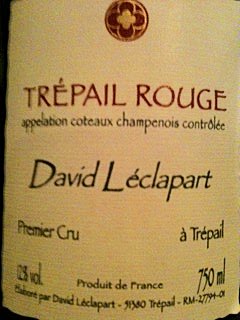
2008 Léclapart Coteaux Champenois Trépail Rouge, $55, Imported by Jandell Selections. Very fragrant, fresh red berries and flowers with woodsy undertones, very persistent. There is a "natural streak" here, as there often is in Thierry Puzelat's wines, for example. Bottle variation is significantwith this wine, apparently. This was a good bottle, the one I drank a few months ago was not as good.

2008 Egly-Ouriet Coteaux Champenois Ambonnay Rouge, $95, Imported by Michael Skurnik Wines. The nose is dominated by oak right now, and I found it hard to enjoy at this early stage, even harder to evaluate. Peter Liem told us that among many people in Champagne, this wine is considered to be the best Coteaux Champenois. I'd love to taste the '08 again in 5 or 10 years.

2001 Marie-Noëlle Ledru Coteaux Champenois Ambonnay Rouge, not imported (kindly donated for this tasting by Charlie Woods, whose company Bonhomie Wine imports Ledru's sparkling Champagnes). Still shows freshness, there is complexity on the nose, which becomes more layered and detailed with air, perfectly harmonious on the palate. Delicious, and one of my favorites of the tasting.

2004 René Geoffroy Coteaux Champenois Cumières Rouge, $55, imported by Michael Skurnik Wines. The nose is spicy, rich, voluptuous, and also energetic with dark fresh fruit. This is a powerful wine that doesn't lack for concentration, but still offers god detail and balance. I like Geoffroy's wines very much, and this was no exception.
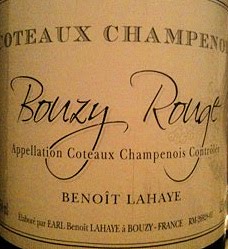

2003 Benoît Lahaye Coteaux Champenois Bouzy Rouge, not imported (kindly donated for this tasting by Jeffrey Alpert, whose company Jeffrey Alpert Selections imports Lahaye's sparkling Champagne). "Bouzy Rouge" has got to be one of the best names in the world of wine. My favorite wine of the tasting. The nose opens slowly (as with all of Lahaye's wines) but shows real elegance, especially in light of the very warm 2003 vintage. Mineral infused spicy red fruit on the nose, and a harmonious palate whose delicate red fruit shows a bit of maturity and although reflects some of the opulence of the vintage, for me didn't cross into over-done territory. Delicious wine, and Lahaye is an absolute star, in my book.

2000 Jean Vesselle Coteaux Champenois Bouzy Rouge, $41, Dionysos Imports. This wine showed a candied aspect that I didn't care for, and I found it to be a bit one-dimensional, uninspiring. But there were others who enjoyed it, so grain of salt here.

2002 Paul Bara Coteaux Champenois Bouzy Rouge, $40, Imported by Jandell Selections, although bara's sparkling Champagne is imported by Kermit Lynch. This wine was corked, which is a shame because in an odd coincidence I happened to drink a glass the night before this tasting, and it is wonderful wine, very intense but also very light in body, a truly excellent Coteaux Champenois.

2002 Larmandier-Bernier Coteaux Champenois Vertus Rouge, $40, Louis/Dressner Selections. This bottle did not show as well as the others that I've had. It was very reduced, even after an hour open, so we decanted it and it was much better. Similar in style to the Bara wine - purity, finesse, freshness, lightness in body. The fruit is rich and vibrant and the wine is well balanced, but it never became as good as other bottles that I've had. This bottle notwithstanding, this particular wine is the finest Coteaux Champenois that I've had.

2002 Bollinger Coteaux Champenois La Cote aux Enfants, $120, Imported by Terlato Wines International. Shows nothing of what makes Coteaux Champenois appealing. Overripe grapes, rasiny, too concentrated, chunky and not graceful, jut not enjoyable wine. I normally wouldn't condemn a wine like that, but I believe that everyone at the table felt approximately the same way, and so it's safe to say that my take on the wine is not an outlier. Bollinger is so great too, so this wine was quite confusing.

Tuesday, September 07, 2010

Wild Champagnes That I Have Loved

I hung out with Peter Liem for a lot of the past two weeks. It's weird - when I spend time with Peter I find that I drink a lot of Champagne.

-- Warning -- Laundry List to Follow --

Here are the amazing Champagnes I drank in the past few weeks, along with a few notes, and I will tell you now that with the exception of the Larmandier-Bernier and the 2000 Tarlant, I drank these wines solely because of the generosity of others.

NV Franck Pascal Cuvée Tolérance Brut Rosé, price unknown, no longer imported (JD Headrick was the importer until recently, as I understand it). As reported in ChampagneGuide.net, Franck Pascal is a rising star in the northern part of the Marne, in the village of Baslieux-sur-Châtillon where the soil is especially friendly to Pinot Meunier. This rosé is mainly Meunier, based on the regular NV cuvée with still red wine (both Pinot Noir and Meunier) blended in. I loved this rosé. Fresh and bright with fruit, and it really showed what to my taste is typical of Meunier - a round and fleshy, very broad character with something sweet and nutty like marzipan or cashew under the fruit. And despite all of that, the wine retained a classy sense of control and finesse. Very impressive, very delicious, I hope not too expensive when it makes it back to the States so I can buy some.

(2002) Larmandier-Bernier Vieille Vignes de Cramant Extra Brut Blanc de Blancs, $70, Louis/Dressner Selections. Some say that this wine does not benefit from long aging. I'm glad that I saved this for at least a few years (2005 is the current vintage), as it seems to be in a particularly sweet spot right now. Laser-like focus, delicate aromas and flavors but with great intensity. Much more about salt and rock than about fruit, and the chalky finish is graceful as it stains the palate and goes on forever. To me, a truly great Champagne.

NV Jacques Selosse Champagne VO, about $165, Imported by the Rare Wine Company. This particular bottle actually was purchased in France and traveled here by suitcase. I've had this wine once before and the two bottles were quite different. This one was probably a blend of wines from 2003, 2002, and 2001, and was aged on the lees for five years. It showed less of the oxidative character that has (quite beautifully) run through the few Selosse wines I've drunk. This one was lithe and stony, with bright and ultra-clean lemon fruit. Three of us drank this bottle and I don't know about you, but it's hard to go slow with Selosse. We may have sucked it down right as it was ready to fully show itself.

(1999, 2000) Tarlant Champagne La Vigne d'Antan Extra Brut Non-Grefée Chardonnay, $65, $60, 1999 imported by JD Headrick Selections, 2000 Imported by Jandell Selections. Here is Peter on this wine, in ChampagneGuide.net:

...a blanc de blancs from a 40-are parcel of ungrafted chardonnay vines in a vineyard called Les Sables, planted between 1951 and 1960. The soil here is very sandy and siliceous, preventing phylloxera from penetrating it, and these vines have thrived on their own rootstocks, although attempts at planting vines in other areas of the same vineyard have failed. The idea of this ungrafted cuvée is to reflect the personality of the terroir as expressed by these special vines, and it’s not necessarily intended to be a vintage wine: “The character of the site is stronger than that of the year,” says Tarlant. “This parcel isn’t always necessarily representative of the vintage.” The first release was based on the 1999 vintage, blended with roughly 25 percent of 1998, while the follow-up version was made entirely from the 2000 vintage.

My good pal Adam recently opened a bottle of the '99 and it was utterly gorgeous. The essence of the wine is this sandy brown mineral tone that permeates everything else. There is some fruit, but it is part of the supporting cast. Such intensity and focus, such wonderful balance. What I remember best about this wine is the way it unfolded in the nose and mouth - layers of aromas and texture, always crystalline and pure. Peter and I drank the 2000 two weeks later and I was struck by how similar the wines are. The 2000 is a bigger and richer wine, but that warm sandy brown mineral tone still suffuses everything. The flesh of the wine tastes like marzipan here, and it shows remarkable grace and class for a big wine. La Vigne d'Antan has become one of my favorite Blanc de Blancs.

2004 Louis Roederer Brut Blanc de Blancs, $60, imported by Maisons Marques & Domaines USA. Okay, stop right there if you're thinking "Wait, Roederer? Isn't that the huge négoce wine that Jay-Z likes?" Well, yes and no. Roederer does buy a lot of grapes, but only for their basic non-vintage Brut. All of the grapes used to make the other wines are estate grown. This is a wine of delicate subtlety and great finesse. There are no fireworks, there is no flash. There is chalk infused lemon fruit and a remarkably fine texture - that's what stayed with me, the pillow-y texture.

2002 Louis Roederer Champagne Cristal Brut Rosé, about $575, imported by Maisons Marques & Domaines USA. The first thing that struck me is the continuity in style between this and the above wine - we drank them on the same night. Both wines are honestly marvels of texture, well structured but cloud-like. It is hard for me to describe a wine like this, but I will say that it was as close to perfect as any wine I've had. How can so much intensity, detail, and raw material be packed into such a refined and elegant package?

2000 Dom Pérignon Brut Rosé, about $320, Imported by Moët Hennessy USA. Richness and density, but still elegant and vividly detailed, kind of an amazing thing to have rolling around in the mouth. Hard to describe this one too - just an amazing wine. Funny how this and Cristal seem to both have sacrificed their credibility among wine aficionados by allowing their brand to be portrayed as the ultimate in over-the-top luxury wines. They are stratospherically priced and out of reach of most of us. But if these bottles are representative, and I was assured that they are, they are finely crafted and exquisite wines, among the very best Champagnes.

Sunday, December 27, 2009

Champagne and Grape Character

I often find it quite difficult to identify the grape blend when drinking Champagne. I can think of many times when my guess was way off base. And even when I am drinking a familiar wine where I already know the grape composition, the grape character is not always as prominent for me as are other elements of the wine.

This is probably a good thing, from the producer's perspective - they are trying to make a seamless wine that expresses something of a place. If the drinker feels "this is so very much about Chardonnay," that's probably not what the wine maker was going for.

But it can be satisfying sometimes to drink a Champagne, and amidst all of the other sensations, to get a clear sense of the grape blend. Here are a few wines I drank recently that I found to show a particularly prominent varietal character. Not that it makes them better wines, I just find it interesting.

(2004) Larmandier-Bernier Terre de Vertus Brut Nature Blanc de Blancs Premier Cru, $55-73, Louis/Dressner Selections / Polaner Imports. This has had several years of post-disgorgement aging. The current release is 2006, I believe. It's funny to use this wine as an example, as according to ChampagneGuide.net it comes from a single terroir: "three adjacent parcels totaling 2.5 hectares, located on the chalky side of the village along the road to Le Mesnil." You'd think that this single terroir wine made in the incredibly pure Larmandier-Bernier style would be all about a particular place. And perhaps more experienced or more careful drinkers would find terroir to be the most prominent aspect of this wine. For me, with brunch on Christmas morning and then savored with BrooklynLady over the rest of the afternoon, this wine was a glorious expression of Chardonnay. Gentle and completely harmonious, the salty minerality of its youth is now in the background. The finish is delicately floral and very fragrant, and the sensation that lingers for me is pure, ripe Chardonnay.

NV Roger Coulon Champagne Tradition Brut, price unknown (this was a gift), Steven Berardi Selections, Elizabeth Imports. The Coulon estate is located in Vrigny, a place where Meunier does very well. From what I've read, this wine is only 50% Meunier, but it was defined by Meunier for the first 45 minutes or so. Broad marzipan and orange peel aromas, exuberant and expansive. I am confident that I would have pegged it as a Meunier-based wine had I drank it blind withint the first hour open. After an hour or so open, the wine lost some of its Meunier exuberance but gained harmony and precision. It was delicious in both incarnations.

NV Billiot Champagne Brut Reserve Grand Cru, $45, Terry Theise Selections/Michael Skurnik Imports. I think I've had this wine more often than I've had any other Champagne, and I always enjoy it. It smacks of pure dark Pinot fruit, juicy and rich, but completely in control. I had a glass the other night with friends, and although I was distracted by a hundred different things, I remember at one point, after putting my nose in the glass, thinking "wow - that is indisputably and deliciously Pinot Noir." Some people feel that Billiot's Brut Reserve is a bit high in dosage. I think it works this way. Somehow the relatively high dosage brings out the joyfulness of the Pinot fruit.

Tuesday, November 03, 2009

More from the Dressner Tasting

More thoughts and notes from the recent Dressner Portfolio Tasting:

The 2007 Domaine de la Pépière Granite de Clisson is here. I thought it was very tasty, although somewhat reserved in its expression. To be fair, this is not a wine that I can understand at a big tasting. It will be more expensive than the 2005 was, about $23, and I will happily buy it.

I loved the "entry-level" 2008 Muscadets by Luneau Papin, particularly the 2008 Luneau-Papin Clos des Allées, about $15. This typically racy and stony wine showed a bit more concentration and richness than I am used to, but in a good way. Lower yields perhaps?

All of the Larmandier-Bernier Champagnes showed very well. The 2004 Vieille Vigne de Cramant Extra Brut Blanc de Blancs, about $100 was well balanced and delicious, but my favorite on this day was the Terre de Vertus Brut Nature Blanc de Blancs Premier Cru, about $80 (based on 2006, but not a vintage wine). I thought this wine was simply fantastic, with pretty floral aromas layered atop the salty rocks. I want it.

I liked François Pinon's 2008's even more than I did the 2007's at this early stage. The 2008 Vouvray Cuvée Tradition, about $21, was sweet but well balanced and with good acidity, and the 2008 Vouvray Silex, about $26, was an awesome wine, very pure, with beautiful fruit, great structure and balance.

I think that I prefer François Chidaine's Montlouis wines to his Vouvrays. I'd love to test this little theory with many bottles, some friends, and dinner, but so far, I think I like the Montlouis wines better. They just seem more complete to me. The 2007 Chidaine Montlouis Clos du Breuil, about $30, a sec, or dry wine, is herbal and complex with woolly fruit. The 2007 Chidaine Montlouis Clos Habert, about $30, a demi-sec, or off-dry, and always a favorite of mine, was ripe and restrained and exuberant and about fruit and mineral and wool and soil. I loved it.

I really liked both of the Clos du Tue-Boeuf Pinot Noirs from Cheverny. Thierry Puzelat makes a load of different wines under his own label and also under this one, and it can be hard to keep track of what's what, but that's all part of the fun. The 2008 Clos du Tue-Boeuf Cheverny Gravotte, about $24, is 100% Pinot Noir from 30 year old wines on chalky soil. It smells of dried roses and is bright and elegant on the palate, with a definite chalky feel. The 2008 Clos du Tue-Boeuf Cheverny Caillère, about $28, is also 100% Pinot Noir from vines of about the same age, but from clay soils. The wine is darker and richer, very earthy and animale. Both are delicious wines, and very expressive of their place.

Many of you already know the late Baldo Cappellano's wines. I had never had one until this tasting. I appreciated all of them, but there are two that simply blew me away. The 2004 Cappellano Barolo Pie Franco (from un-grafted vines), about $165, is too absurdly brilliant of a wine to try to describe for you. A truly complete wine of incredible clarity, this left me speechless. And I also loved Cappellano's Barolo Chinato, about $100. The Cappellano family apparently was one of the first to produce this drink, a maceration of wine, quinine bark, and spices. There were five Chinatos poured, including a Roagna Barolo Chinato,and the Cappellano version was playing a whole different game. Floral and spicy, completely harmonious, and with a lingering sweet spicy quinine essence, this is an utterly delicious drink.

Tuesday, September 08, 2009

Two Weeks of Incredible Champagne

I used to write about sparkling wine every Friday in a sets of posts that I called Friday Night Bubbles. Every week for over a year, typically alternating between Champagne and other sparkling wines. It got expensive, but what made me stop this series was the fact that I wasn't satisfied with the quality of most sparkling wines at the $20-$25 price point. I decided that I'd rather spend my $25 on whatever wine I think is best, not necessarily a sparkling wine.

And so my sparkling wine consumption has gone way down, Champagne obviously included. In the past two weeks, though, I've had more top notch Champagne than in all of the past year, I would say. These things come in waves, I guess. I know it's boring to read lists of "The Great Wines I Just Drank," but please - allow me to share about some of these. These are rare and expensive wines that I may never have another chance to drink, and they are worth talking about.

I was in Seattle last week for work (thanks for having me back here, by the way). I know no one in Seattle, and I had business all day but nothing at night. I did take myself out to dinner one night at this place, and it was quite nice. But a million times more fun was dinner at my new friend Brian's house, a guy I met through another friend I met because of this blog. And they say that sitting in front of your computer is anti-social! Brian works for Triage Wines, one of the better importer/distributors on the west coast. He invited a few other Seattle wine-types, made a beautiful dinner of schnitzel and other goodies, and we opened what might in some circles be called an excessive amount of wine. I could tell you about the three 1998 Rieslings we had with dinner, including the FX Pichler Unendlich, but this is supposed to be about Champagne. So instead I'll tell you about Sugot-Feneuil, a producer I had never heard of. Brian served the 1998 Brut Blanc de Blancs as an aperitif, and it was just lovely, so full flavored, and also so elegant. But this was a fleeting experience, as apparently the grower is deceased and the vines have been sold to a big house.

That was only the beginning. One of Brian's friends brought a bottle of 1997 Larmandier-Bernier Special Club, I think the last Special Club vintage that Larmandier-Bernier did. This wine took a while to open up, but when it did it was a well balanced wine with rich nutty fruit and a mouth-coating texture. I think that it was starting to truly shine after we had moved on to other wines. And how about this - Brian went downstairs to his cellar (normal people can afford to live in houses in Seattle, apparently) and returned with not one, but two bottles by Vouette et Sorbée. We drank the Saignée de Sorbée (photo courtesy of Peter Liem) and the Blanc d'Argile, both 2006's, although they are not labeled as vintage wines. Both of these wines were entirely remarkable, impossible to overstate the level of quality here. The fruit in the rosé was utterly beautiful, almost impossibly fresh and alive, sweet and perfumed with subtle spices. Like all Vouette et Sorbée wines, this has no dosage - imagine how perfectly ripe these grapes must be! The other thing that I found striking about the rosé was its texture - full and rich, but exquisitely detailed and fine. Such a joy to drink. Peter and I drank the 2005 Saignée de Sorbée merely days before this Seattle dinner, and it was also a great, but an entirely different wine. The 2005 was not as much about fruit, it was completely saline and pungently rocky and earthy, and it was great with our roast bonito. The 2006 was a far more hedonistic wine that offered immediate and intense pleasure, but I wonder which wine will be better in 10 years...The Blanc d'Argile was also great, with that same brilliant fruit and texture, but I was so smitten with the rosé that I could barely pay attention to anything else. Thank you again Brian, and your welcoming and generous friends too.

The funny part is, you probably think that's all the great Champagne I've had recently. Not at all true, friends. I went to Alice Feiring's house the other night for her Champagne tasting, a semi-blind (we saw the list of wines, but drank them blind) look at a handful of wines with the idea of discussing whether or not they represent good value. I'll leave the results of the value discussion for Alice to print in her upcoming Wall Street Journal article, but I'll tell you that the wines in general showed tremendously well. I learned that Drappier makes very good wines - the nose on the 2002 Grande Sendrée was fantastic, rich and nutty with a focused depth of clean fruit, intriguingly orange-y in character. And I confirmed for myself that I am a huge fan of both Billiot's and Lallement's basic NV cuvées. That Larmandier-Bernier's Terre de Vertus smells and tastes of seashells, and that the 2004 Raymond Boulard Les Rachais Extra Brut will be excellent in about 8 years. Boulard's wines, in my humble opinion, might be the best value in the NYC Champagne market.

The three "S"s - a part of any balanced diet.

Alice somehow stocked her Blanc de Blancs lineup with 1997 Salon, and two different Selosse wines, Substance and VO. Yes, I drank Substance twice in two weeks - very extravagant. When I drank the VO I thought it was Substance, as the nose was immediately reminiscent of the wine I drank with Peter the week before. Wine maker's stamp, I guess. The '97 Salon took a while to unwind, but when it did it was just gorgeous, so expansive and richly satisfying in the mouth, and so perfectly balanced.

Alright, that's enough, I'm running out of gas - just excited to be back, I guess.

Tuesday, May 26, 2009

A Special Bottle from Larmandier-Bernier

The other night my generous friend Adam came to dinner and brought with him a truly fantastic bottle of Champagne, Larmandier-Bernier's Brut Premier Cru Blanc de Blancs. Larmandier-Bernier is one of the best producers in the Côte des Blancs, making delicious wines of finesse and purity that can be thrilling in their clear expression of terroir. Any bottle by this producer is special, but some are more special than others.
The thing that made this particular bottle so special is that it was disgorged in June of 2005. This is before team Dressner began to import the wines, back when Pierre and Sophie Larmandier-Bernier were working with Terry Theise and Michael Skurnik. We're talking about four years of bottle age here, more than most of us give our non-vintage bottles. More than I do, anyway. There is no code etched onto the bottle (recent bottles have an etched on the glass that reveals base year and disgorgement date) so I cannot be certain about the base year, but I'm guessing 2002 grapes primarily, and bottled in 2003.
What happens to high quality non-vintage Champagne when you cellar it? There are some folks who will tell you that nothing happens, except that the wine loses freshness. Perhaps that is true regarding many generic Champagnes, but not with wines from producers like Larmandier-Bernier. This wine was just fantastic, with a captivating nose that showed a regal and mature character, but still with great vibrancy and freshness. And it got better over the hour it was open, its nose broadening and its mineral and nutty flavors really crystallizing. The mousse is really just a gentle buzz on the palate, with great depth of fruit and mineral, and a lovely savory note that Adam described as Hoisin. Absolutely finely integrated - a well oiled machine. Truly memorable and delicious wine, a wine that has me re-thinking what I want to do with Champagne in my own cellar.

Friday, December 19, 2008

Friday Night Bubbles

I have a special treat for us all to share this week. Peter Liem, the finest Champagne blogger there is (and his other writing isn't bad either), has most graciously written today's Friday Night Bubbles installment. The good news is, you'll learn far more about wine by reading Peter's post than you do when you read typical Friday Night Bubbles posts. The bad news is, I have not yet been able to convince Peter that he should simply assume command of the ship over here on Fridays. He makes it sound as though he has better things to do. Anyway, check this out: Peter Liem doing Friday Night Bubbles.

NV Larmandier-Bernier Terre de Vertus Blanc de Blancs, $55, Louis/Dressner Selections. Non-dosé champagne is highly fashionable in the Champagne region right now, but few people really do it right. The problem is that in order to make good non-dosé champagne, you have to work exceptionally well in the vineyards, to achieve fruit that is ripe enough and complete enough in feel to stand on its own. You can't just take your regular brut NV and decide that you won't add any sugar to it. One producer who knows how to consistently get it right is Pierre Larmandier of Larmandier-Bernier, with his Terre de Vertus blanc de blancs.

This wine is a monocru champagne, coming entirely from the village of Vertus, but even beyond this, it's all grown in a very specific area in Vertus: the chalky heart of the gentle, east-facing slope on the northern side of the village, in the direction of Le Mesnil-sur-Oger. This area makes the most overtly minerally wines of the village, wines that can echo those of Mesnil in their racy, focused structures but that carry less overt weight, making them feel even more linear and energetic, with an intensely pronounced chalkiness. Comparing the wines of Vertus to his wines from Cramant, farther north, Pierre Larmandier says, "It's the same minerality, but Cramant has more power and more body. In Vertus the minerality is a little more naked."

The Terre de Vertus is not technically a single-vineyard wine, as it comes from three adjacent parcels: Les Barillées, Les Faucherets and La Vieille Voie. However, the terroir remains fairly homogenous over Larmandier's 2.5 hectares in these three plots, so for all intensive purposes this functions identically to single-vineyard champagne, expressing the particular characteristics of a highly specific site. As with all of Larmandier's wines, this is grown biodynamically, picked at an elevated degree of ripeness and fermented with indigenous yeasts. A portion of it is fermented in barrique, another portion in large oak foudre and another in stainless steel tank—Larmandier likes the respiration that wood provides, but doesn't want the wine to be influenced by the flavor of oak, so he adds some tank-fermented wine into the blend. He's been very pleased with his foudres so far in the way that they allow the wine to breathe without imparting too much of a flavor imprint, so if he can solve the problem of physical space (those suckers are big), look for Larmandier's champagnes to involve more wine vinified in foudre in the future.

Although the Terre de Vertus has always come entirely from a single year (the first was 1995), it cannot be vintage-dated as it's released too early to qualify for a vintage champagne. The bottle that Brooklynguy and I drank together this week was from 2004, disgorged in April of 2007, meaning that it spent about two years on the lees. I always think that Larmandier's wines need a lot of post-disgorgement aging to show their best, and even tasting this one, 20 months after disgorgement, I felt that it could still use a little more time to put itself together. It started off very compressed and austere, taking about half an hour for the nose to unwind and reveal its fruit, although the palate was more generous, with aromas of sweet apple and citrus peel, infused by fragrant chalkiness and finishing with light notes of clear honey. Silky in texture and tone, it felt driven by the taut, lively character of the terroir, and while it demonstrated a good deal of depth and concentration on the mid-palate, the overall impression was one of raciness and energy. We didn't decant it, but I don't see why it wouldn't have benefited from decanting—after drinking about two-thirds of the bottle, I told Brooklynguy to put it in the fridge and save it for the next day, when it would likely be showing even better (and he confirmed later that this was indeed the case). While it's not a wine to age for a tremendously long time, I would be interested in seeing how it develops over the next three to five years, at least. Back in February of 2007, I wrote in my notebook that the 2004 "will vie with the 2002 as the greatest Terre de Vertus that Larmandier has made so far." I see no reason to amend this statement, and I suspect that there is even more complexity and character contained within this wine, waiting to emerge.

Tuesday, October 28, 2008

Dressner Portfolio Tasting Notes

So after the hard and wonderful work of the Terry Theise Portfolio tasting, we rushed over to the east side for Louis/Dressner tasting. There was simply no way to taste everything, even if this were the only tasting of the day. There were 250 wines, and I don't know about you, but I can't thoughtfully taste more than about 50 wines in one session.

I had to narrow the field, and so very sadly, I decided to taste mostly the new vintages of old and familiar wines. The Italian wines - I didn't taste 'em. Wines of the Savoie - didn't taste 'em. Burgundy, Jura, and Muscadet...nope.

Did I taste anything, you might be wondering, or did I just mingle with the wine stars? Oh, I tasted, buddy, and some great wine at that. I went for the Bubbles, the Beaujolais, the Cab Franc, and the Chenin Blanc. I had an hour - that's all I had time for.

First, I have to tell you about the 20 year table. In honor of their 20th anniversary, the Dressner folk dug into the cellar and set out a load of wines from their inaugural vintage. How thoughtful is that? And what a great opportunity for those of us (like me) who haven't tasted many of these wines with bottle age. I missed some of these wines, much to my dismay. Breton's Bourgueil Perrières, Chateau d'Oupia Cuvée les Barons, Pepière Clos des Briords...gone. And the Clos Rougeard Le Bourg - corked (but even so the fruit was young and lovely). The 1988 Closel Savennières Clos du Papillon was complex and beautiful, and the Chidaine Montlouis Clos Habert and the Pinon Vouvray Moelleux were great too. And as far as I know, 1988 wasn't a particularly great vintage - just a normal working class year in the Loire Valley. I'm more determined than ever to let my bottles sleep in peace...

Bubbles first, and what bubbles! Larmandier-Bernier wines are so different from the wide open style of much of the Theise portfolio. These wines are not generous, they are cautious and they'll hold back on you. There is nothing similar in style in the Theise portfolio except maybe Gimonnet, and those wines, if I may say so, do not have comparable depth or focus. These are piercing wines of great definition, and they can seem like turtles, just their head visible underneath all of that shell.

The Blanc de Blancs was opened as I was standing there and needed time to come together. But this bottle of Terre de Vertus showed better than any other I've tasted - richly fragrant with broad mineral flavors and ripe fruit. A memorable wine, and well worth the price (about $75). The 2004 Vieille Vignes de Cramant was focused and lovely with floral notes, although quite closed. There was no Rosé de Saignée left, which is tragic, as I have never tasted this legend of a wine.

Right near the Bubbly table sat two unattended bottles of Dard et Ribo white wine, both from 2006, a Crozes-Hermitage Blanc and a Saint-Joseph Blanc. I've never tasted a Dard et Ribo wine but I'd heard very good things, and these were better than very good. Fresh and pure with beautiful fruit and floral aromas, and great texture - voluptuous without that viscosity that find distracting in white Rhone wines.

Next was Beaujolais. This is such an impressive aspect of the Dressner portfolio. We're talking about many of the finest producers - Desvignes, Descombes, Brun, Tête, and Roilette, all at the same table. The wines that I liked the most on this day were the 2007 Clos de la Roilette Fleurie for its grace and purity of fruit, and the 2006 Desvignes Morgon Côte du Py for its depth and brambly intensity. There were many other excellent wines, but these are the two that I wanted to take those home with me.

The 2006's from Chidaine are quite good, although if you're used to the 2005's they will seem light. The 2006's are probably typical and the 2005's are probably extra rich and intense. My favorite was the 2006 Clos Habert, a demi-sec wine that I also love in 2005. The 2007 Pinon Vouvray Cuvee Silex Noir is just a great wine too, and a very good value at about $25. It was the temperamental 2006 Anjou Blanc from Agnès et René Mosse that I liked best of the current Chenin Blancs, with rich fruit on top of a pool of minerals, and a great underlying streak of acidity. At about $23, this is another excellent value. Rich enough to drink with a hangar steak, relaxed enough to enjoy with a bowl of vegetable soup.

I took a brief Burgundy excursion at this point and tasted through the Philippe Pacalet wines. Pacalet has a cellar in Beaune proper and buys grapes from various growers, often tending the plots himself. His wines are made in the classic style, focusing on purity, grace, and expression of terroir (read - not overly extracted and dark). Although these are not among my favorite red Burgundies, tasting Pacalet's 2006's was as fine a lesson in terroir of the Côte de Nuits as I've ever had. The Nuits-St-Georges was earthy and had wild game on the nose. The Pommard was muscular and dense, almost a bit clunky. The Gevrey-Chambertin was also muscular but with higher toned fruit. The Chambolle-Musigny was silky and more elegant. The Gevrey-Chambertin 1er Cru Perrieres (about $125) was in my opinion the finest of the lineup with great depth and intensity to compliment the ripe fruit and the firm structure. The Chambolle-Musigny was, as advertised, silky and more elegant.

And last for me were the great Loire reds, and what a way to end the day. I'm talking about Breton, Baudry, Raffault, Filliatreau, Clos Roches Blanches, and Clos Rougeard. I think the 2007 Baudry Les Granges is the best Les Granges since 2004. My first time tasting the 2006 Croix Boisée and I'm not sure where I stand. It had nice fruit, but it was so tannic and muddled that I couldn't decide whether or not I would buy it for myself. I need to taste this again. I was super impressed with how well the Raffault wines showed - all of them. The 2005 Chinon Les Picasses was ripe and expressive, but restrained and elegant too, and complex with herbal and earthy flavors. And under $25. The 2002 was a bit more awkward at this stage, but also shows elegance and balance to go along with the silky fruit. The 1990 was gone, but the 1989 was smooth and well balanced, and seemed quite youthful, nothing secondary about it.

All three Clos Rougeard wines were excellent - 2004 was an under appreciated year for red wine in the Loire, I think. Le Clos, the "entry level" wine, was ripe and delicious, and all elbows and knees right now. And by the way, this wine now costs about $60. Les Poyeux used to cost $50. These wines have become too expensive for most of us, sadly, as they represent some of the finest red Cabernet Franc wine from anywhere. Les Poyeux was delicious and oddly more accessible than Le Clos, and Le Bourg was your high school friend's huge but gentle older brother, more into math than football.

An amazing tasting that showcased the work that Louis/Dressner has done over the past 20 years to bring natural wines to the US. Next year if I am invited, I don't care if Barack Obama's white house tasting is the same day, I'm spending the day with Dressner.

Friday, October 10, 2008

Friday Night Bubbles

NV Larmandier-Bernier Champagne Brut Premier Cru Blanc de Blancs, $37, Louis/Dressner Imports. Like driving at night on a lonely road, there is something about drinking this wine that closes out all other stimuli.

The outer layers are lovely, with a wonderfully clear sense of chalky soil, and focused mineral, saline, and citrus flavors. There is a fragrant chalky finish that really lingers, the acidity tingling the cheeks. But honestly, that's just the outer layers.

I've had this bottle for about a year now, and I'm starting to see that some non-vintage wines do really well with a little bit of bottle age. This bottle was so different from the first one I had back then. This is a wine of delicacy and great finesse, but there is something finely chiseled, penetrating, and powerful at its core. Not an aroma or a flavor, more of a sensation. Underneath all of the delicate aromas and flavors, there is an inner layer, a cylinder of intensity that drives through the mid palate and into the finish. It is a piercing sensation, and one that really defines this wine for me.

Larmandier-Bernier's Blanc de Blancs is made from the grapes of several villages in the Côte des Blancs. There are two other wines by this producer that are both highly prized - the Terre de Vertus, a non-dosé Blanc de Blancs and a Vieille Vignes de Cramant. I've not had the chance to drink either of these wines at home, but I do have a bottle of the 2002 Vieille Vignes sleeping in the cellar. That will be a good day...

This is a brilliant wine made by grower/producers that are completely dedicated to truth in the bottle. Not a surprise really - this is Dressner wine, which means that the growers practice healthy farming, natural yeasts ferment the juice, there is minimal dosage (minimal intervention of any kind) and the producers practice yoga and/or meditation at least 3 times a week.

The metal cap in the wire cage bears the Latin phrase "Abusus non tollit usum." I assumed that this quote contains the key to the mysteries of this great Blanc de Blancs, and so after some emailing and a little translation help from our friend in Dizy, I learned that this means "The abuse does not prevent the usage." Not what I was expecting...

In any case, the wine is great - one of the finest NV Blanc de Blancs that I know of.