Showing posts with label René Geoffroy. Show all posts

Wednesday, April 03, 2013

Champagne, Revisited.

Once again, I am reminded that it takes several experiences, at least, in order to understand a wine. Subtlety can get lost even when drinking a wine calmly with friends over a meal, especially if other wines are present. I had dinner with a few friends on a recent night and one of them very generously brought along a bottle of Cedric Bouchard's Blanc de Blancs called La Bolorée. Here is what I wrote about this wine in August of 2011:

La Bolorée is an unusual wine. It is an old vines Pinot Blanc grown on chalky soils in the Aube, there's nothing else like it. It was very smokey and mineral, and quite rich with honeyed flavors on the finish. I appreciated the quality of this wine but it was my first time drinking it and I must say that I didn't really understand the wine, it was simply too far away from what I know of the aromas and flavors of Champagne. I'd love to drink it again, but this is not an easy thing to do as quantities are small and the wine retails for about $175.
I've since had the wine twice, and it is a curiosity, for sure. The only pure Pinot Blanc Champagne that I know of, it is quintessentially Bouchard in its clear expression of terroir and its purity of fruit. That time I drank it in August, 2011 at the Bouchard dinner, for me it got lost among the other wines. It is a wine that I imagine would show terribly at a tasting - people would be left shaking their heads at how a wine like that could cost so much money, at how capricious the Champagne hipsters are.

But the thing is, La Bolorée is a great wine. It's also an unusual wine, a Champagne that shows aromas and flavors that have no bearing on what we think of as "normal." It is herbal and green. Not green as in under ripe, green as in tarragon and chervil, green as in the forest in springtime. The wine thrives on its almost impossible fineness of texture and flavor, not on fruit or anything else that's expected or easy for us to latch onto. Honestly, the wine just doesn't taste like any other Champagne. And so, it is easy to miss why this is a great wine.

Peter Liem, a huge proponent of Bouchard and of this wine before it was introduced to the US,  generously opened a bottle this past xmas. Drinking it over a few hours without other wines next to it that would speak louder, I think I understood it. And then on this recent evening even though a few other wines were present, I appreciated it even more, the way its vibrant herbal flavors were layered on a gossamer old vines frame. It seems to me that if one were to draw a large rectangle that contains the world of Champagne, one of the corners of the rectangle would be occupied by this wine - it represents one extreme possibility.

On another recent evening I was in New Orleans at the wonderful Bacchanal, a wine store and bar/restaurant where one can buy a bottle and take it out to the garden in back, order some good food, listen to some shockingly good jazz, and feel happy to be alive. I wandered through the shelves and came upon a bottle of wine I hadn't had in quite some time, René Geoffroy's Champagne Brut Expression. I really like Geoffroy's wines from top to bottom - they are so expressive and joyous and generally offer a great value dollar for dollar. This one was disgorged in 2010, so I figure the base wine is 2008. I was charmed immediately by the harmony of fruit, earth, and vivid chalkiness on the nose and the complexity, particularly on the finish. So much so that I snapped a picture and sent it to Peter, bragging about my outdoor wine affair. 

I thought about this wine over the next few days and resolved to buy some. I mean really - a wine with such such a pure chalky expression of such lovely Pinot fruit, for under $50? I asked Peter if the 2010 disgorgement indicates 2008 as the base wine, and he said that it might be but that there is always a lot of reserve wine here too. Wait a minute! Reserve wine? I thought that Expression is made from a single vintage, but not aged long enough to be labeled as a vintage wine. That's when I realized that the wine I thought I was drinking was an entirely different wine! I mixed up Empriente, the almost purely Pinot Noir single vintage wine, with Expression, the wine that is typically comprised of about 50% Meunier, and perhaps 40% Pinot Noir, the rest Chardonnay.

One explanation here is that I have no idea what I'm drinking, and cannot tell Pinot Noir from Meunier, or my a$$ from my elbow. This is entirely possible, perhaps likely. But I prefer to think that the undeniably chalky essence of both wines renders moot the particular cépage. And that the richness and complexity conferred by the high proportion of reserve wines in Expression allows it to feel just as grand of a wine as Empriente. Seriously, this wine is all about chalk, richness of fruit notwithstanding. This is something that I didn't understand about either wine until now.

If there is a lesson here, aside from the fact that I can be an absent minded schmendrik sometimes, it's that no matter who we are, no matter how often or how grand the wines we drink, it's all too easy to miss the point, to be off-base about things sometimes. Best to allow for that possibility and not to shout too loudly about opinions, and to try to find value, even, in being wrong.

Thursday, January 13, 2011

A Coteaux Champenois Tasting

Not all Champagne is sparkling wine. Peter Liem, many of whose comments and ideas are paraphrased within this post, told me that the modern history of sparkling Champagne is only 300 or so years old, and that Champagne used to be a still wine. Many Champagne producers continue to make small amounts of still wine, called Coteaux Champenois. If you've never heard of these wines or never tasted one, you are most certainly not alone. Not a lot is made, and most of what is made is consumed in Champagne. The grapes used to make Coteaux Champenois are the same highly valuable grapes that could be used to make Champagne - it just doesn't make good financial sense to divert production from a highly profitable wine that is in demand all over the world to a little known wine that is harder to sell at the same prices.

So why is Coteaux Champenois made at all, given that logic? Well, producers need still red wine if they make a rosé of Champagne by blending still red wine into sparkling wine. Also, people in Champagne enjoy drinking red wine from time to time and from what I gather, in much of France, you drink the local wine. Perhaps most importantly, Coteaux Champenois continues to be made because some producers want to honor the tradition and history of Champagne. "Take Larmandier-Bernier, for example," Peter said. "Pierre Larmandier wants to make red wine from Vertus Pinot Noir because he wants to preserve the history of Vertus."

Coteaux Champenois can be red, white, or rosé, although the red wines are by far the most common. The wines can be released as vintage wines or non-vintage wines, and do not need to be aged in bottle for three years, as sparkling Champagne does, in order to be labeled as vintage wines. The villages where Pinot Noir thrives are also the villages that make highly regarded Coteaux Champenois. Bouzy and Ambonnay are perhaps considered as the sources of the finest wines, but there are excellent wines made elsewhere too.

There are very few examples of Coteaux Champenois available at retail stores. Importers have trouble selling the wines, and so they don't bring them in. "I have trouble selling them, especially a non-vintage still red wine from Champagne that would retail for $50," said Kevin Pike, Director of National Sales and Marketing at Michael Skurnik Wines. There are retailers, however, who believe in these wines enough to keep them in stock. Joe Salamone at Crush in Manhattan, for example, has been selling Coteaux Champenois for years, when he can get his hands on it.

Last summer I drank a bottle of 2002 Larmandier-Bernier Coteaux Champenois with a few friends and absolutely loved it. I knew I needed to try more. A few friends agreed, and we decided to buy whatever we could and to hit up a few importers for bottles that are not (yet?) available in stores. We recently got together over a completely fantastic dinner at Prune and drank the wines. It was quite a crew, including the aforementioned Peter Liem, Joe Salamone, and Kevin Pike, and also Levi Dalton of Alto (where at least one Coteaux Champenois is on the wine list), Dan Melia, Clarke Boehling, and Keith Levenberg.

The results were mixed, I would say. The two wines that I have previously loved didn't show well on this night. Other wines were disconcertingly big and concentrated - stylistic decisions by top quality wine makers. But there were a few true gems. Here are the wines we drank in the order in which we drank them, along with a few notes:

2008 Roger Coulon Coteaux Champenois Blanc, $40-50, Rosenthal Wine Merchant. I found myself saying "this wine smells just like Champagne!" It really does, just like a Blanc de Blancs. Tastes just like one too. Feels entirely different, obviously, and it was a strange sensation. This was the very first Coteaux Champenois Blanc I've ever tasted, I think I need more experience before saying much.

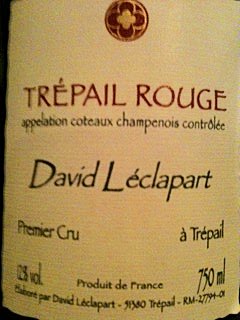
2008 Léclapart Coteaux Champenois Trépail Rouge, $55, Imported by Jandell Selections. Very fragrant, fresh red berries and flowers with woodsy undertones, very persistent. There is a "natural streak" here, as there often is in Thierry Puzelat's wines, for example. Bottle variation is significantwith this wine, apparently. This was a good bottle, the one I drank a few months ago was not as good.

2008 Egly-Ouriet Coteaux Champenois Ambonnay Rouge, $95, Imported by Michael Skurnik Wines. The nose is dominated by oak right now, and I found it hard to enjoy at this early stage, even harder to evaluate. Peter Liem told us that among many people in Champagne, this wine is considered to be the best Coteaux Champenois. I'd love to taste the '08 again in 5 or 10 years.

2001 Marie-Noëlle Ledru Coteaux Champenois Ambonnay Rouge, not imported (kindly donated for this tasting by Charlie Woods, whose company Bonhomie Wine imports Ledru's sparkling Champagnes). Still shows freshness, there is complexity on the nose, which becomes more layered and detailed with air, perfectly harmonious on the palate. Delicious, and one of my favorites of the tasting.

2004 René Geoffroy Coteaux Champenois Cumières Rouge, $55, imported by Michael Skurnik Wines. The nose is spicy, rich, voluptuous, and also energetic with dark fresh fruit. This is a powerful wine that doesn't lack for concentration, but still offers god detail and balance. I like Geoffroy's wines very much, and this was no exception.


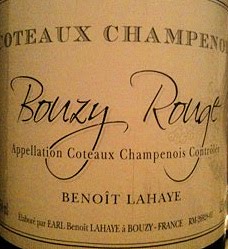
2003 Benoît Lahaye Coteaux Champenois Bouzy Rouge, not imported (kindly donated for this tasting by Jeffrey Alpert, whose company Jeffrey Alpert Selections imports Lahaye's sparkling Champagne). "Bouzy Rouge" has got to be one of the best names in the world of wine. My favorite wine of the tasting. The nose opens slowly (as with all of Lahaye's wines) but shows real elegance, especially in light of the very warm 2003 vintage. Mineral infused spicy red fruit on the nose, and a harmonious palate whose delicate red fruit shows a bit of maturity and although reflects some of the opulence of the vintage, for me didn't cross into over-done territory. Delicious wine, and Lahaye is an absolute star, in my book.

2000 Jean Vesselle Coteaux Champenois Bouzy Rouge, $41, Dionysos Imports. This wine showed a candied aspect that I didn't care for, and I found it to be a bit one-dimensional, uninspiring. But there were others who enjoyed it, so grain of salt here.

2002 Paul Bara Coteaux Champenois Bouzy Rouge, $40, Imported by Jandell Selections, although bara's sparkling Champagne is imported by Kermit Lynch. This wine was corked, which is a shame because in an odd coincidence I happened to drink a glass the night before this tasting, and it is wonderful wine, very intense but also very light in body, a truly excellent Coteaux Champenois.

2002 Larmandier-Bernier Coteaux Champenois Vertus Rouge, $40, Louis/Dressner Selections. This bottle did not show as well as the others that I've had. It was very reduced, even after an hour open, so we decanted it and it was much better. Similar in style to the Bara wine - purity, finesse, freshness, lightness in body. The fruit is rich and vibrant and the wine is well balanced, but it never became as good as other bottles that I've had. This bottle notwithstanding, this particular wine is the finest Coteaux Champenois that I've had.

2002 Bollinger Coteaux Champenois La Cote aux Enfants, $120, Imported by Terlato Wines International. Shows nothing of what makes Coteaux Champenois appealing. Overripe grapes, rasiny, too concentrated, chunky and not graceful, jut not enjoyable wine. I normally wouldn't condemn a wine like that, but I believe that everyone at the table felt approximately the same way, and so it's safe to say that my take on the wine is not an outlier. Bollinger is so great too, so this wine was quite confusing.

Tuesday, December 21, 2010

Great Champagnes, Under $50

It's the time of year for lists of Champagne's greatest hits. Today alone, Eric Asimov of the NY Times published an article reviewing his tasting panel's thoughts on sparkling wines not from Champagne, and also a blog post listing some of his favorite Champagnes.

Well, I want to add my .02 cents. Here are some of my favorite Champagnes that cost $50 or less before sales tax:

Blanc de Blancs.

Pierre Gimonnet Selection Belles Annees Brut Premier Cru, $34, Terry Theise Selections/Michael Skurnik Imports. Bright fruit, a graceful style.
Jacques Lassaigne Les Vignes de Montgueux Brut Blanc de Blancs, $47, Jenny & François Selections. Richer and more robust, from the Aube.

Pinot Noir-heavy wines.

René Geoffroy Empreinte Brut Premier Cru, $48, Terry Theise Selections/Michael Skurnik Imports. This is always based on a single vintage, and is usually about 90% Pinot Noir. Fragrant and vivid, well balanced.

Benoît Lahaye Brut Essentiel Grand Cru, $40, Jeffrey Alpert Selections. About 90% Pinot from the village of Bouzy. Simply excellent.

Pinot Meunier-heavy wines.

Françoise Bedel Cuvée Origin’elle Brut, $45, JD Headrick Selections. About 80% Meunier, slow to unwind, quite rich, made in a slightly oxidative style, lots of soil.

Blended Wine.

Chartogne-Taillet Brut Cuvée St Anne, $38, Terry Theise Selections/Michael Skurnik Imports. For me, a classic Champagne.

Rosé Wines (Tough, because there are few choices at $50 and under).

Margaine Brut Rosé Premier Cru, $50, Terry Theise Selections/Michael Skurnik Imports.

Brut Nature/Non-Dosé Wines.

Raymond Boulard Mailly-Champagne Grand Cru Brut Nature, $43, Imported by Selected Estates of Europe. Complex wine that is more about soil than about fruit, but still feels ripe and delicious.

Tarlant Brut Zero, $45, JD Headrick used to handle Tarlant, and I'm not sure who does now. Spicy and vibrant.


So...what do you think? Suggestions welcome. There is still time for us all to blow some dough on Champagne before the big eves and days arrive.

Sunday, July 18, 2010

René Geoffroy's Empriente - One of the Best Values in Pinot-Heavy Champagne

I want to tell you about what I think is one of the best wine values in Champagne, a wine made by René Geoffroy. All of René Geoffroy's wines are compelling, from the wildly energetic Rosé de Saignée to the refined Volupté to the truly fine "entry level" wine, a non-vintage wine called Expression. It is primarily Meunier and it is a delicious wine that offers more complexity and finesse than one might expect from a non vintage wine.

There is another wine in the portfolio, a wine that has quietly amazed me since the first time I tasted it. I'm talking about Empriente, the Pinot Noir based wine made from a single vintage, although it is not a vintage wine. This is a brilliant wine every year, easily equal in quality to most vintage wines I've drunk, and it is priced like a high quality non-vintage wine at about $55 in NYC. The problem is, hardly anyone sells the wine. I've looked for this wine for years without success. I did find some recently, however, and the other night I enjoyed sharing a bottle with friends after dinner.

Here is what Peter Liem of ChampagneGuide.net has to say about Empriente:

Empreinte is pure Cumières, made predominantly from pinot noir and always made from a single year, which is stated on the back label rather than on the front. While all three of Champagne’s major grape varieties are grown in Cumières, the village is known primarily for its pinot noir, and Geoffroy believes that Empreinte, which means “footprint”, is the cuvée that best expresses the Cumières terroir. For simplicity’s sake, Geoffroy usually says that the Empreinte is a blend of 75 percent pinot noir and 25 percent chardonnay, all fermented in large oak foudres, but in fact this changes considerably from one year to the next.
NV René Geoffroy Champagne Empriente, $55, Terry Theise Selections/Michael Skurnik Imports. We drank the 2004, and this wine is still in the early part of its life. It took a solid half hour to fully reveal itself, but the reward was worth waiting for. This wine is in perfect balance - it has everything and nothing juts out even a little bit. The expression of fruit here is so delicate - tiny thick skinned red berries, pure and intense. And oddly, considering that this wine is mostly Pinot, there was a unmistakable lemon note to the nose and palate once the wine opened up - the Chardonnay in the blend (12%) showed more of its character than might be expected. Underneath this red lemony fruit is the layer that for me really defines this wine - there is a bass note of chalk here that everything rests upon, and it is graceful, and the overall effect is one of subtlety and finesse.

There is no flash here and it is so perfectly balanced that it might be possible to miss how deep and great this wine is. If you open one soon, let it unfold, pay attention - it's hard for me to think of many Champagnes that offer the same quality at this price.

Sunday, September 20, 2009

NV Champagne from '05 and '06 - Thoughts on the Terry Theise Champagne Tasting

I went to the big Michael Skurnik / Terry Theise tasting last week, the only tasting in NYC where one can gaze upon Robert De Niro's father while sampling wine. I arrived quite late and had nowhere near enough time to taste everything. So I focused instead on the producers I like the most, trying to get to know the new versions of their wines.

Many of the non-vintage Champagnes are based on 2005 grapes, a very ripe year, as it was in most of the wine making world. Peter Liem of ChampagneGuide.net said that at one time he thought 2005 juice will make for very good non-vintage wines, in general. Now he's not so sure, as some wines are showing overripe flavors. There were also plenty of NV wines based on 2006 grapes, another very warm vintage, but with a cool and wet August that perhaps allows the finished wines to show better balance and freshness than the 2005's. Where am I getting all of this Champagne vintage and climate information from?

Please let me interrupt this post to tell you something very important: Peter has added new features to what is already the best online Champagne guide - there is now a 'vintages' section that provides detailed info on Champagne vintages, an 'articles' section where he will publish a feature length article every month, and most excitingly, for me anyway, a blog. Peter hasn't been writing about Champagne anymore on Besotted Ramblings, but he's blogging again on his new site and the posts are as fun, interesting, and chock full of insider's information as you would expect.

Sorry, back to the Theise Champagne Tasting. After the tasting it was interesting to compare my notes on wines based on '05 to those based on '06. Here is what I found:

The Gaston Chiquet NV Brut Tradition was based on 2005 (80%) and was very nice wine, although it did not seem to have the energy that I remember it having. Plenty of ripe dark fruit, but this wine is 45% Meunier and it felt a bit too spread out, its frame too malleable. The Chartogne-Taillet NV Brut Cuvée St Anne was based on 2005 (80%) and for the first time ever, I was not terribly impressed with the wine. I liked the nose a lot, with its flowers, ripe fruit, and chalky earth. But the palate felt a bit clunky, without the focus and clarity that I am used to.

The Pierre Gimonnet Brut NV 1er Cru Blanc de Blancs was better than I remember though, with a delicately focused nose of flowers and chalk. It felt both lacy and ample on the palate, and although I don't have terribly high expectations for this particular wine, I really liked this version. It was based on 2006 grapes, as it turned out. The other NV Blanc de Blancs that I liked a lot was the Pehu-Simonet NV Blanc de Blancs, this version almost entirely 2006 (90%). The nose was just gorgeous, with salty white flowers, very gentle, and the grapes are all from Mesnil, as with a famous Champagne you may have heard of, called Salon. The Lallement NV Brut smelled great, with clean dark fruit and a brooding earthiness, and it tasted great too, very well balanced. It is 80% 2006 grapes.

The interesting thing is, my favorites turned out to be more of a combination of 2006 and 2005 grapes. The René Geoffroy Brut NV Expression is always one of my favorite NV wines. This version is 65% 2006 and 35% 2005 grapes, and although it is more overtly fruity than in the recent past, I thought it was complex, well balanced, and just lovely. And the Henri Billiot NV Brut Reserve is 50% 2006, 25%2005, and 25% 2004, and it was delicious, open and inviting with ripe dark fruit and great energy. This wine always improves dramatically with a year or so of bottle age, and I'm curious to see what will happen with this particular version. Perhaps the folks in Champagne were onto something, with all of this blending.

Friday, November 28, 2008

Friday Night Bubbles

N.V. Champagne Raymond Boulard Champagne Rosé de Saignée, $39, SelectedEstates of Europe. I love drinking Francis Boulard's wines. I like writing about his wines too - he apparently lurks out there in the blogosphere, and read my posts on his Brut Nature and Petraea. His comments are edifying, funny, and I think, very humble and sweet.

In my understanding, there are essentially two ways to make rosé of Champagne: still red wine is added to the blend, or the juice of red grapes is allowed a short period of skin contact. With the latter method, some of the color (and also skin tannins, aroma, flavor, I would imagine) bleeds out into the juice. This is called the Saignée, or bleeding, method.


I have not been a big fan in general of rosés of Champagne thus far. My experiences have been hit or miss, and the hits have rarely moved me enough to get really excited. That changed with a bottle of Geoffroy Rosé de Saignée. So much more vibrant and alive than the others I had tasted, and my first Saignée (at home, where you can watch the wine unfold in the glass, etc.). Now I keep my eyes open for rosés made using this method,
so when I saw Boulard's non-vintage Saignée sitting there for less than $40, I pounced.

This wine has a spicy nose of pure and beautiful dark fruit and candied orange peel with lots of minerals and earth underneath. It is a nose of great clarity and vivid complexity. It kept my nose in the glass for literally minutes at a time between sips. The palate is richly fragrant with high toned currant and orchard fruit and a savory tea leaf component. There is a cleansing chalky finish with a resonant mineral depth that seems to be a Boulard calling card. We drank this with simple turkey burgers, but it seems as if it would support a variety of full flavored dishes.

Sunday, October 26, 2008

Terry Theise Tasting Notes

What's the right thing to do at an enormous industry wine tasting? Do you try to taste every wine being poured? Do you find some way of narrowing the field, and taste only a subset of the wines? The answer is personal, I suppose. I used to try to taste everything but in the end I learned less that way, and did not really enjoy myself. Nowadays I try to figure out what I most want to taste before I get there.

I was invited to both the Terry Theise Selections/Skurnik Champagne Portfolio Tasting and the Louis/Dressner Selections tastings last week, invitations that I am truly grateful for. The largest and arguably the finest portfolio of grower Champagnes in the US, and the largest and finest portfolio of natural wines from France and Italy - what a treat to participate.

Both tastings, however, took place on Tuesday October 21st from noon-4:00. Admit it - that just sucks. Thoughtfully tasting everything in the Terry Theise portfolio alone is challenging enough, but to do that and then find a way to do the same thing at the Dressner tasting...that's a tall order. Luckily I had my buddy and fellow blogger David McDuff as a partner in tasting.

I did a much better job at the Theise tasting simply because I went there first. I learned that if I had to pick one Champagne producer's lineup to take to a desert island, it would be that of René Geoffroy. From top to bottom, just amazing. I re-discovered Pierre Peters and Marc Hébrart. And best of all, I am beginning to put together an understanding of terroir in Champagne. Here are some of the wines that I would buy for myself (great wine, good value) from the Theise portfolio (prices are estimates):

NV Pierre Peters Cuvée Réserve Blanc de Blancs Brut, $50. My favorite on this day of the non-vintage Côte des Blancs wines.

NV Marc Hebrart Sélection Brut, $50. Deep rich perfume, just gorgeous. 65% Pinot Noir and 35% Chardonnay. Complex, delicious, and balanced. I never see this in stores though...

NV René Geoffroy Expression Brut, $50. Heavy in the Meunier, and one of my favorite non-vintage wines of the whole portfolio. If you're skeptical of this whole grower Champagne thing, and you buy only one wine from this portfolio, try this one.
NV René Geoffroy Empreinte Brut, $60. This one is 82% Pinot Noir and it's gorgeous. Again, I've never seen it retail. Not in New York, nowhere. Please, someone...buy this wine so I can buy it.
NV René Geoffroy Cuvee Volupté Brut, $80. For the first time (I think) this is a Blanc de Blancs. It's all 2004, although it's not a vintage wine. It's a baby and it's very delicate, but it's already got a well defined and muscular physique. This will be a knockout in a few years.
2000 René Geoffroy Brut, $125. I didn't say that I'd be happy about spending the money, I just said that I would buy these wines myself. And since I buy maybe two wines at this price each year, this is a serious comment on the quality I saw in this wine at this price. This wine has no sugar in the dosage, but you might not guess that when drinking it. What a thing of beauty! It is full and deep and rich and delicate and a full-on sensory experience. If you have the money and the inclination, this is not to be missed. Will someone carry it in their store, though?
1995 René Geoffroy Cuvée de René Geoffroy Brut, $300 (magnum). Truffles and strawberries. This was the wine of the tasting for me, and although I cannot spend my own (and my wife's) $300 on a magnum, I'm hoping that the gods of wine will somehow allow me to taste this again someday.

NV Gaston Chiquet Tradition Brut, $45. Also heavy on the Meunier, and another favorite non-vintage wine. I haven't always loved this wine, but on this day it was great.

NV Margaine Brut Rosé, $55. Refined and delicate, yet bold and lovely fruit. Delicious.
2000 Margaine Special Club Blanc de Blancs Brut, $75 (but this price could be totally wrong - the book is missing information). Gorgeous mature nose of nuts and minerals, very rich.

2002 Henri Billiot Brut, $75. Just gorgeous 80% Pinot Noir deliciousness. So deep fruited and satisfying. And a keeper too - this has a long life ahead of it.

NV Lallement Brut, $55, Intense spicy fruit with a steely mineral backbone. Powerful but also delicate somehow in its purity.

NV Chartogne Taillet Cuvée Sainte Anne Brut, $45. Bring this to someone who thinks they don't like Champagne. It's a classic, well balanced, fragrant, deeply fruited wine, and delicious wine. And I've seen it, the same disorgement as in the tasting, based on 2004, with the new label, for as little as $36.
2000 Chartogne Taillet Brut, $65. Bold and rich, with a spicy depth. This is big wine, but it's well balanced and gentle.
2002 Chartogne Taillet Cuvee Fiacre Brut, $75. From their oldest vines, this wine is refined and elegant, and still pretty closed. The 2000 Fiacre that I tasted in September was much more approachable. But this will be a beauty in a few years, I suspect.

Dressner notes coming soon...

Friday, September 12, 2008

Friday Night Bubbles

NV René Geoffroy Cuvée Rosé de Saigné, $30 (375 ml), Terry Theise Selections/Michael Skurnik Wines. I must admit, rosé of Champagne is something that still perplexes me. I find very few to be truly compelling, maybe one in five. The same grower/producers who make wines that I love, I often find their rosés to be uninspiring, and they're more expensive than the regular non-vintage wines too. I definitely need more time with the wines in order to understand them, but it's also possible that as a style of wine, rosé of Champagne might not be my thing.

But wait, it's not so simple. There are two distinct styles of
rosé of Champagne, and I've been drinking only one of them, as it happens.

Broadly speaking, rosé of Champagne is made in two ways. The more common method involves blending still red wine with the white base wines. This method allows the producer a greater degree of control over the finished wine, and therefore, consistency. For whatever reason, I've not found these wines to be as lively and exciting as other Champagne.

With the
saigné method, the producer allows the red grape skins to stay in contact with the juice for a short while, and then bleeds (saigné means bled off- sang=blood...think sangria, sang-froid, etc.) off the now red-tinted juice. It is more difficult to control the finished product here - the natural variations of the growing season play a more prominent role. This is why each bottling of one producer's rosés de saigné can be quite different in color, aroma, and flavor.

I'
ve been drinking rosés made by blending still wines. There are a few that I've really liked, wines by Billiot in particular. Time to try some wines made with the saigné method.

As it turns out, Geoffroy makes a rosé de saigné that I really like. Not a big surprise for me - I like every single Geoffroy wine that I've tasted. At this point, if I could take one Champagne producer's lineup to a desert island, it would be me and René out there under the palm trees. The version currently on the shelves is almost electric orange - the photo doesn't do it justice. The nose is deeply perfumed with luscious dark Pinot fruit with a stabilizing chalky base. Such richness and perfume on the nose! The palate is super lively with fruit and acidity. Smooth and creamy in texture with a broad mouth filling feeling. The finish is deeply mineral and leaves a floral fragrance in the mouth. This wine is just delicious, and plenty bold enough to partner with our late summer meal of broiled bonito and Italian-style braised green beans.

More
rosé de saigné is in my future, I can tell. I know Boulard makes one. Any others that you'd care to recommend?

Friday, June 20, 2008

Friday Night Bubbles

NV René Geoffroy Champagne Brut Expression, $39. Terry Theise Selections. A little more than a year ago I tasted a Geoffroy wine for the first time, and it helped to open my eyes to the beauty, grace, and power of good Champagne. A grower in the village of Cumières in the Marne Valley, Geoffroy makes wines of real depth, wines whose richness and power are matched by their elegance and poise.

There is a high proportion of Meunier in this, his "entry level" Champagne. Usually about 50%. And the balance is mostly Pinot Noir, so this is almost a Blanc de Noirs. Chardonnay plays a bigger role in the Cuvée Volupté, the Tête De Cuvée (top blend of the house). But that is the only one - red grapes dominate most of this producer's wines.

This bottle was just outstanding, the best showing yet for the April 2007 disgorgement. Yeasty wet bread dough on the nose enlivened by citrus and ripe green apples. There is no malolactic fermentation for this wine and the acidity remains sharp and bright. A very broad and inviting nose of great clarity, and it fleshes out and gains depth with air time. The palate is beautifully balanced with figs, fresh red fruits, piercing acidity, and plenty of chalky minerals. The wine feels very full in the mouth with a sappy richness of red fruit, but maintains great focus. It's as if there are different phases in the mouth: an initial bready and muscular phase, structured and firm. Then comes the fruit, pure and delicate. Then a deep sappiness that's grounded in chalk. Just beautiful wine, and it seems like it could age gracefully.

I love this wine, one of my favorite entry level Champagnes for sure. Everything I've tasted from Geoffroy has been excellent, but sadly, I've merely tasted most wines, not enjoyed them at home with a meal. That's because I've seen only this cuvée in stores. My kingdom (puny and with no powers of taxation, but a kingdom nonetheless) for a bottle of Empriente or Cuvee Volupté!