Showing posts with label Chartogne Taillet. Show all posts

Wednesday, February 16, 2011

Champagne - Some Last Tidbits

Some odds and ends to wrap up my recent trip to Champagne:

First of all, I was wrong when I said that Peter Liem hasn't yet written about single-vineyard wines in Champagne. He wrote an article that appeared in the San Fransisco Chronicle a few years back, and like everything he writes, it's worth reading.

And speaking of Peter...he was a great host. Our first night in Dizy, after a day of driving from Paris and through the Marne to visit a couple of growers, Peter whipped up quite a dinner. He likes to cook Japanese food and we ate simmered Sea Bream, age-dashi tofu, bok choy and mushrooms, miso soup with enoki mushrooms, pickles, and rice that he prepared in a clay pot.

And we drank a delicious bottle of 1999 Marie-Noëlle Ledru Brut, and then an absurdly good bottle of 1976 Diebolt-Vallois Blanc de Blancs. Amazing wine - must age more Champagne.

We also drank a fair bit of Brandy de Jerez, including the rich and concentrated Equipo Navazos La Bota de Brandy Nº 13 and the deeply satisfying Gutierrez Colosía Brandy de Jerez Juan Sebastián Elcano Solera Gran Riserva.

Peter and I drank lots of other interesting things in the late evenings, including a pair of rare Amaro that are not imported to the US. With each sip I could feel the growing outrage and resentment from my friend, the writer of the Amari file.

I got a kick out of the lunch that Alexandre Chartogne served after tasting through his wines. The terrine with the aspic ring around it was good - pork head on top, a strip of blood sausage in the middle, and other parts on the bottom. But the one that looks like a loaf of bread, the terrine with fois gras and pastry around it, that one was truly memorable. A glass jar of fois gras too, in case we wanted to sample it without the bothersome pastry around it. There was cheese too. There were no vegetables. Everything was delicious, but I hope that his diet is typically more varied. I was assured that it isn't.

I had my first taste of Bordier butter. And I got to eat it several times, actually. With sea salt, with seaweed, and plain unsalted - each one a special treat with layers of flavor and texture that I didn't know could exist in butter. It reminded me of how simple things are usually not as simple as we think they are.
I listened to Charles Philipponnat talk for a while, and he is as knowledgeable as they come. Friendly and charming, too.

I drank more Georges Laval wine in one sitting than I am likely to in the next few years.

Including his great 2009 Coteaux Champenois, from the tank.

I walked by the old vertical press at Champagne Pierre Peters. It's no longer in use, but it is a beautiful thing.

I stood mid-slope in the Clos des Goisses and looked down at the village of Mareuil-sur-Aÿ.

It was an amazing and unforgettable trip, but beyond the wine and the food and everything else, the best part was that I got to spend so much time with my good friend.

Monday, February 07, 2011

A Trend Toward Single-Vineyard Wine in Champagne?

The hills of Champagne, as in Burgundy, are divided into many individually named vineyards, some containing more than one lieu-dit, or named parcel. In Burgundy the decision was made a long time ago to bottle the wines from each vineyard separately, and we can compare Vosne-Romanée 1er Cru Les Suchots to Vosne-Romanée 1er Cru Les Beaux-Monts, or to any other of the 14 or so 1er Cru vineyards in that village.

Champagne houses, in general, followed a different path. Champagne is a blended wine, mostly. Wines from different vineyards within a village, and from different villages altogether, wines from different vintages are blended. Although this tradition clearly hasn't hurt the quality of the wines, their reputation around the world, or the price they command, it is probably one of the issues that create questions for some people about the degree to which Champagne expresses terroir.

I am certainly not the person you should look to for the latest news in Champagne, but it seems to me as though there is a trend towards single-vineyard wines, particularly among young producers. Makes perfect sense, when you think about it. As grower Champagne continues to gain in popularity, the producers of these wines can offer new products to their expanding audience, especially when those products further extend part of the grower ethos - that of expressing terroir.

I began to think about this during our visit with Alexandre Chartogne of Champagne Chartogne-Taillet. After lots of tasting in the cellar we were back in the comfortable and warm reception room, tasting through the current lineup of wines. I remembered that Chartogne-Taillet makes a Blanc de Blancs, but we weren't drinking it. When I asked if he still makes it, Alexandre said that it is now bottled as Les Heurtebises, the vineyard it comes from.

The next morning I thought of this again with Vincent Laval in the cellars at Champagne Georges Laval, as Vincent told us about the conditions in Les Chênes and Les Hautes-Chèvres, the vineyards that produce his single-vineyard Chardonnay and Pinot Noir. Laval's estate is tiny, producing no more than 10,000 bottles per year, and yet he bottles these wines separately. And they command very high prices - at least $150 per bottle.

I thought of this again later that day, tasting with Raphaël Bérèche. Beginning with the 2007 vintage, he makes an old vines Pinot Meunier from the vineyard of Les Misy in Port à Binson. It is called Vallée de la Marne Rive Gauche, and Bérèche's intentions are clearly announced on the wine's label, as the place of origin is far more prominent than the family name. The back label, by the way, contains information on the vineyard, disgorgement date, and everything else that we might want to know.

Around this time I asked Peter what he thinks of this trend, if it is in fact a trend. "I've been meaning to write something about that," he said. That's fine - we can wait together to read whatever it is Peter has to say on this issue.

The next day I thought of this again, but in an entirely different context. At Philipponnat, a larger house, we drank Clos des Goisses, one of the most celebrated wines of Champagne, and also a single-vineyard wine. The house could theoretically blend much of the grapes into non-vintage wines, use some for a vintage wine, and sell many more bottles much more quickly than they do with Clos des Goisses, which ages on its lees for way beyond the required three years. But Charles Philipponnat and the others at the house understand how special the vineyard is, and bottle it separately.

And later that day at Salon, when Export Director Jean-Baptiste (Tista) Cristini showed me around the gorgeous house and property. We looked at a picture frame that contained a menu from Maxim's in Paris, from 1928. It reads "Salon 1921 - Mesnil Nature, cuvée pure de raisins blancs." This means "Pure Mesnil, Blanc de Blancs." There were other wines offered on the menu, but none of them mentioned the place of origin. I guess Mesnil has been considered great terroir for a long time, and Salon recognized the power of marketing the single village wine.

My point, I guess, is that perhaps this is nothing new, this trend toward single-vineyard wines in Champagne. If it is, in fact, a trend. Maybe it's a cycle and we're approaching a single-vineyard section of the wheel. The real question, in the end, might be why are there more single-vineyard wines appearing in Champagne, and what impact will they have? As I mentioned before, we can wait together for Peter on those questions.

Monday, January 31, 2011

Vin Clair and Champagne Terroirs

To really know the taste of wines from a certain place - this is not an easy thing for most of us. If you are fortunate enough to drink many examples over many years, it becomes possible. When trying to learn about terroir, Champagne presents challenges that Burgundy, for example, does not. Although the majority of Burgundy wines are of the regional or villages classification, single vineyard bottles are so widely available that your local wine shop doesn't have to be particularly creative to stock them. There are nowhere near as many single vineyard Champagnes on the market, although the number is growing. Most often when we drink Champagne, we drink a blend of wines from several parcels of several vineyards, perhaps even from several different villages and vintages. Add that to the fact that Champagne must be crafted in the cellar in a way that most still wines are not, it is easy to understand why some people do not consider Champagne to be a wine of terroir.

It may be understandable, but it is simply wrong. Just because it is challenging to discern Champagne terroir does not mean that Champagne is not a wine of terroir. It requires more experience, and I would say more commitment on the taster's part, to understand Champagne terroir. I most certainly do not understand it and I drink as much Champagne as I can. One of the best things about being in Champagne recently was that I had the opportunity to vastly accelerate my learning about the different terroirs.

Vincent Laval of Georges Laval pouring vin clair - Chardonnay from Les Chênes.

If you visit a Champagne producer a few months after the harvest but before the following spring, and if you are lucky, you will have the chance to taste vin clair, the base wine that eventually becomes sparkling wine. Some producers vinify all of their parcels separately and you might taste them one after the other, listening as they describe the characteristics of that particular place, comparing the taste of a Chardonnay from an the middle of an east-facing slope with hardly any topsoil to a Chardonnay from the same village, but from a sandy parcel lower down on a south-facing slope. The wines smell, taste, and feel different from one another.

Tasting and then blending of vins clair has typically been the purview of the wine maker and his or her team, a behind the scenes affair. Peter Liem told me that it was only about ten years ago when critics began to taste vins clair. "I want to truly understand the wines," he said. "To do that I need to taste them from the beginning as vin clair, before following their development in bottle." Peter's post on his old Besotted Ramblings blog demonstrates the kind of learning one can do when tasting vin clair.

The first estate that Peter and I visited last week was Chartogne-Taillet in Merfy, and the first thing we did was taste vins clair. Alexandre Chartogne dipped a pipette into a barrel of Chardonnay from Les Heurtebises, a vineyard of sand and limestone. This is the base wine that becomes Chartogne-Taillet's Blanc de Blancs.

We tasted Pinot Noir from Les Orizeaux that is eventually blended with Chardonnay from a great vineyard called Chemin de Reims to make the house's prestige wine, Cuvée Fiacre. And most instructively for me, we spent a lot of time with the Meunier from Les Barres. This wine comes from 55 year old ungrafted vines on sandy soils, and I found it to be highly distinctive. The aromas reminded me of Tarlant's La Vignes d'Antan, another wine made from ungrafted old vines on sandy soils. Sounds reasonable enough until you consider that Tarlant is located in Oueilly in the Marne Valley and Chartogne-Taillet is way up north in the Montagne de Reims. And La Vigne d'Antan is made of Chardonnay, not Meunier! Maybe there is something about ungrafted vines on sandy soils...

I had a similar experience when tasting vins clair at Champagne Philipponnat in Mareuil-sur-Aÿ. Philipponnat is the sole owner of one of the most famous vineyards in Champagne, the Clos des Goisses.
Clos des Goisses is a very well exposed severely steep vineyard and is one of the warmer sites in Champagne. Export Manager Vianney Gravereaux said that the grapes regularly achieve 12% potential alcohol, compared with between 10 and 10.5% in most of Champagne. It is a large vineyard at 5.5 hectares, long and narrow with many different parcels, a bit more than half Pinot Noir and the rest Chardonnay. There is not much topsoil over the abundant chalk.

We were lucky enough to taste two vins clair from the Clos des Goisses, a Pinot and a Chardonnay. Although the character of the grape was discernible in both wines, they shared a powerful floral fragrance and an exquisite depth and richness while maintaining great detail and finesse. This, not the grapes, defined the character of both wines.

All of this said, what strikes me the most in reflecting on these experiences is that in the end, I learned how much that I don't know. For example, how to translate this new understanding of certain Champagne terroirs via vin clair, to understanding what I am tasting and smelling when drinking a bottle of the finished product?

Tuesday, December 21, 2010

Great Champagnes, Under $50

It's the time of year for lists of Champagne's greatest hits. Today alone, Eric Asimov of the NY Times published an article reviewing his tasting panel's thoughts on sparkling wines not from Champagne, and also a blog post listing some of his favorite Champagnes.

Well, I want to add my .02 cents. Here are some of my favorite Champagnes that cost $50 or less before sales tax:

Blanc de Blancs.

Pierre Gimonnet Selection Belles Annees Brut Premier Cru, $34, Terry Theise Selections/Michael Skurnik Imports. Bright fruit, a graceful style.
Jacques Lassaigne Les Vignes de Montgueux Brut Blanc de Blancs, $47, Jenny & François Selections. Richer and more robust, from the Aube.

Pinot Noir-heavy wines.

René Geoffroy Empreinte Brut Premier Cru, $48, Terry Theise Selections/Michael Skurnik Imports. This is always based on a single vintage, and is usually about 90% Pinot Noir. Fragrant and vivid, well balanced.

Benoît Lahaye Brut Essentiel Grand Cru, $40, Jeffrey Alpert Selections. About 90% Pinot from the village of Bouzy. Simply excellent.

Pinot Meunier-heavy wines.

Françoise Bedel Cuvée Origin’elle Brut, $45, JD Headrick Selections. About 80% Meunier, slow to unwind, quite rich, made in a slightly oxidative style, lots of soil.

Blended Wine.

Chartogne-Taillet Brut Cuvée St Anne, $38, Terry Theise Selections/Michael Skurnik Imports. For me, a classic Champagne.

Rosé Wines (Tough, because there are few choices at $50 and under).

Margaine Brut Rosé Premier Cru, $50, Terry Theise Selections/Michael Skurnik Imports.

Brut Nature/Non-Dosé Wines.

Raymond Boulard Mailly-Champagne Grand Cru Brut Nature, $43, Imported by Selected Estates of Europe. Complex wine that is more about soil than about fruit, but still feels ripe and delicious.

Tarlant Brut Zero, $45, JD Headrick used to handle Tarlant, and I'm not sure who does now. Spicy and vibrant.


So...what do you think? Suggestions welcome. There is still time for us all to blow some dough on Champagne before the big eves and days arrive.

Thursday, May 20, 2010

A Laundry List of Recent Wines

I try not to do laundry list posts that sound like "here's what I drank recently." But I've had some interesting wines lately, some of them great, others a bit lackluster. So this will, in fact, be a laundry list post. Feel free to change channels now if you refuse to participate.

Here's what I drank recently:

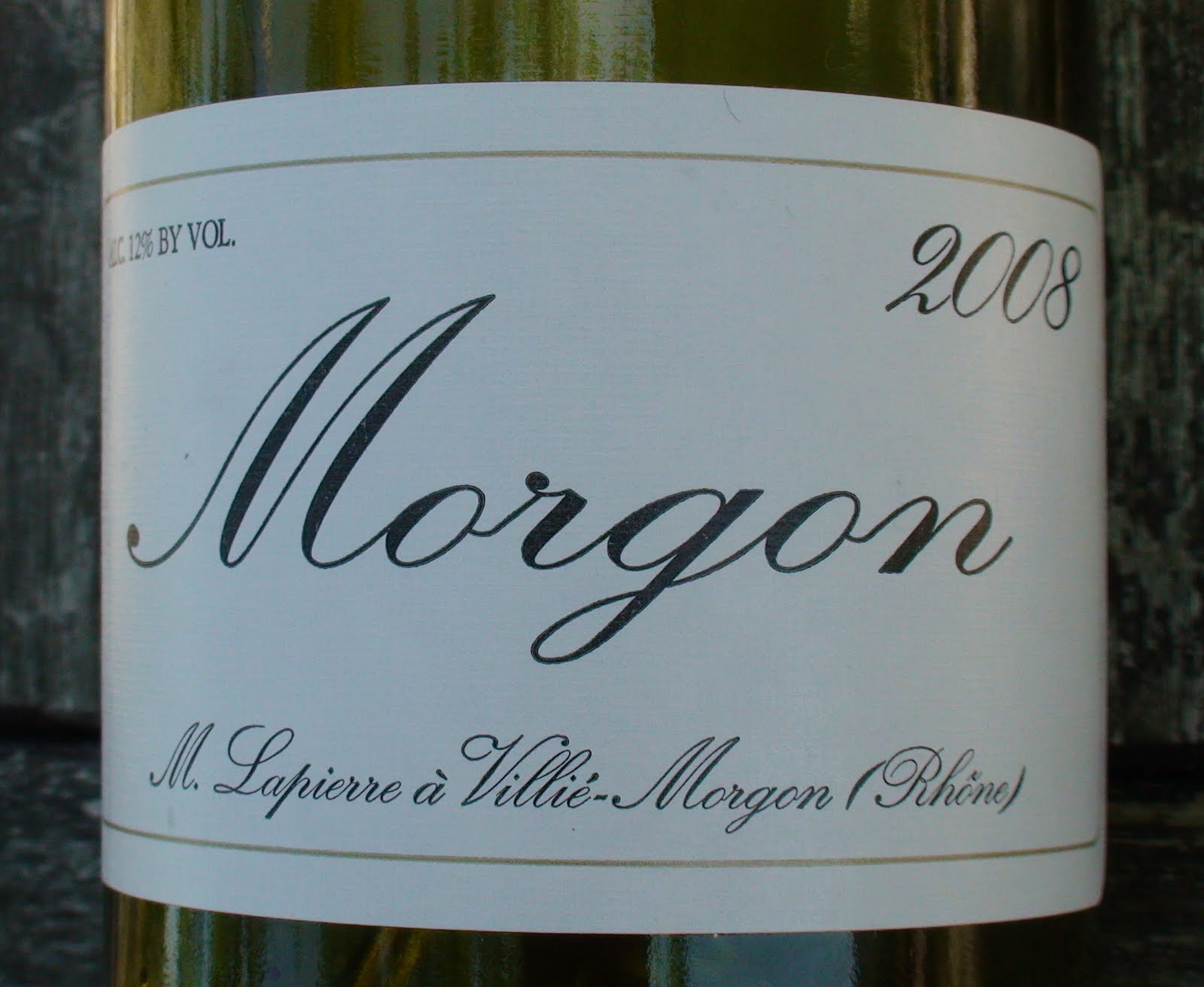
2008 Marcel Lapierre Morgon, $20, Kermit Lynch Wine Merchant. Sigh of relief. This wine was great. And I was starting to lose a little faith, as my 06's haven't shown so well and I had two bad bottles of the 07 for every okay one. But this, this is why I love Lapierre's wines. Graceful and with crystal clear purity, perfectly balanced, just gorgeous wine. The next two bottles could be bad - who knows? But if this is representative of his 08's, then I'm back on the wagon. Mine is from an "S" lot, which I understand to mean that it had a bit of sulfur at bottling. I've read comments on the interweb about variation again in 2008, but specifically with the "N" lots - no sulfur as I understand it. Chime in with your 08 Lapierre thoughts, please.

2008 Jean Foillard Morgon Cuvée Corcelette, $34, Kermit Lynch Wine Merchant. I love this wine in general, and this bottle was good, but it didn't show nearly as well as a bottle I drank a few months ago. The nose is full of fresh fruit and leafy herbs, but the palate is in a tight place right now. It felt constrained and rigid, with a lot of iron and mineral and lots of grip. I'm sure it will loosen up again in a few years.

2007 George Descombes Morgon, $20, Louis/Dressner Selections. I keep hearing about how great this wine is drinking right now, but I wasn't terribly impressed. I like it, but I wanted to love it, the way I love the 2007 Régnié. I prefer the Régnié in the end. The Morgon is very pure and there are minerals and soil, there is iron on the palate, and herbs too. What there isn't a lot of is fruit. There is some, but not a whole lot, and I'm fine with that actually. But the nose is a bit muddy - the overall effect is not as fresh as I would hope for and that kind of killed it for me. That said, I did drink this on a root day...

2009 Bernard Baudry Chinon Rosé, $18, Louis/Dressner Selections. A different animal entirely compared to the 2008. Whereas the 08 was a lean and super acidic kind of beautiful, the 2009 is much more fruit forward. This is a fun wine - there are strawberries here. Still a serious wine with great texture and balance and lots of acidity, but it is a more openly joyous wine this year, with more exuberant fruit. On a hedonistic note I'll take this wine. If I were showing Baudry's Rosé to other people who had never had it, or if I were cellaring some for the future, I'd take the 2008.

2009 Ameztoi Getariako Txakolina Rubentis, $21, De Maison Selections. Those of you who aren't familiar with this culty Basque wine might be thinking "Watch your language, fella." This is a well regarded producer working with approximately 85 year old vines of an indigenous grape called Hondarrabi Zuri. The white wines are fantastic - saline and brisk, slightly effervescent, full of character. I had one recently at my pal Bruce's house and it really sang. This wine, however, left me wanting more. I understand its appeal - the nose grows but never gets loud, and it shows this unusual and appealing mix of watermelon and savory herbs, like rosemary and thyme. And texturally it is a marvel, slightly effervescent and silky. The alcohol is under 11%, the wine is dry and full of minerals and it is definitely interesting. But in the end I just wasn't really captivated by it - it wasn't all that delicious.

2007 Domaine de Roally Viré-Clessé Tradition, $24, Louuis/Dressner Selections. This was a shimmering beauty, full of fresh and baked yellow apples. Fresh, energetic, a rich wine that is also very pure and just lovely. Good acidity and balance too - wears its residual sugar well. The remaining third of the bottle was not as good on day two though, which I found confusing. Shouldn't this wine age well? I drank a 1994 last year that was fantastic.

NV Valdespino Sherry Fino "Inocente," $20 (375 ml), Imported by Quality Wines of Spain. Now THAT is some Fino. I know the price sounds high, but I could find only one store that carries the wine, so they can charge what they like. So light and brisk, yet there is a pungent undercurrent of smokey nuts and saltiness, something almost like good coffee - it builds slowly and steadily and this one is better to sip slowly because there's a lot going on. But that's hard to do because it offers so much visceral pleasure. It was at its best on the third day out of the fridge, and it could have kept going, but I finished the bottle. This is in the very top level of Fino that I've tasted, right there with La Bota #15. And I guess that shouldn't be a surprise, because if I'm not mistaken, Equipo Vavazos selected from among the Valdespino butts to make #15. I could very easily be mistaken...

2002 Chartogne-Taillet Champagne Cuvee Fiacre, $70, Terry Theise Selections/Michael Skurnik Imports. I bought this wine because I like the producer's wines in general, and because when I tasted it as part of a blind tasting a few years back, I thought it was superb. Haven't had it since. I was warned that it is too young to drink, don't touch it for ten years. I don't know...I opened one recently at the end of a great night of wine with friends, and I thought the bottle was fantastic. Not closed at all, very approachable. Beautiful ripe fruit that showed the dark berries of Pinot and also the apples of Chardonnay, compelling richness and depth, a stout frame and firm structure. And still this wine showed grace and poise, harmony. I loved the way the minerals mingled with the fruit on the finish, very long. This is very serious stuff, worth every penny.

Okay folks, that's it. Thanks for coming out tonight. I'm here two or three times a week.

Sunday, September 20, 2009

NV Champagne from '05 and '06 - Thoughts on the Terry Theise Champagne Tasting

I went to the big Michael Skurnik / Terry Theise tasting last week, the only tasting in NYC where one can gaze upon Robert De Niro's father while sampling wine. I arrived quite late and had nowhere near enough time to taste everything. So I focused instead on the producers I like the most, trying to get to know the new versions of their wines.

Many of the non-vintage Champagnes are based on 2005 grapes, a very ripe year, as it was in most of the wine making world. Peter Liem of ChampagneGuide.net said that at one time he thought 2005 juice will make for very good non-vintage wines, in general. Now he's not so sure, as some wines are showing overripe flavors. There were also plenty of NV wines based on 2006 grapes, another very warm vintage, but with a cool and wet August that perhaps allows the finished wines to show better balance and freshness than the 2005's. Where am I getting all of this Champagne vintage and climate information from?

Please let me interrupt this post to tell you something very important: Peter has added new features to what is already the best online Champagne guide - there is now a 'vintages' section that provides detailed info on Champagne vintages, an 'articles' section where he will publish a feature length article every month, and most excitingly, for me anyway, a blog. Peter hasn't been writing about Champagne anymore on Besotted Ramblings, but he's blogging again on his new site and the posts are as fun, interesting, and chock full of insider's information as you would expect.

Sorry, back to the Theise Champagne Tasting. After the tasting it was interesting to compare my notes on wines based on '05 to those based on '06. Here is what I found:

The Gaston Chiquet NV Brut Tradition was based on 2005 (80%) and was very nice wine, although it did not seem to have the energy that I remember it having. Plenty of ripe dark fruit, but this wine is 45% Meunier and it felt a bit too spread out, its frame too malleable. The Chartogne-Taillet NV Brut Cuvée St Anne was based on 2005 (80%) and for the first time ever, I was not terribly impressed with the wine. I liked the nose a lot, with its flowers, ripe fruit, and chalky earth. But the palate felt a bit clunky, without the focus and clarity that I am used to.

The Pierre Gimonnet Brut NV 1er Cru Blanc de Blancs was better than I remember though, with a delicately focused nose of flowers and chalk. It felt both lacy and ample on the palate, and although I don't have terribly high expectations for this particular wine, I really liked this version. It was based on 2006 grapes, as it turned out. The other NV Blanc de Blancs that I liked a lot was the Pehu-Simonet NV Blanc de Blancs, this version almost entirely 2006 (90%). The nose was just gorgeous, with salty white flowers, very gentle, and the grapes are all from Mesnil, as with a famous Champagne you may have heard of, called Salon. The Lallement NV Brut smelled great, with clean dark fruit and a brooding earthiness, and it tasted great too, very well balanced. It is 80% 2006 grapes.

The interesting thing is, my favorites turned out to be more of a combination of 2006 and 2005 grapes. The René Geoffroy Brut NV Expression is always one of my favorite NV wines. This version is 65% 2006 and 35% 2005 grapes, and although it is more overtly fruity than in the recent past, I thought it was complex, well balanced, and just lovely. And the Henri Billiot NV Brut Reserve is 50% 2006, 25%2005, and 25% 2004, and it was delicious, open and inviting with ripe dark fruit and great energy. This wine always improves dramatically with a year or so of bottle age, and I'm curious to see what will happen with this particular version. Perhaps the folks in Champagne were onto something, with all of this blending.

Friday, October 31, 2008

Friday Night Bubbles

NV Chartogne-Taillet Cuvée Sainte-Anne Brut, $36, Terry Theise Selections/Michael Skurnik Imports. First of all, the $36 price tag is today's price, this is what you'll see the wine selling for right now. And that's pretty great, considering most $36 Champagne a year ago now costs $44 or more. For whatever reason, this excellent non-vintage wine is still in the mid $30's and although it's an excellent wine, it's also a great value.

This is the April, 2008 disgorgement and it is based mostly on 2004 grapes with 20% from 2002. The blend is 50% Pinot Noir, 40% Chardonnay, and 10% Meunier. It is interesting to note that the Meunier in this wine is from non-grafted pre-phylloxera vines.

I've always like this wine and this is the best version I've tasted. It is a classic, a caricature of what good Champagne should be. Overtly fruity and joyous, and with real depth and character to the nose, and a lively and round feeling in the mouth. Good acidity and a chalky and floral fragrance on the finish. Totally accessible and delicious wine. This is the bottle to open for someone who thinks they don't like Champagne.

The Chartogne-Taillet estate is located in the village of Merfy, to the northwest of Reims. Peter Liem's June post on the 1999 vintage wine describes Merfy and the vineyard soils in good detail, and explains why this wine might be a bit different in character from many others in the Montagne de Reims.

There are 6 wines that I know of in the Chartogne-Taillet portfolio: this non-vintage Brut, a Brut Rosé, a Blanc de Blancs, a demi-sec, a vintage wine, and the tête de cuvée called Cuvée Fiacre. I've drank the 1996 and the 1999 vintages, and both were excellent wines. I tasted the 2000 a few months ago and loved it, although I haven't yet seen it on shelves. The vintage wines will be more expensive now - I bought the 1999 for $55 a year ago, which seems cheap now. I've never seen the Fiacre on shelves, which is a shame. It is a Chardonnay dominant wine from the estate's oldest vines, and it's a coeur de cuvée, the best part, or heart of the juice, without the first or last several hundred liters of the pressing. This concept is better described by, again, Peter Liem in his post discussing the wines of Vilmart:

"...a special selection of the very heart of the cuvée—in Champagne, a 4,000 kilogram pressing yields 2,050 liters of juice in the cuvée, and Champs selects only the finest 800 liters from the middle of the pressing to make the Coeur de Cuvée. (Although not an exact comparison, think about the heads and the tails in the distilling of spirits.)"
Happily, Chartogne-Taillet's Cuvée Fiacre is not prohibitively expensive - maybe $75 a bottle. Yes, that's a lot of money, but like the Cuvée Sainte-Anne Brut that is the subject of this post, it is one of the better wines of it's class, and also the among the least expensive.

Sunday, October 26, 2008

Terry Theise Tasting Notes

What's the right thing to do at an enormous industry wine tasting? Do you try to taste every wine being poured? Do you find some way of narrowing the field, and taste only a subset of the wines? The answer is personal, I suppose. I used to try to taste everything but in the end I learned less that way, and did not really enjoy myself. Nowadays I try to figure out what I most want to taste before I get there.

I was invited to both the Terry Theise Selections/Skurnik Champagne Portfolio Tasting and the Louis/Dressner Selections tastings last week, invitations that I am truly grateful for. The largest and arguably the finest portfolio of grower Champagnes in the US, and the largest and finest portfolio of natural wines from France and Italy - what a treat to participate.

Both tastings, however, took place on Tuesday October 21st from noon-4:00. Admit it - that just sucks. Thoughtfully tasting everything in the Terry Theise portfolio alone is challenging enough, but to do that and then find a way to do the same thing at the Dressner tasting...that's a tall order. Luckily I had my buddy and fellow blogger David McDuff as a partner in tasting.

I did a much better job at the Theise tasting simply because I went there first. I learned that if I had to pick one Champagne producer's lineup to take to a desert island, it would be that of René Geoffroy. From top to bottom, just amazing. I re-discovered Pierre Peters and Marc Hébrart. And best of all, I am beginning to put together an understanding of terroir in Champagne. Here are some of the wines that I would buy for myself (great wine, good value) from the Theise portfolio (prices are estimates):

NV Pierre Peters Cuvée Réserve Blanc de Blancs Brut, $50. My favorite on this day of the non-vintage Côte des Blancs wines.

NV Marc Hebrart Sélection Brut, $50. Deep rich perfume, just gorgeous. 65% Pinot Noir and 35% Chardonnay. Complex, delicious, and balanced. I never see this in stores though...

NV René Geoffroy Expression Brut, $50. Heavy in the Meunier, and one of my favorite non-vintage wines of the whole portfolio. If you're skeptical of this whole grower Champagne thing, and you buy only one wine from this portfolio, try this one.
NV René Geoffroy Empreinte Brut, $60. This one is 82% Pinot Noir and it's gorgeous. Again, I've never seen it retail. Not in New York, nowhere. Please, someone...buy this wine so I can buy it.
NV René Geoffroy Cuvee Volupté Brut, $80. For the first time (I think) this is a Blanc de Blancs. It's all 2004, although it's not a vintage wine. It's a baby and it's very delicate, but it's already got a well defined and muscular physique. This will be a knockout in a few years.
2000 René Geoffroy Brut, $125. I didn't say that I'd be happy about spending the money, I just said that I would buy these wines myself. And since I buy maybe two wines at this price each year, this is a serious comment on the quality I saw in this wine at this price. This wine has no sugar in the dosage, but you might not guess that when drinking it. What a thing of beauty! It is full and deep and rich and delicate and a full-on sensory experience. If you have the money and the inclination, this is not to be missed. Will someone carry it in their store, though?
1995 René Geoffroy Cuvée de René Geoffroy Brut, $300 (magnum). Truffles and strawberries. This was the wine of the tasting for me, and although I cannot spend my own (and my wife's) $300 on a magnum, I'm hoping that the gods of wine will somehow allow me to taste this again someday.

NV Gaston Chiquet Tradition Brut, $45. Also heavy on the Meunier, and another favorite non-vintage wine. I haven't always loved this wine, but on this day it was great.

NV Margaine Brut Rosé, $55. Refined and delicate, yet bold and lovely fruit. Delicious.
2000 Margaine Special Club Blanc de Blancs Brut, $75 (but this price could be totally wrong - the book is missing information). Gorgeous mature nose of nuts and minerals, very rich.

2002 Henri Billiot Brut, $75. Just gorgeous 80% Pinot Noir deliciousness. So deep fruited and satisfying. And a keeper too - this has a long life ahead of it.

NV Lallement Brut, $55, Intense spicy fruit with a steely mineral backbone. Powerful but also delicate somehow in its purity.

NV Chartogne Taillet Cuvée Sainte Anne Brut, $45. Bring this to someone who thinks they don't like Champagne. It's a classic, well balanced, fragrant, deeply fruited wine, and delicious wine. And I've seen it, the same disorgement as in the tasting, based on 2004, with the new label, for as little as $36.
2000 Chartogne Taillet Brut, $65. Bold and rich, with a spicy depth. This is big wine, but it's well balanced and gentle.
2002 Chartogne Taillet Cuvee Fiacre Brut, $75. From their oldest vines, this wine is refined and elegant, and still pretty closed. The 2000 Fiacre that I tasted in September was much more approachable. But this will be a beauty in a few years, I suspect.

Dressner notes coming soon...