Showing posts with label Schloss Gobelsburg. Show all posts

Saturday, May 19, 2012

La Paulée de...Austria !

About 50 or 60 wine lovers came together to celebrate Austrian wine the other night at Seasonal Restaurant in midtown Manhattan. Stephen Bitterolf, the Wine Director at Crush, conceived of this event with an eye towards the famous La Paulée Burgundy dinners where everyone competes to bring the finest bottles and people walk from table to table tasting each others' wines. That's right - Austrian wine, La Paulée style.

It takes big bottles to put together the La Paulée of Austrian wine, and Stephen Bitterolf has them.

This was an incredible opportunity to drink so many of Austria's greatest wines. Okay, you don't spend an evening with a wine watching it unfold, and for me that's the road to understanding. But I've had barely more than a handful of mature bottles, and still haven't tasted some of the best sites and producers, and this was a great way to delve in a bit further.

Importer Carlo Huber and Seasonal Executive Chef Wolfgang Ban.

I could be wrong in saying this, but I think that Austrian wine is not something that most people understand, even in the wine-loving community. Stephen Bitterolf is a passionate believer in Austrian wine and has for a long time carried a wide selection at Crush, where Joe Salamone and others who work there also believe in the wines. And yes, there are serious collectors in the NYC area who have old bottles stored in their cellars.

Robert Dentice, a huge collector of Austrian wine, and his partner Renee Patronik. 

But I see German wines far more often at restaurants and when friends get together. Maybe this is because most Austrian wine is sold in Austria - the wines sell easily, right there at home. Maybe it's because the modern wines are dry, and a lot of Riesling lovers talk about how they prefer their wines to have a bit of residual sugar. It can't be the prices, because it's possible to buy some of the greatest Austrian wines for the price of a villages Burgundy. Whatever the reason, the wines are not as mainstream as they should be based on quality, price, and deliciousness.

Ray Isle of Food and Wine, and Joe Salamone of Crush, both enjoying Austrian wine.

So it was a great evening for Austrian wine lovers, and also an opportunity for some of the great Austrian wines to get some much-deserved attention in NYC. This is why several producers donated rare large-format bottles for the event, and why the Austrian Wine Marketing Board was so helpful in getting those wines quickly to NYC for the dinner. This is why Executive Chef Wolfgang Ban closed Seasonal and used the whole space for the event, and charged only $90 all-in for a fine 4-course meal (full disclosure - I was comped a ticket by Crush because they apparently have mistaken me for a wine writer).
Allan Roth and Gene Vilensky, a couple of guys who love Austrian Riesling. Don't let the wood-framed glasses fool you - they are not Williamsburg hipsters. Allan is in education and Gene is a mathematician. Regular folks like them love Austrian wine too.

It was an embarrassment of riches - the wines were great. Not every wine, but I was seriously impressed with so much of what I drank. Of the big name Wachau producers, Prager and Knoll seemed to be the most prevalent at this dinner. Most of the other big shots were there too - I saw bottles by Alzinger, FX Pichler, Hirtzberger, and Moric. I saw no Nikolaihof and no Rudi Pichler, which kind of surprised me. From the Kremstal I saw Brundlmayer and Schloss Gobelsburg, but no Hirsch or Nigl. And I don't think I saw anything from the Wagram, which makes sense on a night when people are bringing the fancy bottles. But there is plenty to love in the Wagram (I'm a little bit obsessed with Bernhard Ott right now, but that's another story).

Stephen hosted and spent the whole night pouring. I don't think he stopped to eat.

I didn't really take notes, but here are some of the wines that were memorable for me, in the order in which I tasted them:

1986 Alzinger Gruner Veltliner Mühlpoint Kabinett Trocken. A designation no longer used. A wonderful old nose.

2002 Bründlmayer Riesling Zobinger Heiligenstein Alte Reben. I've heard Heiligenstein described as the finest site in the Kremstal. This wine was in magnum format, and was beautiful in its lush fruit and its focused minerality.

1988 Alzinger Riesling Ried Loibenberg Kabinett Trocken. The wine was in excellent shape, despite the dodgy label. Complex, fresh, vibrant, a real treat and a great advertisement for storing these wines.

2000 Prager Riesling Smaragd Achleiten. I brought this wine and that's why I thought it was so interesting. But it was impressive in its balance and elegance, considering that it was a very hot vintage that in some cases produced some overly fleshy wines.
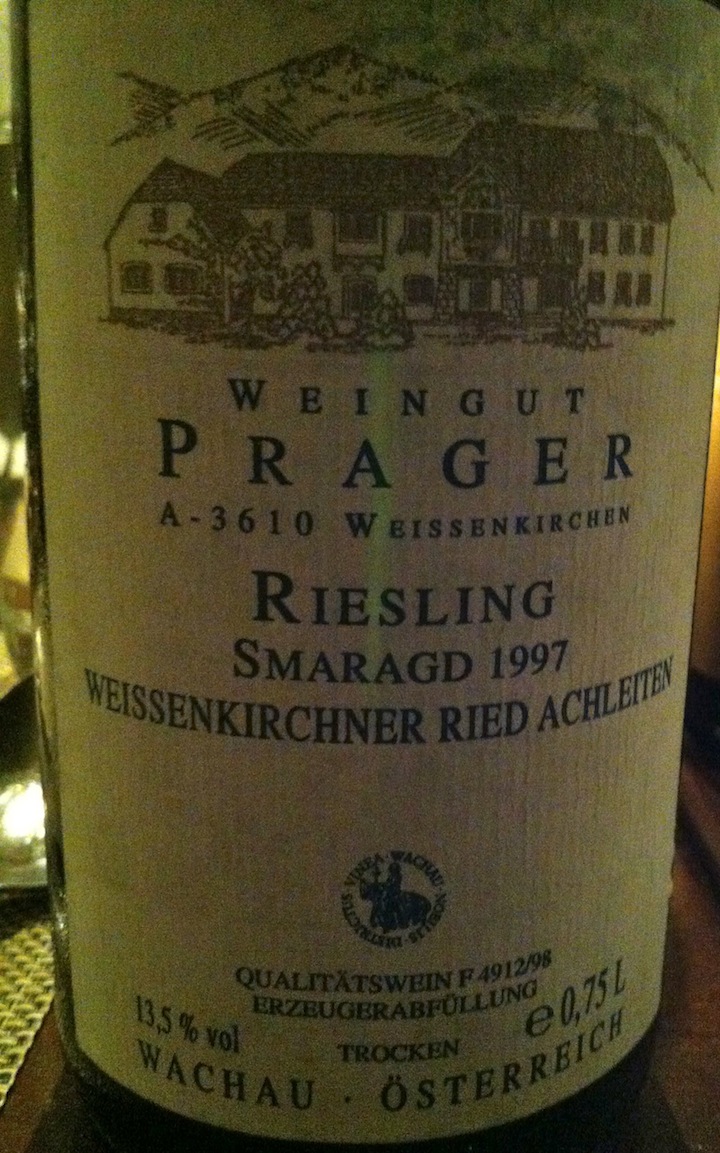
1997 Prager Riesling Smaragd Weissenkirchner Ried Achleiten. I don't know how (or if) Weissenkirchner Ried is different from the regular Prager Achleiten bottling. But this was as fine a wine as any that I tasted on this evening. Rocks, lemongrass, so subtle and wonderful.

2001 Prager Riesling Smaragd Klaus. Intense and very long, and shows how Klaus is so absolutely different in character from Achleiten. More lush in its fruit, more forward and generous.  

1997 FX Pichler Riesling Smaragd Kellerberg. Whoa, this wine floored me. Just beautiful wine, as fine as any on this evening, for me.

2002 Moric Blaufrankisch Lutzmannsburg Alte Reben. There were several Moric reds and for whatever reason, they didn't show as well as they might have. But this wine was great, so beautifully perfumed.

2001 Hirtzberger Riesling Smaragd Singerriedel. Intense and big, but harmonious. I loved this wine. I think I prefer the more gossamer style of Alzinger and Prager, but I love Hirtzberger's Singerriedel.

This was such a wonderful evening and I feel lucky to have been a part of it.

Wednesday, October 27, 2010

And on the 19th Day...

It had just become evening, time to stop working, time to get dinner ready for the kids, time to have a glass of wine. I opened the door to the wine fridge and started rummaging around - I was looking for Muscadet, Marc Ollivier's 2009 Clos des Briords, to be exact. And then I saw something I wasn't expecting to see, a bottle of 2009 Schloss Gobelsberg Kamptal Gruner Veltliner Gobelsburger, $14, Terry Theise Selections/Michael Skurnik Imports.

I thought I drank all of those. What a happy surprise - I love this wine and I decided to drink it immediately. But when I extracted it from the web of wine bottles, I saw that it was only about a third full. I must have started drinking it, put it back in the fridge, and forgotten about it. CellarTracker tells me that the last time I opened a bottle of this wine was...19 days ago. Could it still be drinkable?

Let me first tell you about drinking this wine under normal circumstances. You could say that it is Schloss Gobelsburger's entry level wine, a Gruner made from purchased grapes (as I learned from reader Yule's comment on a previous post). It is a delicious wine that is unmistakably Austrian Gruner Veltliner. Classic scents of lemongrass and sour cream, great balance and texture, and impressive length and complexity, never mind that it retails for under $15. I went through quite a bit of it in the late summer, and although it is immediately pleasing, it was always better on the second day. The wine becomes more detailed and there is a slightly peppery edge to the nose. It's simply a lovely wine, and a great value.

But could it still be good after 18 days open?

You've probably guessed by now that the wine was great, and it was. Can you believe it - 18 days in and the wine was great. Honestly, not merely drinkable, but great. Better than on day 2. So expressive and finely tuned, good energy on the finish, more than one has a right to expect in a regional Gruner Veltliner. And there it was, day 19. How can such a thing be explained?

I don't have an answer for you. I can tell you that the wine is closed with a screw cap, and that wine maker Michael Moosbrugger has a great reputation. But I have nothing here, not even a guess as to how this little entry level wine shined 19 days in.

If you would like to share guesses or opinions, please do. Otherwise, it's just one more wine mystery.

Tuesday, July 27, 2010

My Favorite Rosé of the Summer?

I think I might have decided on my favorite rosé of the summer, so far. I'm not considering things like Tempier, Pradeaux, or the other Bandols. I think of those more as Bandol wines than as rosé anyway. But among the summer flood of generally inexpensive rosés - I think I've found a favorite.

I've always enjoyed white wines from Schloss Gobelsburg, but I'd never had the rosé until this summer. I'm not sure, but I think that 'Gobelsburger' is the second wine of Schloss Gobelsburg. This wine's name recalls the monks who managed the winery until 1995, and it is made from Zweigelt and St. Laurent grapes. It should cost about $15 and honestly it's great rosé, case-worthy, in my opinion.

2009 Gobelsburger Rosé Cistercien, $14, Terry Theise Selections / Michael Skurnik Imports. This is not a fruity rosé, so let's just get that out of the way first. There is fruit in this wine, but it shows up on the finish in a controlled little burst of red. The main body of the wine is more about the steely and sleek tone, the acidity and focus, and the aromas and flavors are more mineral than fruit. This wine reminds me very much of the 2008 Bernard Baudry Chinon Rosé in that it drinks more like a white wine than like a rosé. It is bottled under screw cap and a bit reductive at first, so open it 15 minutes before you want to drink it or just give it a vigorous swirl in the glass.

I love how versatile this wine is with food. Unlike rosés that are on the fruitier side (which I also love), this wine can elevate foods that are complex and to me anyway, not always easy to pair. For example, I never know what to drink with pesto.

Although in some ways they are polar opposites, the wine was great with this classic dish. Intensely herbal anise-tinged notes from the basil, umami from Parmesan cheese, savory walnuts...would that work with rosé? Yes, when it is a steely high acid and very pure wine. I'm telling you, when you deal with your summer basil, think of this wine.

On another evening, I knew that I wanted to drink this wine before deciding what to eat. Drinking this rosé, I can detect traces of that sour cream, white pepper thing that I often get from the Gruner Veltliners, and so I decided to try to eat something that would go well with Gruner.

I thinly sliced a smoked duck breast and roasted some small white turnips and pink radishes. There is nothing Austrian about Fregola, the Sardinian pasta balls made from coarse semolina that are toasted after being dried. But I like the way the nutty tasting Fregola absorb simple flavors like butter and white pepper, and so that was it. This pairing was more about synergy - the flavors of the wine seemed to recognize the smoked duck and the radishes, to understand that white pepper is friendly.

I hate the idea that $15 wines, particularly rosés, are not serious wines. This is a serious wine, and unless you clean the racks I will be drinking a lot of it this summer.