Thursday, February 28, 2013

Comfort Food

You've noticed that I've been busy lately, sorry to drop out like that. Lots of work and some work travel, and things just pile up.

I'm trying to get better about work travel, as it has become an inescapable fact of life for me, and it seems like it will get worse before it gets better. There are a few simple things I'm trying to do now that make it easier.

1) Travel light - sounds obvious, but I've begun taking it to the extreme. I pack almost nothing, try to fit whatever I need into a large laptop shoulder bag. Yup, I'm that guy with underwear in his computer bag. I cannot bring myself to wear lace-less shoes, and it's not for lack of trying. They just look so dorky on me.

2) Leave the house clean - coming home to a clean house just feels better.

3) Leave something easy and comforting in the fridge to cook when I get home. It cam be tempting to go out to eat after work travel because it's easy, but it's so much nicer to put on some music and make something at home, and to open a pleasing bottle.

Upon returning from a recent work trip I made the simplest of comforting meals - steak and mashed, and a salad. I feel like people think there's some sort of trick to making good mashed potatoes, and I just don't see it. Why is this tricky? I peel and coarsely chop a couple of russets (they cook quickly and have the right texture when mashed), put them in a pot of salted water, bring to a boil, reduce to a simmer, and test them until they give easily to a fork. Then it's through the potato ricer, and here is where the magic happens. The still hot but now ground potatoes are begging for seasoning, and they will readily accept whatever you give them. I keep it simple, with a glug or two of buttermilk, a pat or two of butter, a shake or two of salt, and a grind or three of black pepper. Honestly, it's hard to argue with the results.

Although I am still a believe in this method of cooking steak, the just-returned-from-work-travel mood doesn't allow for 25 minutes in the oven. I just pan fried this baby, let it rest, sliced it thick, whisked a little sherry vinegar and soy sauce into the pan juices, and went to town.

This has got to be one of the easiest dishes as far as wine pairing goes, it's hard to go wrong. This was comfort food night for me, after work travel. I wanted something familiar that would offer a pure form of pleasure.

The problem is, the wine just wasn't very satisfying. I drank the 2007 Coudert Fleurie Cuvée Tardive on only one other occasion, about 5 years ago at a friend's house. I remember thinking that it was entirely closed aromatically and on the palate, which is to be expected at that stage (and perhaps still now), but I also remember thinking that the wine just didn't feel right.  It had a murky quality, a lack of clarity that bothered me. But this is 5 years later and 2007 shouldn't be the type of vintage that requires a million years to reveal its charms. Shouldn't this be approaching drinkability now?

Who knows? The wine was still tight as a drum aromatically and on the palate - I mean nothing doing. Dark, dark, dark, and impenetrable. And then three hours later, the sun shone in and the veil lifted, and the wine showed lovely fruit and a nice clarity of flavor. Okay, I thought, this wine is just too young. And it probably is too young to drink now. But it never really stayed clear and bright - the darkness returned, especially on days 2 and 3, and by day 3 it seemed to be going downhill.

I am not familiar with the aging curve of Cuvée Tardive, and maybe I made a classic mistake in opening the bottle at this age. But I also think that the wine has a murky quality, a blurriness to the flavors that isn't terribly appealing. It's hard to accept that from a producer that I know and love - could it really be a not-so -great wine in 2007?

No matter. My dinner was comforting, and even though I didn't love the wine, it was comforting too. A familiar drink can be comforting even when it's not as delicious as it usually is.

Wednesday, February 13, 2013

Japanese-style Food, and Fino Sherry

I've been trying to cook Japanese food lately, and I've succeeded in cooking Japanese-style food. It's amazing how far you can get with a couple of miso pastes, some kombu (dried kelp) and dried shaved bonito flakes, some mirin and shoyu.

Here is one recipe that my daughters and I have been enjoying - Japanese-style stew with beef and potatoes. Disarmingly simple, and very satisfying, especially in this cold weather. You are essentially braising beef and potatoes in a mixture of Japanese sweet rice wine and shoyu. Here's what you do:

1) Watch the Shogun miniseries in it's entirety. This is 10 hours of your life well spent. And it gets you into the right frame of mind, as a foreigner attempting to do something Japanese.
2) Slice against the grain 1 pound of flank steak (but you can use other similar cuts) into pieces 1 inch thick, but leaving them the width of the steak. Brown the meat and remove from the pot.
3) Cut a large onion in half and slice it with the grain into long thin strips.
4) Peel two russet potatoes and cut them into chunky half moons, chunky enough to hold together in a braise. 
5) Peel a decent sized knob of very fresh ginger and grate it finely.
6) Mix together a quarter cup of good quality mirin with a quarter cup good quality shoyu, and 1 cup of good quality hand-poured water. This is the ratio that I like, but you can add more shoyu or mirin - they are strong flavors though and this combination is nicely balanced.
7) Saute the onions in the beefy pot, but don't brown them. After they have cooked for a few minutes, add the ginger and mix well.
8) Add the braising liquid and bring to a simmer.
9) Add the beef and the potatoes, bring to a boil and immediately turn down the heat to a simmer.
10) Cover with a Japanese drop-lid, or if like me, you don't have one, cover the pot with a damp piece of parchment paper and a tight-fitting lid. Every 15 minutes or so move the stew around the pot to make sure that all the meat and potatoes have a turn being submerged.
11) When the meat is very tender, maybe 90 minutes, turn off the heat and let the whole thing rest for 10 minutes or so.
12) Top with scallions and serve over rice.

Would it surprise you if I tell you that this dish is fantastic with Fino Sherry? A lot of Japanese food is great with Fino Sherry. There is the umami factor - Japanese home cooking and Sherry both have it, and they compliment and elevate each other tremendously. But it's more than that. As I understand it, one of the ideas in Japanese cooking is to bring out the essence of the ingredient, to accentuate the beef's beefiness, or the radish's radishiness, if you will. Fino Sherry, with its very pure chalky saline and savory flavors somehow enhances the purity of the flavors in Japanese dishes.

One night I drank Emilio Hidalgo's beautiful Fino called La Panesa with this dish, and I swear to you it was as good a pairing as any I've had in a very long time.
On another evening I made a simple Savoy cabbage, daikon radish, and pork dish, simmered again in a light mixture of mirin, shoyu, and water. First of all, this is seriously delicious. My young daughters were happily eating Savoy cabbage, that's how good it was. There was half a bottle of La Panesa leftover, and surprise surprise, it was a wonderful pairing.

Tonight I made tofu with snap peas, carrots, and onions simmered in a mixture of red and light miso pastes, mirin, and water. Again, the daughters lapped it up - these girls like the savory.

And I drank the old reliable Valdespino Inocente, a spirited little half-bottle. I'm telling you, if you're into Sherry and you haven't tried it with Japanese (or Japanese-style) food, you really should.

One day I will learn to make oden like this. Probably not, actually. But at least I had the sense at this restaurant to pair it with the very grand La Bota de Manzanilla No 22. As Morgan Freeman said at the beginning of the movie Se7en, "This isn't over - there are going to be more of these."

Friday, February 08, 2013

I Might be Corked

I'm stuck in the middle of a tough streak right now, friends. Be very careful sharing your good wine with me, as since early January there have been some incredible disappointments. Lately, every bottle that should be great is corked or flawed in some other way. It's starting to spread now to the daily bottles too, which is alarming.

It began with a bottle of 1988 Drouhin Musigny at the annual Burgundy Wine Club dinner in early January. Should have been a brilliant bottle, but it smelled and tasted like roasted peat.

This established the tone for the next month. I opened a bottle of 2006 Marquis D'Angerville Volnay 1er Cru Les Fremiets one night and it was corked. That teasing kind of corked, too, where you keep drinking it because you haven't had the wine before and it's not the stinky vicious kind of corked. It was the kind that wisps in and out in a subtle way, gradually building, until eventually it can no longer be denied.

And then this majestic bottle was corked. Again, it wasn't immediately clear (except to one very experienced drinker). Everyone agreed that something was wrong with the wine, but we all fought as hard as we could to deny reality, for obvious reasons. Seriously, this is tragic, isn't it? When am I ever going to drink 1989 Gentaz again?

Then one evening last week I decided to try the 2011 Domaine de la Pépière Muscadet Clos des Briords, always exciting to try the new vintage. Corked. Not hard to replace, but still frustrating.

Then on Friday last week my good friend brought a special bottle to my house for dinner, a bottle he bought a year or so ago at my encouragement. 1987 Domaine Terrebrune Bandol, which I've actually tasted before and I'm a sucker for Bandol from those years, when the wines were less bombastic and lower in alcohol (although this one was 13.5%). The problem was, the wine was corked. And in that especially annoying subtle way that took us 30 agonizing minutes to recognize. Was it taking its time opening up, was it a little heat damaged (yes), was it corked, why was it so muted and weird...because it was corked.

And on Super Bowl Sunday my good pal very generously opened a great bottle to share, the 1998 Giacosa Barbaresco Rabaja. The Bud Light ads were tempting, but this wine had us way more excited. He decanted it for a while and we were ready to go, but the wine was heat damaged. We drank some anyway because it was possible to see the potential of the wine underneath, but I could tell he was frustrated, and I didn't have the heart to tell him that these days, I bring this plague with me wherever I go.

My friend Peter said to me recently, joking around, but not entirely, that no where else would consumers allow this sort of failure rate in the products we buy. "Imagine buying a new car," he said, "turning the key and finding that it doesn't go. And then the salesman smiles sadly and says 'Yeah, sorry, that one doesn't go, that happens sometimes and you'll have to live with it.'"

Okay, a new car is a bit more expensive (unless we're talking about corked Jayer or DRC). But his point is interesting. Why have we accepted the fact that 1 of 8 or 9 bottles of wine is corked? We are told that we have to accept this, that it's part of the game. Maybe so. It still stinks, and can be soul crushing if you've invested cellar time and/or a lot of money in the bottle.

My friend Lee Campbell who used to sell the Dressner portfolio of wines and now is the wine director at Reynards, among other things, once had me guffawing as we complained about corked wine. She said that she's convinced that lots of things can be corked. There is a small park near her house that she thinks is corked. Certain television shows are corked (I think she said that Glee is the most recent offender), a diner near her office is corked, North Korea is corked.

I am worried that I might be corked.

Monday, February 04, 2013

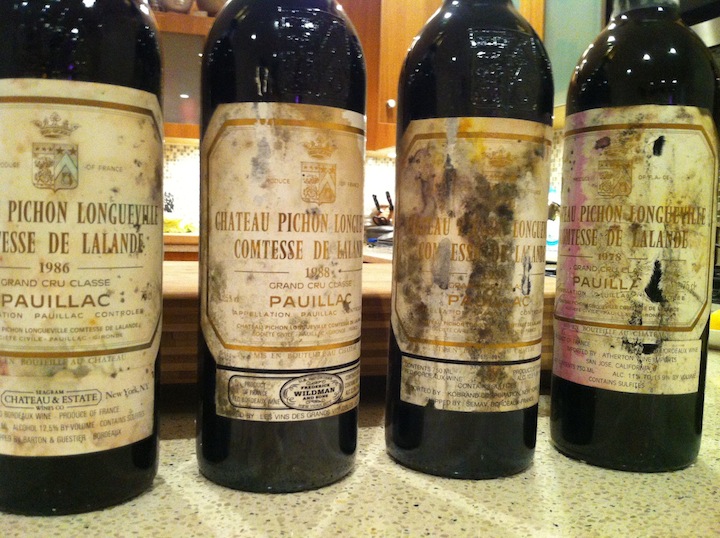
Drinking Four Wines by Château Pichon-Lalande

Not long ago I had the opportunity to drink four bottles of very fine Bordeaux, wines by Château Pichon-Lalande. A good friend was in NYC for the weekend and he brought these from his cellar - lucky me! I've had mature Bordeaux before but one bottle at a time, and quite infrequently. This may not surprise you, but I don't have any old Bordeaux in my cellar. Here's another thing that might surprise you - I truly wish that I did.

There are few wines that could be considered less hip and cutting edge than Bordeaux right now. And rightfully so, in a way. The modern wines tend to be over extracted fruit bombs with little to offer in the way of terroir articulation, never mind detail or elegance. They are big, artificially made wines, in most cases. And they are hugely successful, making tons of money for everyone involved.

But like most things that are classic, old Bordeaux is classic for a good reason. They are made from noble grapes and come from interesting terroir, and when well made they combine brawn with detail, complexity, and grace. Many wine lovers of my generation and younger may not have had a great old Bordeaux - it's not something that gets much attention anymore. I think that those of us who haven't had a great old Bordeaux are missing out, not only on beautiful experience, but also on a vital piece of wine appreciation and history. How can we even approach having an understanding of why wine is great without knowing what a grand old claret tastes like?

Pichon-Lalande is one of the top second growths, and comes from Pauillac, a terroir that apparently gives some of the brawnier wines of the region. You can almost see this in the color - look at that inky purple!

My friend generously brought wines from 1978, 1985, 1988, and 1989. Although the youngest was 23 years old, none can really be considered old by Bordeaux standards. My pal Peter says that you shouldn't bother opening good Bordeaux before it hits 20 years old, and that's probably just the beginning of its maturity.

I roasted a leg of lamb over potatoes, and we went to town. The wines were amazing, all four of them. They continued to evolve over many hours, and were delicious and deeply satisfying throughout. In general, I appreciated the raw power of the wines, and this was easy to do because they also showed such detail and complexity. There was power, but that was only part of the package. There was also balance - these were wines that showed lovely and refreshing acidity, and great complexity of aroma and flavor. Inspiring, really. Not in the way that I felt like going out and buying the current vintage, because as I understand it, the new wines will not become like these wines, even with 25 years in the cellar. They are made differently now. But inspiring nonetheless. If you have any old Bordeaux and you want some one to appreciate it with, I will make dinner.

The 1989 was a wonderful wine, Peter said that it was the grandest wine of the four, and that it had years, maybe decades of life in it. It was the most complete wine on the table, but I found it hard to compare the wine from 1989 to the wine from 1978 - I just don't know enough to be able to understand where the 1989 is in the context of the evolution of Bordeaux. Will it shed some weight and feel like the 1978 in 10 years? Will it always feel this full bodied, but become more gentle and mellow, and offer even more complexity with further maturity? I would guess, yes.

I found the 1978 to be the most rewarding on this evening, with its mellow and gentle nose of tobacco and leather, its complex and long cedary finish. It felt like being inside a log cabin in the woods. Still plenty of energy, an elegant structure, very long and plain and simple - absolutely delicious.

The 1985 was the most approachable right after we opened and decanted the bottles, and was perhaps the most fruit forward of the wines. I enjoyed it tremendously, but in the end we found the other vintages to be more compelling. The 1988 felt more mature than I might have expected, but in a good way, and showed ripe fruit that was thoroughly infused with earth. I loved this one in particular with the lamb, and it seemed to have a lot to offer even as we finished it. This one might, sneakily, be a wonderful wine.

There are plenty of reasons to ignore modern Bordeaux, I get it. The wines can be bombastic and overbearing, and the story of the Bordeaux region seems to be one of opulence and privilege, there is no struggle, no individuality. People in meticulously hip Brooklyn restaurants want to drink wines made without sulfur by scruffy guys or gals living in ramshackle trailers on lonely hillsides. Those wines have their place, I guess. But that's not Bordeaux.

But there is something to this, to old Bordeaux wine. Don't believe me? Get your hands on an old bottle by a good producer - you and three of your friends can do this and spend less than $50 per person. And really, this is history, and it's worth knowing for yourself.

Would you ignore The Police because Sting was kind of lame later in his career? Would you dismiss Woody Allen because Scoop kind of sucked? Are you not going to drink the one bottle of 1976 Lynch-Bages that Chambers Street is selling for $115 because 2010 Lynch-Bages costs $150 and will never be as good? Seriously, what kind of person are you, anyway?

Monday, January 28, 2013

An Unknown Wine from Piedmonte

The other evening I was at a friends house as our daughters played together. I accepted a last minute dinner invitation. My friend is from Piedmonte, from a small village called Briona in Valtelinna the Valesia region of the Colline Novaresi. This is the friend who helped me get started making my own pizza (something I continue to attempt, never terribly well).

She made pasta for dinner, a type I'd never seen before, calamari-shaped. When I asked what it was called I believe she actually said "calamari." She tossed them in Sicilian pistachio pesto and topped them with a generous helping of aged Parigiano. This was a very delicious dish, by the way.

While she was cooking she opened a bottle of red wine. The label said Fara - I had never heard of this. My friend told me the story of the wine. Her mother's cousin inherited some money from a distant relative, enough to leave her job as an accountant and to pursue a new life as a wine maker. She bought some vineyard land in her village. This is her fourth or fifth vintage, and my friend said that the previous wines were not so great, but this one, the 2009 Cantina Castaldi Fara, is good.

What a nice story! Many of us have imagined a world in which we leave our daily grind and become wine makers. Of course that's a different kind of daily grind, but why ruin the romance of the idea...

Anyway, we poured the wine and it was quite good - brightly fruited, snappy and refreshing with acidity, not terribly complex but aromatic and very lovely, and showing the structure that I suppose comes with the territory in Piedmonte.

"What grape is she using here," I asked.

"Hmmm, I don't know," my friend said. "She grows Nebbiolo, Barbera, and Uva Rara, maybe also Vespolina, but I don't know what is in here. Maybe it's Nebbiolo."

We chatted about our kids, about their schools, about upcoming travel, about new apartments, and NYC in the winter time. I had my nose in the glass and was trying to figure out what the wine was, but I'm painfully ignorant when it comes to Italian wine. "I think it cannot be Nebbiolo - it's too approachable," I said. "Barbera, maybe with some Nebbiolo in there too?"

My friend just smiled, and told me something about Sicilian pistachios, or maybe it was about how hard it is to get a good contractor for renovating an apartment.
The point is, I realized, it didn't matter. Sure, I was curious, and I'd still like to know. But my friend loves wine because she grew up with it (and Barolo was only for the most special of occasions, she says), and because she likes the taste with her meals. Is it Nebbiolo in this bottle, Barbera, Vespolina...it couldn't have mattered any less to her. What's important to her is the story of her grandfather's brother's daughter - her mother's cousin, and how she had this interesting life change. And my friend takes obvious pleasure in drinking this distant relative's wine. And she chose to share it with me, because she knows I love wine.

There are many ways to enjoy this very fine and fascinating thing that we all love. It's good to experience these different types of enjoyment, especially the ones we don't typically engage in. I cannot tell you the last time that I enjoyed a bottle of wine so much, having so little idea of what was inside.

Tuesday, January 22, 2013

Drinking an Aged Fino Sherry.

The other night I was lucky enough to drink a fino Sherry sourced from Bodegas Valdespino, one of the finest Sherry producers. There are two things that make this wine very special. Firstly, it was selected from special barrels within the Inocente solera by Jesús Barquín and Eduardo Ojeda, two-thirds of the team behind Equipo Navazos. And Ojeda is the capataz, or cellar master, at Valdespino (and La Guita), and so you have to figure that the two of them chose interesting and very fine barrels. Secondly, it was bottled in April of 2007.

This wine had an average age of something like 10-12 years when it was bottled, but now it has aged in Peter Liem's cellar since release - it's almost 5 years in bottle. The common wisdom about fino Sherry is that you drink it when it's young, before it looses its freshness. There are some fino Sherries that probably should be consumed pretty quickly after release - those that are bottled unfiltered, and that still have small bits of flor floating about. The presence of flor makes it possible for the wine to continue to develop, to change in some way, and producers typically urge us to drink these wines within 6 months. I've heard Antonio Flores of Barbadillo Gonzales Byass say this about his palmas, for example. I do not have any personal experience cellaring a wine like this, so I cannot agree or disagree.

Regarding high quality fino Sherry, however, wines that have been lightly filtered - the common wisdom is wrong. You've read this here before, I know. The more personal experience I gain drinking fino with bottle age, the more I am convinced that this is a wine I am just starting to get to know. Like any other fine wine, it has an essential character, but it evolves in the cellar and shows differently as it ages.

Equipo Navazos la Bota de Fino Nº 7 was a wonderful old bottle. It was Peter's very last one, and it was generous of him to share it over dinner at Aburiya Kinnosuke in midtown. And if you haven't yet had Sherry with Japanese izakaya-style food, you really should try it. The fino needed a little air but it opened up beautifully, and at this stage in its life showed rich and mouth-watering notes of butter and toffee, although I was able to sense the delicate sea-sat mineral undertone. Peter smiled when I told him this, and explained that La Bota Nº 2 (also a fino sourced from the Inocente Solera) and 7 are very different from the current release, Nº35. They were brawnier and bigger upon release - Jesus was interested in making a bigger wine back then, I guess. With time in the bottle, though, I experienced Nº 7 as a delicate wine. Rich, but delicate.

We drank this next to my last bottle of La Bota de Fino-Amontillado Nº 24, bottled in October of 2010. This is a fantastic wine, Peter calls it "probably the best PX ever made." I've been fortunate enough to drink a lot of this wine, and it has changed since it was first released. On this night it was bright, energetic, and focused, and entirely delicious. What shocked me was how young it seemed, next to Nº 7.

There is a lot of life in these wines, plenty of potential for development in the cellar. It is my goal to be better about actually saving a few bottles. It's hard though because the wines are so delicious from the very start. Note to self: get some fino self control.

Thursday, January 17, 2013

Burgundy Wine Club 2013 - Chevillon, Lignier, Montrachet, and Musigny!

I got into wine too late to be able to drink things like La Tâche, Chambertin, or Musigny. There was a time not too far back when a person could buy a bottle of wine like that and yes, it would cost a lot, but buying a bottle wouldn't necessitate changing the way you live. Now, a bottle of mature Chambertin by a top producer costs at least $1,000. La Tâche...fugedaboudit. But these are among Burgundy's greatest vineyards and they give wines that all of us would love to taste. How, in this day and age, can those of us who do not manage hedge funds experience these wines?

Burgundy Wine Club is the answer, my friends. Seven friends and I kick in a few hundred dollars every year, and by pooling our money we are able to buy expensive wines that none of us alone would purchase. Not only are we pooling our resources, we are also sharing the risk of flawed bottles.

I am graced with the task (joy is more like it) of choosing the wines, and the theme of our annual dinner. Last year we drank a lot of Pommard, which is now a curse word in my house. The year before that we focused mostly on Volnay. This year I was not as concerned with picking one theme, and instead focused on finding bottles that I really wanted to drink - things I'd never had before that would be accessible to me only via Burgundy Wine Club. So, we drank a bottle of Montrachet (!), several bottles by Robert Chevillon from the early '90's, some Lignier Clos de la Roche, and yes, we drank Musigny. Musigny!!!

Obviously there is visceral pleasure in drinking these wines, and in the act of getting together with good friends for this annual Big Night of Burgundy. I learn a tremendous amount too at these dinners, and this night especially so. I learned for myself why it is that Les Saint Georges is considered to be the finest terroir in the southern part of Nuits Saint Georges. I was reminded that Montrachet is great, but appreciated the way that some vintages give more of a thrill than others. I learned what Clos de la Roche tastes like, what it really tastes like. And I learned that Musigny, even from a poor vintage, is one of the true apexes of red wine.

We gathered at the bustling and energetic Manhattan hot spot The Breslin, where my friend Carla is the wine director, and she and her team were amazing. We opened the bottles as we sat down, poured the Montrachet, and mostly let it sit in the glass to open up over the course of the next few hours. We began with wines by the great master of Nuits Saint Georges, Robert Chevillon. Chevillon makes wines from 8 vineyards of 1er Cru standing: 4 in the northern and 4 in the southern part of Nuits Saint Georges. His wines are known for their transparency and terroir expression.

We drank only wines from the southern part of the village (the northern side continues up the hill to Vosne-Romanée), including the great vineyards of Les Saint Georges, Vaucrains, and Les Cailles. With onion soup laced with bone marrow we drank 1994 Les Vaucrains and 1994 Les Saint Georges. 1994 is thought of as a poor vintage, but these wines were terrific. Vaucrains was bright and energetic, and also showed a bit of a rustic side. It was balanced and long, and the fruit was still lively. Les Saint Georges was, even on the nose, immediately recognizable as the finer terroir, with greater depth and complexity, it was a more complete wine. I was thrilled by the way the wine combined density and power of flavor with a silky and graceful frame. One experienced drinker found the alcohol to be a bit intrusive at 13.5%, but still thought it was a great wine. Oddly enough, Vaucrains was the better pairing with the onion soup, meshing perfectly with its salty and savory flavors.  

With various savory vegetable plates we then drank 1992 Les Cailles and 1992 Les Saint Georges, and sadly, this wine was corked. I actually did not identify it as such, and neither did most of us. Some found it a bit musty, I found it simply to be not terribly complicated. An experienced drinker suggested it was corked and it made sense. Live and learn. Les Cailles however, was the prettiest of the Chevillon wines, with rose inflected red fruit that glowed with energy. Chevillon! These are wines that can still be purchased without liquidating my retirement account, and they are wonderful wines.

There are several great producers of Clos de La Roche, including Dujac, Rousseau, Ponsot, and Lignier. On this night we drank two bottles of Lignier Clos de la Roche, and both were great wines. I've read that Clos de la Roche gives one of the longest lived red wines in Burgundy, and that as per its name (roche = rock), the wines show pronounced minerality. The 1998 Clos de la Roche was superb, with intensely savory and smoky aromas and flavors that were completely shot through with stone. I loved this wine, and it's funny because it wasn't pretty or even very approachable, but it was detailed and intense, and I was assured by experienced drinkers at the table that this was quintessential Clos de la Roche. The 1995 was delicious, with more pronounced fruit and generally more approachable, but I found less complexity, less intensity of stone - less Clos de la Roche. I would love to drink the 1998 again in 10 years.

With a gorgeous set of homemade terrines and pâtés, we drank Musigny. First I should tell you that the 1988 Drouhin was drastically heat damaged and completely unsmellable, never mind undrinkable. This is a shame of epic proportions, but such is life. Thank goodness we were able to experience the 1986 JF Mugnier Musigny Vieilles Vignes, as wonderful of a red Burgundy wine as I've ever had. Another poor vintgage, and another great wine. If La Tâche is aromatic fireworks, if Clos de la Roche is rock, and if Chambertin is raw power, Musigny is complexity and grace, spherical like Montrachet. I'm not going to be able to describe the smells and flavors here, but I can tell you what it felt like to drink the wine. The nose undulated. I thought of a dimly lit room with a lush red velvet robe tossed haphazardly on a couch. So many aromas moving, and in all directions, always graceful. I must have smelled the wine for almost a half hour before taking a sip, and when I did I was shocked by the energy and power on the palate. The nose was glorious, but docile. The palate, anything but docile. This was a haunting wine, as thrilling to me as any red wine I can remember drinking. And I wasn't the only one - most of us at the table were fascinated with this wine and I saw people swaying as they smelled, as if praying at the Wailing Wall.

And to cap it all off, we drank Montrachet, the 1991 Marquis de Laguiche / Drouhin. Although this wine showed plenty of class and breed, I thought that it was not as great a wine as the only other two bottles of Montrachet I've had, same producer but 1989 and 1988 vintages. The 1991 was excellent but it showed a bit thick, with surprisingly sweet flavors, and without the focus I would have liked. An experienced drinker said that he detected some botrytis and this makes sense. Criticizing Montrachet is sort of like criticizing Mozart - who am I, really to say anything here. Just sharing my thoughts, that's all.

Another great Burgundy Wine Club night, and this time our wines showed very well, in general. I'm already thinking about themes for next year...