Showing posts with label Emilio Hidalgo. Show all posts

Tuesday, June 04, 2013

Gratuitous Seafood Shots

The fish people are back at my market after their winter vacation. Actually they've been back Since the beginning of April but I've only recently gotten into the swing of things. And now all of the sudden we are eating a lot of seafood in my house. Here are some recent favorites, and the wine pairings that love them:

I've been making fish soup for years, ever since I learned how easy it is to make fish stock. Type "fish soup" into the 'Search this Blog' box on the left sidebar and you'll see a load of posts that include my attempts at fish soup. Just made my first of the season and wound up going for a saffron, tomato, and chili flake version. Honestly, it was very good.

 One night I drank a Provence rose with this soup, always a winning pairing. Another time I opened a bottle of 2010 Domaine de Veilloux Cheveny Blanc. This is an absolutely lovely little Loire Valley wine that Mike Wheeler's MFW company imports, and I bought it for under $15. It's mostly Sauvignon Blanc with a little Menu Pineau in there too. I've liked everything I've had from the Loire Valley in the 2010 vintage, and this is no exception - it's crisp and fresh and quite energetic, with herbal and creamy flavors, and it's well balanced and complex on the finish. The acidity worked well with the rich and slightly spicy soup.

There hasn't been a lot of Mackerel this year, not that I've seen anyway. These pieces were so fresh and pretty that I merely dabbed them with a bit of miso and mirin glaze and put them under the broiler. At home I cannot reproduce the amazing golden char that Japanese restaurants are able to achieve, but mine are delicious nonetheless. Many white wines are delicious with broiled Mackerel but on this night I went with a chilled Poulsard, 2011 Tissot Poulsard Vieille Vignes, and the fish brought out the savory side of the wine, while at the same time the wine brought out the sweetness of the fresh fish.
Oysters are a pleasure that I haven't learned to love with the same gusto as some other folks. But maybe it turns out that it is the large east coast variety that I do not love so much. That said, I was in Martha's Vineyard recently with a good friend and he loves the locally farmed oysters. I must say that with a bracing glass of the beautiful Emilio Hidalgo Fino La Panesa, this was a lovely experience.

And bay scallops? SO delicious, and they require no cooking. If you trust your fish monger, (and why would they be your fish monger if you didn't trust them), just pop them in your mouth. Or, add a little bit of olive oil, sea salt, and lemon zest. We ate these while making dinner, while drinking the lovely NV Agrapart Brut Les 7 Crus Blanc de Blancs. This was such a great pairing! Okay, scallops and Champagne, not so hard. But Agrapart's style, even in this, the house's basic wine, is one of focus and finesse. There is nothing sticking out and the wine is quiet. It would not be understood in a large tasting, I imagine. But with bay scallops, whose delicate flavors I did not want to obscure in any way, this wine was perfect. And sitting there at the kitchen counter enjoying the subtle and chalky citric tones of the wine with a bay scallop or two...pas mal.

That's it, just a little gratuitous seafood. You know, to whet your appetite.

Wednesday, February 13, 2013

Japanese-style Food, and Fino Sherry

I've been trying to cook Japanese food lately, and I've succeeded in cooking Japanese-style food. It's amazing how far you can get with a couple of miso pastes, some kombu (dried kelp) and dried shaved bonito flakes, some mirin and shoyu.

Here is one recipe that my daughters and I have been enjoying - Japanese-style stew with beef and potatoes. Disarmingly simple, and very satisfying, especially in this cold weather. You are essentially braising beef and potatoes in a mixture of Japanese sweet rice wine and shoyu. Here's what you do:

1) Watch the Shogun miniseries in it's entirety. This is 10 hours of your life well spent. And it gets you into the right frame of mind, as a foreigner attempting to do something Japanese.
2) Slice against the grain 1 pound of flank steak (but you can use other similar cuts) into pieces 1 inch thick, but leaving them the width of the steak. Brown the meat and remove from the pot.
3) Cut a large onion in half and slice it with the grain into long thin strips.
4) Peel two russet potatoes and cut them into chunky half moons, chunky enough to hold together in a braise. 
5) Peel a decent sized knob of very fresh ginger and grate it finely.
6) Mix together a quarter cup of good quality mirin with a quarter cup good quality shoyu, and 1 cup of good quality hand-poured water. This is the ratio that I like, but you can add more shoyu or mirin - they are strong flavors though and this combination is nicely balanced.
7) Saute the onions in the beefy pot, but don't brown them. After they have cooked for a few minutes, add the ginger and mix well.
8) Add the braising liquid and bring to a simmer.
9) Add the beef and the potatoes, bring to a boil and immediately turn down the heat to a simmer.
10) Cover with a Japanese drop-lid, or if like me, you don't have one, cover the pot with a damp piece of parchment paper and a tight-fitting lid. Every 15 minutes or so move the stew around the pot to make sure that all the meat and potatoes have a turn being submerged.
11) When the meat is very tender, maybe 90 minutes, turn off the heat and let the whole thing rest for 10 minutes or so.
12) Top with scallions and serve over rice.

Would it surprise you if I tell you that this dish is fantastic with Fino Sherry? A lot of Japanese food is great with Fino Sherry. There is the umami factor - Japanese home cooking and Sherry both have it, and they compliment and elevate each other tremendously. But it's more than that. As I understand it, one of the ideas in Japanese cooking is to bring out the essence of the ingredient, to accentuate the beef's beefiness, or the radish's radishiness, if you will. Fino Sherry, with its very pure chalky saline and savory flavors somehow enhances the purity of the flavors in Japanese dishes.

One night I drank Emilio Hidalgo's beautiful Fino called La Panesa with this dish, and I swear to you it was as good a pairing as any I've had in a very long time.
On another evening I made a simple Savoy cabbage, daikon radish, and pork dish, simmered again in a light mixture of mirin, shoyu, and water. First of all, this is seriously delicious. My young daughters were happily eating Savoy cabbage, that's how good it was. There was half a bottle of La Panesa leftover, and surprise surprise, it was a wonderful pairing.

Tonight I made tofu with snap peas, carrots, and onions simmered in a mixture of red and light miso pastes, mirin, and water. Again, the daughters lapped it up - these girls like the savory.

And I drank the old reliable Valdespino Inocente, a spirited little half-bottle. I'm telling you, if you're into Sherry and you haven't tried it with Japanese (or Japanese-style) food, you really should.

One day I will learn to make oden like this. Probably not, actually. But at least I had the sense at this restaurant to pair it with the very grand La Bota de Manzanilla No 22. As Morgan Freeman said at the beginning of the movie Se7en, "This isn't over - there are going to be more of these."

Friday, November 02, 2012

Scenes from Sherryfest

Two weeks ago, before the hurricane, there was Sherryfest. The main event, if you will, was a Grand Tasting held at Liberty Hall in the Ace Hotel. I think it's fair to say that the only human being in the room that day who was not in the least bit surprised was Peter Liem. He knew it would be a grand event, he knew that there would be way more people who wanted to be at the tasting than the space could accommodate, he knew that all of the producers would be there and pull out the great bottles, he knew that everyone would be blown away by the opportunity to speak with all of the producers and to taste all of the amazing wines.

Everyone else was at least a little bit blown away. You could see it on all of the faces - the childlike glee. It was dark in Liberty Hall and I had trouble getting good photos with my mobile phone. I want to share a few images anyway.

Felipe González -Gordon was there, of González Byass. He poured maybe 10 or 15 wines, including the rare and wonderful Palmas. He is holding a bottle of Cuatro Palmas in this photo. The Palmas had not previously been available in the US, and it is exciting to think about being able to drink those wines here.
Carmen Gutierrez of Gutierrez Colosía was there, along with her two very bright and lovely daughters. The Colosía Sherries are great in general, and I think that their Fino called El Cano (or not, depending on the importer) is a fantastic example of the style, showing a pronounced salinity that speaks of El Puerto de Santa Maria.

All of the Colosía wines showed very well on this day, and a highlight for me was tasting the three wines from the Solera Familiar. These wines are not yet available in the US, and I sincerely hope that there is an importer out there who will change this. These are stunning old wines that will thrill any Sherry lover.
Jan Petterson of Bodegas Rey Fernando de Castilla was there, pouring his four Antique Sherries and also his basic Fino to rapt audiences. I love these wines. They are deep and complex, and they speak so clearly. They happen to be well priced, too. David Bowler recently added these wines to his portfolio, and this I imagine will be great for everyone involved.

Lorenzo Garcia-Iglesias Soto was there representing Bodegas Tradición, the boutique Bodega that releases only four wines, all of them very old. There is a Palo Cortado, and Amontillado, an Oloroso, and a PX - there is no Fino. These are glorious wines and if you are interested in Sherry and haven't yet tried them, you really should. Lorenzo pours his Palo Cortado first, and I loved his explanation for why he does this. "This one has the most delicate aromas," he said. "It is floral and elegant. If I pour this after the more powerful Amontillado, the things that make this Palo Cortado so special will be lost."

Fernando Hidalgo of Bodegas Emilio Hidalgo was there. This is as classy a gentleman from Jerez as I have met. And the wines are superb. From the basic Hidalgo Fino to the older and more special wines, everything shows great character and finesse. The old Villapanés Oloroso is now available in the US, which is exciting. It is an elegant and deep Oloroso, and it adds to the lineup of Hidalgo Especial Sherries with the Fino La Panesa and the Palo Cortado Marques de Rodil. Now, if only we here in the US could buy El Tresillo, the great old Amontillado...

Marcelino Piquero (right) and Borja Leal represented Bodegas Sanchez Romate. I had never before tasted many of these excellent wines, as they simply do not appear on retail shelves. Romate is distributed by Southern, and Southern focuses on selling Romate's Cardenal Mendoza Brandy. I hope some one begins to focus on selling the Romate Sherries because they are quite good.
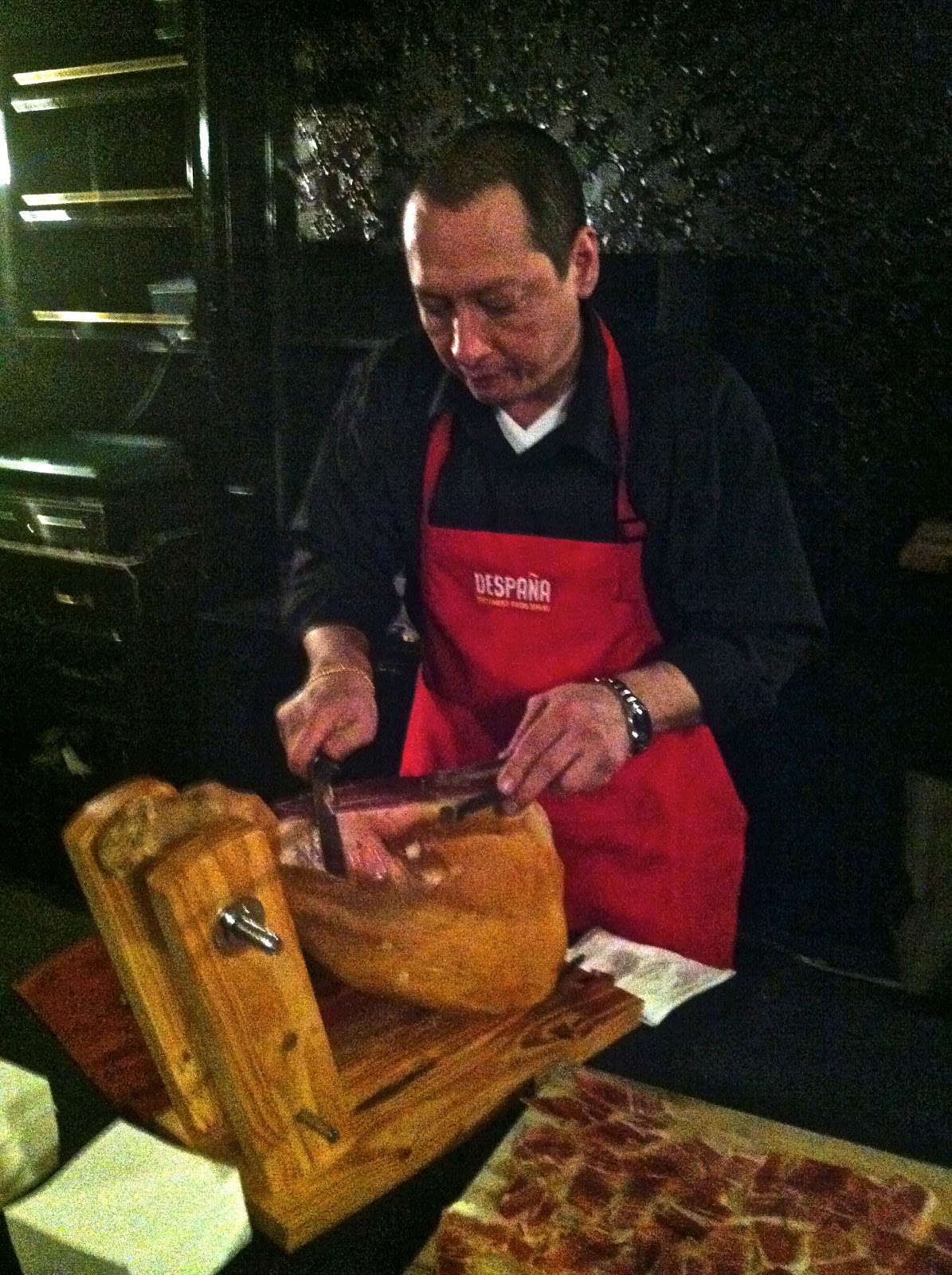
By the way, the food at the Grand Tasting was well planned and delicious. Croquetas, cheeses, and all sorts of tasty morsels. And the jamon station was much appreciated. I parked myself there for a solid 15 minutes, and no one seemed to mind too much.

Many other producers participated too, from Valdespino to El Maestro Sierra to Lustau to César Floridio. This was truly the greatest Sherry event ever on US soil, and I hope it was the first of many.

Sunday, September 30, 2012

Sherryfest

In NYC a lot has changed with Sherry in the past year. Sherry is lovable now, and this is a great thing.

 Emilio Hidalgo Fino Especial La Panesa and Jamon Iberico at Palo Cortado in Brooklyn. 

Any restaurant with modern or hipster ambitions has Sherry on the wine list. Wines that previously were difficult or impossible to buy here are now readily available. For example, almost the whole line of Valdespino Sherries wines are now imported by Polaner.

In Jerez you can walk into any small grocery store and buy a 750 ml bottle of Inocente for maybe 8 Euros. Inocente has only been available (when it is available, which was rare) in 375 ml bottles. Tio Diego, the delicious young Amontillado and the excellent Palo Cortado called Viejo CP were unavailable here, except when the intrepid Joe Salamone at Crush would find a way to sell a few bottles. Now these and other Valdespino Sherries can easily be purchased at many stores. And let me tell you that there is nothing like a 750 of Inocente - you should try one.

Fernando de Castilla's Sherries are now imported too, by David Bowler. The line of Antique Sherries is excellent - my favorite is the Palo Cortado, but they are all worth trying.

And my friend Peter Liem's new Sherry book will be released in less than a month! He wrote the book with Jesus Barquin of Equipo Navazos, and it promises to become one of the absolutely definitive pieces of writing about the region and the wines.

To top it all off, Peter and Rosemary Gray have created what will be the largest and most important Sherry tasting the Unites States has ever seen. It is called Sherryfest. There will be a grand tasting on Monday October 21st (you have to register and reserve a spot if you want to go, demand is large enough so that they have to be serious about this). There will also be seminars where you can taste with cellar masters, and dinners at great restaurants that feature the Sherries of selected producers.
This is a very big deal for the Sherry industry, for Peter and Rosemary, and for us as consumers. Congratulations to Peter for his groundbreaking new book, and to Peter and Rosemary for creating Sherryfest! I'll see you there...

Monday, August 06, 2012

A Delicious Summer Breakfast Featuring Okra.

So I'm going to reveal to you that back in fall of 2008 I was a Brooklynguy who practiced home-pickling. I found, though, that I was unable to grow a good looking soul patch, or really any facial hair that looks normal. I grew a mustache once as part of a Halloween costume but it freaked people out, they said I looked like a porn star. 86 the mustache, they said, and so I did. So clearly I should not be pickling vegetables at home either. But there was a time when I was doing some pickling. Okra, even.

What's also funny about the post I linked to above is that there is mention of essentially the same okra recipe I'm going to share today. It's the simplest of recipes - the important thing is that you use good ingredients. You are braising okra in a sauce of fresh tomatoes and garlic. And then creating a beautiful weekend breakfast by topping this with a sunny side-up egg. There are variables you can play with here. I like to use a jalapeno pepper in the braising sauce, but you can play with heat, or leave it out. You can use wine in the tomatoes, or not. You can season the braising liquid with anything you like, although I find that with super good ingredients, you don't need much. 

Okra is at the markets now, and you should try this - it's delicious and quite healthy:

Wash the okra and trim the stem so that a centimeter or less remains. Put some music on - I think that Coltrane Live in Stockholm works well here, but you can go with Giant Steps too. You can use good canned tomatoes, but 'tis tomato season. I like to use fresh plum tomatoes, but last weekend I used a smaller variety of the same shape called Juliettes. Use good tomatoes - that's what's most important. Chop the tomatoes coarsely. Use a mortar and pestle to make a paste of a very large clove of garlic. In a heavy bottomed pot over medium heat, using olive oil or neutral oil to your taste, cook the tomatoes until they begin to break down a little, stirring a lot, maybe 5 minutes. Add the garlic paste and some salt. Stir some more.

Add the okra and stir to coat them with the tomato sauce. Here I like to add a fresh jalapeno pepper that I've poked with a fork so that its flavors will easily seep out into the sauce. Stir some more, turn down the heat to low, cover the pot, and simmer, stirring a few times, until the okra are as tender as you want them to be. You will have something that looks like this (although you can stop the simmer 8 minutes earlier and have firmer okra, also amazing):

You can do anything with this. Eat it as a side dish, put it on rice, put it between your knees (a prize to whoever gets that film reference). For me, it has become breakfast.

Fry an egg and put it right on top. A hunk of baguette too.

I especially like it when the egg is all broken up and merges with the somewhat gooey okra and tomato. You know what - this dish isn't for you. Just forget about the whole thing.

Now, drinking wine on a weekend morning is a bad thing to do, because it's the morning time and we shouldn't drink in the morning. So I really cannot recommend a wine to pair with this because as I've explained already, it's breakfast and we don't drink wine on an August Saturday morning with okra stew and fried egg. But if, however, you were to ask me from a theoretical perspective, what wine it is that I would recommend to the type of scallywag who actually would drink wine in this situation... I would say that a good Fino, perhaps the basic Emilio Hidalgo Fino ($14 for a 750, imported by Winebow) is a great match. This is purely hypothetical, of course.

Thursday, June 07, 2012

The Best Pairing of the Past Few Weeks - Bitter Greens, Bitter Dressing, and Oloroso Sherry

I remember a long, long time ago eating lunch at a friend's house in Connecticut. His grandmother lived most of her life in Italy and she spoke almost no English. She made our lunch and I do not remember most of what we ate, but I remember the very first thing we ate. It was a salad of dandelion leaves, nothing else, and it had this incredibly bitter dressing. Dandelion leaves are already bitter. I was worried. But somehow it worked, this elevation of bitter. In my understanding, this is a common thing in Italy, bitter greens with bitter dressing.

There is chicory at Bill Maxwell's stand at the farmer's market these days. Chicory is a bitter green. It's good for you, you should try it. There are many delicious ways to enjoy chicory, but the other day for lunch I was craving a salad that showcased the bitterness of the green. So I took two shiny white cloves from a green garlic bulb and along with two chunky anchovy fillets, mashed them to a paste with a mortar and pestle. I added a pinch of salt. Then added a couple of glugs of good olive oil and whisked. I put just a dab behind each of my ears. The dressing never really integrated - there was no egg yolk, no mustard, not even any vinegar. But it didn't matter - it was pungent and bitter and umami and delicious.

A few spoons of the dressing tossed with the greens, a quartered lightly boiled and hand-peeled egg, and a few strips of red pepper to remind me that there is, in fact, sweetness in the world. This is a healthy and satisfying salad, albeit one that should be followed by a piece of very high quality mint flavoured chewing gum.

What to drink with this salad and its bitter flavors? I wanted something that feels fresh and bright, and maybe with a sweet note. But not sweetness of fruit. Not sugar at all, actually, but something that has sweet aromas. And definitely but not something terribly acidic or piercing. Something that might complement the bitter, or at least not fight with the bitter. Emilio Hidalgo Oloroso Gobernador Sherry, $23, imported by Winebow. It made perfect sense.

I must admit that Oloroso is the dry Sherry category in which I have found the fewest wines to love, so far. But I am a big fan of Gobernador (and of essentially everything made by Emilio Hidalgo). The wine is richly complex on the nose, and also very elegant, a wine of finesse on the palate. It has a brightness in tone that I appreciate in a wine that also shows the richness of roast nuts and dried fruit peels. With a little bit of air, there is a lemony, almost sweetness to the aromas. And this is not an acidic wine, it is mellow.

Sometimes you get it right. This was one of those times. The salad and the wine were both delicious and the pairing elevated them both. And let this be a lesson to the both of us - Sherry pairs well with everything. 

Tuesday, March 13, 2012

My Favorite Sherry Bar in NYC - Palo Cortado

I want to tell you about my favorite place to drink Sherry in NYC, a tapas bar called Palo Cortado. Palo Cortado is actually a restaurant with a full menu, and it serves a wide and interesting selection of wine and beer. You can go there and have a "normal" restaurant experience, with an appetizer, an entree, and dessert. But I'm going to talk about Palo Cortado in the way that I experience it, as a tapas bar.

Let me start by saying this: Palo Cortado has as good of a by-the-glass Sherry list as anyplace I've seen. There are about 20 Sherries on the list at any time, and wines rotate in and out.

This is a place where you can drink interesting wines in each category of Sherry, wines that can be quite difficult (in some cases, impossible) to find on retail shelves. There are lovely Finos and Manzanillas, interesting Amontillados and Palo Cortados, and several examples of Moscatel and Sweet Pedro Ximenez wines too. The most expensive wine I've seen, I believe, is the Bodegas Tradición Amontillado at perhaps $20 a glass. That's right - you can drink things like Bodegas Tradición Amontillado, by the glass, at Palo Cortado. The least expensive is the extremely delicious Emilio Hidalgo Fino at $6. Think about it - you can sample Sherries of all types for very reasonable prices, play around, try new things, expand your understanding of this forgotten (but perhaps now re-discovered) great wine of the world.

The wines are served in Sherry glasses and this is a great decision, particularly with the brown Sherries. I think Amontillado and Palo Cortado wines show best in these copitas, benefiting from the focus the glass confers. I prefer the way Fino style wines smell and taste out of white wine glasses, but copitas are fine too, and it certainly feels more like a tapas bar that way. Alessandro Piliego (pouring, above), who goes by Sandro and is one of the owners of Palo Cortado, is a true believer, and will be happy and excited to pour various wines for you, to talk about them with you, to support you in exploring the bottles he offers. If you go, you should talk with him - you will feel as though you have been well taken care of.

Palo Cortado is a destination place, it's worth traveling to because of the great Sherry selection and the great service. The food can be good too - there are dishes that I love to eat at Palo Cortado and I always enjoy my meals there. But the reason to travel to Palo Cortado is the great Sherry and the great service, and there are also some good things to eat. And I should say that I've never tasted even one of the main dishes. I order tapas, that's it.

To me, the most delicious and very best thing to eat at Palo Cortado is Jamon Iberico. Sandro simply does this right, no question about it. High quality jamon, aged two years, cut by hand into thin (but not too thin) toothsome and highly perfumed slices. A plate of jamon is served with large caper berries, Marcona almonds, fig bread, and pickled Basque peppers. A little bread on the side, a nice glass of Sherry...what could be better? I usually drink Palo Cortado with the jamon, like the wonderful Emilio Hidalgo Marqués de Rodil, but Sandro recommends Fino, and I tried this last time and it was great.

The other tapas that I always enjoy at Palo Cortado include Pulpo a la Gallega (tender octopus and potatoes with vinegar and lots of pimenton), Empanadas, which are completely home made and stuffed with delicious flank steak and melted Tetilla cheese, Patatas Bravas (fried potato chunks in pimenton and aioli, the Tortilla a la Cazadora (mushoom and potato omelet), the Albondigas de Cordero (lamb meatballs) and a frequent special of fluke crudo with grapefruit. And if you think about it, along with the spectacular (I would say, best in NYC) Jamon Iberico, that's plenty of tapas. Order a plate or two with a copita, and when you and your friend finish, order another plate or two and another copita, and continue until exhausted or the bar closes.

Another thing I appreciate about Palo Cortado is that it actually reminds me of being in Jerez. Okay, every tapas bar I can think of in Jerez and surrounding environs shows you many of the tapas you can order - they sit under glass and are served from troughs as you order them. That's not going to happen here, and that's fine. But the decor is right at Palo Cortado. Not too dark, not bright at all, some interesting paintings around, and they perfectly hit that critical mix of giving you enough space and somehow maximizing the hum of conversation from other tables.

And there is tile. Tile at the bar.

Tile on the tables.

You can always walk around and look at the paintings if you like.

Or sit at a table near the sultry painting in the back.

If you are interested in Sherry, and want to go beyond La Bota, go check out Palo Cortado. It might be a bit of a trip for you, yes. But you like Sherry, you're interested and curious. It's more than worth the trip.

You will have a great time here, trust me. And you will eat a glorious plate of Jamon Iberico that really tastes nutty like acorns and has a truly inviting and complex aroma. Careful, you might order a second plate. Or perhaps just return on another night and do it all over again. That's what I do.

Palo Cortado
520 Court Street, Brooklyn, between Huntington and Nelson.
Cash and Amex only.

Thursday, January 12, 2012

Brown Sherries Improve After Opening !

On new year's eve a good friend took pity on me, alone in the house with my very young and very wonderful daughters, and he decided to come over to hang out and have dinner. We of course opened some special wines on that night, one of which was a bottle I brought back from Jerez in October, Emilio Hidalgo Especial Amontillado Viejo El Tresillo 1874. I was very excited to drink and share this wine. The solera began in 1874 when the Hidalgo family purchased the bodega and the wines in the bottle are an average of about 50 years old. This is special wine - very little is bottled every year and it is not imported to the US. When I visited the bodega in October they were generous enough to open a bottle for us to try, and the wine was amazing. I bought one to carry home in my suitcase.

So, on new year's eve at some point, I went to the back room where my wine fridge sits and retrieved this bottle and proudly strutted into the kitchen where my friend stood and showed it to him. "We're going to drink this now," I said. And I told him about the wine and how good it would be and he was impressed, or at least acted like he was impressed.

It is clear from the photo that the wine is in a vise-like grip, and would be mute for days.

The problem is, the wine was absolutely and completely mute. It smelled and tasted like almost nothing. Nothing.

Sure, it didn't matter because we had a great time together and it was new year's and it's just a bottle of wine, and so on. But of course it matters. It matters to me. I drank this wine and I know how good it is. Why not on this night? It wasn't flawed in any way, just very, very quiet. We both drank a glass, I re-corked it, stuck it back in the wine fridge, and we moved on to other things.

Peter Liem has told me on many occasions that brown Sherries - Amontillados, Palo Cortados, and Olorosos, when well made, tend to show better at least a day or so after being opened. Why, it's hard to say. It's not like a young red wine, where exposure to oxygen approximates the aging process and the wine shows a more complete version of itself. The wines in this Amontillado are already quite old. Perhaps we can think of it the way we think of other very old wines - they sometimes do better when we open them hours in advance of drinking and let them air out a bit. Whatever the reason, well made old brown Sherries do not degenerate over several days after opening, quite the opposite - they improve.

Remembering this, I decided to experiment with this bottle of El Tresillo, to drink one glass every day until the wine is finished, to measure it's development. It was quite interesting, I must say, and the wine did indeed improve tremendously over a few days. It was best on days 4 and 5, but my last glass on day 6 was not quite as good as the ones on days 4 and 5. I will share some notes with you, starting with day 2:

Clearly the wine is improving here, but as evidenced by the photo, it is still constricted.

Day 2 - Now there is flor character on the nose - caramel and butter. The aromas are brighter and the flavors more vibrant in the mouth, but the wine is still not terribly compelling right now, somewhat uni-dimensional and not showing much complexity, or much of anything.

Day 3 - Did not taste. Whaddaya want from me? I had other things going on.

One can see here, by day 4, how the wine has reached its apex of aroma and flavor.

Day 4 - Whoa, what a difference. The nose is walnut skins - yes, the skins - there is that level of detail all of the sudden. There is still a creamy flor-influenced base note. The nose is still a bit constricted maybe, but the palate has expanded and improved dramatically. There are bright and vibrant flavors of lemon peel, caramel, and hazelnut, very complex , and the wine changes through the midpalate and is very energetic, the finish is orange and coffee and goes on and on. This is the great wine that I remember.

Day 5 - The best of the lot. The nose is regal in its complexity and subtlety, with coffee grounds and nuts, definite flor character, and it is moving in its penetrating focus and its elegance and finesse. The palate achieves complete harmony of flavor, striking complexity, and a mouth watering and long finish whose perfume I could access two hours later as I was getting ready for bed. Truly a beautiful wine.

Day 6 - The nose is still lovely, but there are some oxidative notes that appear too, and here and there I am aware of the alcohol. The palate is just as great as it was in the past two days, even longer maybe, but again with the slightly oxidative note of dried prune. If I had tasted this win only on this day I would think it great, but the memory of days 4 and 5 are even better.

So what does this prove? Absolutely nothing. But it's interesting I think, and probably representative of what you will get when you open a bottle of very fine brown Sherry. it might be worth opening it and pouring a small glass, and then leaving it for a few days until you are ready to share it with friends. The wine will improve. Even if it starts out well, it will get better.

Tuesday, November 22, 2011

Sherry Bodega Visits - Some Highlights

Instead of trying to write about individual visits, I thought it would be fun to summarize a bit and share some highlights.

Emilio Hidalgo was my first visit to a Sherry Bodega. I find it hard to remember the details of a first visit - my senses are always so overwhelmed by the newness of it all. A few things stick out in my mind, however, when I remember the Hidalgo visit. Fernando Hidalgo was our guide, and he and Peter caught up a bit as we walked though the courtyard and into the Bodega - Peter had last been in Jerez in May. The first wine that Fernando poured for us was the very special old Fino called La Panesa, and as he was about to draw wine from a barrel he said "Wait, this is the barrel you tasted last time, Peter. We should taste another barrel."

This is impressive. There are obviously many barrels of La Panesa and to remember from which one a rather quiet journalist tasted many months prior...well, it shows an attention to detail and an immersion in one's work that I think is reflected in the wines in general. We tasted several barrels and then walked out of one Bodega and into another.

We passed these tools hanging on the wall. In order to respect Fernando's privacy, I'm not supposed to discuss here what these are actually used for, but I can tell you that it has nothing to do with making wine.*

These old barrel parts lay in a courtyard outside of another Hidalgo Bodega. Between this and the tools above, I began to feel as though I better behave myself at Bodegas Emilio Hidalgo.

In the tasting room we sampled several wines from bottle, including the miraculous old Amontillado called El Tresillo. How cool is that old label? This is one of many great wines I drank that is not available in the US, to my knowledge, a real shame.

Bodegas Tradición is barely over 10 years old, very new for a Sherry producer. The wines, however, are much older. An old Bodega along with wines of very high quality was purchased by a group including billionaire Joaquin Rivero Valcare. Here is a blog post that describes this story in more detail.

We walked through the facilities and I was fascinated by the guy wax-sealing the bottles.
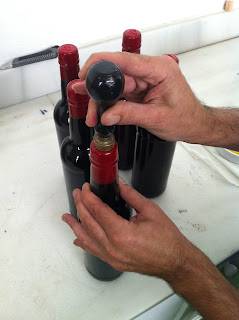
I suppose this is something that happens at wineries all over the world, but it was nice to realize that every bottle of wine that leaves Tradición is sealed in exactly this way.

This is a paper filter. They are stacked together, separated by porous plastic, and this is what some producers use to filter their wines.

I was surprised to learn that this is among the most gentle of filtering techniques. How could that be gentle, wine having to work its way through many layers of plastic and something that feels sort of like paper mâché? Everything is relative, I guess.

Before going to the tasting room to sample the wines, we visited the museum. Yes, that's right, there is a museum in the Bodega, filled with master works owned by Mr. Rivero Valcare. The above tile painting is by Picasso at age 8.

We tasted Tradición's four Sherries, a 1975 vintage Oloroso, and their brandies too. I like these wines very much, particularly the Amontillado and the Palo Cortado - another wine that is not available in the US.

Peter already described the incredible tasting of the Palmas at González Byass. Another highlight for me at Byass was tasting a barrel of Amontillado wine of indeterminate age, but at least 100 years old. The wine was undrinkable, and Antonio Flores said as much before we tasted it. After enough time in barrel, a wine takes on so much tannin from the wood that it becomes difficult to drink. That said, this wine could be bottled and sold as perfume.

I also learned here to rid myself of preconceived notions about the value of mass produced Sherries like Tio Pepe. I'm not saying that I'm stocking up on Tio Pepe, but it is wrong to think that this is bad wine - it is not. González Byass is a grand old Bodega and they have the resources to make very high quantities of Tio Pepe, and quality is consistent. There are other basic Finos that I much prefer, but I would gladly drink Tio Pepe if those are not available, and I think it stacks up pretty well against most of the world's $12 wine.

Fernando de Castilla is a small Bodega making high end Sherries. Jan Petterson is a Norwegian who worked for decades at Osborne, and left to take over this gem of a place. I was struck by the fact that he would not pour us samples of his Antique Fino. "I am completely obsessed with flor," he said. "We are very small, and I will not disturb the flor like this. We are entering the season where flor is very delicate and I don't want it to experience any more stress than is necessary." I must say, I admire his dedication to his wines.

The wine in bottle was lovely, but a bit confusing to me. It is an old Fino, like Inocente or Panesa, and it is higher in alcohol (18%?) than any other Fino I can think of, and I felt it just a little bit on the palate. Or was it the power of suggestion? I wish I could drink it again, but none of Fernando de Castilla's wines are imported in the US. I brought home a bottle of the very special Antique Palo Cortado and I would invite you to taste it with me but alas, I already drank it.

Perhaps the highlight of this visit, for me, was tasting Fernando de Castilla's brandies from barrel. We tasted Brandy in its youngest incarnation, throughout the next decade of its life, and then the final product before it is bottled. I actually loved the youngest wine - it reminded me of eau-de-vie in its powerful and delicious fresh fruitiness - it smelled and tasted of ripe pears.

Our Barbadillo visit was also fascinating. First of all, the wine maker is a woman, which is highly unusual in this part of the wine making world.

Her name is Montse Molina and she is originally from Madrid, I believe. So in addition to being a woman, she is also an outsider in Sanlucar, which I imagine must have made it difficult for her in the beginning with the group of men she supervised and collaborated with in making Barbadillo's wines.

We tasted three barrels of Barbadillo's Manzanilla Pasada, each from a different room within one of the Bodegas. These three rooms differed in size, ventilation, and humidity - they produce entirely different wines, in other words. They are eventually blended in order to produce the Manzanilla Pasada that goes into bottle. It was fascinating to taste these three wines in succession, to get a concrete view of the impact of the environment of a Bodega on the barrels of wine it produces. Peter and I took our glasses and blended the three wines in what we thought would be an advantageous way, and it was good. Montse tasted our blend and smiled the way I sometimes smile at my two year old when she is able to get her coat off by herself.

We tasted an old Amontillado and it became instantly clear to me that Amontillado made from Manzanilla is different from Amontillado made from Fino. One is not better than the other, but Manzanilla Amontillado, or at least the few that I've tasted, can have a certain saline and lemon peel brightness that I think is tremendously delicious. These are not easy to find, but worth a special search, if you're into Amontillado. I would suggest that you try Barbadillo's version, which I loved, but it is not imported in the US.

And we tasted the Reliquias. These are very old wines, relics, if you will. They are some of the most expensive and rare Sherries, and Barbadillo literally keeps the room where the Reliquias are served under lock and key. And there was some confusion about the location of the key - several workers were sent scurrying about to search for it. Finally it was located, no one was hurt, and in we went. It would be pointless to try to describe the smell and taste of wines as complex as these, but I can tell you that I have never ever tasted an Amontillado as impossibly light and pungent and balanced and beautiful as this one.

What can I say about visiting La Guita and Valdespino with Eduardo Ojeda? Anything I say will trivialize the actual experience of being there with him, listening to him discuss the wines, the Bodegas, the region. He is a passionate, intelligent, an absolutely gentlemanly and lovely person, a living treasure of the wine making tradition in Jerez and Sanlucar. If you go and visit the region, find him and visit La Guita and Valdespino.

At both La Guita and Valdespino, Eduardo wanted to show us the progression of the wines from their youth to the Solera, ready to be bottled. This was an incredible experience for me, seeing the wine in various stages of its life. At La Guita we tasted a special barrel, barrel No 3 from the 4th criadera that was just lovely - bright, saline, refreshing, intense.

We tasted the barrel that gave us La Bota No 20, and our reaction inspired Cabo, the guy in charge of the Bodega when Eduardo isn't there, to draw off a bottle for us to leave with.

We tasted a hidden barrel of Amontillado, that little one above barrel 17, something that is not bottled. This is one of the great things about visiting a Sherry Bodega - if you are lucky you will get to taste special things, wines that the cellar master cares about but that will never see the inside of a bottle. Again, Amontillado made of Manzanilla wine can be very special, and this was absolutely one of the most memorable wines of the trip for me.

At Valdespino we tasted through many of the 10 criaderas of Inocente, several criaderas of Tio Diego, and and a few other great wines. Inocente is a Fino that comes exclusively from grapes from the Marchenudo Alto vineyard, one of the "Grand Cru" sites of Jerez. Tio Diego is what happens when Inocente becomes an Amontillado - not 30 years later, but very soon after it becomes Amontillado.

What happens after Tio Diego? We walked to the section of the Bodega where a few very special wines age in barrel. There is Viejo CP, a lovely Palo Cortado that originates as Inocente, a wine that is not imported in the US. And finally, there is Cardenal, one of the great wines of Jerez, a very old Palo Cortado of which perhaps 400 half bottles are released each year. The Cardenal solera is fed by Viejo CP. As it was first described to me by Peter, "Even seasoned Sherry buffs in Spain widen their eyes if a bottle of Cardenal is served." We tasted this wine next to Coliseo, a very old Amontillado that originates as a Manzanilla, actually. Both are superb wines of astounding depth and intensity, and also great clarity and articulation, and of seemingly unending length. I calculated 47 minutes on Coliseo, but honestly I just stopped counting at that point. These glorious wines are something like the Richebourg and La Tâche of Sherry, but they can be had for a fraction of the price. I should say they could be, if they were imported to the US. I'm starting to sense a pattern here regarding importation, or lack thereof, of fine Sherry. Are you?


* Patently false. These are wine making tools. And Fernando Hidlago is an upstanding citizen who is well regarded in his community.