Showing posts with label Barbadillo. Show all posts

Monday, October 28, 2013

En Rama Sherry

A few years ago Equipo Navazos Sherries began to get a lot of attention, and this opened the floodgates here in the US - a new generation of wine lovers became interested in tasting and drinking Sherry. There are many special things about the wines bottled under the Equipo Navazos label. One of them is that the wines are bottled with minimal filtration.

Young whippersnapper wine connoisseurs such as myself may take this unfiltered thing for granted. Most, if not all of the wine I buy from Burgundy, the Loire Valley, and elsewhere is either unfiltered or minimally filtered. But with Sherry, this is typically not the case. A little over two years ago I wrote something about this that was fun (for me, anyway) to go back and re-read. At that point there were almost no unfiltered Sherries to buy here in NYS. Equipo Navazos, and Pastrana - a Manzanilla Pasada by Bodegas Hidalgo (La Gitana). Now, however, it seems as though everyone makes an unfiltered wine. I thought it would be good to revisit this subject, to take a look at the current NYC market for these wines.

First, a couple of basics:

Fino style Sherry (including Fino, Manzanilla, and wines from El Puerto de Santa Maria) is aged in barrel under a layer of living yeast, called flor. To bottle the wine without filtration would mean bottling bits of flor, perhaps still living, and various other solid matter. Most producers opt instead to bottle their wines after a heavy filtration. This allows the wines to be more stable during their overseas journey and the subsequent movement to warehouse and eventually to retail shelves or restaurant refrigerators. Stabilizing though it may be, this heavy filtration strips the wine of solid particles that contribute significant color, aroma, and flavor - the resulting wines are typically pale and without the complex aroma and depth of flavor that makes Sherry great. Consider the following quote from page 72 of Peter Liem's book Sherry, Manzanilla, & Montilla: a Guide to the Traditional Wines of Andalucia:

What is insidious about this, in our opinion, is that we as consumers are now trained to believe that the pale color of these wines in bottle is natural. In fact, fino and manzanilla are not naturally pale in color, nor are they particularly light in body, except perhaps in relation to other types of sherry. By definition, they are aged wines, having spent many years in cask - even the simplest of these is aged in barrel for at least two years, and the best versions for much longer. When sampling a fino or manzanilla from cask, its color is pronounced, is aromas are pungent, and its presence on the palate is much richer than one might anticipate. All of this is lost, or at least significantly modified, by excessive filtration.
When we fell for dry Sherry all over again, we fell for wines that had not been filtered in this way. Okay, Equipo Navazos filters wines before bottling, but lightly, "just to remove the flies," they like to say. But it is this lightly filtered style of wine that was our gateway drug. And as the market for fine Sherry continues to grow, more producers are releasing an en Rama, or unfiltered version of their brand. Here are those that I can think of off the top of my head:
  • Tio Pepe now releases Tio Pepe en Rama (and also the Palmas, which are lightly filtered).
  • Gutierrez Colosía bottled an en Rama version called Amerigo of their lovely Fino el Cano.
  • Lustau released an en Rama Fino, a Manzanilla, and a wine from El Puerto. 
  • Bodegas Hidalgo now releases an en Rama version of La Gitana.
  • Valdespino releases an en Rama version of their Deliciosa Manzanilla.
  • Barbadillo releases four en Rama versions of their Solear Manzanilla, one for each of the seasons (!!).
  • And soon Fernando de Castilla will release an en Rama Fino.

I'm sure there are others and I'm just not remembering them right now. This is such a great thing for Sherry lovers. We can taste different versions of the wines we love, experience them in a state that is closer to what they were in barrel. But please notice that I did not say "better," I said different. Deliciosa is a lovely Manzanilla, brisk, saline, and focused. Deliciosa en Rama is excellent too, with more expression and detail of aroma and flavor. But it's also more spread out on the palate - less focused, and feels a bit rustic in comparison. That's not a bad thing. The en Rama bottling showcases one style of wine and the regular bottling showcases another.

All of these en Rama wines are worthy of your attention. But I have a favorite - let me tell you about Barbadillo's Solear en Rama. First of all, Solear is an excellent Manzanilla, averaging 7 years of age and fully expressive.

The unfiltered versions are also excellent, even better in my opinion, with an amplified lemon-enriched flor character and a more expressive saline minerality. What sets these wines apart, for me, though is the almost shocking complexity of aroma and the intensely savory nature of the palate. These things are true of the wine in all four seasonal releases, although the recent 2012 winter bottling was as darkly savory a wine as I've encountered. And the 2013 spring bottling is ridiculous, the best version of this wine that I've tasted, combining great focus and lightness of body with great intensity and richness of flavor. Joe Salamone at Crush has worked hard to bring these wines to the NYC market, and although they are gone for now, the summer 2013 bottles should be out soon.

If you like Sherry, and I think that you do, you should make a point to seek out and taste these en Rama wines. But as you do, I hope you will not feel that en Rama automatically means that the wine is great, or that it is better than its filtered counterpart. En Rama represents a style of wine, and you might prefer the more filtered counterpart. That's not wrong - Solear is delicious and so is Deliciosa. Drink both styles next to each other and see if you prefer one over the other. The amazing thing is that you can do that, with 375 ml bottles, for under $40. That, my friends, is something that will not last.

Wednesday, October 09, 2013

Sherry Fest 2013

The second annual Sherryfest just wrapped up in New York City. Peter Liem and Rosemary Gray did an excellent job once again, raising funds, organizing many people and events, and creating the largest Sherry tasting in the United States.

This year Peter and Rosemary hosted the Grand Tasting at the Astor Center. The space was perfect - brightly lit and cheerful, roomy, not too noisy, but humming.

This is such a special event, and here's why: most large tastings are put on by a particular importer/distributor. If you attend that tasting you do so to taste that particular book of wines. Sherryfest celebrates Sherry, not any particular importer, and brings together over 25 Sherry producers (and there really aren't many more than that) and 160 wines. This is a unique opportunity to learn about one of the world's greatest wines.

Jan Petterson of Fernando de Castilla was there, showing and discussing his wines. He is a wealth of knowledge and any time listening to him is time well spent. He brought along a new wine this year, the first ever bottling of Fernando de Castilla Fino en Rama - delicious. En rama translates literally as "on the lees," and it means bottled without filtration. This is a popular trend now and many producers are offering an en rama version of their Fino or Manzanilla.

Lorenzo García-Iglesias was there representing his superb lineup of Bodegas Tradición wines. Such a treat to be able to taste these great wines next to one another.

Antonio Flores, the master blender behind Gonzáles Byass, was there. He is such a lovely man, and so good at explaining the wines. Tío Pepe is the world's highest selling Fino, if I am not mistaken, and the soleras that create the wine are massive, the job of tending them is enormous.

Flores offers an en Rama version of Tío Pepe every year, and this one was delightful. Most of it goes to the British market, sadly. It was also an incredible treat to taste the four Palmas, the series of wines meant to illustrate to progress of Fino towards Amontillado. This year Flores showed the second batch of these wines, and they completely and entirely lived up to the hype. The wines are incredibly fine and wonderfully expressive.

I tasted the entire lineup of Barbadillo wines (minus the Reliquias, those elusive treasures) with importer Julio Baguer and his daughter. These are such excellent wines, and they are so accessibly priced. I remembered at this tasting that Solear is a lovely wine, very complex and expressive, entirely delicious. A wine like this, produced on a large scale, not the top wine of the house - a wine like this can get lost in the Sherry shuffle. But Solear is really a good wine. And that's just the beginning for Barbadillo. 

I enjoyed speaking with these and other producers I am familiar with, revisiting their wines. Sherryfest also offers the chance to discover new wines.
I had never before heard of or tasted the wines of Delgado Zuleta, for example. Apparently this is the oldest Sherry firm, founded in 1744! I enjoyed the whole lineup of wines, particularly the lovely Manzanilla called Barbiana. The wines are an average of 6 years old and show a deep complexity of flor character, and lovely balance and freshness. One taste at one large tasting is not sufficient to judge a wine, but based on my experience at Sherryfest, I will eagerly try a bottle of this wine when it appears on retail shelves.

Importer Robert Jordan said that it should retail for about $22 for a 750ml, a friendly price point for a wine of this caliber.

This year Peter and Rosemary thought it would be fun to bring Sherry cocktails to Sherryfest. They were correct. Four talented bartenders offered a Sherry cocktail of their choosing. I was expecting to enjoy these drinks, and still I was surprised at how good they were.

Joaquín Simó of Pouring Ribbons made a Coronation. Fino, dry vermouth, maraschino liquor, and orange bitters Delicious!

And Dan Greenbaum of The Beagle made one of my favorite cocktails (and something he introduced me to), the Adonis. This is a wonderful cocktail and it's not really that boozy, so you can have a few and not be drunk. He uses La Ina Fino, sweet vermouth, and orange bitters. So good.

Sherryfest is not only the Grand Tasting. There are seminars and dinners too. This year I attended a dinner at Maysville at which Bodegas Tradición and Bodegas Aecovi wines were paired with this restaurant's excellent cooking.

Oysters and bracing Fino or Manzanilla Sherry is an excellent pairing.

Bodegas Tradición introduced their new Fino at this dinner, and I loved it. Sadly, very little was bottled and we will have to wait to be able to buy this wine.
Delicata squash stuffed pasta topped with crab and almonds was a beautiful dish, and it elevated and was elevated by Bodegas Tradición Amontillado. Is it possible that the Tradición wines are underrated? I believe so. People new to Sherry are so focused on La Bota wines, and with good reason - they are great. But there is so much more out there, these great wines among them. 

Thank you Peter and Rosemary for creating this wonderful event! I'm already looking forward to next year...

Monday, January 07, 2013

Lessons in a Bottle

There are many things I learn when drinking wine. Here are some things I've been thinking, things I want to remember entering 2013, along with the bottles that helped to inspire the lessons:

There is no "perfect" moment, so don't waste life by waiting. Share and enjoy today.


But it's also important to be patient.


Accept the kindnesses of strangers. 


Be gracious at all times. 


Consume only what is necessary, not to excess simply because something is available. 


Keep experimenting, never stop learning. 


 Things are not always as they seem.


Wonderful things of great value can come in modest packages. 


There is nothing more valuable than a true friend. 

 -----
Heres to a great 2013!

Tuesday, November 22, 2011

Sherry Bodega Visits - Some Highlights

Instead of trying to write about individual visits, I thought it would be fun to summarize a bit and share some highlights.

Emilio Hidalgo was my first visit to a Sherry Bodega. I find it hard to remember the details of a first visit - my senses are always so overwhelmed by the newness of it all. A few things stick out in my mind, however, when I remember the Hidalgo visit. Fernando Hidalgo was our guide, and he and Peter caught up a bit as we walked though the courtyard and into the Bodega - Peter had last been in Jerez in May. The first wine that Fernando poured for us was the very special old Fino called La Panesa, and as he was about to draw wine from a barrel he said "Wait, this is the barrel you tasted last time, Peter. We should taste another barrel."

This is impressive. There are obviously many barrels of La Panesa and to remember from which one a rather quiet journalist tasted many months prior...well, it shows an attention to detail and an immersion in one's work that I think is reflected in the wines in general. We tasted several barrels and then walked out of one Bodega and into another.

We passed these tools hanging on the wall. In order to respect Fernando's privacy, I'm not supposed to discuss here what these are actually used for, but I can tell you that it has nothing to do with making wine.*

These old barrel parts lay in a courtyard outside of another Hidalgo Bodega. Between this and the tools above, I began to feel as though I better behave myself at Bodegas Emilio Hidalgo.

In the tasting room we sampled several wines from bottle, including the miraculous old Amontillado called El Tresillo. How cool is that old label? This is one of many great wines I drank that is not available in the US, to my knowledge, a real shame.

Bodegas Tradición is barely over 10 years old, very new for a Sherry producer. The wines, however, are much older. An old Bodega along with wines of very high quality was purchased by a group including billionaire Joaquin Rivero Valcare. Here is a blog post that describes this story in more detail.

We walked through the facilities and I was fascinated by the guy wax-sealing the bottles.
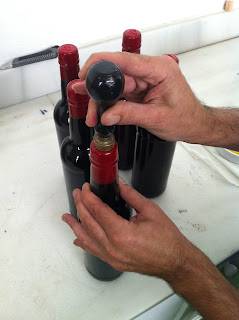
I suppose this is something that happens at wineries all over the world, but it was nice to realize that every bottle of wine that leaves Tradición is sealed in exactly this way.

This is a paper filter. They are stacked together, separated by porous plastic, and this is what some producers use to filter their wines.

I was surprised to learn that this is among the most gentle of filtering techniques. How could that be gentle, wine having to work its way through many layers of plastic and something that feels sort of like paper mâché? Everything is relative, I guess.

Before going to the tasting room to sample the wines, we visited the museum. Yes, that's right, there is a museum in the Bodega, filled with master works owned by Mr. Rivero Valcare. The above tile painting is by Picasso at age 8.

We tasted Tradición's four Sherries, a 1975 vintage Oloroso, and their brandies too. I like these wines very much, particularly the Amontillado and the Palo Cortado - another wine that is not available in the US.

Peter already described the incredible tasting of the Palmas at González Byass. Another highlight for me at Byass was tasting a barrel of Amontillado wine of indeterminate age, but at least 100 years old. The wine was undrinkable, and Antonio Flores said as much before we tasted it. After enough time in barrel, a wine takes on so much tannin from the wood that it becomes difficult to drink. That said, this wine could be bottled and sold as perfume.

I also learned here to rid myself of preconceived notions about the value of mass produced Sherries like Tio Pepe. I'm not saying that I'm stocking up on Tio Pepe, but it is wrong to think that this is bad wine - it is not. González Byass is a grand old Bodega and they have the resources to make very high quantities of Tio Pepe, and quality is consistent. There are other basic Finos that I much prefer, but I would gladly drink Tio Pepe if those are not available, and I think it stacks up pretty well against most of the world's $12 wine.

Fernando de Castilla is a small Bodega making high end Sherries. Jan Petterson is a Norwegian who worked for decades at Osborne, and left to take over this gem of a place. I was struck by the fact that he would not pour us samples of his Antique Fino. "I am completely obsessed with flor," he said. "We are very small, and I will not disturb the flor like this. We are entering the season where flor is very delicate and I don't want it to experience any more stress than is necessary." I must say, I admire his dedication to his wines.

The wine in bottle was lovely, but a bit confusing to me. It is an old Fino, like Inocente or Panesa, and it is higher in alcohol (18%?) than any other Fino I can think of, and I felt it just a little bit on the palate. Or was it the power of suggestion? I wish I could drink it again, but none of Fernando de Castilla's wines are imported in the US. I brought home a bottle of the very special Antique Palo Cortado and I would invite you to taste it with me but alas, I already drank it.

Perhaps the highlight of this visit, for me, was tasting Fernando de Castilla's brandies from barrel. We tasted Brandy in its youngest incarnation, throughout the next decade of its life, and then the final product before it is bottled. I actually loved the youngest wine - it reminded me of eau-de-vie in its powerful and delicious fresh fruitiness - it smelled and tasted of ripe pears.

Our Barbadillo visit was also fascinating. First of all, the wine maker is a woman, which is highly unusual in this part of the wine making world.

Her name is Montse Molina and she is originally from Madrid, I believe. So in addition to being a woman, she is also an outsider in Sanlucar, which I imagine must have made it difficult for her in the beginning with the group of men she supervised and collaborated with in making Barbadillo's wines.

We tasted three barrels of Barbadillo's Manzanilla Pasada, each from a different room within one of the Bodegas. These three rooms differed in size, ventilation, and humidity - they produce entirely different wines, in other words. They are eventually blended in order to produce the Manzanilla Pasada that goes into bottle. It was fascinating to taste these three wines in succession, to get a concrete view of the impact of the environment of a Bodega on the barrels of wine it produces. Peter and I took our glasses and blended the three wines in what we thought would be an advantageous way, and it was good. Montse tasted our blend and smiled the way I sometimes smile at my two year old when she is able to get her coat off by herself.

We tasted an old Amontillado and it became instantly clear to me that Amontillado made from Manzanilla is different from Amontillado made from Fino. One is not better than the other, but Manzanilla Amontillado, or at least the few that I've tasted, can have a certain saline and lemon peel brightness that I think is tremendously delicious. These are not easy to find, but worth a special search, if you're into Amontillado. I would suggest that you try Barbadillo's version, which I loved, but it is not imported in the US.

And we tasted the Reliquias. These are very old wines, relics, if you will. They are some of the most expensive and rare Sherries, and Barbadillo literally keeps the room where the Reliquias are served under lock and key. And there was some confusion about the location of the key - several workers were sent scurrying about to search for it. Finally it was located, no one was hurt, and in we went. It would be pointless to try to describe the smell and taste of wines as complex as these, but I can tell you that I have never ever tasted an Amontillado as impossibly light and pungent and balanced and beautiful as this one.

What can I say about visiting La Guita and Valdespino with Eduardo Ojeda? Anything I say will trivialize the actual experience of being there with him, listening to him discuss the wines, the Bodegas, the region. He is a passionate, intelligent, an absolutely gentlemanly and lovely person, a living treasure of the wine making tradition in Jerez and Sanlucar. If you go and visit the region, find him and visit La Guita and Valdespino.

At both La Guita and Valdespino, Eduardo wanted to show us the progression of the wines from their youth to the Solera, ready to be bottled. This was an incredible experience for me, seeing the wine in various stages of its life. At La Guita we tasted a special barrel, barrel No 3 from the 4th criadera that was just lovely - bright, saline, refreshing, intense.

We tasted the barrel that gave us La Bota No 20, and our reaction inspired Cabo, the guy in charge of the Bodega when Eduardo isn't there, to draw off a bottle for us to leave with.

We tasted a hidden barrel of Amontillado, that little one above barrel 17, something that is not bottled. This is one of the great things about visiting a Sherry Bodega - if you are lucky you will get to taste special things, wines that the cellar master cares about but that will never see the inside of a bottle. Again, Amontillado made of Manzanilla wine can be very special, and this was absolutely one of the most memorable wines of the trip for me.

At Valdespino we tasted through many of the 10 criaderas of Inocente, several criaderas of Tio Diego, and and a few other great wines. Inocente is a Fino that comes exclusively from grapes from the Marchenudo Alto vineyard, one of the "Grand Cru" sites of Jerez. Tio Diego is what happens when Inocente becomes an Amontillado - not 30 years later, but very soon after it becomes Amontillado.

What happens after Tio Diego? We walked to the section of the Bodega where a few very special wines age in barrel. There is Viejo CP, a lovely Palo Cortado that originates as Inocente, a wine that is not imported in the US. And finally, there is Cardenal, one of the great wines of Jerez, a very old Palo Cortado of which perhaps 400 half bottles are released each year. The Cardenal solera is fed by Viejo CP. As it was first described to me by Peter, "Even seasoned Sherry buffs in Spain widen their eyes if a bottle of Cardenal is served." We tasted this wine next to Coliseo, a very old Amontillado that originates as a Manzanilla, actually. Both are superb wines of astounding depth and intensity, and also great clarity and articulation, and of seemingly unending length. I calculated 47 minutes on Coliseo, but honestly I just stopped counting at that point. These glorious wines are something like the Richebourg and La Tâche of Sherry, but they can be had for a fraction of the price. I should say they could be, if they were imported to the US. I'm starting to sense a pattern here regarding importation, or lack thereof, of fine Sherry. Are you?


* Patently false. These are wine making tools. And Fernando Hidlago is an upstanding citizen who is well regarded in his community.

Sunday, November 13, 2011

Visiting a Sherry Bodega

In Burgundy and the Loire Valley, it can be difficult to find the producers you are trying to visit. The houses look like any other houses and often the placards at the entrance are quite small. When you eventually find your way, you visit dark and cold underground caves with beautiful mold covered walls. There is enough room for wine barrels and not much else - visiting is an intimate experience. You taste through the lineup of new wines in barrel, and then perhaps a few bottles from recent vintages, maybe an older bottle if you are lucky and the wine maker feels like sharing a special experience.

Entrance to Bodegas Emilio Hidalgo.

Visiting a Sherry Bodega is quite different. Sherry Bodegas, small and large, tend to be a bit easier to identify from the street.

Spiral staircase, Gonzales Byass.

Bodegas are compounds - there are barrels rooms of course, but also courtyards with lovely plants and trees, and offices and all sorts of other buildings.

Inside Bodegas Fernando de Castilla.

Honestly, the larger Bodegas seemed like walled cities with their own private streets, and what I think may have been medical clinics, schools, and libraries. Okay, maybe not, but it seemed that way to me.

Oloroso barrels at Bodegas Emilio Hidalgo.

Most of the Bodegas we visited keep some barrels in the outside air. There are wines in these barrels - Olorosos, usually, wines that never see flor. They are able to withstand greater variation in temperature than biologically aged wines.

Inside the Valdespino Bodega. It felt as though I had been swallowed by a whale.

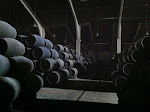
Walking into an actual Bodega, a barrel room, can be startling. You step through a door (they are not underground) and into a vast dark room filled with barrels. Light pokes past the edges of frayed wooden screens that don't really cover the windows. The ceilings are very high. The air smells delicious, kind of like yeasty bread dough and toffee. These are old, quiet, beautiful places that inspire great reverence.

Inside the "Cathedral" at Barbadillo where Solear is matured.

You do not taste finished wines in Sherry Bodegas. In Burgundy, for example, when you taste from a barrel you get a pretty good sense of what the wine will be. Sure, the wine you taste will be blended with other barrels of the same wine and it is unfinished in barrel, so you must interpolate a bit to understand what you are tasting. But in a Sherry Bodega you are tasting merely one ingredient of a wine, and at one moment in that ingredient's never-ending life.

"1/70" indicates that this is barrel #1 of 70, in the 10th and youngest criadera.

You begin by tasting from a barrel in a younger criadera, and get a sense of the wine as it begins. Tasting older criaderas, you get a sense of the wine as it matures, and so on. Even when you taste from the solera barrels you are experiencing but one version of the wine, the version that the cellar master wants you to see on that day, not the finished wine. None of these wines that you taste will ever be experienced in a bottle. They are, as Peter says, "photographs of a moment in time." When you emerge from visiting a Bodega, you leave with an understanding (hopefully) of the Bodega and what the wines can be, not so much of the wines as you might purchase them in bottle.

There are amazing, these old Bodegas, and they are an endangered species. I'm grateful that I had the opportunity to see them and to be with them for those few days.