Monday, January 17, 2011

Cooking a Rabbit

The other night, I cooked a rabbit for the first time. My friend Peter was coming over for dinner and I wanted to try something new. We used a simple recipe from The Art of Eating #76 called Lapin à la crème, or Rabbit in white wine with cream. The first task was to butcher the rabbit.

I've become rather competent, if I may say so, at butchering a chicken. Rabbit - need more practice. You can see from the picture above that I was able to remove the hind and front leg portions without much trouble, but the loin is actually larger than what you see above. I left some meat on the ribcage and there were some thin flaps of muscle that I decided to remove from the main loin portions. When I looked at the Art of Eating photos afterward, those flaps were left as part of the loin. Live and learn...

The recipe calls for "stiffening" the rabbit in butter (cooking but not browning), sweating some aromatic vegetables, returning the rabbit to the pot and braising it with the aromatics in white wine and stock for 45-60 minutes until tender, removing the rabbit and then reducing the braising liquid. Then straining the liquid and adding some cream (although the recipe called for adding the cream before straining, but that didn't sound right to us). Then cooking some mushrooms - we used hedgehogs, returning the rabbit to the sauce with the mushrooms to marry the flavors, and adding white pepper and lemon. We substituted parsley for the white pepper and lemon.

I must say, the braising liquid and the rabbit smelled great. We plated our rabbit portions over a mound of plain white rice, spooned some of the sauce over the top, sprinkled with parsley, et voila.

Rabbit is a very lean meat, more gamy than heavy. This sauce is delicious, but not terribly pungent or complex. What to drink with this dish? James MacGuire in The Art of Eating writes "With the rich but not unusually flavorful sauce of rabbit with white wine and cream, you might drink a dry or near dry, fresh, aromatic Alsace Riesling or Pinot Gris." That sounded good to me, but I had no Alsace wine in the house. So I opened a bottle of the most aromatic Riesling that I had, the 2004 Alzinger Riesling Smaragd Loibner Steinertal, $30, Imported by Michael Skurnik Wines.

According to Peter, Alzinger's Steinertal is one of the absolute greatest white wines of Austria. So yes, it is possible to buy one of the greatest white wines in the world on closeout for $30, and the new vintage (2008) costs under $65, by the way. Anyway, this wine was vividly fragrant, delicate and finely focused, and very intense with a great presence on the palate and a lazy lingering finish. It was a lovely match with the rabbit. I thought it was just a spectacular wine. And it held up for next three days, too.

All of that said, I liked but didn't love my rabbit. I didn't achieve that falling off the bone texture that the recipe suggests. What do you think - have you cooked rabbit with any success? I'm willing to try again but I need a little inspiration. I might prefer simply to drink the Steinertal.

Thursday, January 13, 2011

A Coteaux Champenois Tasting

Not all Champagne is sparkling wine. Peter Liem, many of whose comments and ideas are paraphrased within this post, told me that the modern history of sparkling Champagne is only 300 or so years old, and that Champagne used to be a still wine. Many Champagne producers continue to make small amounts of still wine, called Coteaux Champenois. If you've never heard of these wines or never tasted one, you are most certainly not alone. Not a lot is made, and most of what is made is consumed in Champagne. The grapes used to make Coteaux Champenois are the same highly valuable grapes that could be used to make Champagne - it just doesn't make good financial sense to divert production from a highly profitable wine that is in demand all over the world to a little known wine that is harder to sell at the same prices.

So why is Coteaux Champenois made at all, given that logic? Well, producers need still red wine if they make a rosé of Champagne by blending still red wine into sparkling wine. Also, people in Champagne enjoy drinking red wine from time to time and from what I gather, in much of France, you drink the local wine. Perhaps most importantly, Coteaux Champenois continues to be made because some producers want to honor the tradition and history of Champagne. "Take Larmandier-Bernier, for example," Peter said. "Pierre Larmandier wants to make red wine from Vertus Pinot Noir because he wants to preserve the history of Vertus."

Coteaux Champenois can be red, white, or rosé, although the red wines are by far the most common. The wines can be released as vintage wines or non-vintage wines, and do not need to be aged in bottle for three years, as sparkling Champagne does, in order to be labeled as vintage wines. The villages where Pinot Noir thrives are also the villages that make highly regarded Coteaux Champenois. Bouzy and Ambonnay are perhaps considered as the sources of the finest wines, but there are excellent wines made elsewhere too.

There are very few examples of Coteaux Champenois available at retail stores. Importers have trouble selling the wines, and so they don't bring them in. "I have trouble selling them, especially a non-vintage still red wine from Champagne that would retail for $50," said Kevin Pike, Director of National Sales and Marketing at Michael Skurnik Wines. There are retailers, however, who believe in these wines enough to keep them in stock. Joe Salamone at Crush in Manhattan, for example, has been selling Coteaux Champenois for years, when he can get his hands on it.

Last summer I drank a bottle of 2002 Larmandier-Bernier Coteaux Champenois with a few friends and absolutely loved it. I knew I needed to try more. A few friends agreed, and we decided to buy whatever we could and to hit up a few importers for bottles that are not (yet?) available in stores. We recently got together over a completely fantastic dinner at Prune and drank the wines. It was quite a crew, including the aforementioned Peter Liem, Joe Salamone, and Kevin Pike, and also Levi Dalton of Alto (where at least one Coteaux Champenois is on the wine list), Dan Melia, Clarke Boehling, and Keith Levenberg.

The results were mixed, I would say. The two wines that I have previously loved didn't show well on this night. Other wines were disconcertingly big and concentrated - stylistic decisions by top quality wine makers. But there were a few true gems. Here are the wines we drank in the order in which we drank them, along with a few notes:

2008 Roger Coulon Coteaux Champenois Blanc, $40-50, Rosenthal Wine Merchant. I found myself saying "this wine smells just like Champagne!" It really does, just like a Blanc de Blancs. Tastes just like one too. Feels entirely different, obviously, and it was a strange sensation. This was the very first Coteaux Champenois Blanc I've ever tasted, I think I need more experience before saying much.

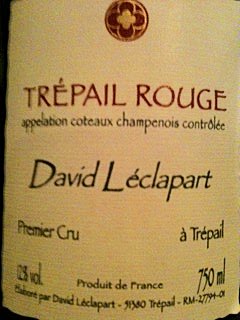
2008 Léclapart Coteaux Champenois Trépail Rouge, $55, Imported by Jandell Selections. Very fragrant, fresh red berries and flowers with woodsy undertones, very persistent. There is a "natural streak" here, as there often is in Thierry Puzelat's wines, for example. Bottle variation is significantwith this wine, apparently. This was a good bottle, the one I drank a few months ago was not as good.

2008 Egly-Ouriet Coteaux Champenois Ambonnay Rouge, $95, Imported by Michael Skurnik Wines. The nose is dominated by oak right now, and I found it hard to enjoy at this early stage, even harder to evaluate. Peter Liem told us that among many people in Champagne, this wine is considered to be the best Coteaux Champenois. I'd love to taste the '08 again in 5 or 10 years.

2001 Marie-Noëlle Ledru Coteaux Champenois Ambonnay Rouge, not imported (kindly donated for this tasting by Charlie Woods, whose company Bonhomie Wine imports Ledru's sparkling Champagnes). Still shows freshness, there is complexity on the nose, which becomes more layered and detailed with air, perfectly harmonious on the palate. Delicious, and one of my favorites of the tasting.

2004 René Geoffroy Coteaux Champenois Cumières Rouge, $55, imported by Michael Skurnik Wines. The nose is spicy, rich, voluptuous, and also energetic with dark fresh fruit. This is a powerful wine that doesn't lack for concentration, but still offers god detail and balance. I like Geoffroy's wines very much, and this was no exception.


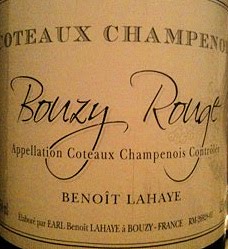
2003 Benoît Lahaye Coteaux Champenois Bouzy Rouge, not imported (kindly donated for this tasting by Jeffrey Alpert, whose company Jeffrey Alpert Selections imports Lahaye's sparkling Champagne). "Bouzy Rouge" has got to be one of the best names in the world of wine. My favorite wine of the tasting. The nose opens slowly (as with all of Lahaye's wines) but shows real elegance, especially in light of the very warm 2003 vintage. Mineral infused spicy red fruit on the nose, and a harmonious palate whose delicate red fruit shows a bit of maturity and although reflects some of the opulence of the vintage, for me didn't cross into over-done territory. Delicious wine, and Lahaye is an absolute star, in my book.

2000 Jean Vesselle Coteaux Champenois Bouzy Rouge, $41, Dionysos Imports. This wine showed a candied aspect that I didn't care for, and I found it to be a bit one-dimensional, uninspiring. But there were others who enjoyed it, so grain of salt here.

2002 Paul Bara Coteaux Champenois Bouzy Rouge, $40, Imported by Jandell Selections, although bara's sparkling Champagne is imported by Kermit Lynch. This wine was corked, which is a shame because in an odd coincidence I happened to drink a glass the night before this tasting, and it is wonderful wine, very intense but also very light in body, a truly excellent Coteaux Champenois.

2002 Larmandier-Bernier Coteaux Champenois Vertus Rouge, $40, Louis/Dressner Selections. This bottle did not show as well as the others that I've had. It was very reduced, even after an hour open, so we decanted it and it was much better. Similar in style to the Bara wine - purity, finesse, freshness, lightness in body. The fruit is rich and vibrant and the wine is well balanced, but it never became as good as other bottles that I've had. This bottle notwithstanding, this particular wine is the finest Coteaux Champenois that I've had.

2002 Bollinger Coteaux Champenois La Cote aux Enfants, $120, Imported by Terlato Wines International. Shows nothing of what makes Coteaux Champenois appealing. Overripe grapes, rasiny, too concentrated, chunky and not graceful, jut not enjoyable wine. I normally wouldn't condemn a wine like that, but I believe that everyone at the table felt approximately the same way, and so it's safe to say that my take on the wine is not an outlier. Bollinger is so great too, so this wine was quite confusing.

Monday, January 10, 2011

Burgundy Wine Club

The first rule of Burgundy Wine Club is: you do not talk about Burgundy Wine Club. The second rule of Burgundy Wine Club is: you do not talk about Burgundy Wine Club. We've only just begun and I'm breaking rules already. But blogging about it isn't exactly the same as talking about it.

What do you do if you want to experience some of the greatest wines of Burgundy, but you don't have the money to make it happen? I started Burgundy Wine Club. Seven friends and I chip in money each year and share the cost (and the risk) of buying expensive bottles. We get together over a great meal and drink about 8 bottles of wine. There should be a theme to the wines, although this will be difficult in the early years. The goal is eventually to have dinner together twice a year, but we need to build our cellar in order to do that, so we meet once a year for now. These 7 friends have entrusted me with the responsibility for selecting the wines, which is quite an honor and a pleasure.

It's also a challenge. Each year I need to use our money to buy some wine for the following year's dinner, some wine for the long term, and also some wine that should be drinking well in the mid-term so that we can eventually meet twice a year. Buying newly released wine for the cellar is the easy part. I think of a theme that should be interesting to the group and find the wines - done. Mid-term wine is also not so tough, although it's sometimes tough to find the bottles that I have in mind. Buying mature wine to drink immediately is much more difficult, as although we are each kicking in real money, it's too expensive to buy old Chambertin, for example. A 1993 Rousseau Chambertin sells for about $1200 - budget blown. I have to be creative and try to find bottles that fit together in some way and that will offer lots of pleasure and interest.

We just had our first dinner and I must say that it exceeded my expectations. Not necessarily in the wine department, although there were some beauties. It was a great group of people and we had a ball together, and we dined in comfort and style at Alto where my good friend Levi Dalton took care of us in his typical gracious style.Here are the wines we drank along with a couple of thoughts. I'll provide the prices I paid too, although you might find these wines priced higher or lower at auction or in different parts of the country.

We began with two Corton Charlemagnes from the 2000 vintage. I know - white Burgundy from that time is very risky because of the premature oxidation problem, but no risk, no reward. I don't hear Corton-Charlemagne mentioned in the same breath as Puligny, Chassagne, or Meursault in terms of quality. Two members of our group who have a lot of experience with the wines told us that Corton-Charlemagne requires much more time in order to fully express itself, and that it might be undervalued in relation to those other illustrious wines because when young, the wines can be simple and not all that interesting. Our wines would be only 10 years old, but from a vintage that might produce wines that are ready to drink at a younger age. Levi paired these with an organic egg raviolo with winter mushrooms, and crisp sweetbreads. It was really, really good.

2000 Boneau du Martray Corton-Charlemagne Grand Cru, $100. Premoxed! The very first wine of our very first dinner and it's wrecked. It tasted like butterscotch and Madeira after 10 minutes open and showed almost nothing of why Corton-Charlemagne can be great, especially in the hands of perhaps its most classically revered producer.

2000 Georges Roumier Corton-Charlemagne Grand Cru, $175. Everything that I hoped for, and more! What struck me about this wine was the way it packed so much into such a fine texture and body. Laser-like in its focus, lean and energetic with a firmly mineral core. There are nuts and white fruit and flowers that flirt about on the surface, but more about stone, and it is precise, elegant, seamlessly balanced, and we all though it very beautiful. Gorgeous now but there doesn't seem to be any reason to rush.

We then had two wines from the Grèves vineyard in Beaune. Perhaps not as illustrious as Chambertin, but can be excellent in the right hands. Levi paired these with country-style oxtail and foie gras terrine - excellent.

1989 Albert Morot Beaune 1er Cru Grèves, $65. Corked! Bad luck so far...

1996 Michel Lafarge Beaune 1er Cru Grèves, $60. Immediately obvious that this was showing beautifully. More approachable than a bottle I drank several years ago. Lafarge is one of the great old-school masters in Burgundy and this "little" wine illustrates this. Dark and spicy fruit that is still youthful, although gentle, over a firmly mineral floor. There is no excess weight whatsoever - the thing about this wine that most impressed us was its sense of complete harmony - totally seamless.

Then came a flight of Volnay from 1998 - two from Santenots in the far south of the appellation, a vineyard that technically is located in Meursault, and one from just north of the village. The contrast in terroir was equal to the contrast in style among the wine makers. Levi paired these with quail stuffed with mortadella - perfect.

1998 Marquis D'Angerville Volnay 1er Cru Clos des Ducs, $138. This is one of the iconic wines of Volnay, from a great vineyard that is a monopole of the Marquis D'Angerville. This truly excellent wine can be had for under $100 in current vintages, by the way. This one was a bit reticent at first, but it opened up to show tiny wild strawberries on the nose over lots of chalk - serious chalk, Champagne style chalk. The character is one of weightlessness, finesse and elegance. Well balanced on the palate, layered and complex, and absolutely delicious. The finish shows some drying tannins, but not intrusively so. This wine is not at all at its apex, but it was expressive and delicious to drink now. A wine I would eagerly drink again, from any vintage.

1998 Domaine des Comte Lafon Volnay 1er Cru Santenots-du-Milieu, $99. Somewhat disconcerting for the first 20 minutes or so, as the nose was entirely mute and the palate somewhat uni-dimensional. But 45 minutes in and the wine opened up a lot. Both of the Santenots wines were richer in character than the Clos des Ducs. The nose here shows lots of earth and clay and also some herbs, and dark fruit that is in that nice secondary stewed place, too. The palate showed a much greater intensity than the nose, and really shined in its clarity and layered flavors. I liked the sense of restraint and class.

1998 Domaine Leroy Volnay 1er Cru Santenots-du-Milieu, $150. This was the one we all gravitated to as they were first poured because the nose was exuberant with richly ripe dark fruit and violets that literally wafted up from the glass. "Uncharacteristically open and generous," said one experienced Leroy drinker. This wine smelled great and tasted delicious, pure and energetic and fresh. But many of us preferred the other wines as they opened up, as they offered a different degree of complexity and depth. But if you enjoy the rich and dense Leroy style, this wine was certainly lovely.

We closed out our evening with two bottles of Volnay Clos des Chènes from the 1969 vintage by Remoissenet. The modern wines by Remoissenet are not so interesting, in my opinion, but apparently in the old days when it was more common to sell off great material to the negociants, they made some very good wines. Why two bottles of this one wine? Well, I couldn't find another comparable old wine, and what if one of them is flawed? And in fact, one of them was flawed - way more advanced than the other, oxidized notes and generally tired. Levi paired this with braised veal cheeks with creamy polenta - inspired.

1969 Remoissenet Pere et Fils Volnay 1er Cru Clos des Chènes, $159. Youthful and bright, especially with 15 minutes in the glass - this wine grew in intensity and grip. Stewed cherry fruit, some dried flowers, and a lovely lingering finish. Interesting in that the texture was almost wispy, but there was lots of punch to the flavors. Almost chalky in the mineral feel. This was satisfying wine, but I don't think that it is the same qualitatively as Lafarge's Clos des Chènes, which one experienced drinker in our group called the greatest wine in Volnay. That will have to be the subject of a future BWC dinner...

Thursday, January 06, 2011

On Wine Glasses

I have a lot of wine glasses, but they are mismatched, as I have broken many over the years. I have three Ravenscroft glasses, for example, that I use for Cabernet Franc and Syrah. I had four but I broke one. I replaced it one day before hosting a dinner in which I knew that an old Bordeaux would be served, but I have since broken another one. I had two of those enormous Riedel Burgundy glasses - BrooklynLady and I were given them as a gift for our wedding. I broke one while cleaning it, as the stem simply decided that it needed separation from the bowl. Then a friend gave me his two to babysit while he lives out of the country, so now there are three. Things break, such is life. I find myself using basic Schott Zwiesel white wine glasses for all white wine and most Champagne, and for Beaujolais too. I don't often use the few great glasses that I have because they are large and very fragile and I don't have a good track record regarding their safety.
Do the aromas and flavors of wine show differently in different types of wine glasses? This is a question that in and of itself can annoy some people. I can understand the annoyance factor, as this is a topic is too often discussed in a snobby way. By snobby, I mean that the tone used in writing or talking is dismissive and condescending, or can make people feel as though the knowledge required to appreciate differences in glassware is unobtainable. This is a shame because unlike the art of pairing wine with food, which is also too often discussed snobbishly, and in which I would argue that there is no absolute correct answer and in which creativity and personal preferences are key, there is a science to making good wine glasses. Some wine glasses simply are better than others.

I'm not saying that wine cannot be enjoyed unless the proper glass is used - that's obviously rubbish. We all have our stories about a simple white in glass tumblers at a seaside restaurant, and rosé out of paper cups in the park on a sunny day with friends. That is soulful stuff and what I am saying does not preclude loving those experiences. I am saying, however, that certain glasses do bring out the best in a wine, and experiencing this firsthand can be compelling.

The other night three friends and I had dinner and drank several great wines. Clearly this was an occasion to break out the best glasses. One of the wines I served was the utterly excellent 2001 Domaine Fourrier Gevrey-Chambertin 1er Cru Champeaux, $65, Imported by Neal Rosenthal Wine Merchant. Unfortunately I had only three Riedel Sommelier Series Burgundy bowls, so I drank from a Riedel Oregon Pinot Noir glass - no problem. But one of my friends surprised me by bringing another great Burgundy, the 1998 Claude Dugat Gevrey-Chambertin 1er Cru Lavaux St. Jacques, price unknown, Robert Kracher Selections. I wanted to serve these wines together with one of the dishes we ate, so I needed 8 Burgundy glasses and had to use my "daily" Burgundy glasses, the Schott Zwiesel Tritan Burgundy bowls that I bought a while ago, and that so far have resisted breaking regardless of the abuse I regularly subject them to. We had several types of glasses on the table, and an unintended opportunity to compare them with these two great Burgundies.

The Riedel Sommelier Series Burgundy glass (about $100 each) is the insanely large one on the left. The Riedel Oregon Pinot Noir glass (prince unknown) is in the middle and the Schott Zwiesel Tritan glass ($10) is on the right. We didn't take notes or anything, but I can tell you that I absolutely loved the Fourrier wine in my Schott Zwiesel glass, with its beautiful stone floor and graceful dark fruit, and its striking sense of harmony. And then I tried it using one of the Riedel Sommelier Series glasses and it honestly was a different wine, and it was even better. In the larger glass more complex gamy notes emerged, and the wine seemed to be even more layered and complete. I loved the wine, and I'm sure I would love it from any vessel, but it was better out of the Riedel Sommelier Series glass. From the Oregon Pinot Noir glass the wine for some reason showed more alcohol on the nose and on the palate.

Thanks to my mismatched wine glass collection, we were able to repeat this experiment with 2001 Clos Rougeard Saumur-Champigny Les Poyeaux, $45, Louis/Dressner Selections and several different glasses meant for Cabernet-based wines, and again the large Riedel Sommelier Series glass (I have only one) brought out the very best in the wine (which is fantastic, in any glass).

So what does this all mean? For me, it means that I will start using my best glasses on a daily basis with any wine, including and especially my daily $15 wines. They help to bring out the best in a wine - why shouldn't I use them? If they break, they break. Drinking wine from another glass when I have these superior glasses just sitting there is akin to purposely forgoing part of a great experience. And I might even spring for two of those expensive but supposedly phenomenal Riedel Sommelier Series Champagne glasses, although I would bet the under on my keeping them intact for at least 6 months.

Tuesday, January 04, 2011

December Wines - a Laundry List

December tends to be a good month for wine drinking. Everyone reaches into the cellar for the good bottles to help celebrate the passing of another year. Here are the wines I drank in December that have not, even in passing, appeared recently on this blog. Usually I put them into groups - excellent, very good, and so on, but I had so many great wines in December that I will simply list my favorites without any qualification.

1993 Chateau Laville Haut-Brion Pessac-Léognan Blanc, price unknown, Chateau & Estate Wines. My generous friend Adam shared this treasure with me over his tasty braised veal shanks. First of all, I've had maybe two or three white Bordeaux wines in my life before this one, and none of them were terribly exciting. This one, however, was thrilling. The Wine Doctor profiles the estate here, so you can read up on the details if you like. In short, Laville Haut-Brion is owned by the same people who own Haut-Brion, but the Laville vineyards and wines are distinct. They are made from old vines, mostly Semillon and the balance Sauvignon Blanc. Pungent and still very graceful aromas of orange peel, wax, menthol, and honey. A mesmerizing nose, and one that grew in detail and breadth over the hour or so in which we drank it. Youthful acidity on the palate and perfectly balanced at only 12% alcohol (!), with a dazzling combination of richness and delicacy to the flavors. Memorable wine, and I suspect that it is a wine that might not exist in this style these days.

(2000) Tarlant Champagne La Vigne d'Antan Extra Brut Non-Grefée Chardonnay, $65, was imported by Jon-David Headrick Selections, not sure who imports it now. As described by Peter Liem on ChampagneGuide.net, this wine comes from un-grafted French rootstock in the sandy phylloxera-resistant soils of a vineyard called Les Sables. This is just the second release of this wine (Benoit Tarlant began making it in 1999) and already it is one of my favorite Champagnes. It expresses with incredible clarity the sandy brown tones of the soil. The fruit is piercingly clear, although the fruit plays a secondary role. The fruit and the soil work together so harmoniously, and the wine is both fascinating to think about while drinking, and also just plain delicious.Well worth seeking out.

2002 Domaine Huet Vouvray Demi-Sec Clos du Bourg, $33, Imported by Robert Chadderdon Selections. Such an incredibly beautiful wine, and so accessibly priced. Crystalline purity, elegance and energy, rocks, herbs, honey, and stone fruit are all in perfect balance. The wine is delicious now although it is probably showing only a little of itself. It started to show a spearmint kind of herbal complexity on the finish only after an hour open, and the texture became more energetic and almost grippy after that hour. I'm sure this will last forever but it will be delicious at any point between now and forever.

1981 López de Heredia Rioja Gran Reserva Viña Bosconia, price unknown (but you'd have to pay over $100 in NYC to buy this now), imported by Polaner Selections. A very generous host at a holiday party opened this and also the 1985 and 1991 Gran Reserva Viña Tondonia. They were all great wines and it was interesting to drink them next to one another. The 1991 was just too young, I thought. The 1985 was utterly lovely, but the star of the show was this wine, and it was all class and grace, with deeply complex aromas and flavors, an incredibly elegant mouth feel, and a finish that just didn't quit. Awesome wine, and it's the same price as a newly released 1er cru red Burgundy from a good terroir. One of the best ways to spend $100 on wine, in my opinion.

2004 Henri Prudhon Chassagne Montrachet 1er Cru Les Chenevottes, $47, Imported by Neal Rosenthal Wine Merchant. White Burgundy is tough to buy, I think. I want to buy good bottles, but there have been oxidation problems so it's a dicey proposition to cellar them. But the really good bottles take time to fully express themselves. Prudhon's wines are a safe bet, I would say. The range includes some very good terroirs and the wines are made in a classic understated style. Perhaps not the very finest that Burgundy has to offer in white wine, but delicious and expressive of place, and accessibly priced. This bottle was very good when we opened it, but it was day two when it really shined. Slightly smokey and marine inflected aromas that mostly feature stones and rocks. The palate is all elegance and finesse, with good intensity and a grippy finish that smacks of the ripe raw material. And the thing is, this wine is completely light in texture and weight, almost sheer - you have to pay attention to get it. Very impressive.

2007 Bernard Baudry Chinon Cuvée Domaine, $18, Louis/Dressner Selections. This is one of baudry's two "entry level" wines, and it can be simply fantastic. I love it in 2007, and it's drinking better than ever. Showing a mineral pungency and lovely floral tones that weren't there earlier in its life, a bit musky too on the nose. The fruit is a bit less pronounced and the dry leathery earth components are more prominent. Well balanced and great wine and year in, year out, one of the finest red wines that can be purchased for under $20. Yup, I said that.

2002 Louis Boillot et Fils Pommard 1er Cru Les Fremiers, $52, Imported by Neal Rosenthal Wine Merchant. Louis Boillot is Ghislaine Barthod's husband and they will star together in a new MTV reality based mini-series on wine making spouses, their trials and tribulations. Keep an eye out for it. This wine is still young, but certainly showing good detail in aroma and flavor and the minerality is prominent. The fruit aromas are dark and brambly and with air, completely infused with wood smoke. Plenty of extraction here, but the palate is still balanced and lively and with air the minerality takes on a pungency that for me, defines the wine. Very lovely.

NV Jacques Lassaigne Champagne Cuvée Le Cotet Extra Brut Blanc de Blancs, $70, Jenny & François Selections. 45 year old vines planted in 10 centimeters of topsoil over chalk in an east-facing vineyard in Montgueux. This is a laser beam of chalky Chardonnay, and because it is farmed so well and grown in such a ripe climate, you'd never guess that it is dosed at merely 2 grams and is technically an extra brut wine. So good, and with an hour of air, terrific.

NV Billecart-Salmon Brut Rosé, $75, T. Edward Wines. So silky and refined, such finesse. This wine has earned its reputation as one of the finest NV rosés in Champagne.

1997 Chateau Pibarnon Bandol, about $25 on release, but $54 a few years ago, Imported by Michael Skurnik Wines. Absolutely classic Bandol, with lots of animale inflected tobacco and earth. Offers a lot of pleasure, and it is perhaps just approaching middle age. Very well balanced and the acidity is strong. The tannins are dusty and pretty fine, and the whole package is very attractive and typical of the place. Very strong wine.

2009 Immich-Batterieberg Riesling Kabinett, $23, Mosel Wine Merchant. I'm just beginning to start attempting to engage in trying to begin learning about Riesling. This is one of my favorites so far. I love how it is almost extreme in its focus, but its also so pretty and generous in its flavors. At first it's all orchard fruit but with air time the earthy notes emerge. There are fleeting sponti whiffs, the palate is very mineral, and the wine is well balanced and expressive. Hard to argue with that.

Thanks for indulging me in this very long laundry list post. December was a good month and I wanted to share...

Friday, December 31, 2010

Goodbye 2010

2010 was for me a typical vintage. There was plenty of sun and rain, and also plenty of obstacles and challenges. In the end, it was a good year. Not the kind that will be remembered as a blockbuster, more of a classic year. The kind of year that I've learned to respect and appreciate more as I get older.

The day after Christmas we got two feet of snow in my part of Brooklyn. I love the way the neighborhood looks when it's freshly blanketed in snow.

The city wasn't quite able to adequately manage snow removal, however, and there were buses and ambulances abandoned in the streets. Side streets went un-plowed for days and some people were effectively trapped in their homes.

Silly as it may sound, it reminds me a little of how I sometimes feel about my blog. I've been writing it for what feels like a long time, and it's easy to get stuck, to feel trapped, like I have nothing more to offer.

Then I remember that I am not obligated to try to entertain anyone, I am not beholden to any wine business interests, and that I write this blog because it makes me happy. It helps me to advance my own learning and it's my primary creative outlet.

But I won't lie - it feels great that you seem to enjoy reading the blog. So much so that I can fall prey to the temptation to try to entertain you, as opposed to doing what I do best - simply sharing my thoughts about the things I'm learning.

I promise to get back to that in 2011, or to do my best anyway. It shouldn't be too hard at first, as January is shaping up to be the most amazing wine month of my life so far. Several amazing tastings, a lunch and cellar raid that should be completely insane, the first meeting of my Burgundy Wine Club (I'll explain later), and a long awaited trip to Champagne. Thank you so much for reading and for participating on this blog. It's an honor to have you here with me and I hope that my ramblings will continue to be of interest to you in 2011.

And mostly, I hope that your 2010 ends beautifully.

Tuesday, December 21, 2010

Great Champagnes, Under $50

It's the time of year for lists of Champagne's greatest hits. Today alone, Eric Asimov of the NY Times published an article reviewing his tasting panel's thoughts on sparkling wines not from Champagne, and also a blog post listing some of his favorite Champagnes.

Well, I want to add my .02 cents. Here are some of my favorite Champagnes that cost $50 or less before sales tax:

Blanc de Blancs.

Pierre Gimonnet Selection Belles Annees Brut Premier Cru, $34, Terry Theise Selections/Michael Skurnik Imports. Bright fruit, a graceful style.
Jacques Lassaigne Les Vignes de Montgueux Brut Blanc de Blancs, $47, Jenny & François Selections. Richer and more robust, from the Aube.

Pinot Noir-heavy wines.

René Geoffroy Empreinte Brut Premier Cru, $48, Terry Theise Selections/Michael Skurnik Imports. This is always based on a single vintage, and is usually about 90% Pinot Noir. Fragrant and vivid, well balanced.

Benoît Lahaye Brut Essentiel Grand Cru, $40, Jeffrey Alpert Selections. About 90% Pinot from the village of Bouzy. Simply excellent.

Pinot Meunier-heavy wines.

Françoise Bedel Cuvée Origin’elle Brut, $45, JD Headrick Selections. About 80% Meunier, slow to unwind, quite rich, made in a slightly oxidative style, lots of soil.

Blended Wine.

Chartogne-Taillet Brut Cuvée St Anne, $38, Terry Theise Selections/Michael Skurnik Imports. For me, a classic Champagne.

Rosé Wines (Tough, because there are few choices at $50 and under).

Margaine Brut Rosé Premier Cru, $50, Terry Theise Selections/Michael Skurnik Imports.

Brut Nature/Non-Dosé Wines.

Raymond Boulard Mailly-Champagne Grand Cru Brut Nature, $43, Imported by Selected Estates of Europe. Complex wine that is more about soil than about fruit, but still feels ripe and delicious.

Tarlant Brut Zero, $45, JD Headrick used to handle Tarlant, and I'm not sure who does now. Spicy and vibrant.


So...what do you think? Suggestions welcome. There is still time for us all to blow some dough on Champagne before the big eves and days arrive.